Oregon Art Beat
Beautiful Form
Season 23 Episode 3 | 27m 38sVideo has Closed Captions
Ted Juve is a ceramicist in Enterprise, Oregon; LeBrie Rich uses the art of felted wool.
Ted Juve is a self-taught ceramicist in Enterprise, Oregon. The designs of his work draw from the beauty of his surroundings. “Every day is a new day,” says Juve “and it's a great way to begin. LeBrie Rich uses the art of felted wool to create the unexpected, including a recent series of eye-catching felted foods, like M&Ms, Fritos and a life-size bag of Hostess Donettes.
Problems playing video? | Closed Captioning Feedback
Problems playing video? | Closed Captioning Feedback
Oregon Art Beat is a local public television program presented by OPB
Oregon Art Beat
Beautiful Form
Season 23 Episode 3 | 27m 38sVideo has Closed Captions
Ted Juve is a self-taught ceramicist in Enterprise, Oregon. The designs of his work draw from the beauty of his surroundings. “Every day is a new day,” says Juve “and it's a great way to begin. LeBrie Rich uses the art of felted wool to create the unexpected, including a recent series of eye-catching felted foods, like M&Ms, Fritos and a life-size bag of Hostess Donettes.
Problems playing video? | Closed Captioning Feedback
How to Watch Oregon Art Beat
Oregon Art Beat is available to stream on pbs.org and the free PBS App, available on iPhone, Apple TV, Android TV, Android smartphones, Amazon Fire TV, Amazon Fire Tablet, Roku, Samsung Smart TV, and Vizio.
Providing Support for PBS.org
Learn Moreabout PBS online sponsorshipSupport for Oregon Art Beat is provided by... and OPB members and viewers like you.
WOMAN: I guess the most satisfying moment when I'm making a piece is when I take the two-dimensional felt I've been felting on and I wrap it in three dimensions around the form.
And that's kind of the moment where the product comes alive.
They might all look the same, but if you get to looking closer, then they're all just done like this, one at a time, so every one has its own unique features.
Whoo!
MAN: You actually really get to see, you know, what someone is feeling on the inside when they're doing this, and you really can.
You know, when someone is really in the moment, you really see it in them.
[ ♪♪♪ ] [ ♪♪♪ ] Come on.
My name is Ted Juve, and I was born in Enterprise, Oregon, in 1954.
I'm very fortunate.
I'm living in kind of a dream, in a way.
Every day's a new beginning, and it's a good way to start.
[ whistles ] The studio that I work in now is in a barn that my father built when I was probably about 6 years old or so, and I remember playing in the sand piles where he was, like, mixing up the concrete for the footings.
I started doing ceramics a little over 50 years ago now.
And little did I know that that would be my life's work.
[ ♪♪♪ ] Working with clay is so fluid.
I never get tired of the feeling of the clay in my hands.
You can get your fingers just in the right position and, you know, whip something up, and then a little energy this way, a little energy that way, and it forms a beautiful form.
I probably average four or five tons of clay a year or so.
Clay is-- It's taken eons to break it down into that material, so you gotta really respect that what you're making is important enough to actually put on the earth.
[ ♪♪♪ ] You take this rare-earth material and you turn it back into a stone.
It's a pretty big responsibility.
That's how I feel about it.
I try to work intuitively, and so when I'm doing my design work, I don't really think about it so much rather than just through actions, one thing leads to another to another, and pretty soon there's a whole new design showing up.
They might all look the same, but if you get to looking closer, then they're all just done like this, one at a time.
So every one has its own unique features.
Well, I'll just... We'll do this here on this one.
I'm surrounded by so much beauty every day where I live.
I like to try to reflect that beauty back into my work and spread that out into somebody else's space.
Sometimes they're hard to let go of when they come out just right, but I love to pass it on.
Come on, Banjo.
Let's go.
Get to work.
[ ♪♪♪ ] I got exposed to clay, you know, actually firing the clay back in junior high when I was going to school in Hermiston, Oregon.
By the time I was a junior, senior in high school, I was running the ceramics program there.
When I graduated high school in '73, I was making pots and experimenting, and I'm self-taught, so I didn't really know what I was doing, but I was having a good time doing it, and, like, one thing led to another, and all of a sudden I was a studio potter.
I never planned it.
[ chuckles ] It just-- The clay consumed me, and now I'm really consumed.
Trying to make a living, a have to do a lot of utilitarian work, and once in a while I'll break away and I'll get into my low fire, the raku and the obvara, and my experimental work and have some fun with that.
I preheat the pots in a gas-fired kiln set to about 1,200 to 1,300 degrees, and I pull the vase out of the kiln and put it off into the obvara mix.
And then when I pull it back out, it starts to sear and burn, and it sucks that carbon right in, and it saturates the surface into kind of a glaze-like look.
It's a real active nature, and you can kind of control some of the pieces, but not much.
There's not much predetermined about it.
Beautiful.
I really enjoy the look that I get when it comes out right.
Once in a while, you get that really fantastic piece.
A clean-up on the inside yet, but, all in all, a keeper.
After so many years, I've built a name for myself, and I can't keep up.
I'd say a couple vases... Then it just like goes out faster than I can keep them stocked, so it's quite a dilemma, actually.
I'm going to try to reign it in a little bit.
[ chuckles ] So I can take a break and go fishing.
[ ♪♪♪ ] I love Ted Juve's work.
All people love his work.
We get tourists that come in and have heard of it and are excited to bring home a bunch, and we have locals that can hardly wait for him to come out with some new stuff, which he does every couple months or so.
He's a local staple in the artists' community and the tourist community and the local community.
The thing that excites me about my work today is I'm confident enough when I sit down to do something with the clay that I can talk to the clay and master it in the direction I want it to go.
That there's all these experiments that are yet to be discovered, and I'm just in the beginning.
That's the way I feel about it.
[ ♪♪♪ ] I've discovered, in making this work, that we all have these nostalgic connections to certain brands or certain foods, and they're connected to very deep, very real memories.
I don't think of my work as an advertisement to go out and eat more candy bars, but there is a way that it validates and acknowledges the real pleasure of these products in our lives.
I'm Lebrie Rich, and I make felt sculpture.
When I want to make new work, it usually starts with a trip to the grocery store or to a convenience store to just kind of walk the aisles and see what catches my eye.
But then also I'm kind of searching for some emotional resonance or what does this product mean to me or mean to us as a culture.
So I'm always on the lookout for new products that I haven't made before, and I found this box of saltine crackers.
And it's just kind of a classic American product.
After I buy a product, I take the packaging and I carefully unwrap it.
And then I photocopy it and I create a stencil out of it.
I use an X-Acto knife and cut out the different letters or the different elements and then lay that onto my felt to start the felting process.
So the felting needle is just a little piece of steel.
It's a little tool, and it has a triangular tip.
And then at the end of the tip, it has these little barbs.
When you stab it into the wool, it mats the fibers together.
So it's just about stabbing.
That's what I do.
[ laughs ] What's fun about making this work is that each piece is like a little puzzle.
There's blue on top of white on top of yellow.
How am I going to pull that off with the materials restrictions that I have with using wool felt?
What is interesting about these is that they're look-alikes, so you look at it, and then you have to double take.
And it's that moment, you know, that is exciting for people.
[ ♪♪♪ ] A favorite that I did was this Donette bag.
And that one was fun because I actually cut a window in it so you could see inside of the bag and see felt versions of the product.
Making these vegetables takes a lot of detail work to have the shadows look legible.
And even this fork took a lot of work because it's a shiny object, and so to try and figure out how to make a shiny object be readable in felt, which is a non-shiny material is pretty tricky.
I'd never made work before where people came up to me and they were like, "You have to make Honey Grahams!"
[ laughs ] Like, people have such strong feelings about treats.
I think these products are so powerful to us because we have spent, like, millions of human hours trying to make the F a little longer on Frito, whatever, to sell another hundred, another thousand units.
If you think about the candy aisle, it's totally overstimulating.
So these products are all competing with each other to get our 59-cent purchase.
And so I think that all the human hours invested in this packaging really is compelling to us, because it works.
[ ♪♪♪ ] This work is really about products that are ubiquitous.
I think this work also speaks to the scale that these products are made at.
Start to make it look like the real thing.
And that's so in contrast to this little totem that took weeks and weeks to make.
So right now I'm working on the nutrition facts.
I don't do every word on the nutrition facts.
I couldn't do that in felt.
But also I feel like the calories, the saturated fat, the sodium, are we really reading that?
I don't think so.
So there's something about having the title of the nutrition facts there, but then everything else is kind of blurred out that I feel like is sort of accurate to how I actually interact with the package when I'm snacking.
Some people have come up to me at a show and said, "I ate four of these things in the last week."
And then the next person comes up to me and says, like, "I haven't eaten any of these things in 20 years."
Unless you grew up in a cave, we all have a connection with all of these products.
Open your box.
And I think the best thing to do-- Oh, I see in there.
Yeah.
[ laughs] One of the things I'm teaching now is felted pizza.
Yeah, so there's a menu.
Wow, on the menu!
It's like a collision of my interests, teaching the community felt-making and then felted food.
We're going to sculpt this crust, and then we're going to add the color over the top.
And so the way that works is I teach people how to make the crust and the sauce and make it look realistic, and then they get to choose whatever toppings they want.
So each slice is totally unique, and people get to make their favorite food.
It's really fun.
This is the most delicate pepperoni in the world.
[ ♪♪♪ ] I guess the most satisfying moment when I'm making a piece is when I take the two-dimensional felt I've been felting on and I wrap it in three dimensions around the form.
And that's kind of the moment where the product comes alive, because it goes from an image of the product and it starts to become the thing itself, and that's really exciting.
What I've found with this work that's so rewarding is people's reaction to it.
When I made my first Cheez-It bag, people went crazy for it.
Something about them opened up a little bit, and then the next time that they go to the grocery store, there's like a memory of this artwork that happened.
To me, that's what it's about.
It's about people being in the world just a little bit more present after encountering this artwork.
[ electronic dance music playing ] MAN: Every city -- Chicago or New York, San Francisco, everybody's got their own style of skating.
You could call it rhythm skating.
MAN: We're not professionals.
We don't get paid, we don't get medals.
I don't think we look for them, either.
MAN: You know, everybody thinks it's like roller disco with disco balls and bell-bottom jeans.
They just have, like, no conception of what it really is.
MAN: It's not your grandma and grandpa's organ music style.
It's... [ laughs ] It's get down and boogie.
We call it rexing.
It's done to the beat of the music.
[ dance music playing ] They call me Spinner.
It's a name they gave me many years ago because I like to do a spin on the corners.
MAN: We call it soul skating.
Strictly from the soul.
They say I'm good.
I don't know.
I don't do any jumps, flips and twists and...
I used to, though.
But now I'm 65, and I'm broke down and I gotta take it easy.
I love to burn that energy like I was still a young kid.
It makes me feel good and keeps me, some say, looking good.
[ chuckles ] A lot of work, lot of work.
[ Michael Jackson's "Thriller" plays ] MAN: I'd say my style most closely resembles J.B. skating, James Brown skating.
James Brown had what we call footwork.
I would always ask people, "Am I doing this right?"
People would say, "There's no handbook."
No, you learn the basics and then you put your own panache on it, if you will.
My name is Ezell Watson III, and my skater name is Mighty Chondria.
Strolling is something that I learned in Dallas.
A stroll is a synchronized way of skating where you're usually moving around the entire rink and doing a series of different steps.
SPINNER: They will follow the exact same pathway as the next person.
You all get in the same rhythm and you're just floating along, and it's beautiful.
It just brings back all these happy memories of me being in line.
In the early '80s, I heard about another session that was supposed to be really good.
I went there, and I was blown away from the way people skated.
It was called rexing, and I'd never seen it before.
The man, "Doc" Titus, that was teaching it, he taught me how to do the 180 jump.
He has kind of changed my life.
I mean, I had been racist at one time in my life.
Because of Doc, I was so open to multiculture people.
My friends and I -- white friends, black friends -- we've started putting together a club.
We were trying to build something in Portland where we didn't have the prejudice, we didn't have white or black, we had cross-culture.
And we became cross-culture Rhythm Rollers.
[ dance music plays ] EZELL: I've skated Dallas, I've skated in Baltimore, I've skated in D.C.
I've skated quite a few places, and everywhere I go, I've noticed a higher proportion of black skaters than what I noticed in Portland.
JON: In Portland, it's more whites than blacks.
It doesn't make me a difference, because, I mean, we all just skate.
You know, we're rollers.
It's what we do.
We roll.
And it ain't about your color, it's just... Do you got a beat?
If you ain't got a beat, then come over here, and I'll show you how to get a beat.
EZELL: Some of the hurdles that I have faced in Portland with respect to skating... have definitely been because of race.
But your love for skating, be it black, white, any color in between, your love for skating keeps you coming to the rink.
Love has a way of breaking down barriers.
[ dance music playing ] Hey, all right!
[ indistinct comments ] MAN: I definitely would appreciate just having more rinks around and just having younger kids more into roller skating.
[ dance music playing ] My name's Noah Bowers.
I'm 22, and my skate name is Choo Choo, which I actually got from my parents.
MAN: It's actually brought my family together.
My son is 22 years old.
WOMAN: Noah skates four days a week.
My husband skates like two to three days a week.
Even though I work from 6:00 to 4:00, 7:00 comes, I want to skate.
MAN: I didn't know I liked dancing until I started skating.
Once I got on skates, I felt like I had an excuse to try whatever I wanted to try as far as dancing goes because if you look silly, you're on skates.
You know, I just worry about the situation of skating.
You know, I know there's a lot of rinks closing.
We see it here in Portland and you can see it across the country.
Tonight we're in Gresham, Oregon, and we're at Gresham Skate World.
And it is the last event for 2Raw here at this place because this place is closing down like so many rinks across the United States.
So we're here, and we're throwing our last jam here, and we're trying to get the word out that we're not dying, that we're just moving to Oaks Park, which is another local rink.
[ hip-hop music playing ] JON: We're trying to keep a dying thing going.
And I have a lot of friends just like me, the die-hards, we'll skate until we drop.
[ birds chirping ] SPINNER: Oaks Park is the only remaining skating rink within, I would say, 150 miles.
Some of my friends I've skated with for 35, 40 years are down here every Tuesday night.
It makes my heart feel good just to see how many people are down here and the young people that are coming in, how they are affected, how they are touched by it as it touches me.
[ hip-hop music playing ] [ Jaheim's "Put That Woman First" playing ] Whoa!
BEAU: You actually really get to see, you know, what someone is feeling on the inside when they're doing this, and you really can.
You know, when someone is really in the moment, you really see it in them.
NOAH: I definitely used to be a very shy person.
But just finding roller skating definitely helped me get out of my comfort zone and just be able to just have fun in front of everybody.
SPINNER: We're jumping, we're spinning backwards and spinning around, we're having fun.
For me, skating in this style and in this community represents everything that's right with the world.
[ "Put That Woman First" continues playing ] Right here.
Now stay, right there.
Hey, no.
Up here.
Come here.
To see more stories about Oregon artists, visit our website, opb.org/artbeat.
Let's have you get in the car and start it and do all that.
And for a look at what we're working on now, follow us on Facebook and Instagram.
MAN: Pretend we're not here.
TED: Okay, is this the right one?
I hope this one has enough coloring.
Okay.
[ ♪♪♪ ] Support for Oregon Art Beat is provided by... and OPB members and viewers like you.
Video has Closed Captions
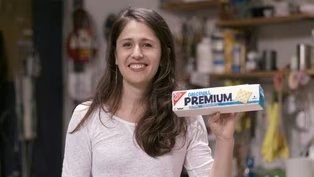
Clip: S23 Ep3 | 7m 30s | LeBrie Rich uses the art of felted wool to create the unexpected. (7m 30s)
Video has Closed Captions
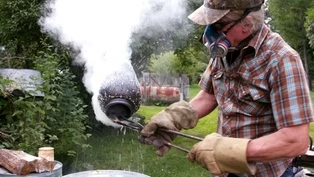
Clip: S23 Ep3 | 8m 40s | Ted Juve is a self-taught ceramicist in Enterprise, Oregon. (8m 40s)
Providing Support for PBS.org
Learn Moreabout PBS online sponsorship















Support for PBS provided by:
Oregon Art Beat is a local public television program presented by OPB