
Becoming America with Bonnie Boswell: Life
Special | 26m 20sVideo has Closed Captions
Bonnie Boswell explores the work of biologist E.E. Just and how it connects to life today.
Bonnie Boswell travels across America finding people applying the values of “LIFE, LIBERTY AND THE PURSUIT OF HAPPINESS.” Bonnie goes to Massachusetts and Washington, DC to learn more about biologist Ernest Everett Just who believed all life is connected. Next, Bonnie meets people in Los Angeles working to support their neighbors by providing healthy food choices.
Problems playing video? | Closed Captioning Feedback
Problems playing video? | Closed Captioning Feedback
Bonnie Boswell Reports is a local public television program presented by PBS SoCal
Becoming America with Bonnie Boswell: Life
Special | 26m 20sVideo has Closed Captions
Bonnie Boswell travels across America finding people applying the values of “LIFE, LIBERTY AND THE PURSUIT OF HAPPINESS.” Bonnie goes to Massachusetts and Washington, DC to learn more about biologist Ernest Everett Just who believed all life is connected. Next, Bonnie meets people in Los Angeles working to support their neighbors by providing healthy food choices.
Problems playing video? | Closed Captioning Feedback
Where to Watch Bonnie Boswell Reports
Bonnie Boswell Reports is available to stream on pbs.org and the PBS app.
Providing Support for PBS.org
Learn Moreabout PBS online sponsorshipAnnouncer: The funding of this program is made possible by: the Ford Foundation, the California Wellness Foundation, and Woodcock Foundation.
Bonnie Boswell: Whether in the endlessness of space or closer to home, life itself is both commonplace and extraordinary.
In fact, the very idea of life was so important, the founders called it a right in the preamble to the Declaration of Independence.
Hello, I'm Bonnie Boswell, and welcome to "Becoming America."
In 1776, when the preamble to the Declaration was adopted, the founders believed that life was not something bestowed by kings.
Instead, life had its own intrinsic value.
Singer: ♪ America ♪ ♪ I reach out and talk to you ♪ ♪ If we could see each other ♪ ♪ I wanna know, wanna know ♪ ♪ Wanna know ♪ ♪ Where you're coming from ♪ Our lives are connected to each other and the universe around us.
To sustain life, we need access to the basics-- food, water, clothing, and shelter.
My lifelong friend and colleague, the late Pastor James Lawson, viewed life as a gift.
People like Gandhi and Jesus and Martin King said that the gift of life is the most powerful form of energy for human life.
When we use those powers to build our community, we have a strong, stable community.
Life has to start somewhere.
In the biological sense, it starts with cells and how we are all made up as individuals.
I reconnected with my aunt, Bernice Bell Just, a daughter-in-law of Ernest Everett Just, or E.E.
Just.
He was a renowned 20th-century scientist who thought all life is connected and proved the connection between the cell and its environment is important.
Just's ideas about the interconnection of all life in the universe are in his 1941 unpublished book, "The Origin of Man's Ethical Behavior," which was not discovered until 2018.
"His spirit is the music of the ages that never dies but rises again waveringly to the stars to become again one with the essence of that whence it came."
To learn more about Just's life and work, I traveled to the Marine Biological Laboratory in Woods Hole, Massachusetts.
This is where Just began his research career in 1909, breaking ground as the first African-American to study at the lab.
Guiding me through the institution is Dr.
Nipam Patel.
Dr.
Nipam Patel: As you know, he spent roughly 20 summers here doing his research in various capacities over those years.
He was a real sort of pioneer and stickler about-- was that animals actually had to be kept in very normal, good condition, so that their embryos and eggs could behave normally.
Rather than doing what other people were doing, when people were taking worms or whatever out of the water, sometimes the sunlight would get on them.
And he was like, "No, we can't have them in the sunlight," right?
Patel: Yeah, exactly.
Bonnie: A stickler for detail.
Yeah, really understanding the life history of the organism and paying attention to that.
Patel: So, this is Eel Pond.
Just and his friends in the marine biology lab would go out on boats and collect... They would collect, right.
So, at that time, you know, they didn't have these larger boats, they had smaller boats, but they would go out.
So, they're-- like, Nereis we can collect in this pond.
He was one of the huge figures in doing that and making the MBL such an important place for biological discovery.
Bonnie: I continued my journey of discovery and went to Boston to meet MIT professor Kenneth Manning.
Kenneth Manning: Hey!
Hello.
Bonnie: Hi.
How are you?
Voiceover: He wrote the Pulitzer Prize-nominated book, the "Black Apollo of Science: The Life of Ernest Everett Just."
I saw myself working mostly on Ernest Everett Just, because I could see that his life was so rich and complex, and it opened up to so many questions that I myself had had over the years about the place of Blacks in American society.
So, let's talk about that seaside town where young Ernest Everett Just grew up.
That was a pivotal kind of experience for him.
Well, it was, and I think it's where he really gained his interest in science at a very early age.
He was attuned to his environment, and being on the sea, I think he loved the life of flora and fauna that existed there.
Bonnie: Ken spent years gathering details of Just's life.
And for a Black scientist in the early 1900s in America, the career path was full of challenges.
At Dartmouth College, E.E.
Just was the only graduate in his class to receive a Magnum Cum Laude distinction, but he was not allowed to give the commencement speech.
He was even detained briefly in a Nazi concentration camp.
And despite having stellar credentials, he was denied work opportunities at prominent Ivy League institutions.
He was told he would never be offered a job as a researcher, solely because of the color of his skin.
Manning: This man decided nothing was going to stop him from doing what he wanted to do.
He gave his life for science.
He kept a sort of a dignity and pride in his work and his own self-worth that is admirable for anyone in any discipline to see and want to emulate.
Bonnie: I went to the nation's capital to talk with E.E.
Just scholar and former Howard University biology professor Malcolm Byrnes.
From your professional perspective, why was he an important person?
Well, first of all, he made important discoveries in biology.
And one thing he learned was that egg cells have a mechanism whereby they can prevent more than one sperm from entering the egg cell, because if that were to happen, it would be devastating for the entire development of that egg and embryo.
And, from that, he felt that the egg was very responsive to its environment.
What influence did that work have on today's biologists?
E.E.
Just had a very unique or different view of biology.
He believed that all life is interconnected.
And he had, in some ways, a dialectical understanding of the organism and the environment.
And that resonates with biologists today.
Bonnie: It was becoming clear to me that Just's talent in science was equally matched by his philosophical yet poetic writing.
In the unpublished manuscript, he says this: "The organism is product of its environment-- arose from it, depends upon it, returns to it."
That's the passage in that book that really struck me too, because it is so poetic and makes you think.
And when he was at Dartmouth, you know, he wrote plays and organized plays and, you know, had this classical information that was going through his head.
I think he was incredibly well-educated and incredibly expressive in his writing.
And, you know, he will sort of, I want to say, launch into something that's incredibly poetic but also highly relevant, right?
Right, to the biology.
Byrnes: To biology!
Bonnie: Right.
Voiceover: Whether it's behind a microscope at the Marine Biological Lab or Howard University, E.E.
Just's legacy lives on and continues to inspire future scientists.
The word "pioneer" really describes him the best, because he was one of the first, and he's the reason why we're even able to stand here in the first place.
Ernest Everett Just made a major contribution by showing the innate connection between life at its core and its environment.
Can this basic understanding propel human beings to help one another?
For us to live in this world, we all depend on the basics of food, water, clothing, and shelter, and that requires work and decent wages.
In your view, how does their work relate to the quality of people's lives?
Work is essential.
All work, Martin King said, has dignity.
We work in order to express ourselves, but we also work because therefore we can make a living.
The last hundred years or so, we go through all these cycles, but our poverty doesn't get really diminished.
Bonnie: No, it doesn't.
So where does poverty come from?
It comes from the failure to see to it that our working families have wages so that they can care for their own bread.
Bonnie: As it turns out, a remedy to this very scenario was being played out in my own backyard in Los Angeles, California.
Meet Susana Cabrera-- a mother of six, a loving wife, and now a franchise owner of two grab-and-go Everytable restaurants in her community.
But her path to this point wasn't easy.
When did you start thinking about financial independence?
I come from a single-parent home.
My mother was always working endlessly.
And despite that she was such a hard-working person, she always struggled with finances.
Growing up alone was pretty hard.
It was just me and my sister, both of us.
My mom would go to work from 7 a.m.
until 7 p.m.
Seeing my mother struggle working so hard, there's got to be a way that I can personally do this.
And that's where my entrepreneurial heart was born.
I started in the fast food industry, but I quickly learned that was not the space for me in the sense that I decided to become a street vendor.
And I started selling hot dogs in the street.
I worked way less time, and I made just enough money, and I was content.
How did you end up at Everytable?
Everybody had something-- either diabetes, high blood pressure-- and that opened up my eyes to what it really was, right?
"Do I want to represent myself like this?
Is this the way I give back?"
And I was like, "Yeah, this is not it."
There was this man that I so adored, and he lost his leg because he did not know he had diabetes, and he did not control it, so the doctors had to amputate his leg.
And that was an awakening.
It was like, "Ooh," you know, "This is what I'm being part of."
Because even though I didn't force him to eat hot dogs, I was part of his choices, and that made me feel part of the-- responsible for what had happened to him.
Susana's concern for her customers reminded me of Just's insight that our interconnection with others compels us to care for each other.
Pastor Lawson's words underscore this point.
You've got all you have to have to become a king or Rosa Parks, or to become simply a responsible human being, living in such a fashion on earth.
We have to be in conformity with the extraordinary gift of life.
Non-conformity will never work.
Girl: There's only 3 people... Man: Do you want to try some?
Boy: Yeah.
Bonnie: This is Sam Polk, a husband, father of three, and former Wall Street trader turned social entrepreneur.
He is the founder of Everytable.
I grew up in Los Angeles, and then I went to school at Columbia University in New York.
And when I was coming out of school, I really had one need for a job, and that was to make sure that I made $100,000 a year.
And the reason for that is that my family growing up was always sort of on the edge financially, and so, I really wanted a career that I could have the stability of a steady income.
So, I started off as a bond trader, and then I became a credit derivatives trader.
And by the time I was 30, I was a senior trader for one of the largest hedge funds in the country.
So, that was around 2008 and 2009.
And, if you remember, that was a very crazy time on Wall Street.
That "crazy time" Sam references was the Great Recession, the collapse of the housing market, a stock market crash, and the failure of major financial institutions.
Millions of Americans lost their homes and jobs.
And, in a lot of ways, that sort of held a mirror to my face, and it sort of pushed me to think, "We all get this one life," you know, "and at the end of it, we're gonna have to look back and take stock."
I could have had a fun, great, enjoyable career on Wall Street, but I knew that I wanted to do something more that would align, you know, my ambitions and what I wanted to accomplish in the world with also my values and principles for what I thought was right.
This is such an easy target.
So, Kirsten, this was a big family decision.
He was leaving Wall Street.
What did you think about that?
Well, I actually encouraged him, because my first career was a couple of years on Wall Street at J.P.
Morgan, and I had already left my career to go back to medical school.
So, when he was kind of vacillating, I was really supportive, and his heart wasn't in the work anymore.
So, that just meant it was sort of a tie to the salary, and that wasn't meaningful enough to build a life out of just a salary, so I was really supportive.
Kirsten has always believed that we should both be living meaningful and important lives and doing stuff that really matters, and, you know, she's never really, you know, wanted us to be, you know, striving for money and fame, and-- but instead, you know, wanting us to do stuff that we both care about.
Paul Solman: Sam Polk just opened the first outpost of what he hopes will be a nationwide chain of restaurants.
Susana: I learned that there was a new business coming in town.
They were a business with a mission.
Their mission was to provide nutritious meals for the neighborhood.
And I'm like, "Wait, what, here?"
And they were going to be affordable.
And I was very intrigued.
I was like, "Let me see how they do it.
I want to learn more about it."
Bonnie: That new business was Everytable, the ready-made food distribution company based just outside of downtown Los Angeles.
Sam invited me to take a look inside their central kitchen.
So, this is the warehouse where we keep all of our dry ingredients.
We follow principles of lean manufacturing, which basically means we try to keep the inventory as small as possible and have it move through as fast as possible.
And that's one of the disciplines that keeps everything fresh.
Now, this is a great room.
This is our spice room.
What we're doing is we're creating meals that tell a story.
So, it would be a story that their mom used to make this meal when they were a kid, or this is a meal that they'd go to.
So, we can make this food and then send it out into the world.
Well, that's the one thing we all have in common, right?
Is food.
And the food is so much more than just nutrition.
It's the story and the feeling and the community.
The memories, the connections.
I mean, who doesn't have that?
You know?
So, to be able to use that effectively for good purposes is really kind of nice.
This is 34,000 square feet.
We're actually moving into a 40,000-square-foot kitchen that is-- I mean, we think that we can do millions, if not tens of millions of meals per week for these locations, and we'll get there.
Sam's vision is to grow the company beyond its current 40 stores.
His inspiration came from a documentary he and Kirsten watched, called "A Place at the Table."
It was the first time I had heard these words, like "food desert" and "food inequality."
And I think, to both of us, it was just such a simple idea that, you know, healthy food should be a human right.
It should be accessible to everyone instead of being a luxury product.
And, you know, that sort of idea really sort of fueled the next, you know, 15 years of my life.
Yes, check it out.
It's really good.
I learned, you know, that there was a huge demand for healthy food in the neighborhoods that we were working in, but it just had to be at the right price point.
And I think that was, you know-- There's often a misconception, especially when I deal with investors, that there's no demand for healthy food in underserved neighborhoods.
And I think a lot of times what people are doing is mistaking supply for demand, which is, you know, if all you have around you that you can afford is a $6 burger and fries, well, that's what you're going to eat, but that doesn't mean that that's a choice.
In America, nearly 48 million people lack access to quality food.
Some would point to our economic system as the culprit, one that results in low wages and food insecurity.
But rather than accept this harsh reality as the norm, Sam saw an opportunity.
On some level, I think that we've created a business that says everybody can win.
Our customers can win by having access to incredibly great food and incredibly great prices.
Our team members can win with both having a job, but having a job that has the upside of ownership.
Anybody who spends a lot of time in capitalism understands that it's not about salary that drives wealth-- it's about equity that drives wealth.
A big piece of being a successful entrepreneur is having that strong mindset.
You know, the vision might be so big and so scary, but just keep on moving forward.
And that's something that I was able to see in Sam as he was building the stores one after another.
"This is really happening.
This is really happening."
Bonnie: Susana's hard work paid off.
She's grown from one of Sam's first employees to now owning two Everytable stores.
And she's making sure that her community has access to quality food.
I visited her in her Englewood store.
Tell me about this space in general, you know, because what impresses me about it is that it is so cheerful.
The colors are great, right?
And then these wonderful pictures on the wall.
Susana: Yes, it's a beautiful space.
It definitely makes my eyes happy when I come in.
So, this is our Pay It Forward board.
The stickers are purchased meals by the community for the community.
If you are in a need of food, no matter what the situation is, we don't ask any questions.
You basically come, grab a Post-It note, go to our fridges and grab your food and check out with that.
Bonnie: That's amazing.
What's interesting to me is that, you know, Sam's original idea of really supporting the community and having this be kind of a theme has really carried forward all these years, and you can see it here, right?
Yes, the Pay It Forward meals is supported by the community, and they're showing up for others.
Bonnie: This time around, Susana can feel good about the type of food she's serving to customers, especially the ones who need it most.
I actually work not too far from here on Aviation and Manchester, so this spot is pretty solid for me, because I don't have to drive that much to come get my food.
Bonnie: So, how important is it for you to have this healthier choice in your neighborhood?
Bill: The healthy food is very good for me for the fact that I am actually pre-diabetic.
After learning that, then I'm out here trying to make sure that I'm eating right and healthy.
So, learning about this place here, it helped out a lot.
Bonnie: Being inside this store helped me to see how all the pieces fit together.
Sam laid the foundation not only to feed and provide financial stability to the community-- In the popular metaphor, Sam was teaching people how to fish.
Life sustaining life.
Susana: Alice is my daughter.
She's 22.
She will be opening the store.
She'll pack the orders, and she'll have us ready for her lunch.
And that's when I come in to support her, and we'll talk about sales and how the day is going.
And what do you think about the work that's being done here, serving the community?
People come for healthy food, and at the end of the day when you kind of finish and you're closing... it's a good feeling.
Bonnie: So, how does it make you feel, having Susana do this kind of work?
It's very exciting to, you know, be with her along the journey, and also, she's bringing along the kids to talk about empowering other women to step up and maybe find their calling.
Bonnie: Your mom has two stores.
She's a business owner.
What do you think about that?
I mean, I'm happy for her.
Like, she's worked really hard with Everytable.
I was just really happy that she got to have a store, and then when she got the second store, she was like, "I'm gonna get another opportunity!"
And, like, yeah, she's-- Like, in her head, she's a millionaire, so... [Laughter] Juan: Okay, just be careful.
Just be careful, because you're wearing Crocks.
It didn't work out?
It is really nice to see everybody supporting the journey, right?
Because it takes a village, really, to raise the kids.
And knowing that the kids are safe while I'm out and building my business, and they're well taken care of.
His mom cooked for our kids.
His dad picks up our kids from school.
And then just having him supporting with, like, if there's meetings, I cannot go, he goes to school.
And just knowing that I have the support system to make this happen for me, because I couldn't do it alone.
Where is the merchandiser?
But, long story short, like, the more stories you have about the food, the better.
The better?
Okay, I hear you.
True success is figuring out sort of how I can fulfill my ambition and take care of my family, but at the same time make a contribution that I really care about.
And I think that, to me, is sort of like what makes me sort of, like, content in this work, because it's hard every day, and it's-- you know, it can be grueling and stressful, but both of those things are always present.
And so, there's never sort of any doubt, at least for me, that I feel like I'm sort of doing important work.
The fabric of who we are in our day-to-day life is that we work and have built businesses where we're sort of working towards equality every moment for everyone.
And it's sort of-- it's just kind of the basis for our family values.
And I think we're very aligned on that.
We both feel incredibly fulfilled by our work, and it brings us so much joy, because there's nothing better than that.
Bonnie: In 2026, America turned 250 years old.
For me, it's a natural milestone to reflect on how far we've come, yet still how far we have to go, to deeply appreciate the interconnectedness and value of all life, expressed in the preamble to the Declaration of Independence.
[Man speaking on radio] Bonnie: One timely event in 2026... [Rumbling] Derrol Nail: And liftoff!
...helped put things in perspective.
Nail: The crew of Artemis II now bound for the moon.
Humanity's next great voyage begins.
Bonnie: The launch of Artemis II helped me see the bigger picture.
I was struck by Mission Specialist Jeremy Hansen's perspective about seeing the Earth from afar.
Our purpose on the planet as humans is to find the joy in lifting each other up by creating solutions together instead of destroying.
And when you see it from out here, it just absolutely reaffirms that.
It's extraordinary when you look back upon the Earth with over 8 billion people, and you see this concrete example of what humanity can do, this extraordinary thing, when we set big goals and we work together to achieve them.
Bonnie: 250 years later, the view from space is confirming what the founders envisioned, what biologists like E.E.
Just studied at the cellular level.
It's what Pastor Lawson fought for and preached about, and what people like Sam Polk and Susana Cabrera are living out every single day.
Life requires each other.
All life is connected.
♪ ♪ If we could see each other ♪ ♪ I wanna know, wanna know ♪ ♪ Wanna know ♪ ♪ ♪ Where you're coming from ♪ ♪ Announcer: The funding of this program is made possible by the Ford Foundation, the California Wellness Foundation, and Woodcock Foundation.
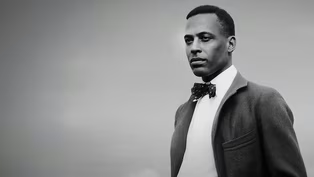
EE Just & the Interconnectedness of Life
Video has Closed Captions
Clip: Special | 6m 14s | Bonnie Boswell explores the lasting legacy of pioneering biologist E.E. Just. (6m 14s)
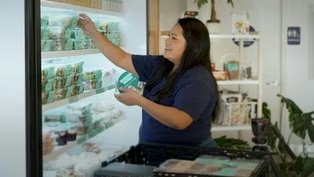
The Grab & Go Store Built Around Health and Equity
Video has Closed Captions
Clip: Special | 13m 41s | Bonnie Boswell meets with Sam Polk bringing healthy, affordable food to Los Angeles. (13m 41s)
Providing Support for PBS.org
Learn Moreabout PBS online sponsorship New Season
- Drama

Hugh Bonneville stars in a crime drama inspired by one of the largest robberies in British history.
 New Episode
- News and Public Affairs

Top journalists deliver compelling original analysis of the hour's headlines.

 New Season
 New Episode
 New Episode

 New Episode


Support for PBS provided by:
Bonnie Boswell Reports is a local public television program presented by PBS SoCal