
Prairie Yard & Garden
Bee’s Books and Blooms
Season 39 Episode 12 | 28m 45sVideo has Closed Captions
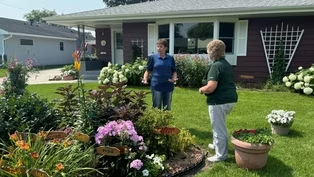
This garden is a neighborhood treasure, featuring flowers, vegetables, and a Little Free Library.
Hydrangeas offer big, beautiful blooms on countless varieties, but the biggest question remains: When is the right time to prune? Host Mary Holm travels to the Minnesota Landscape Arboretum, where Audrey Busch oversees hundreds of hydrangeas. Audrey demonstrates precisely when and how to prune these popular shrubs to ensure maximum flower power in your own garden.
Problems playing video? | Closed Captioning Feedback
Problems playing video? | Closed Captioning Feedback
Prairie Yard & Garden is a local public television program presented by Pioneer PBS
Production sponsorship is provided by Shalom Hill Farm, Heartland Motor Company, North Dakota State University, Friends of Prairie Yard & Garden, and viewers like you.
Support provided by:


Prairie Yard & Garden
Bee’s Books and Blooms
Season 39 Episode 12 | 28m 45sVideo has Closed Captions
Hydrangeas offer big, beautiful blooms on countless varieties, but the biggest question remains: When is the right time to prune? Host Mary Holm travels to the Minnesota Landscape Arboretum, where Audrey Busch oversees hundreds of hydrangeas. Audrey demonstrates precisely when and how to prune these popular shrubs to ensure maximum flower power in your own garden.
Problems playing video? | Closed Captioning Feedback
Where to Watch Prairie Yard & Garden
Prairie Yard & Garden is available to stream on pbs.org and the PBS app.
Visit the Prairie Yard & Garden Website
Do you love gardening? Consider becoming a friend of Prairie Yard & Garden to support this show and receive gifts with your contribution. Visit the link below to do so or visit pioneer.org/donate.Providing Support for PBS.org
Learn Moreabout PBS online sponsorship(peaceful music) - Years ago, Mike, our show producer got magnetic signs made to put on our travel vehicles.
They have been a big hit as they will draw attention wherever we go and whenever we stop, often people will flag us down or come up to visit with us just to let us know they enjoy our show.
And sometimes they give us ideas for future shows too.
I love it when people come up to visit.
And today you will see one of those suggested shows.
Come along and enjoy.
- [Announcer] Funding for "Prairie Yard and Garden" is provided by Heartland Motor Company, providing service to Minnesota and the Dakotas for over 30 years, in the heart of Truck country, Heartland Motor Company, we have your best interest at Heart.
North Dakota State University through its field to fork educational program, providing research based information on growing, preparing, and preserving fruits and vegetables.
Mark and Margaret Yeakel Jolene, in honor of Shalom Hill Farm, a nonprofit rural education retreat center in a beautiful prairie setting near Windham, Minnesota, and by friends of "Prairie Yard and Garden," a community of supporters like you who engage in the long-term growth of the series.
To become a friend of "Prairie Yard and Garden," visit pioneer.org/PYG.
(peaceful music) - I think most people have heard of "Where's Waldo?"
When we travel for filming "Prairie Yard and Garden" shows, our crew says, "Where's Mary?"
It seems like I'm off chatting with someone most of the time and the crew tries to keep me on task, but visiting is often how we get great ideas for shows.
Like the day I was visiting with someone who told me her parents love our show, do activities for children, and have a nice yard.
Well, I called her parents, Al and Mary, and they said we could come and see.
Thanks so much for letting us come.
- This is the greatest day of the whole summer for us.
Mary, we're so happy that you are here and we share the perfect first name.
- Oh, well, tell me about yourselves.
- We have lived on this property for 24 years now.
Alan and I have been married almost 50 years.
When we purchased the property, there was not a lot of gardening going on here.
So we have since started the process of getting gardens to look like this.
- [Mary] What is the story behind Bees Blooms and Books?
- The story behind it is in 2019, my mother passed away, and at that point there was a tree here, a tree there, and a berm tree.
And in the spring of 2020, we lost two of these trees and I would sit out my window and look at this big empty space and think we need to do something.
So I thought of a flower garden and a little kid library because that would be to honor my mom.
She was an avid flower gardener, a big reader, a librarian at one point in her life.
And so it turned out that we started working on this in the spring of COVID and the little library arrived at our doorstep on the first anniversary of her passing.
So we decided to put this garden in, and of course in the beginning it was pretty bare, so we would put pots just to fill the space until we were able to get more perennials growing in that space.
So my mom's name was Bernadette.
She didn't, wasn't real crazy about her name and sometimes she went by Bee just because it was shorter.
So that's where the Bees books and Blooms comes in because it was all related to her.
- [Mary] How did you get started with outreach to children?
- Well, I suppose it was probably day one when we put the library up because right away, as I said, it was during COVID and a lot of the young moms could not go to libraries, so they would come to our little library and pick up books so that they had something for the kids to read and do.
And at that point also I thought, well, we don't have to do just books.
We can do fun little puzzles.
And right now there's school supplies in there, which is getting ready for school.
When we first started, I was very concerned about am I gonna have to go and buy all new books to stock this library?
No, I didn't have to do that.
We go to garage sales, estate sales, and any other form that we can, we had a bookstore that even donated some of their books.
Oftentimes people will drop boxes of books on our front door, and if I go to a garage sale, I make them a deal that they can't refuse.
It's just to get enough books.
So that's basically how we do it.
And of course the exchange, a lot of the moms in the neighborhood are trying to teach the kids, if you take a book out of this library, we need to put a few more back in to take the place because this is for everybody.
So it's a learning experience for all of us.
- [Mary] Did you and Alan build the little library?
- [Mary] We did not, as you can see on the front, there's a little plaque that says Little free library.
So it was made by the actual company that sponsors this and there's a universal map where you can go to their website and track all the little free libraries, I think all over the world.
- [Mary] Did you have to go in and register your site then?
- [Mary] We did.
We did because we wanted people to know when they went to the map that there was one at 440 Campbell Drive.
So that's how we did that.
And we wanted one that was made sturdy out of composite material, so we would not have to ever replace it.
We wanted it durable.
- [Mary] How often do you have to restock it?
- [Mary] Well, I restocked this morning because there were books in there and I thought this would be the perfect day to put out some school supplies.
But I check it probably every day, maybe not as much in the winter because the traffic of the children lessens, but in the summer I'm checking it every day.
- [Mary] Do you put other things in besides just books and school supplies?
- So last June 1st, we received a grant from Modern Women Insurance Company where they gave us $200 to purchase items for the library, mainly books.
They wanted us to purchase books.
So we did that and we set up in the driveway many tables, and we enlisted the help of some of the neighborhood kids to help.
And we advertised on Facebook and through the library that we had a free book giveaway.
And along with that we had coloring books and different things like that and it was a huge success.
So it was nice to know that there are organizations that will help and sponsor your events if you just know how to access and are willing to do the work to get the money.
- Well, it looks like you have a lot of beautiful flowers, but do you have vegetables too?
- We do have a few vegetables.
In fact, Alan is overtaking care of my tomato plants as we speak.
(both laughing) (peaceful music) - Cooking is an art, but food preservation is a science.
You can experiment all you want when you're cooking in your kitchen, but when you are preserving food, you wanna think like a scientist, canning or putting up food can be done safely using the recommendations that scientists have worked out for us.
You do wanna follow these recipes very closely.
For example, if you love to grow tomatoes, as many people do, remember that if you decide to can them, they should have added acids such as bottled lemon juice or citric acid.
If you decide to pickle produce, you can use 5% vinegar safely and then follow a tested recipe.
Acidic or acidified foods can be safely canned in a boiling water bath canner.
If you wanna can low acid foods like soup or green beans or carrots or corn, be sure to use a pressure canner.
Most of these will have a pressure gauge.
Some have the rocking type.
If your canner has a pressure gauge, be sure to have that tested annually.
Many cooperative extension offices offer this service.
Remember that only recipe adjustments that have been proven to be safe, such as using one type of pepper in place of another can be done.
You don't wanna change the ratio.
You can save money, reduce waste, and enjoy your produce all year round, but remember, safety is the first ingredient.
This is Dr.
Julie taking you from Field to Fork, until next time.
(peaceful music) - [Mary] Al, your tomatoes are absolutely beautiful.
- Well, we started out, we had a vegetable garden in the back and it just didn't work.
So we started doing it here and lo and behold it with the sun coming from the south and the driveway, it turned out it was a fairly decent area.
So we started working on how to improve it and we put down some mulch.
And then last year, in fact, we planted nine tomato plants here and at the end of the season it got to be too much.
So Mary said just cut down to four this year.
But what we did was a couple things.
I used a trick that I found from your show and I go to the flowers and I simply dust them and move them around to help pollinate them.
And also to make sure that I don't forget what tomatoes we plant, I put 'em on the top of the stakes and put zip ties on them so it's easy to see.
And in the fall I go down to the local Ace Hardware store and simply buy some 10, 10, 10 fertilizer spread out and let it absorb into the ground over the winter, then in the springtime again, I dress it with some more 10 10 fertilizer.
And what we do in the fall, we clean up all the tomato residue to make sure that we don't any carryover disease from one year to the next, and then I actually mark the holes in the fabric where the tomato plants were planted and we plant 'em back in the same holes.
Initially when we started out, I put some potting soil in here, we dug it all out and put potting soil all the way along here to fill it in.
So this, the tomatoes and the two pepper plants are the vegetables that we grow and we then turn the back into a flower garden.
- [Mary] Well, whatever you're doing, don't quit, because yours are about twice the size of mine.
So you're doing great.
- What is working for us may not work for everybody, but it has been years of working back and forth and improving each and every year to try to make it a little better.
And that's what I think everybody has to do when it comes to gardening.
- Well, whatever you're doing, it's perfect, but can I see the backyard that used to be your garden?
- Sure.
We'd be more than happy to show that to you, Mary.
This used to be our vegetable garden here and it never really worked out.
So Mary and I talked about making it into a cutting garden.
Well, it's not necessarily quite that easy.
First of all, we had to till it up real good to make sure that there weren't as few weeds as possible.
But then we also wanted to make sure that we divided it into quadrants.
And so we put these stepping blocks in place.
But the thing is, with this, it takes a lot of horsepower and shovel power to get this.
And I have the girth and the shovel power to do some of the stuff that Mary isn't able to do.
So that's how we started.
And then we come up with a plan on what plants to put in what location and slowly worked on it.
And this is the first year of our cutting garden.
So hopefully each year we're going to look at improving it and doing a little better job of, you know, figuring out where the plant should be.
- [Mary] When did you start the seeds?
- We started, I started some of the seeds in February of this year.
Some of the snapdragon seeds, some of the moss roses, I started in the spring.
We already had the rain barrel in place back here that we'd gotten a few years ago.
So we didn't really need it this year because of the rain we've gotten.
But some years it really comes in handy and you know, we can use that to help water some of the plants.
- [Mary] Al, how do you get all of these plants?
- Well, some of them we buy the seeds, some of 'em I save from year to year.
I save, for example, moss rose plants, I save Petya plants, I save snapdragons, and I save them in the fall of the year.
And after they bloomed, instead of cutting the plants down at that time, I just let 'em turn into seeds, the petunias, the snap dragons, the marygold, the zinnia.
And then after they somewhat dry out, I cut the plants back.
And sometimes I'll use regular shoe boxes or paper bags will also work to put them in and divide them up and then let 'em dry that way for probably a couple months.
And then later on in the fall, after everything is done, that's when I start trying to haul out some of the plants.
And I have different sieve sizes that much like when I grew up on a farm where you would harvest grain and save some of the grain and run it through the fan mill to make sure that you had some good clean grain.
Except these are a lot smaller, you know, screens that I run 'em through and then save them till the next year.
And so far I've had fairly decent luck.
But what I do, I start 'em out in a tray and then I actually use red solo cups as individual planters.
Later on I've got a small iron that I just poke little holes in around for good drainage and then just let 'em drain and water 'em from the bottom so that you don't have problems.
And then in the spring when it gets time, you know, you get to set 'em out and some of them, for example, the moss roses, a lot of them I just save the seeds and direct plant them into it.
And what I do when I direct plant them is I take real fine sand and mix with the seeds so that you don't get seeds all bunched up.
It kind of helps spread the seeds out along the way so that helps.
- Well you have your things labeled so well.
How do you get your signs?
- Mary and I talked about it a long time ago because part of the garden, while she wanted to not only just label it, but she wanted to also use it to educate people on what some of these flowers were.
So I started working on it and this I work on in the wintertime between the time that I clean out the seeds and start my planting, I can work on signs that are needed for the next year.
And over the years we've added signs and at the end of each year she comes up with a list of more signs that she needs and I paint them sometime during the winter months.
And again, it keeps me busy.
- Well, I would also like to see some of the beautiful flowers we have in front.
Do you think Mary could show us those?
- Yes, very much so.
She'd be more than happy to.
(peaceful music) - I have a question.
I have a boulevard in front of my house.
Do you have ideas of what I can plant there?
- So the boulevard, it's that area of your yard between the sidewalk and the road.
It's a really unique spot because it is right next to the road.
So it gets all that salt from the road during the winter.
It also is really compacted soil and there's not a lot of space for the roots to grow, it's also very dry.
So you need something for that space that can survive some tough conditions.
So you're thinking drought resistant plants, you're thinking maybe you want something that's a tree that's gonna shade your house, but the branches need to be high enough so that you're not running into it when you're walking on your sidewalk.
Turf sometimes doesn't do very well in this space.
So if you want something low growing, you could think about putting a pollinator garden in there.
Think about things like drought resistant segs, maybe wild bergamot, echinacea, yaro, things that just tend to grow easily, that attract pollinators, very a good idea for that space.
If you wanna look into some boulevard trees, hackberry is a wonderful option.
It's very drought resistant and that's what you want.
The branches are also high off the ground, so it's not gonna block people trying to walk on your sidewalk.
Another one is Kentucky Coffee Tree.
And we see this planted in our suburbs along the boulevards a lot.
Kentucky Coffee Tree is another that's kind of a medium sized tree.
It has kind of sparse branches so that some sunlight can still get in below it for you to grow other things.
And it also doesn't care about what soil it grows in.
So it's a nice boulevard tree.
Before you embark on any boulevard planting, just check with your city code, give them a call, or look online to see if they have any restrictions about what you can plant in that boulevard space.
Your boulevards are a really great place to increase plant diversity and provide some of those ecosystem services for our local wildlife and insects like pollinators.
So don't overlook that space.
Give it a try.
(peaceful music) - Mary.
This bed is just beautiful.
Do you use annuals, perennials, or both in here?
- We use both.
You can see white petunias splattered in and mostly the rest is perennials though.
In the fall I pull out all the annuals, but we leave the perennials so that they gather snow, because we have really good luck if they have good snow coverage the next spring they'll come back very well, but then come spring everything is flat again, 'cause it goes away.
And then one day you'll come out here and you'll start to see these little specks of green coming and you think, okay, we're good again.
It's gonna happen again.
So yes, both.
- [Mary] What is that beautiful plant right next to you?
- [Mary] This is a hardy hibiscus, also known as a rose mallow.
It is a perennial, it will come back every year.
It has to stay through the winter, this part, then you cut it back in the spring and it will not show signs of growth until June 1st, not one day before.
And now we are at August 1st, and that is how much it has grown in two months, and as you can see in the next week, we will have flowers and we have three of these total.
We have a red, a pink and a white.
- Do you try to have plants in here that are blooming at different times in the season?
- Yes, it kind of just happens naturally because some years plants don't always bloom when you think they're going to bloom.
But yet there's always something blooming.
Sometimes I can come out here and a whole new color palette has happened.
It you can go from one color to the next overnight.
We have tulips in the spring of course, and of course they're first and they make quite a showing in both the gardens and that's always our most hopeful time when when they start.
- I noticed that this plant here has a really pretty foliage, what is this?
- [Mary] That is actually three bleeding hearts.
There's a white one, a dark red one, and the traditional pink.
I wanted them all together in this corner of the garden, so when they all bloom together, it actually looks like a strawberry sundae.
Sometimes it works, sometimes it doesn't.
This year we had more ice cream than strawberries because the white just took over and there wasn't so much of the pink and red.
But next year we're hopeful for next year that we will get that.
So right now blooming, we have two colors of phlox.
I have a hard time deciding which one is my favorite because I love them both.
We also have cone flowers in a few different colors.
We have bright red or orange or whatever you wanna call that, traditional purple and white.
This tall yellow lily two weeks ago was completely full of flowers and I'm happy that it saved one for today just for you to keep on the stem, so.
- [Mary] A while ago I saw a monarch butterfly and a swallowtail butterfly flying around.
Do you plan for pollinators too?
- We do.
We do.
We have butterfly weed, we have milkweed.
So specifically we do, and we're always happy see them.
The bees come just naturally and I'm surprised at how many different colors can be in a bee.
- [Mary] I see a sign there for Monarch waystation.
Is your yard registered?
- Yes, it is registered and the swamp milk weed is what they really prefer.
It started out as one little lonesome plant and it has grown into that this year.
So we're pretty happy that it could feed a lot of monarchs if it needs to.
- Do you get monarch eggs on some of these?
- We do, we have two growing in the house right now, but it appears that there won't be quite as many this year.
We also have the tiger swallow tail and we just now saw when you pulled in a black one 'cause you identified it for us.
So that was pretty exciting.
- How do you raise the monarchs inside?
We cut the milkweed out out here and then put it in water in containers and then it just stays well enough for them to mature.
Some make it, some don't make it, but one year we actually hatched out 35 monarchs in the house and I made a little video of one hatching that I saved.
It took about 25 minutes for it to actually come out of its cocoon.
- [Mary] Then do you bring them outside and release them?
- We do.
We have enough little kids in the neighborhood.
We'll plan it so we can let one of the little kids put it on their finger and then they get to watch it fly away.
- So do you have families and children that come and visit your yard?
- Probably every day.
Yes.
We have a lot of children in the neighborhood.
There seems to be a lot, in the winter, of course it slows down because kids don't get out as much, but almost every day somebody's coming by.
- So what are your plans for the future here with your yard?
- I feel like we have met our maximum.
We increased the backyard this year to flowers and about four, three years ago we added the round garden where there was a birch tree.
And I feel like right now this is still manageable.
We still can do it and we don't want it to become too much work for us.
- [Mary] I saw in the back it said Mary's cutting garden.
What do you do with your cutting flowers?
- [Mary] Well, the plan was to save jars through the winter or vases and let the kids come and cut their flowers and take their bouquets home.
But just this week is when that actually started, so we felt like we could cut some flowers back there.
Before that it was kind of like, well, there's really nothing to cut, but now we could maybe start doing some of that.
We have some heritage plants here.
Part of them came from Alan's mother and part of them came from my mom's gardens.
His mom had a bleeding heart and a day lily, my mom had a ponie and a gas plant, so that was, they were probably the first things that we planted into this garden when we got started.
- What kind of advice would you have for people that wanna get started?
- Probably start small, plant what you love, and what's known to grow in your area.
We want to have success and that is probably the best way, is to know that it's hardy for your area and maybe also get a plant from somebody that loved you in the past.
- [Mary] Thank you both of you so much for letting us come and see your beautiful yard.
- Thank you, Mary, for coming to see us too.
We really appreciate your visit.
- Thank you for coming to Grand Forks.
It's a wonderful town.
- [Announcer] Funding for "Prairie Yard and Garden" is provided by Heartland Motor Company, providing service to Minnesota and the Dakotas for over 30 years.
In the heart of truck country, Heartland Motor Company, we have your best interest at Heart.
North Dakota State University through its field to fork educational program, providing research based information on growing, preparing, and preserving fruits and vegetables.
Mark and Margaret Yaegel Jolene in honor of Shalom Hill Farm, a nonprofit rural education retreat center in a beautiful prairie setting near Windham, Minnesota, and by friends of "Prairie Yard and Garden," a community of supporters like you who engage in the long-term growth of this series.
To become a friend of "Prairie Yard and Garden," visit pioneer.org/pyg.
(upbeat music)
Video has Closed Captions
Preview: S39 Ep12 | 30s | This garden is a neighborhood treasure, featuring flowers, vegetables, and a Little Free Library. (30s)
Providing Support for PBS.org
Learn Moreabout PBS online sponsorship














Support for PBS provided by:
Prairie Yard & Garden is a local public television program presented by Pioneer PBS
Production sponsorship is provided by Shalom Hill Farm, Heartland Motor Company, North Dakota State University, Friends of Prairie Yard & Garden, and viewers like you.