
Benton Harbor Water Crisis, Homeless Youth Sleepout Campaign
Season 49 Episode 50 | 23m 55sVideo has Closed Captions
Benton Harbor Water Crisis, Homeless Youth Sleepout Campaign | Episode 4950
Host Stephen Henderson talks with stakeholders from Benton Harbor about the lead-contaminated water crisis currently affecting the city and its residents. They discuss aging infrastructure, the impacts of unsafe drinking water, and possible solutions. Plus, the Detroit Phoenix Center shares its latest campaign, "One Night Without a Bed." Episode 4950
Problems playing video? | Closed Captioning Feedback
Problems playing video? | Closed Captioning Feedback
American Black Journal is a local public television program presented by Detroit PBS
Benton Harbor Water Crisis, Homeless Youth Sleepout Campaign
Season 49 Episode 50 | 23m 55sVideo has Closed Captions
Host Stephen Henderson talks with stakeholders from Benton Harbor about the lead-contaminated water crisis currently affecting the city and its residents. They discuss aging infrastructure, the impacts of unsafe drinking water, and possible solutions. Plus, the Detroit Phoenix Center shares its latest campaign, "One Night Without a Bed." Episode 4950
Problems playing video? | Closed Captioning Feedback
How to Watch American Black Journal
American Black Journal is available to stream on pbs.org and the free PBS App, available on iPhone, Apple TV, Android TV, Android smartphones, Amazon Fire TV, Amazon Fire Tablet, Roku, Samsung Smart TV, and Vizio.
Providing Support for PBS.org
Learn Moreabout PBS online sponsorship>>Coming up on American Black Journal, the lead contaminated water crisis in Benton Harbor.
We're gonna talk about the efforts to deliver safe drinking water to this city's residents.
Plus the Detroit non profit issues a call to action to raise awareness and help homeless young people.
Stay where you are, American Black Journal starts right now.
>>[Female Narrator 1] From Delta faucets to Behr paint, Masco Corporation is proud to deliver products that enhance the way consumers all over the world experience and enjoy their living spaces.
Masco, serving Michigan communities since 1929.
>>Support also provided by the Cynthia and Edsel Ford Fund for Journalism at Detroit Public TV.
>>[Female Narrator 2] The DTE Foundation proudly supports 50 years of American Black Journal in covering African-American history, culture, and politics.
The DTE Foundation and American Black Journal partners in presenting African-American perspectives about our communities and in our world.
>>Also brought to you by AAA, Nissan Foundation, Impact at Home, UAW, solidarity forever, and viewers like you.
Thank you.
(upbeat music) >>Welcome to American Black Journal.
I'm your host, Stephen Henderson, and as always, I'm glad you decided to join us.
It has happened again.
Another predominantly African-American city in Michigan is under a water emergency.
Reminiscent of Flint water crisis, the lead levels in Benton Harbor's drinking water tested much higher than the allowable federal limit.
The state is providing free bottled water for residents to use for cooking and drinking and brushing teeth.
Governor Whitmer has committed to securing the $30 million that are needed to replace all of the city's lead service lines by 2023.
Meanwhile, residents have filed lawsuits in federal court seeking class action status.
I spoke with Benton Harbor, Mayor Marcus Muhammad, Michigan environmental justice advocate, Regina Strong, and Ben Harbor resident, Princella Tobias.
So Princella, I want to start with you because you're a resident there in Benton Harbor.
And I just want you to tell us what this has been like, what it's like to not be able to turn on the faucet and be sure that the water that's coming through is clean.
>>Well, I will tell you it's not a great experience by any means.
And we can look at it that way because that's exactly what it is, not being able to use water.
When I think about it, I think about a saying that I heard, every time there's a problem there comes a solution.
And what I truly believe, that what's happening, and I've said this many times, that what's happening right now in Benton Harbor, it could be in DC tomorrow, in Mississippi.
It could be in New Orleans.
It can be all over.
And my friends who call me from afar, I say to them, when's the last time you have actually, do you know when the pipes under your home were actually placed or you have checked.
So what we're doing in Benton Harbor, and this is where it's twofold, bad experience that we're turning into something that could be wonderful for the residents of Benton Harbor.
The mayor will speak about the pipes and how we're having them replaced throughout the entire city.
Then he would also, we would talk about what this is doing for our community.
We're building capacity.
We're giving people hope and we're changing the game of Benton Harbor, Michigan.
We're improving and we're providing solutions from water, pipes, to other things down the road.
So when you think about this whole entire challenge is what I call it, is that it gives us a sense of hope of what is yet to come.
Even as we go through this challenge for the city of Benton Harbor and its residents.
Thank you.
>>So for you, what is the daily routine, I guess, look like to make sure that you have water that you can drink, that you can brush your teeth with, that you can bathe with.
What are you doing to get through this?
>>So, you know, we hear the phrase about a village and about a movement.
That is what has happened.
Neighbors are helping neighbors.
The state has come in to help us.
Even the federal government has come in to help us.
People that you normally wouldn't talk to every day, it's like, can I help you?
Because it's true.
We can not drink our water.
So today, as I speak, we're getting used to it because we are survivors.
Benton Harbor is resilient.
And I hope that is the message that is taken from this conversation throughout the entire nation, about how resilient we are.
Because think about it, we cannot drink our water.
That's, and water is a necessity.
But it is bringing our community together.
It is showing the resilience of this wonderful community and what we're doing.
I'm not saying it's all bad, and I'm definitely not saying it as good right now.
But every single day, there are water distribution centers.
Every single day, there are churches and organizations going door to door delivering water.
Every single day, there are people uniting and coming together because of this challenge that we are facing.
So it's not all good, but I'm telling you, I thank God for the solutions that this situation, this challenge, is presenting themselves to the residents and the businesses and the stakeholders of Benton Harbor.
>>Yeah.
Yeah.
So Mayor Muhammad, you have been trying to, first of all, help the residents there get through this, but also I know trying to attract attention from state and federal authorities and figure out what the short-term and the long-term solutions are.
Let us know where you are.
This has been going on for a long time, we should say that upfront in Benton Harbor.
Let us know where you are though in the process of trying to solve this right now.
>>Well, I think that it's important to know that what legally is to be done in 15 years, Governor Whitmer and her administration has put the funding and resources in place where we can get it done in 18 months.
And that's unprecedented.
>>Yeah and that's the replacement of the lead service lines.
>>That's the replacement of the lead service lines.
We're about 9 close to 10% in that effort.
We have the bids out, our city engineer, city manager, and staff are engaging contractors, working with the state where we'll be able to replace up to 4,000 lead service lines.
And I've said this before, you know, quoting it Ecclesiastes 10:19, that money answersth all things.
So, you know, a $30 million deal is on the table and a city like Benton Harbor who just climbed out a receivership in 2017, where we went back to Public Act, the Home Rule Act, pardon me, where we now are governing ourselves.
And we need the help of the state.
We need the help of the federal government, which we have both now, and we're moving forward to remedy and fix the problem.
>>So I also want to give you a chance to talk about how we got to this place, and who's responsible?
How much of the work that was done to try to save, quote unquote, Benton Harbor from financial ruin should have been focused, I guess, on this kind of infrastructure.
I mean, we had the state running the city twice in the last decade.
Why was this problem not found and dealt with then I guess.
>>Well, under the Snyder Administration engaging in urban centers, there was a different approach, where Public Act 4, Public Act 4 3 6, where you had the emergency manager who was to come in and (unintelligible) one man solution.
And our first emergency manager, you probably have learned or know that he tried to sell the water money and tried to outsource it.
Then he laid off half the staff and fired the director.
And the second emergency manager, you know, tried to manage the problem, but, you know, it had mounted.
So by the time we inherited or received the government back, the water department or water plant had been neglected for 7 years.
So in terms of a lot of the efficiencies that came out in the report from the EPA, as well as from Eagle.
But with all that being said, you know, it's easy to play the blame game, and I'm not in a position as the mayor at this point to go about assigning blame, because there's enough blame to go around for everyone.
But again, at the end of the day, it's money.
It costs money to fix problems.
And three years ago, we didn't have the money.
>>So Regina Strong, this is the same old song in a different place in Michigan.
And I think we would be remiss if we didn't note that this seems to happen, certainly more frequently if not exclusively, in communities that are majority African-American.
Talk about from the state perspective, what we're doing wrong, what we're getting wrong about clean water.
>>Well first thing, you know, as the environmental justice public advocate for the state, a position that was created in 2019, that's exactly why my office exists now.
Because there was a realization that communities that had disparate impact of disinvestment and lack of opportunity also had lack of resources as the mayor, you know, referenced to address some of the challenges that we as an industrial state, as a state with lead pipes that have been in the ground for 80, 70, 60 years.
Communities across this part of the country, basically, have a very old infrastructure.
Communities have been in more of a position to address that than others.
And unfortunately, many of the communities in the lowest and most, I'd say, had the most disparate impact of all of that are communities of color.
Our black communities, our low income communities across Michigan and across the Midwest and across the country.
And so having both that focus on environmental justice communities and understanding how you both support the city as it moves forward and support the people.
Because one of the things that Princella said that is so vitally important is people don't want to be victimized.
They don't want, you know, for people to say, oh, poor Benton Harbor.
What they want to do is be able to live like everybody else, have the resources to do that, and have the support to make that happen.
And so we know that communities have a lack of resources.
It is incumbent upon us as, you know, state partners, federal partners, to support communities, you know, because they're already starting at a point where over time institutional decisions have put them at a disadvantage.
And so now how do we fix that?
And that's part of the work that's going on right now in Benton Harbor.
Because you're absolutely right, as a predominantly black community, you know, people see that and they think, oh, environmental justice communities are just black communities.
They're not just black communities, but oftentimes the disinvestment in majority, you know, black communities and black and brown communities, there's been less investment.
There's been less opportunity over time.
And so you're exactly right.
That's why we need to focus.
And that's why my office exists to help us do that from the state perspective.
>>Yeah, so we don't have a terrible amount of time left, but I do want to get you a chance to talk about, so we saw this happen in Flint.
Then we reacted and said, we're going to clean up the lead lines.
It's happening in Benton Harbor.
Now we're finding the money for that.
Do we have to keep doing it that way, where a crisis inspires the investment?
Or is there a plan to, I mean, I know we're talking about replacing lead lines over time, but can we go faster so that we don't have another crisis?
>>So I'm going to flip your question a little bit and say we need to go faster, right?
The challenge with that is resources and investment.
To the mayor's point, we have to be able to invest in communities.
We already know these aging infrastructure issues exist.
We already know certain communities are going to be at a disadvantage.
It is about finding the resources and money.
I think there is an opportunity right now with a lot of money coming down from the federal government to help communities and not just Benton Harbor.
There are other communities across the state who are in similar situations, or will be, because when we, as a state, created more stringent rules around identifying lead exceedances, the goal was to be able to address those faster and providing this window of resources and really getting communities to invest is so vitally important.
So we don't have to react to crisis because it will continue along this route until we've gotten rid of all the lead service lines, until we've invested in water systems.
I mean, there are thousands across the state of Michigan of water systems.
They're everywhere.
And all of them have aging infrastructure and some have been able to address them.
So we should not be in crisis mode.
We should be in a proactive mode.
And, you know, that's what the administration is really pushing for is the investment to be able to support communities in that work.
'Cause some of it has to happen at the local level whether the community has resources or not to do that.
And so we're looking for ways to make that happen.
>>So talk to me about this idea, the idea of having people sleep out and donate to help kids who are homeless.
I don't know that when we think about the homeless problem, we always think about youth.
>>Yeah, youth homelessness is a hidden crisis in our community.
And so basically, the One Night Without A Bed Campaign is our signature end of the year appeal, right.
Where we're trying to make the visible, the invisible visible.
So youth homelessness is a very indivisible, invisible crisis.
Young people are living doubled up.
They're living in cars.
They're sleeping on floors.
They're on couches.
They're taking a bus back and forth and so we really wanted to challenge our community to make themselves uncomfortable for a night so that a young person doesn't have to be.
And so for one night in December, we're challenging our community to stand in solidarity with the 4.2 million young people who are experiencing homelessness every year in the United States by giving up their bed for one night to sleep on the floor, to sleep on the couch, to sleep anywhere that makes them uncomfortable.
Because every day we have a privilege that we don't sometimes recognize, that sleeping in a bed, it shouldn't be a privilege, right, but it is.
And so we are challenging our community to give up their bed for a night, to post about it on social media, because we want people to see, right, what to see the invisibleness of youth homelessness, and then to make a contribution to the Detroit Phoenix Center so we can continue to provide critical resources, support, and a space nurturing environment for youth and young adults who are experiencing homelessness every single year.
So it's a call to action.
It's not a simulation.
We're not by any means saying that if you're uncomfortable for one night, that you understand the grim realities that our young people face every single day, we're just asking for a sacrificial call to action.
>>Yeah so it strikes me that, you know, the challenges for young people who are homeless might look a little different than they would for adults who are homeless.
Can you talk a little about what those challenges are?
>>Yes.
The challenge is definitely look a lot different.
So first and foremost, mental health, young people who are experiencing homelessness are three times more likely to struggle with suicide ideation, thoughts of suicide.
And struggle with mental health, having positive mental health, having social permanent connections because young people are very transient it's sometimes very hard to establish those relationships and then also in the middle of a pandemic, right?
And if we're saying, you know, wash your hands, you know, stay at home as much as possible, wear face masks.
If a young person is hopping from place to place to place, that's a lot of movement.
And then also, if there is no utilities in the home, no running water, then hygiene, you know, may be a challenge for these young people.
Staying connected to school.
Using, you know, technology, having those services are all challenges that young people experiencing homelessness face, but these young people are incredibly resilient.
They're incredibly resourceful.
So having a resource like the Detroit Phoenix Center to be able to drop in, to get face masks, to get hand sanitizer, to be able to be connected to social permanent connections, help to improve those negative outcomes that we see statistically.
>>Yeah.
So I think a lot of people would ask about whether the solution or part of the solution that youth homelessness is for people just to go back home.
These are children in many cases, minors.
Talk about the complications of why they can't just always return home.
>>Yeah so, that's not always possible because a lot of young people that are actively transient or at risk of experiencing active homelessness are running away.
They're fleeing physical abuse and neglect.
They're leaving certain circumstances.
Many of them have been involved in the child welfare system.
So after they have been discharged from foster care, some of them have literally nowhere else to go.
Economic downturn, we've seen this pandemic affect all of us at different levels.
And sometimes that financial strain just leaves young people, literally with nowhere to go.
And those are some of the complications, not all, because it's not a silo issue.
It's so complicated and so layered, but it's not just as simple as going back home.
Because sometimes they don't have anywhere else to go.
>>Right.
And at the same time, the traditional supports for the homeless population don't always fit their needs either.
You can't just walk into a shelter as a teenager and be safe even, among all the adults there.
So, I mean, they're facing that challenge really on both ends.
>>Absolutely.
And also youth homelessness looks very different from adult homelessness.
Most young people don't prefer to go to a shelter.
And for the sake of this conversation, when we're talking about young people, that are experiencing homelessness, we're talking about up to the age of 24.
Because according to the federal government, a youth is defined up until the age of 24, according to the college admission process.
So like, just like you said, young people don't feel safe going to a shelter.
And many of those services are geared more towards adults.
So having a developmentally appropriate and youth friendly space is what young people need.
And also they're couch surfing.
The majority of the population of youth that are experiencing homelessness are couch surfing.
They're hopping from one home to the next home.
And they're living doubled up.
There's multiple people in one space.
They're in hotels.
They're in varying living situations.
>>So we've only got about a minute left, but I wanna have you talk about solutions and things that would get permanent homes for kids who don't have them.
What do those look like?
>>Absolutely, so that's a wonderful question.
So I think that supporting organizations like the Detroit Phoenix Center, who provides a continuum of services, education, and employment, emergency housing, and support, right?
When we have education employment that provides social mobility.
We provide mental health services.
We provide a continuum of services to meet the young people where they're at at each juncture of their life.
So supporting organizations that are doing the work is one way.
Of course, raising awareness on the youth homelessness crisis is another.
And then advocate is, advocacy in a policy arena.
Sometimes as human service providers, we're forced to put band-aids on wounds created by bad policy.
So really advocacy is a way to also to be in the sphere of ending youth homelessness in our community.
>>That is going to do it for us this week.
You can find more information about our guests at americanblackjournal.org And you can keep up with us on Facebook and on Twitter.

The Benton Harbor Lead Water Crisis
Video has Closed Captions
Clip: S49 Ep50 | 12m 59s | The Benton Harbor Lead Water Crisis (12m 59s)
Video has Closed Captions
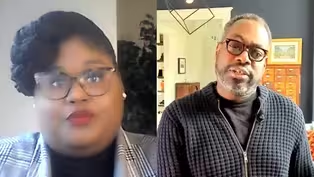
Clip: S49 Ep50 | 7m 15s | Detroit Phoenix Center Launches Campaign to Support Homeless Youth | Ep 4950/Seg 2 (7m 15s)
Providing Support for PBS.org
Learn Moreabout PBS online sponsorship
- News and Public Affairs

Top journalists deliver compelling original analysis of the hour's headlines.

- News and Public Affairs

FRONTLINE is investigative journalism that questions, explains and changes our world.












Support for PBS provided by:
American Black Journal is a local public television program presented by Detroit PBS