
Bhutan: The Last Place
Clip: Season 2002 | 9m 56sVideo has Closed Captions
In 1999, Bhutan became the last country in the world to legalize TV.
In 1999, Bhutan, a Buddhist kingdom that had remained isolated in the Himalayan mountains for centuries, became the last country in the world to legalize TV.
Problems playing video? | Closed Captioning Feedback
Problems playing video? | Closed Captioning Feedback
Funding for FRONTLINE is provided through the support of PBS viewers and by the Corporation for Public Broadcasting. Major funding for FRONTLINE is provided by the Ford Foundation. Additional funding...
Support provided by:

Bhutan: The Last Place
Clip: Season 2002 | 9m 56sVideo has Closed Captions
In 1999, Bhutan, a Buddhist kingdom that had remained isolated in the Himalayan mountains for centuries, became the last country in the world to legalize TV.
Problems playing video? | Closed Captioning Feedback
Where to Watch FRONTLINE
FRONTLINE is available to stream on pbs.org and the PBS app.
Buy Now
Inside the Scam
Follow scams as they unfold — and examine tactics used to manipulate victims. A collaboration between FRONTLINE and The Associated Press.Providing Support for PBS.org
Learn Moreabout PBS online sponsorship♪ ♪ (indistinct talking, audio tuner squealing) (music playing) >> ALEXIS BLOOM: Bhutan is a Himalayan kingdom tucked between China and India.
A seemingly magical place that has for centuries secluded itself from the rest of the world.
A place with no traffic lights and no fast food chains.
A country with more monks than soldiers, where it's law to wear traditional dress in public places.
This tiny country of less than a million people has guarded its culture from outside influence.
(drumming, bells clanging) >> People who come here to Bhutan, they all fall in love with Bhutan.
Why?
Because we have a beautiful country; we have a rich tradition, rich culture.
Unspoiled.
People who travel to Bhutan cannot believe that there is a country still left in the world which is almost untouched.
And time and again, they've always told me, they said, "Don't bring television into the country."
>> (speaking Bhutanese) >> BLOOM: But in June 1999, Bhutan did bring television into the country.
After years of cultural protectionism, TV was legalized by royal decree-- the last place on Earth to hook up to the box.
We found the man who the Bhutanese call the cable guy, Rinzy Dorji.
Just a few years ago, he hardly knew how a television worked.
>> I thought, "How is it possible "that pictures were just coming out there "without any, uh, tape being played there?"
Then, of course, I tried to find out how it was coming, and this, that.
Then I saw it is a wonderful technology that broadcasting from somewhere else, and that everybody could see on the television set.
We are tuning the TV.
>> Fine, you don't want to accept the fact... (indistinct TV audio) >> BLOOM: We watched Rinzy wiring up homes every day-- 45 channels for just five dollars a month.
Everything from the BBC to "Baywatch," all for the same price as a bag of dried red chilies.
But not everyone welcomes the new entrepreneurs.
>> You want to know the real reason I'm here?
>> These are businesspeople.
These are not even technicians; these are businesspeople who want to sell.
And they will broadcast, they will show anything they want.
(music playing on TV) >> There are good things as well as bad things.
But as a cable operator, I can't selectively give programs, because the demand is such that some parents would like to have some programs which are not good for others.
(music playing) >> BLOOM: Rinzy invited us to his family home.
In the backyard, five satellite dishes receive signals from all over the world.
(indistinct TV audio playing) Beneath the living room, racks of receivers and decks have taken the place of traditional livestock.
The family home has become central control.
>> This... with this setting that we have at the moment, it is good for 33 channels.
Once we go on expanding, then we would require more space and more equipment and more racks.
>> BLOOM: But Rinzy's mother-in-law was skeptical.
>> (speaking Bhutanese) (passing traffic) >> I think, uh, people have suddenly realized that there are so many things that they desire, which they were not even aware of before.
And the truth is that most of these television channels are commercially driven.
(indistinct chatter) And so, the Bhutanese people are, yes, driven towards consumerism.
That's inevitable.
And that's, to some extent, unfortunate, but inevitable.
>> When I come home from school, I change my clothes and go straight to the TV room and watch television.
I watch Cartoon Network, and check if there is wrestling in Star Sports.
When it's my exam time, I could not study because of thinking about the cartoon.... cartoon characters and the superstars of the wrestling.
>> (on TV): Hey, that's pretty good.
Wait till your dad sees it.
>> (speaking Bhutanese) >> (speaking Bhutanese) (laughs) (bell chimes) (bell chimes) (bell chimes) >> Television introduced only last year.
Everybody, one thing, is curious to see what is happening.
They have never seen, especially monks, they have never seen television in their life, so they are curious, you know, very much curious to know, "What is that?"
I noticed that the last week when I was with my brother and watching television, so sometimes I forget my prayer things lately, you know.
So sometimes it's disturbing, this TV, these kinds of TV, so I thought maybe better not to have myself.
(car horn honking) (indistinct chatter) >> Soon after television started, we started getting letters to the editor for the newspaper from children, children who seemed very hurt.
The letters actually specifically asked about this World Wrestling Federation program.
"Why are these big men standing there hitting each other?
What's the purpose of it?"
They didn't understand it.
They were very hurt.
Now, a few months later, one morning, a personal example, one of my sons, seven years old, jumped on me early in the morning on the bed, and he says, "Hey, I'm Triple H. You can be Rock," and we are fighting.
Suddenly these were new heroes for our children.
("Carmina Burana" playing) >> Championship.
Championship.
(indistinct chatter) Rock!
(kids grunting, laughing) ("Carmina Burana" playing) (song ends, children laughing) >> The government has requested that the cable operators, that they should, to the extent possible, exercise discretion on their part.
But it's easier said than done.
With, with all these satellite dishes that are available, it will be difficult to control.
(bell chimes) >> BLOOM: And so the light of 45 channels flickers, and the Bhutanese tune in to the rest of the world.
(bell chimes) >> I have myself heard comments from people saying that, "My God, we didn't know "that we were living in such a peaceful country.
"There seems to be violence and crime everywhere around the world."
So, in a way, the positive thing is that Bhutanese people realize how good a life they are living in this country.
(person singing, playing stringed instrument) ♪ ♪
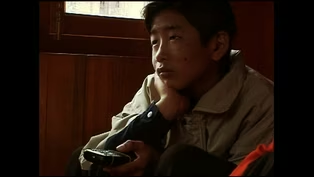 Now Playing
Video has Closed Captions
Clip: S2002 | 9m 56s | In 1999, Bhutan became the last country in the world to legalize TV. (9m 56s)
Preview: S2002 Ep19 | 30s | Airs Tuesday, August 30, 2011 at 9:00 p.m. ET/PT. Check your local listings. (30s)
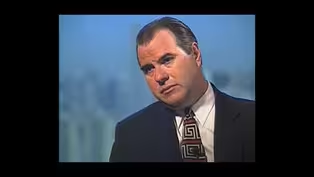
A 1997 Interview With John O'Neill
Clip: S2002 Ep19 | 3m 47s | Footage of "The Man Who Knew" talking about his job, the work of FBI agents and more. (3m 47s)
Providing Support for PBS.org
Learn Moreabout PBS online sponsorship New Episode
- News and Public Affairs

Top journalists deliver compelling original analysis of the hour's headlines.

- News and Public Affairs

Today's top journalists discuss Washington's current political events and public affairs.



 New Episode

 New Episode


 New Episode
Support for PBS provided by:
Funding for FRONTLINE is provided through the support of PBS viewers and by the Corporation for Public Broadcasting. Major funding for FRONTLINE is provided by the Ford Foundation. Additional funding...