Smart Start: A KET Special Report
Biggest Factors for Kindergarten Readiness
Clip: Episode 1 | 7m 32sVideo has Closed Captions
A panel of experts discuss the biggest factors in kindergarten readiness.
A panel of experts discuss the biggest factors in kindergarten readiness.
Problems playing video? | Closed Captioning Feedback
Problems playing video? | Closed Captioning Feedback
Smart Start: A KET Special Report is a local public television program presented by KET
Smart Start: A KET Special Report
Biggest Factors for Kindergarten Readiness
Clip: Episode 1 | 7m 32sVideo has Closed Captions
A panel of experts discuss the biggest factors in kindergarten readiness.
Problems playing video? | Closed Captioning Feedback
Where to Watch Smart Start: A KET Special Report
Smart Start: A KET Special Report is available to stream on pbs.org and the PBS app.
Providing Support for PBS.org
Learn Moreabout PBS online sponsorshipJoining us now is a panel of early childhood education experts and those in the field who deal with this every day.
We're glad to have with us Dr. Jennifer Porter.
She's a pediatrician from Louisville with extensive work in early childhood development.
Dr. Whitney Stephenson, director of Early childhood for Fayette County Public Schools, and Ashley Brant, director of early care and education for the Metro United Way.
So I want to go to you, Ms.. Ashley, to ask about kindergarten readiness.
And you talked about grants, and we thank you for bringing that up.
And that's such a strong correlation to a child's future.
And we know that Metro United Way is focused on getting those kids ready to learn and in those environments where they can really thrive.
What factors have the biggest impact from your experience?
Yeah, I think, you know, there's several different factors that we focus on.
One is health.
So we talked about the important importance of having a pediatrician attending those well-child checks.
That's crucial.
And really, that partnership with a health care provider to ensure that throughout those first five years, all of those pieces are meeting being met.
And as was mentioned, it's not just health.
Those developmental milestones are being checked in on with a pediatrician as well.
We also know that access to formal care setting, so that may be public pre-K, that could be Head Start or that could be child care.
That's one of the indicators that we know best supports kindergarten readiness.
So children who are in a formal setting before that first day of kindergarten, they score the highest on the Brigance.
And we know that a lot of times there are barriers for families to accessing that care.
It could be affordability, availability, quality of child care in their area.
So we want to reduce those barriers as well as support the child care ecosystem to make sure that it's robust enough to support families needs.
And finally, is really supporting the adults and systems that surround children because a child, you know, probably all the way up through high school, is not making their own decisions and determining their own outcomes, but especially 0 to 5.
They are not determining their own outcomes.
So we need to make sure that the adults that are surrounding these children, their parents, their caregivers, that they have the resources they need, starting all the way with basic needs.
You know, if a family is unsure of where they're going to be sleeping that night or how they're going to get dinner on the table for their family, they're not going to be thinking about reading that book or counting up to ten that day.
So we need to start there and ensuring families have the resources they need and then build on that, educating parents and caregivers on what they can do to support their child.
And also just improve the systems that surround these families.
So like I said, one of those systems is child care and making sure that system is robust and has enough slots for children that want them as well as the other public resources that families can rely on to make sure that those are as robust as they need to be supporting families so that the child can thrive and the whole family can thrive.
They can make a really good point about families who are in very uncertain economic environments.
And so it's not top of mind to do some of these activities with their child because they're so focused on basic survival.
Yeah, right, right.
Yeah.
If you are just trying to survive, like you said, this basic survival, there's not we can't put more on top of that.
So we need to meet those basic needs before we can be asking families to do more and provide resources in order for families to thrive.
Again, child care is a big one of those because it allows families to work or go back to school and then, you know, either increase their income or have a stable income because they have reliable childcare.
So that's a big piece of the puzzle as well.
I think we've heard just from this conversation, there is no silver bullet.
There's this is a very complicated issue.
There's so many different factors that play into it.
But childcare is one of the silver bullets we like to say, because as I mentioned, we know that children who are in formal care before that first day, they're the most ready and that that child care space can provide so much more than just care for that child.
Really wraparound services, whether it's health related Head Start, they're mandated to provide vision, dental, health screening.
So if that family can't get to a pediatrician, the child is receiving it through that service as well as meals every day.
Most child care providers provide at least two meals, additional snacks, and may even provide a meal to go home.
So that is just one aspect that can really wrap around a family and support them.
Yeah, in an early learning environment.
Dr. Porter, we know that biases can really affect children who are most at risk.
So talk to us about how race is a factor when it comes to early education.
Well, I mean, there's a lot of research that shows that disproportionately, you know, black children get suspended from childcare even before the age of five.
So it's supposed to be a place of learning and growth.
But when behavior is normal child behavior, they've even shown that their eyes automatically go to that black child.
And there might be other children that are doing the same behavior, but those children get punished.
It's hard, especially for families, that are trying to provide their their child a safe space to learn and grow and then to be dealing with that kind of thing.
It's disheartening, especially as a mother of two children, to think that the place that you send them to help them grow and develop might not you know, they might not be treated okay when they're there.
So it's you know, it puts another burden on a family to figure out, is this the right place for my child?
Are they going to have, you know, teachers that's already a shortage of teachers.
Do they have teachers that look like them or that understand?
But even having teachers that look like them, there's been research that even black childcare providers that have the same kind of behavior for those children, that they more so look at black boys than they do.
Even of the same race.
African-American still treated.
Interesting.
Interesting.
So, Dr. Stevenson, I have to ask you, when it comes to educating the educator.
Right, the early childhood educator on biases and we all have them.
Right.
And how and how to address them.
I mean, is that work happening?
So for us in in Fayette County, we have started a book study with all of our lead teachers and parent educators that serve in our state funded program.
And it's teaching children through an equity lens.
And so we're going chapter by chapter.
And, you know, there's is reflection pieces because it is very personal.
And I mean, people as you read that, like, you know, it's you you do a self-check right now in what and we've talked about the research that you shared as a collective whole.
And so we're moving through that book study this year just to, you know, ensure that those that are working with our our youngest children really and truly are having that that looking inside and seeing what they're they're bringing into the classroom.
Because, you know, again, we all have biases.
And, you know, it's just it's a personal journey that that people have.
And so that is something that we we've started this year is that equity book study.
Right.
And your response to that bias is what really matters, particularly for a young child.

The Challenges of Universal Pre-K
Video has Closed Captions
Clip: Ep1 | 9m 29s | A panel of experts discuss the challenges involved with universal pre-K. (9m 29s)

Child Care Industry's Impact on Kentucky Economy
Video has Closed Captions
Clip: Ep1 | 10m 34s | A panel of experts discuss the child care industry's impact on the Kentucky economy. (10m 34s)
Donna Grigsby, M.D. (Full Interview)
Video has Closed Captions
Clip: Ep1 | 33m 32s | Full Interview with Chief of Division of General Academic Pediatrics. (33m 32s)
Video has Closed Captions
Clip: Ep1 | 6m 54s | A panel of experts discuss the impact of early learning. (6m 54s)
The Importance of Child Care Funding
Video has Closed Captions
Clip: Ep1 | 5m 54s | A panel of experts discuss the importance of child care funding. (5m 54s)
Video has Closed Captions
Clip: Ep1 | 27m 48s | Full Interview with Director of Early Childhood Initiative, Bipartisan Policy Center. (27m 48s)
The Need for Child Care Funding
Video has Closed Captions
Clip: Ep1 | 6m 47s | A panel of experts discuss the need for child care funding. (6m 47s)
Setting a Foundation for Learning
Video has Closed Captions
Clip: Ep1 | 8m 47s | A panel of experts discuss how early education sets a foundation for learning. (8m 47s)
The Status of Kentucky's Early Childhood Education Workforce
Video has Closed Captions
Clip: Ep1 | 4m 47s | A panel of experts discuss the status of Kentucky's early childhood education workforce. (4m 47s)
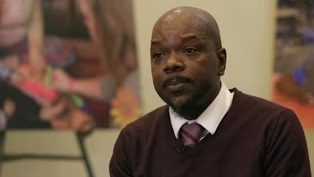
Vaughn Nebbitt (Full Interview)
Video has Closed Captions
Clip: Ep1 | 8m 27s | Full Interview with Vice President of Early Childhood Services Family & Children's Place. (8m 27s)
Providing Support for PBS.org
Learn Moreabout PBS online sponsorship














Support for PBS provided by:
Smart Start: A KET Special Report is a local public television program presented by KET