Virginia Home Grown
Biodiversity in Meadows
Clip: Season 26 Episode 3 | 7m 45sVideo has Closed Captions
Tour the meadow at Barboursville Vineyards
Shana Williams explores the meadow at Barboursville Vineyards with CEO, Luca Paschina to learn about the landscape's contributions to the ecosystem and how it enhances the winery experience for guests. Featured on VHG episode 2603, May 2026.
Problems playing video? | Closed Captioning Feedback
Problems playing video? | Closed Captioning Feedback
Virginia Home Grown is a local public television program presented by VPM
Virginia Home Grown
Biodiversity in Meadows
Clip: Season 26 Episode 3 | 7m 45sVideo has Closed Captions
Shana Williams explores the meadow at Barboursville Vineyards with CEO, Luca Paschina to learn about the landscape's contributions to the ecosystem and how it enhances the winery experience for guests. Featured on VHG episode 2603, May 2026.
Problems playing video? | Closed Captioning Feedback
Where to Watch Virginia Home Grown
Virginia Home Grown is available to stream on pbs.org and the PBS app.
Providing Support for PBS.org
Learn Moreabout PBS online sponsorship(tractor humming) >>I had this desire to convert what used to be a pasture into a meadow because it does enrich greatly the biodiversity of plants, especially of insects and birds and butterflies, the pollinator.
So it's something that I've been doing throughout my 35 years on the estate, is to maintain a very natural environment.
We have wetlands.
We have hay fields.
We have pasture.
We have woodland.
This is an even greater impact that we are doing in the environment by creating all this very intense biodiversity in these four acres.
It's amazing how much is going on here when it is in full bloom, and even through the winter when the birds eat the seeds.
(birds chirping) >>We wanted a mix of grasses and plants that would be native that might have been here to some degree when Governor Barbour actually operated here at the estate.
And so we selected four native grasses, and then we added to that a mix of about 15 plant species, annuals, biennials, and perennials.
So we've got stuff growing at different levels at different rates throughout the meadow.
What we're trying to do with the meadow is to demonstrate that we can create a habitat for birds, animals, and pollinators that's going to be good generally for the whole ecology out here.
And it's consistent with the whole idea of art and science combining to produce good wines.
You'll see, first of all, a variety of bird species out here.
Most of them are common and native to what you might see about anywhere, but the bluebird boxes were a special edition.
We have seven of them out here, and we space them out so that the bluebirds, when they nest, aren't competing with one another.
We see robins.
We see all manner of thrushes and chickadees and wrens out here.
We're particularly interested in ground-nesting birds.
So we do see a lot of flickers out here.
We'd like to see eastern meadowlark because that's a threatened species here in Virginia.
And ultimately, I guess my dream would be to see a regeneration of bobwhite quail out here.
>>One of the things I wanted to know is, across there are your vineyards, but what do you plan on doing expansion-wise?
>>Across the creek, we have a plan to introduce more of a meadow, perhaps a different mix.
Maybe we go more with a mix of grasses, more grasses and less forbs and all natural native grasses like bluestem or the Virginia rye to really enrich more the biodiversity.
One element also very important to understand is that grapes, they don't need pollinators, by the way.
>>Yes.
>>But there are certain insects, there are some that are non-native that can be damaging to the vineyard.
So increasing the population of natural native insects, it puts them in competition and keeps them in balance because trees, they're all fighting for light in a forest.
Insects are also fighting among themself.
>>Just increasing the ladybugs out here will eat a lot of that larva.
>>Yes.
>>Share with me some of the plants that we have around.
>>Yes, we have several native grasses.
>>Yes, we have several native grasses.
We have different other plants like bee balm that everybody knows called wild bergamot.
We have the coreopsis, which is one of the first to bloom with a beautiful yellow flower.
>>I imagine it's gorgeous.
>>Black-eyed Susan.
>>Yes.
>>And then we have Echinacea, which is also- >>Purple coneflower.
>>Exactly.
>>Yeah.
>>So, there are many things.
>>But I also saw a lot of milkweed around.
Tell me about that.
>>A lot of milkweed.
Milkweed was very difficult to introduce.
So what we did, they create some plugs in a greenhouse, and we transplant them.
And now after six, seven years, it's popping everywhere.
At first, we thought almost we would have failed, but then this plant came to grow, and now they're spreading.
And so it's gonna have a lot of milkweed, and it's increasing year after year.
>>I noticed that amongst all the plants, there's a number of invasive species.
>>Yeah.
>>How are you managing that?
>>We're managing to monitor especially the one most invasive, and the worst we have to deal with is vetch, which crawls and really chokes everything.
So we go in certain spots, and manually we just remove it to avoid taking over the whole project.
>>Are a lot of the visitors allowed to pick some of the native plants and seeds that are here?
>>Absolutely.
They are welcome to collect seeds.
The right time of year, it's late fall, when the plants go dormant, and the seeds are drying up, and the pods are easy to get rubbed and the seeds removed.
It happens frequently.
And also one of the success stories of having the meadow is that we inspire somebody locally that bought a farm to put a 20-acre meadow.
And they ask a lot of question, how it's done and so on, so.
>>Well, that's wonderful to know that what you created can extend beyond you.
>>Yes.
>>I really wanna know, what advice, what lessons did you learn from installing this meadow?
What is one of those key things that you learned?
>>For this size, it's advisable to have somebody that can give you the right kind of information.
In a small scale, of course, it's easier to do.
But the preparation of the soil is very, very important.
and then having the seed dispersed the right way, not too deep because it will not germinate.
So there are some simple techniques that if they are followed, it's gonna be successful, the project.
>>Luca, your vineyard has been here for 50 years.
What does it take to be successful?
>>Well, for us was, of course, had to produce a great quality wine.
And we were able to do that through the experience we collected through the many years to work with the soil and the climate.
And then we realized that we had to create an experience on the estate for people to come and find great hospitality.
We have a great restaurant.
We have a few rooms.
People can spend the weekends.
But then you have to also have a very pristine environment.
So in order to maintain these open spaces, vital we plant the vineyard, and we sell the wine.
That gives us energy to continue to invest and maintain this as an open space.
>>How did that cold weather affect the vineyard?
>>Yeah, it was a very impactful frost throughout Virginia.
Lower location of vineyards, lower areas that were colder, we went down to 24 degrees, and upper air instead, they stayed about 30.
So in aggregate, we lost about 30% of our crop.
But '22 vintage, '23, '24, '25, we had a full crop and great quality.
So, farming, sometime it gives you a lot, and sometimes it takes away.
And we accept that.
Otherwise I wouldn't be a farmer.
(chuckleS) >>I understand.
This is beautiful, and I can't wait to come back up here and to see it in full bloom.
Thank you for sharing this wonderful vineyard with us.
>>Thank you, Shana, for visiting.
I had a great time.
Video has Closed Captions
Clip: S26 Ep3 | 5m 9s | Get DIY tips for birdhouses (5m 9s)
Video has Closed Captions
Clip: S26 Ep3 | 3m 32s | Start a meadow with just one plant (3m 32s)
Video has Closed Captions
Clip: S26 Ep3 | 5m 6s | Learn how to grow new plants from cuttings (5m 6s)
Video has Closed Captions
Clip: S26 Ep3 | 7m 52s | Discover how small meadows make big impacts (7m 52s)
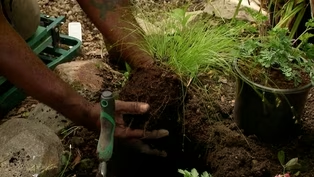
Video has Closed Captions
Clip: S26 Ep3 | 3m 56s | Discover grasses and flowering plants that flourish in shade (3m 56s)
Providing Support for PBS.org
Learn Moreabout PBS online sponsorship















Support for PBS provided by:
Virginia Home Grown is a local public television program presented by VPM