
Birds of Prey: Necks, Eyeballs, and Crops
Clip: Special | 1m 4sVideo has Closed Captions
How do owls seem to turn their head 360 degrees?
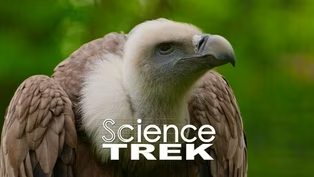
Birds of prey have amazing adaptations to help them hunt. Learn more about their keen eyesight, nimble necks, and how a crop helps them feed their young.
Problems playing video? | Closed Captioning Feedback
Problems playing video? | Closed Captioning Feedback
Science Trek is a local public television program presented by IdahoPTV
Major Funding by the Laura Moore Cunningham Foundation and the Idaho National Laboratory. Additional Funding by the Friends of Idaho Public Television and the Corporation for Public Broadcasting.
Birds of Prey: Necks, Eyeballs, and Crops
Clip: Special | 1m 4sVideo has Closed Captions
Birds of prey have amazing adaptations to help them hunt. Learn more about their keen eyesight, nimble necks, and how a crop helps them feed their young.
Problems playing video? | Closed Captioning Feedback
How to Watch Science Trek
Science Trek is available to stream on pbs.org and the free PBS App, available on iPhone, Apple TV, Android TV, Android smartphones, Amazon Fire TV, Amazon Fire Tablet, Roku, Samsung Smart TV, and Vizio.

Science Trek
Science Trek is a place where parents, kids, and educators can watch short, educational videos on a variety of science topics. Every Monday Science Trek releases a new video that introduces children to math, science, technology, engineering, and math (STEM) career potentials in a fun, informative way.[MUSIC] JOAN CARTAN-HANSEN, HOST: How do human bodies compare to the bodies of birds of prey?
[BELL RINGS] Unlike humans, birds of prey have hollow bones.
Many of their bones are fused together.
This reduces their weight and gives them a ridged structure, like the fuselage of a plane.
Birds of prey have 8 times better eyesight than humans.
On the other hand, humans can move their eyeballs in different directions.
Birds of prey's eyeballs are so big, they can't move them inside the eye socket.
A human meal ends up in the stomach before going through the rest of the digestive system.
Most birds of prey have a crop.
A crop is a muscular pouch in the bird's esophagus.
They use it to store food for later digestion or to carry food to feed their young.
The only exception is the owl.
Owls don't have crops.
They swallow their food whole.
It digests the meal's softer parts and then, several hours later, regurgitates or throws up a pellet made of bones, fur and feathers.
[BLEH] For more information about birds of prey, check out the Science Trek website.
You'll find it at ScienceTrek.org
Video has Closed Captions
Clip: Special | 1m 4s | Why is eating up dead carcasses good for the environment? (1m 4s)
Providing Support for PBS.org
Learn Moreabout PBS online sponsorship
- Science and Nature

Explore scientific discoveries on television's most acclaimed science documentary series.

- Science and Nature

Capturing the splendor of the natural world, from the African plains to the Antarctic ice.












Support for PBS provided by:
Science Trek is a local public television program presented by IdahoPTV
Major Funding by the Laura Moore Cunningham Foundation and the Idaho National Laboratory. Additional Funding by the Friends of Idaho Public Television and the Corporation for Public Broadcasting.