
Black businesswomen, Birwood Wall, Bass Day, Tyrone Winfrey
Season 50 Episode 46 | 26m 46sVideo has Closed Captions
Black women entrepreneurs, Birwood Wall, Detroit Bass Day, and Tyrone Winfrey’s passing.
Host Stephen Henderson talks with two Black women entrepreneurs about the unique challenges they face. Detroit’s Birwood Wall receives a Michigan Historical Marker designation. Bass players gather on Detroit Bass Day to pay tribute to The Temptations and talk about fatherhood. Plus, “American Black Journal” remembers Tyrone Winfrey, the late Detroit education advocate who passed away at age 63.
Problems playing video? | Closed Captioning Feedback
Problems playing video? | Closed Captioning Feedback
American Black Journal is a local public television program presented by Detroit PBS
Black businesswomen, Birwood Wall, Bass Day, Tyrone Winfrey
Season 50 Episode 46 | 26m 46sVideo has Closed Captions
Host Stephen Henderson talks with two Black women entrepreneurs about the unique challenges they face. Detroit’s Birwood Wall receives a Michigan Historical Marker designation. Bass players gather on Detroit Bass Day to pay tribute to The Temptations and talk about fatherhood. Plus, “American Black Journal” remembers Tyrone Winfrey, the late Detroit education advocate who passed away at age 63.
Problems playing video? | Closed Captioning Feedback
How to Watch American Black Journal
American Black Journal is available to stream on pbs.org and the free PBS App, available on iPhone, Apple TV, Android TV, Android smartphones, Amazon Fire TV, Amazon Fire Tablet, Roku, Samsung Smart TV, and Vizio.
Providing Support for PBS.org
Learn Moreabout PBS online sponsorship- Coming up on American Black Journal, we're gonna take a look at the unique challenges that are faced by African American women business owners.
Plus a one time symbol of racial segregation in Detroit receives a historical marker.
Also coming up, a tribute to Detroit's famous bass players, and a 50 year old Motown hit song.
Stay right there.
American Black Journal starts now.
(upbeat music) - [Announcer 1] From Delta faucets to Behr Paint.
Masco Corporation is proud to deliver products that enhance the way consumers all over the world experience and enjoy their living spaces.
Masco, serving Michigan communities since 1929.
Support also provided by the Cynthia and Edsel Ford Fund for journalism at Detroit Public TV.
- [Announcer 2] The DTE Foundation proudly supports 50 years of American Black Journal in covering African American history, culture, and politics.
The DTE Foundation and American Black Journal.
Partners in presenting African American perspectives about our communities and in our world.
- [Announcer 1] Also brought to you by Nissan Foundation.
And viewers like you.
Thank you.
(upbeat music) - Welcome to American Black Journal.
I'm your host, Stephen Henderson.
A study by the National Association of Women Business Owners shows that women now own 42% of the businesses here in the United States, but those businesses are growing at only half the rate of those that are run by men.
Today we are checking in with two African American women entrepreneurs who receive financial or marketing assistance through Comcast Rise, which is a program created during the pandemic that assists small businesses that are owned by women and people of color.
Here's my conversation with Linda Hendricks, who's co-founder of the Detroit Dance Center, and Chinonye Akunne, who is owner of Ilera Apothecary.
Linda and Chinonye, welcome to American Black Journal.
- Hi.
- Yes, thank you.
- Thanks for having us.
- Glad to be here.
- So, I always think that, you know, one of the most daring things you can ever do in life is to go out on your own and start a business.
Decide that you're gonna fare for yourself out in the market economy.
Of course, that looks really different for people of color than it does for the majority population, and it looks really different for women than it does for men.
So, you both face both of those challenges.
I wanna start with both of you just, kind of, telling your story, how you came to decide that this was for you, and what you ended up creating.
Linda, I'll start with you.
- Okay, sure.
So, I'm one of the co-owners of Detroit Dance Center.
We are located in Midtown Detroit.
And myself and my two other partners, Dominique and Jasmine, we all used to teach together.
We taught dance together at a dance studio in Detroit, and we've taught together as I was a teacher, they were students and then we all became teachers, and then the pandemic happened.
And so we were, kind of, on a hiatus.
Everybody was sitting at home and zoom classes, and everything like that.
And it started off as just like a little playful banter, like, you know, oh, if I had a studio I would do this.
If I had a studio, I would do that.
And the discussions became a little serious, and moving forward.
Next thing you know, about a year later, we opened up our studio in September of 2021, and it was kind of weird trying to figure it out during the pandemic, but that's how we all got started.
- Yeah, yeah.
And, and what were some of the risks, I guess, that you felt, or some of the challenges that you faced in making that decision?
- Oh, definitely, yeah, the pandemic.
That's really what it was.
- Let's start there, right?
- Yeah.
It was really that.
We were thinking, you know, would, parents want their kids to be around other kids so close?
And, you know, if we had classes, how many kids can we put in a classroom, and, you know, work on social distancing.
So, it was really unknown how the public would react or would we have students, you know, starting in 2021, that would want to be in person, and not have to do virtual dance classes.
- Yeah, yeah.
Chinonye, tell us how you came to decide to be an entrepreneur.
- Yeah, so I always tell people entrepreneurship found me.
And I say that because about eight years ago, my brother came to me needing a natural deodorant.
He was changing his lifestyle, changing his diet, and was going vegan.
So, he wanted something that was vegan, and that actually worked.
At the time, I studied chemistry in college.
I also got my master's in public health.
And so I was always been like tinkering with, like, formulas and things like that.
So, I was able to make it for him.
And on this journey of making this natural deodorant, I realized that some of the chemicals in my workplace, I was working at a global automotive company at the time, I was making sure we were evaluating the chemicals that were coming into our plants, and some of, I saw a lot of crossing.
And so I said, if I'm banning this from coming into a plant because it's unsafe for people to work in, in a large manufacturing environment, then why are we putting it on our skin.
Even though it's at smaller doses?
But we're still doing that every single day, and that's just compounding onto us.
And so I was, like, I just started doing more research.
I started talking to friends and family.
And when I learned about how many people were suffering with different skin elements from eczema to psoriasis, dry skin, being allergic, I was very shocked 'cause I had never experienced any of that.
And so I realized that my brother came to me for a reason, and I was gonna create the solution.
So, that's when I created Ilera Apothecary, and the goal of Ilera is to make people feel confident in their skin.
Ilera literally translates to health.
And in the Yoruba language in Nigeria, I'm a first generation American.
And so really tying my roots, tying my education, tying who I am into a product that helps people.
And so essentially that's how Ilera Apothecary came to be and that's what we're about.
Growing competence through skincare.
- Yeah, yeah.
So, I do wanna talk in a little bit about the program that has helped you guys with some financial assistance, and other things, but before we get there, I wanna talk about what some of the day to day reminders, I guess, that you get about the challenges that exist because of who you are.
The things that might be easier for other people who start and own businesses than they are for you.
Chinonye, I'll start with you this time.
- You know, it's interesting because in business, you don't know what you don't know until you come across that hurdle.
And then you have to start figuring it out.
And I don't have just, like, a dedicated group of people that I can go and say, like, this is what I'm dealing with.
How can you help me, or where do I go?
It's, like, I talk to one person, they introduce me to another person.
And so it's like the time to resolve issues, the more that I'm, like, learning about business and getting familiar with it, it decreases, but you have to be intentionally in those spaces to even get that access.
And I know, like, when I was applying for the Comcast grant for marketing, it was like, I don't need the money right now, but what I need is for people to know about my business, because essentially the money will come back from there.
And so really just, like, understanding what you need in business, and how you can make it work for you, even if it is something as a tangible dollar.
- Yeah, yeah.
I mean this idea that you need the support of other people, who own businesses, other people who know what it's like to start a business.
Linda, talk about how that challenge looks if you're an African American woman and trying to make a business work.
- Yep, absolutely.
Well, you know, one good thing about me and my business partners is that we are career professionals first and dancers second.
We have that passion for dance.
We love to dance, but we do other things.
Myself, I am an internal auditor, been so for over 20 years.
My partner, Jasmine, is a chemistry teacher, so she works on all the curriculum development, and then Dominique is a project manager.
So, with those things we're able to, you know, work the business, put out, you know, processes and procedures and operations and know about customer service.
However, we struggled a lot with that marketing.
So, being able to use that Comcast grant to, you know, join other groups that are similar with, you know, doing dance studios and how do you get students in, and, you know, bring in the babies so you could help them grow up within your studio, and everything like that.
So, you know, that has been a struggle, and then on a personal level, because we are minority women, we're also mothers.
So, our husbands have had to take on the role of Mr.
Mom, if you wanna say.
'Cause we teach classes in the evening.
So, my husband is, you know, running around, picking up the kids from school, dropping 'em off, and he comes home late at night saying, "Oh, I'm pooped."
I'm like, "Oh really, isn't that so interesting?"
So, that's a challenge of just being able to definitely have that support system of, you know, being able to operate in the evenings when, you know, most family or even women are at home, be it taking care of family, or running errands, or, you know, being the family Uber, so.
- Yeah, so, I want both of you to talk just a little about the grant, the Comcast Rise grant.
But also I wanna have you give some advice to people out there who might be thinking about starting their own business and may be apprehensive about the idea, maybe don't think that it will work, or that they'll have the support.
Talk about both of those things, and how they kind of work together.
Linda, I'll start with you this time.
- Okay, yeah, definitely.
With the Comcast grant, definitely the application process, I think, prepares a person, an entrepreneur, to be able to make sure that they have all their ducks in a row before they're hitting market.
So, it asks a lot of questions about, you know, what is your budget, how do you foresee yourself, you know, after 12 months, what are some of your obstacles, what are some of your risks, what are the markets looking like?
So, just those questions alone, if you don't have those answers to those questions, you know, you might not be in that position quite yet to hit market, but it's not a, you know, it's done for, and you can't do anything about it.
It's really, like, this is what it's gonna take as an entrepreneur.
You're always gonna plan, you'll always have to forecast, you're always gonna have to figure out how can you shift, or, you know, change with the market or the environment of what's going on.
So, you know, my tips are, you know, really thoroughly look at those questions on the application, you know, answer them to the best of your ability, and be real, what am I trying to say, realistic, with those answers.
And if you can do those things, you know, I think you would have, hopefully, a good shot at that.
- Yeah, Chinonye, what would your advice be?
- Yeah, absolutely.
Understand your why.
Why are you going into business.
Often I found that people have said they're going into business, because they don't wanna work for another person.
But what they don't realize is that when you go into business, you get a lot more managers.
You're answering to your customers, you're answering to your employees, your vendors, everyone.
And so really, like, understand what value are you bringing.
Why you, and what difference are you trying to make with your business?
Also, just like Linda said, understand your business.
Know your numbers.
Know the value that you bring and really, like, make sure that you're organized, you have your ducks in a row, but also don't think that you have to know everything.
Don't wait for perfection to get to where you wanna be.
People fail so many times, but as long as you get up after every single one of those failures, you've learned something new where you can then go, and take it to the next thing that you do.
But don't think that you need to have all the answers, make sure that the answers that you do have, you have them organized.
Ask a lot of questions and understand your why.
- That advice about understanding failure.
There is no such thing as a business owner who's never failed, right?
But you learn from those failures.
You don't just give up.
Wonderful advice from both of you.
Okay, Linda and Chinonye, thank you very much for being here.
- Thank you, thank for having us.
- Yes, thanks for having us.
- A onetime symbol of racism and housing segregation here in Detroit, now represents the city's hope for the future.
Civic and community leaders recently gathered at the Birwood wall for the installation of a Michigan historical marker.
The wall, which is located in the Eight Mile in Wyoming area, was built by a white real estate developer in 1941 as a way to separate his housing project for white residents from the adjacent African American neighborhood.
(crowd clapping) - Well, this is a special day and a recognition that is long overdue.
It is really important to remember the history of discrimination in this city.
It still casts its shadow today.
- The wall erected in 1941 was intended to be something negative, but it's ending up being something quite positive, because look at all of us here today.
- Housing discrimination, which this wall symbolizes, is not just racism, it is that, but it is also environmental racism.
We are living with the legacy of that, but we're also living with the legacy of people who despite all of that, kept moving forward.
- These markers commemorate the events, the people, places that define Michigan, what it's all about.
They are physical reminders of our values, ideals of service and sacrifice, of tragic stories, of celebratory achievements.
They educate and they inspire and hopefully that they will inspire more stories to come out.
- My whole passion is about making sure that the quality of life is good for the people that I live around.
Making sure that it's understood that we deserve equality just like everybody else.
Making sure that, you know, the love, and the commitment, and the strength that was passed down from the people who had the tenacity to keep this community together never dies.
So, it's all about Eight Mile for me.
(crowd agreeing) - [Stephen] By the 1950s, black families lived on both sides of the Birwood Wall, and today the wall is an artistic symbol of the city's strength and efforts to move forward.
- Now, it's a positive thing.
We painted the wall.
We can't knock the wall down because the wall is designated here now, but now it's a celebration that it means to me that we are all equal.
- When that plot came up, it just made us, we always knew we were legit, but it just made us to the world say, this is something that happened.
We're not gonna let it go.
- I'm glad to see that the wall is still standing, because if the wall was tore down, then the memory of the wall would be gone.
So, I'm glad to see that remembrance of what happened over here is still being carried on.
- The kids who play basketball who don't have a clue, you know, they don't have a clue of what this is all about.
I mean, literally these young people that live here, they don't know, but having this plaque and they playing that basketball, and they walk by, they will know the history of this wall here.
- Detroit has produced some of the most influential and accomplished bass players in the whole world.
And for the past nine years, hundreds of those bass players have come together, outside the Motown Museum ,to celebrate Detroit Bass Day.
This year's event was a tribute to the 50th anniversary of the Temptations Grammy Award-winning song, Papa Was a Rolling Stone.
It was also a time to reflect on fatherhood and the message behind the song as well as, of course, that kickin' baseline.
American Black Journal contributor Daijah Moss was there.
(rock music) ♪ Papa was a rollin' stone.
♪ Wherever he laid his hat was his home.
♪ - Detroit made Motown famous, and I live in Detroit, and I'm obnoxious.
I am proud.
I am outspoken.
- [Daijah] It's a special day for the city of Detroit.
Motown.
It's Detroit's annual bass day, as in that musical instrument.
- Today we have going on a wonderful, you hear it in the background, we have Detroit Bass Day.
You hear the horns, you hear the celebration.
This is all Detroit, this is what we do.
The music, the mayhem, and the message.
So, we're here today celebrating the 50th recording anniversary of Papa Was a Rolling Stone, The Temptations version.
That Grammy Award-winning song deserved to be honored.
♪ I know you're no good for me - [Daijah] World renowned bassist, and Detroit native Kern Brantley started Detroit Bass Day inspired by the many legendary bassists that have come from Detroit, who've influenced music around the world.
- Ralph Armstrong that works with Mahavishnu orchestra, and Santana is a bass player from Detroit.
Nate Watts, who's the bassist for Stevie Wonder from Detroit.
Alex Al, bassist for Michael Jackson is from Detroit.
Elton John's bass player, Matt, is from Michigan.
Byron Miller, who plays with Marvin Gaye and Luther Vandross is from Detroit.
Lawrence Washington with Charlie Wilson is from Detroit.
So, Detroit has a lot of really prominent bass players.
So, we decided to come together here at Motown, and give honor to Mr. James Jamerson, who was the Motown bass player who played on over 3,000 hit records.
And we're also doing the tribute to the late Mr. Michael Henderson.
Detroit bass player that just passed away, as well as Bass player Reggie Canty and Volley Craig.
So, we got 50 bass players that's gonna gather here today, and we're all gonna perform, Papa Was a Rolling Stone, givin' tribute to a song that came out 50 years ago this month.
Recorded right here at Hitsville USA in Detroit with the Temptations.
- The richness and the legacy of what Detroit specifically contributes to Bass guitar Worldwide is my explanation of Detroit Bass Day.
This is our ninth annual year.
Next year we're gonna do something crazy for the 10th, but we figured no one's ever had 50 bass players playing at the same time.
(laughs) (bass music) ♪ Papa was a rollin' stone ♪ Wherever he laid his hat was his home ♪ ♪ And when he died, all he left us was alone ♪ ♪ Papa was a rollin' stone ♪ Wherever he laid his hat was his home ♪ ♪ And when he died, all he left us was alone ♪ - [Daijah] But today isn't just about celebrating the popularity of the Motown hit.
It's also about exploring deeper themes than the song itself.
Family responsibility and fatherhood.
This is Richard Tolman, with the University of Michigan School of Social Work.
He's leading the Papa Was Project.
- So when we heard that there was gonna be a 50 bassist tribute to the song, Papa was a Rolling Stone.
We thought this would be a great opportunity to tell stories about fathers, and have 50 father stories to match the 50 bassists that are gonna play today about the song.
We've got spoken word artists who are gonna do poems about their fathers and about fatherhood and about fathering.
To bring that into it and to enrich the legacy of this amazing song that so many people resonate with.
- 30 Years with me, three weeks at the hospital, forehead, I kissed it, his hand, I held it, thinking I'm still too young for these growing pains.
His breath was last to remain, it left his body, and filled my own life, now reflects his impact on mine.
Thinking back I was just a little kid, snotty nose, putting on his work boots.
Something fun to do, running endless errands, just to spend more and more time with you.
Sitting at the kitchen table as you paid the bills.
I could only imagine the ticket for three kids.
Waking up on a school night, when I heard you come home from Chrysler, I knew you were tired, but still we secretly ate fries and spoke laughter.
Good nights you gave me kisses on my forehead.
That's the love I knew from my father.
- You know, I think there's a lot of misconceptions about fatherhood from not only society, but fathers themselves.
So, we just wanna provide, like, a open space, a brave space for these men to come together.
So, not only are they supporting one another, but also supporting the development and the relationships of their family.
- And we know there's so many stories of dads in Detroit and everywhere that are showing up for their kids that are doing amazing things, meeting the challenges of being dads.
And we wanted to tell all those stories.
A lot of the guys, you know, that experience, maybe father absence themselves, they dedicate themselves to being the kind of father maybe that they didn't have or that they wished that they had.
And then they go show up and, and make that happen.
- Just like the bass anchors the band, we're here to anchor and support Kern Brantley.
So, One Band Global, Kern Brantley, these 50 bass players, bass players everywhere, Motown Museum, and the message behind the music.
Papa Was the Rolling Stone was a song that while that groove and that beat caught you, the message was one that made you think.
And we're here today to celebrate both the beat, and the groove, as well as, the message.
(jazzy music) - And finally today, we remember a man who was a staunch advocate for education and the academic achievement of Detroit public school students.
Tyrone Winfrey, executive director of community Affairs at the Detroit Public Schools Community District passed away recently after a battle with cancer.
He was a guest on this show in 2013 for a conversation about career and technical education opportunities for high school students.
- In high school, years ago at Cass Tech, the teacher taught to the whole.
And as I sat in the back sometimes I was getting the information, sometime I wasn't.
With individualized students in a learning, we can work with five students on a smart port, five students on laptops, five students on whatever, you know, basically meeting their needs and not just teaching to the whole.
And that's been very important for us.
And not only that, but also the partnerships that we formulated with Focus Hope, and Henry Ford Community College, and Wayne County Community College to make sure that they, particularly the juniors and seniors, are in high school and getting college credit at the same time.
We spent up to $2.3 million on this particular program with $400,000 at least in transportation.
So, we're not only saying you go to the college or Focus Hope, we're gonna transport you there, plus you get three meals a day.
I mean, you know, all to help you with your future.
- And Detroit Public Television was proud to have Winfrey as a member of the station's community advisory panel.
He was also a friend.
Tyrone Winfrey was 63 years old.
Our condolences go to his wife, Detroit City clerk, Janis Winfrey, and all of his family and friends.
That's gonna do it for us this week.
You can find out more about our guests at americanblackjournal.org and connect with us anytime on Facebook and on Twitter.
Take care and we'll see you next time.
(upbeat music) - [Announcer 1] From Delta Faucets to Behr Paint.
Masco Corporation is proud to deliver products that enhance the way consumers all over the world experience and enjoy their living spaces.
Masco serving Michigan communities since 1929.
Support also provided by the Cynthia and Edsel Ford Fund for journalism at Detroit Public TV.
- [Announcer 2] The DTE Foundation proudly supports 50 years of American Black Journal in covering African American history, culture, and politics.
The DTE Foundation and American Black Journal Partners in presenting African American perspectives about our communities and in our world.
- [Announcer 1] Also brought to you by Nissan Foundation.
And viewers like you, thank you.
(upbeat music)
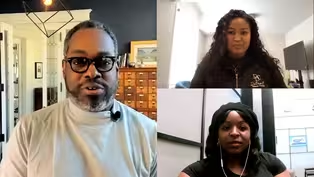
Black women entrepreneurs face unique business challenges
Video has Closed Captions
Clip: S50 Ep46 | 11m 26s | Black women entrepreneurs face unique business challenges | Episode 5046/Segment 1 (11m 26s)
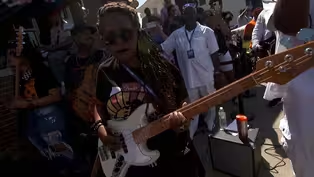
Detroit Bass Day celebrates with The Temptations tribute
Video has Closed Captions
Clip: S50 Ep46 | 6m 18s | The 9th annual celebration features spoken word poetry from the "Papa Was Project." (6m 18s)
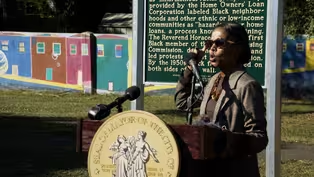
Detroit's Birwood Wall receives Michigan Historical Marker
Video has Closed Captions
Clip: S50 Ep46 | 2m 50s | The wall was installed to separate housing for whites from African American neighborhoods. (2m 50s)
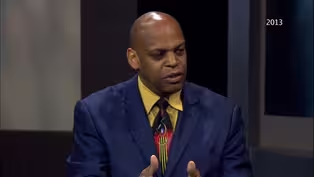
Remembering Detroit education advocate Tyrone Winfrey
Video has Closed Captions
Clip: S50 Ep46 | 52s | Detroit Public Schools Executive Director of Community Affairs Tyrone Winfrey passes away. (52s)
Providing Support for PBS.org
Learn Moreabout PBS online sponsorship
- News and Public Affairs

Top journalists deliver compelling original analysis of the hour's headlines.

- News and Public Affairs

FRONTLINE is investigative journalism that questions, explains and changes our world.












Support for PBS provided by:
American Black Journal is a local public television program presented by Detroit PBS