Alabama Public Television Presents
Blaze: The Trails of Alabama
Special | 54m 59sVideo has Closed Captions
A documentary celebrating Alabama’s diverse trail systems from the coast to the mountains.
Blaze: The Trails of Alabama journeys across Alabama’s diverse trail systems during the official Year of Alabama Trails, showcasing the rugged backcountry, scenic rail-to-trail, mountain bike networks, equestrian routes, and biodiverse blueways.
Problems playing video? | Closed Captioning Feedback
Problems playing video? | Closed Captioning Feedback
Alabama Public Television Presents is a local public television program presented by APT
Alabama Public Television Presents
Blaze: The Trails of Alabama
Special | 54m 59sVideo has Closed Captions
Blaze: The Trails of Alabama journeys across Alabama’s diverse trail systems during the official Year of Alabama Trails, showcasing the rugged backcountry, scenic rail-to-trail, mountain bike networks, equestrian routes, and biodiverse blueways.
Problems playing video? | Closed Captioning Feedback
Where to Watch Alabama Public Television Presents
Alabama Public Television Presents is available to stream on pbs.org and the PBS app.
(lively music) [Narrator] They say every trail tells a story, a winding path shaped by time, footsteps and the pull of adventure.
(hooves clacking) From the high ridges of the Appalachian foothills to rail-to-trail paths where steel once thundered, but now only the hum of bicycle tires remains.
(bike chains whirring) There's a magic to waking up before the world stirs.
The trails are quiet, the air is fresh, and every step feels like a discovery waiting just for you.
It's in these early hours that the trails truly come alive, A moment to breathe, to move, and to connect with Alabama like never before.
-(dramatic music) -(tires crunching) Here trails aren't just dirt and gravel, they're gateways to discovery.
(camera snapping) They lead you through whispering pines, along rushing rivers and into landscapes that change with every mile.
The trails are waiting, and the best way to discover Alabama is to take the first step.
This is "Blaze: The Trails of Alabama."
(dramatic music) How do you get to know a place like Alabama because it's incredibly full of surprises, the whole state.
It's like waking up and discovering your best friend that you played with is suddenly a billionaire.
I've lived in Alabama my entire life, and I'll tell you, one of the many aspects of Alabama I really appreciate is the diversity of our geography and topography.
Not many states can claim they have not only the Appalachian Mountains, but the Gulf Coast.
Our blueways are a flagship of the entire country.
This is something that people wish they could have in their backyards like we do have here in Alabama.
I think everyone should have the opportunity to experience the outdoors and fall in love with it.
If we could just get out and get away and surround ourselves with silence, it's amazing what that does for your attitude and your outlook, and your approach to the next week, to your life, to your family.
We always say that in order to create the next generation of conservationists, we have to create the next generation of users.
We have to find people that are excited about conserving the outdoor assets that we have in the state by using them.
(dramatic music) (insects chirping) One of the interesting things is that when we think about trails across the country, there are a lot of trails that have existed for 100 years or more, and we think those trails probably began from game trails or Native American trails, and those trails often were the fastest way to get between two points.
[Narrator] Long before European settlers arrived, the area now called Alabama was home to tribes like the Creek, Cherokee, Choctaw and Chickasaw.
Chief Ladiga was a Muscogee Creek Indian chief, and this was during the time when the federal government was beginning to move Native Americans east of the Mississippi, west of the Mississippi, and he ceded most of the Creek lands in this region to the federal government, which marked the beginning of the Trail of Tears.
This is how the people who pioneered their state got around, and they had to build paths to get from one location of the state to another.
[Narrator] These tribes created extensive networks of footpaths, and trading routes, connecting villages, hunting grounds, and ceremonial sites.
Many modern trails, particularly in the Appalachian foothills and river valleys, followed the paths first blazed by these Native Americans.
These paths have transformed the state of Alabama by providing many new opportunities.
I think trails like the Chief Ladiga Trail helped tell the story of Alabama because it links together not only the past, but it also brings tourism here, links together outdoor recreation opportunities that abound, and it's just a way to enhance the quality of life for residents of Alabama.
[Narrator] Once, the sound of steel and steam echoed through these valleys, railroads carrying goods, people and progress across Alabama.
But when the trains stopped running, those lines were left behind, silent, overgrown, forgotten.
Out of that silence came a new vision.
So it was a really long time ago, and there was a Birmingham newspaper story.
State Senator Doug Ghee had seen the story, and he gives me a ring, shows me this little article.
I mean, it was just a small article, probably 100-200 words, but they'd talked about this whole idea of rails to trails conversion.
When a railroad is no longer in use, there's different ways to reclaim it, but this rails to trails conversion concept would yank out the rails, would yank out the ties, yank out the gravel, and then you'd have a corridor.
There were different types of land ownerships.
There was rail banking, there was fee simple, and we knew it would be a combination of ownership.
It was complicated, and instead of trying to figure it out ourselves, we recognized an organization that had led other rail trails around the nation, and it was the Rails-to-Trails Conservancy.
[Narrator] Across the state, abandoned rail corridors were given new life, transformed into greenways that stretch for miles.
The Chief Ladiga Trail to me is one of the great gems in the state of Alabama.
I like to think of it as the spine on which we will build all kinds of outdoor infrastructure in this northeast Alabama region.
It stretches from Anniston, all the way to the state line in Georgia.
It's paved and so almost anyone can enjoy that trail.
It's accessible to young children, it's accessible to wheelchairs.
We have hand cycle riders who come here to ride the Chief Ladiga Trail, which makes it an amazing resource for all Alabamians.
Hey, we have one of the longest rail trails.
It is smooth surface and it goes essentially from Atlanta, and now I can say it goes from Atlanta to Anniston, and that had always been the original dream to do that.
How it passes by public lands like Dugger Mountain, Talladega National Forest, Terrapin Creek.
We talk about the beauty of small towns like Piedmont, but the fact that it goes through these beautiful agricultural areas, small towns with mountains.
People don't realize Alabama has as many mountains and hills as we do.
[Narrator] The Chief Ladiga Trail is a paved 39.5-mile rail trail that now connects to Georgia's Silver Comet Trail, forming one of the longest paved pedestrian multi-use trails in the country.
The former railroad path it follows is popular for walking and biking.
The trail runs through Calhoun and Cleburne counties and features incredible scenery throughout.
But the Chief Ladiga trail isn't just a pathway for recreation, it's an economic lifeline for the small towns it touches.
Once an abandoned rail line, this 39.5-mile trail now brings steady streams of visitors into northeast Alabama, connecting the communities of Anniston, Jacksonville and Piedmont.
The Chief Ladiga Trail, you know, is a bit of history and it really serves to link together not only different communities, but to tell the story of Alabama because taking a former railbed, tying into the heritage of Chief Ladiga and connecting into the Silver Comet Trail in Georgia.
So it really is a unifier.
[Narrator] Before the trail came through, Piedmont was like many small southern towns, defined by its past and waiting for something new to move it forward.
Decades earlier, this community thrived on cotton, timber and textiles.
The hum of factory machines and the steady rhythm of freight trains once defined the town's heartbeat.
But when the mills closed, that heartbeat slowed.
(camera snapping) For years, downtown storefronts sat quiet and opportunities became scarce.
Then came the Chief Ladiga Trail.
But you're talking about the longest continuous paved trail in the United States.
It goes all the way into Atlanta, and folks are utilizing it now more than ever.
And I think we've seen that since the seeds were planted years ago, you're still seeing dividends paid with different businesses opening.
So it's really exciting to see how everyone's come together to collaborate and make it happen.
You look up and along the mountain ridges from, you know, Alabama to Maine, so many trail towns.
Well, I would say Piedmont, Alabama is a perfect example of that kind of the future of trail towns here in Alabama.
And there's no reason with our resources, our entrepreneurship, the motivation and the drive to really create a great source of economic interest and development along our trails in the state of Alabama, such as Piedmont.
[Narrator] When the rail line that once carried freight was converted into a multi-use path, few could have predicted the change it would bring.
Suddenly this small town became the midpoint of Alabama's longest paved trail, stretching nearly 40 miles and connecting directly with Georgia's Silver Comet Trail.
That connection transformed Piedmont from a quiet post-industrial town into a gateway for outdoor tourism.
The same railway that once carried goods out of town now brings people in, and with them came a renewed sense of purpose.
Trails all over Alabama have created new opportunities for small businesses and have inspired totally new ones, like the Pinhoti Outdoor Center in Sylacauga, Alabama.
We wanted to open up a full hostel and provide services for hikers that would really, start to finish, make their experience a whole lot better around the Pinhoti and that's how we started the outdoor center.
[Narrator] Kim and Nathan's love for the Pinhoti Trail grew into something more, a desire to give back and support the very hikers who share their passion for it.
When you first come into the Pinhoti Outdoor Center, you're gonna see the kitchen.
This is kind of where it all happens.
We've got our hiker food, we've got just basically microwave, toaster oven, just things that the hikers can use to make themselves feel at home.
And then we have our three sets of bunk beds with a kind of our living space.
We offer two full-sized beds and then four twin sized bunk beds.
The bathroom, we've got a full hot shower for you when you get here.
We do also have opportunity for you to do laundry if you wanted to do your laundry, dry your clothes out.
We just want you to feel at home when you're here.
We do planning services.
We do Zoom calls to help hikers learn about the Pinhoti Trail and everything that they need to know to be safe and confident in their own journey on the Pinhoti Trail.
We have great hiking trails.
The signage is good, it's in the woods.
We don't want just the one time, we want the repeat business of folks saying, "Hey, we're gonna make Alabama our go-to destination when it comes to hiking."
And what do we have that nobody else has?
We're right in the center of the South.
It's so easy to get to Alabama, and all of our different hiking trails, whether it's in north, central or along the Gulf.
I think that's what gives us kind of the advantage that some of the other states don't have.
Trails are really important to attract people to come and live and work in the state.
One of my faculty members who moved here for the job said the first thing that he did when he looked for the job was to see what trails we had.
And he's been very happy, largely because his outdoor recreation opportunities have the infrastructure that he needs to practice his craft.
[Narrator] The Rails-to-Trails Conservancy put together an influencer ride in order to better showcase the Chief Ladiga Trail for its accomplishments in bringing communities together, as well as the overall economic impact the trail has had on those communities.
But what really winds up happening is people begin to travel to that trail, and the longer the trail is, the more interconnected it is, the more entry points or trail heads that it has, the more people come to visit, and those people stay somewhere, you know, find lodging and that generates some lodging tax that benefits the local community.
They'll go out to eat, they'll show up at a grocery store, they'll buy gas.
Investing in trails is really taking advantage of your natural endowment, what's already in your backyard.
It's not making yourself into something you aren't.
It's really highlighting who you are, who your community is.
The idea was to bring attention to the Chief Ladiga Trail in light of progress being made in getting funds through the state of Alabama to take next steps to develop pathways and planning for additional segments.
-(train chugging) -(lively music) [Narrator] What once carried commerce now carries community.
What once linked cities now links lives.
Alabama's rail-to-trail paths are more than roots, they're stories of renewal, stretching forward into the future.
(dramatic music) But not all trails in Alabama are paved.
And for those who enjoy a more rugged exterior, the Pinhoti Trail is sure to impress.
(dramatic music) A trail runner is someone who has decided that they don't like pavement anymore, who likes to run through the woods all day long on a weekend and maybe more.
[Narrator] The Pinhoti Trail is a 351-mile hiking trail through the Appalachian foothills of Alabama and Georgia with its southern terminus in Flagg Mountain, Alabama and its northern terminus at the Benton MacKaye Trail in Georgia.
Keep going.
[Narrator] Renowned for its scenic beauty and challenging sections, the trail is a great starting point for those interested in long-distance hiking.
When I was younger, like eight or nine, my parents and I, we would go on just little day hikes.
I saw a poster and it just talked about a footpath connecting all of the Appalachian Mountain range.
And I didn't even see the name of it or anything.
I just saw footpath and I thought that was really cool.
We know that people are coming from all over the country, some areas, all over the world, to see what Alabama has that's unique.
And when they learn about the Pinhoti, we hope that a lot of people are gonna come to Coosa County, get excited about a place that maybe they had heard of but never been to because this place is certainly, I would say, underutilized.
So the more people that we can get to come to the Pinhoti Trail, the more people that we will expose to this important part of the Appalachian Mountains.
[Narrator] In early October 2025, a ribbon cutting ceremony was held at Flagg Mountain.
The event celebrated the designation of the mountain's historic observation tower as the official start or end of the Pinhoti Trail.
We're not just a trail or a trip, but a journey.
And whether you do the Pinhoti Trail along this mountain or you go all the way to the Georgia line or whether you hike the AT all the way up to Maine, this is where we're starting in Alabama, in Coosa County and Flagg Mountain.
The tower, which was constructed by the Civilian Conservation Corps, part of the federal relief programs of the New Deal is 52 feet in height, and it is kind of the crowning jewel of the summit of Flagg Mountain, which is the centerpiece of Weogufka State Forest, and also represents the southern terminus of the Pinhoti Trail.
We've got to thank all the volunteers, and I know there are a lot of them here.
It's all the blood, sweat and tears of these volunteers who work the Pinhoti Trail from top to bottom, all the trail maintenance, all their hard work, we couldn't be there without them.
The Pinhoti is so important to Alabama.
One of our original tasks was working on Flagg Mountain, where the Pinhoti starts, to really say, "This is the trailhead."
So not only do you get to start on the southernmost mountains of the Appalachians, but you are at a historical structure with the tower at Flagg Mountain.
(feet crunching) It's so cool to be able to look at an era of history and that's what you get when you're at Flagg.
One of the guys I met up there, he lived there while it was the Forest Service property.
So like his dad was the guy who would be in the tower looking for forest fires.
And he told me so many cool stories.
He said that he was up there when they brought power.
Literally it's just like a piece of history that you can go visit and you can just feel it there.
(lively music) (phone ringing) -(keyboard keys clacking) -(chimes dinging) I work in a field as a college professor where I talk to people all day long.
I teach students, and by the end of the week I just wanna be alone.
I don't wanna talk to anyone, and most of my trail runs are alone.
There are a lot of people who run in groups, they all meet together, they run together, they have a beer after the run.
But I like being alone.
-(tranquil music) -(vehicle whooshing) I just wanna drift along and run along the trail and there are times when I've had a hard week, I'll stop, stop my watch and I'll just scream, and just let it all out and there's no one there but the snakes and the birds and the raccoons to hear me.
But to me, it's like a clearing my mind of all the stress because I'm in the middle of the woods.
All I hear are crickets and frogs and birds, and my footsteps, and nothing else.
(gravel crunching) No one can reach me, no one can find me.
And I reset my brain.
-(tranquil music) -(feet pattering) -(tranquil music continues) -(feet pattering) Like a mental health reset, and along with the physical fitness aspect of it, the mental fitness is just as important.
-(tranquil music continues) -(feet pattering) [Narrator] Many hikers have mentioned that the Pinhoti Trail is more than a path through the mountains, it's a journey into the mind.
With every step along its ridges and valleys, hikers shed stress, rebuild resilience, and reconnect with the part of themselves that often gets lost in the rush of modern life.
Another such observer is Doug Clark, a professor at Jacksonville State University who took on a project that revealed more than he could have imagined.
Awesome.
When I was in college, I really got into hiking and at first, it was going out destination to destination.
And then pretty soon after, this was in Virginia, I started going to these really beautiful spots, and then I realized they were part of something called the Appalachian Trail.
And looked at on a map, this Appalachian trail went not only through Virginia, but it went through 14 states on the East Coast.
Falling in love with day hiking became falling in love with overnight backpacking.
That became falling in love with going out for the weekend.
Eventually the more time I spent on the trail, the more I kept meeting other people that had worked on the trail, that had thru-hiked on the trail.
And they all had this look in their eye of just enjoyment whenever they would talk about it.
And by then I knew the trail was really special.
And I think what really inspired me that flipped the switch was when I realized that that's what I wanted.
You know, I wanted the look that they had in their eye when they thought about their experience on the trail.
(tranquil music) In 1994, when I was 23 years old, I had a chance to hike the entire Appalachian Trail from Georgia to Maine.
It had a profound impact on my life as the trail culture I've carried with me all those years.
But I really haven't spent a lot of time on the Appalachian Trail because I lived in the Northwest and then recently been in Alabama.
When the opportunity came up to look at defining my research for a sabbatical, one of the first ideas that came to mind was to do a rephotographic project 30 years later 'cause in 2024 was the 30th anniversary of my thru-hike.
(lively music) And to be able to have that time off work and to go out and take on this photo project that would really allow me to go back to each of the 14 states and spend time in the Appalachian Mountains was truly a special opportunity for me.
[Narrator] What began as a personal journey turned into something larger.
Along the way, Doug began documenting not just the trails themselves, but the people, places and quiet moments that define life along them.
My story that I did in 1994 was about my 23-year-old self doing a thru-hike.
And now 30 years later, the trails had a profound impact on my life and I'm able to use my camera to go back to the trail to document that.
(inspirational music) [Narrator] Those images became the foundation for his photography exhibition "Beyond the Blazes."
The collection invites viewers to see trails not just as routes through the wilderness, but as stories of perseverance, reflection, and connection to the land.
(inspirational music) When I was doing this photography project, I visited each of the 14 states to create my landscapes, but one of the things I wanted to capture was the opportunities where I'd meet other hikers along the way.
This is Kyote and he's standing on McAfee's Knob at sunrise.
The sunrise is coming up behind him.
It's one of my favorite portraits on the wall.
I love the image itself, but to me, it's the place I found my own inspiration when I was a college student.
To be able to share that experience was just really special.
(inspirational music continues) Growing up in the big city, you know, there were plenty of places to hike, but really getting in the woods, getting in that national forest, you are so far from cars and roads and businesses.
You know, that's part of what makes Pinhoti special.
But what also makes the Pinhoti special is the culture that so many individuals take the Pinhoti to heart.
They take care of that trail.
And that's why I enjoy hiking the Pinhoti.
Whether it's part of the, you know, Cheaha State Park, or whether it's in some of the other places around the trail.
I love hiking along the granddaddy of all trails in Alabama.
[Narrator] The Pinhoti Trail challenges hikers with its rugged climbs and peaceful stretches through Alabama's Appalachian foothills.
But just a few miles away, the terrain takes on a different kind of energy.
-(upbeat music) -(bikes whirring) In the nearby city of Anniston, Coldwater Mountain offers one of the South's premier mountain biking destinations.
Trails give me a sense of adventure, a sense of wonder.
One of my favorite things is when I'm on a new trail that I've never been on before.
I can't count the number of times that I've decided how far or how long I will go but I get to the turnaround place and I can't stop.
I need to know what's right around that corner, what's just over that hill?
Is there some view or some waterfall that I'll miss if I don't keep going?
And that sense of adventure, even if you're on a trail that you know is well established, I think it's really important for us as humans because this gives us this idea that we're still discovering things that are new in our life.
[Narrator] Here, more than 35 miles of purpose-built trails twist through hardwood forests and rocky slopes designed for riders of all skill levels.
(upbeat music) Unlike the Pinhoti, which invites hikers to slow down and take in the quiet of the forest, Coldwater Mountain is about speed, flow, and technical challenge.
(upbeat music) [Rider] Woo, that's good.
[Narrator] Riders come from across the region to experience its single track trails and professionally built downhill runs.
Together, the Pinhoti Trail and Coldwater Mountain form a hub for outdoor recreation in northeast Alabama where hikers and bikers share the same landscape, each finding their own rhythm in the hills.
(upbeat music) While mountain bikers carve their own paths through the hills of Coldwater Mountain, another group of trail users enjoys the landscape at a different pace.
Introducing Oak Mountain State Park.
(lively music) Across Alabama, horseback riding trails provide riders and their horses with miles of forest roads, creek crossings and scenic overlooks.
These routes offer a more traditional connection to the land, one rooted in the state's farming and rural heritage.
So at Oak Mountain State Park, we have some of the most beautiful horseback trails.
You can bring your own horse or we also have a vendor on site that offers horseback rides to our guests.
We've got between 25 and 30 miles of dedicated horseback trails going through some of the most beautiful serene landscape that Alabama has to offer.
When the fall is here and the leaves are falling and all the fall colors, it's absolutely beautiful to be riding a horse in the woods here at Oak Mountain State Park.
[Narrator] These equestrian trails allow riders to explore the countryside from the saddle.
Many parks also offer campgrounds and stables, making them ideal for overnight trail riding adventures.
Whether it's a short sunrise ride or a multi-day trek through the foothills, Alabama's equestrian trails open the outdoors to a community that's been part of Alabama's landscape for generations.
(lively music) From the saddle, Alabama's trails reveal sweeping views of farmland, forests and foothills.
But just beyond these riding paths lies another trail system, one shaped not by dirt and rock, but by the rivers that helped form the state itself.
When we think about trails, we often think about a dirt path through the woods, but really one of the most important trail systems in the state are our waterways.
(inspirational music) We oftentimes call 'em blueways or water trails and they're organized by the Alabama Scenic River Trail organizations.
And all of these waterways make their way down to the Mobile Bay and pass through the Tensaw Delta.
Well, blueway trails are a little bit different than land-based trails because they're already here.
I think one of the challenges that we're trying to unlock as a state is how to provide opportunities, both on land and on the water.
But for us in the water world, we're always really excited about the fact that we have the water.
And for many, many years, if not hundreds of years, people have been using those waters.
And so we're really just kind of building upon the experiences and work that's been done in Alabama's waterways really since the state's inception.
And so I think there's definitely a little bit of a difference between blueways and greenways.
Both are very popular and very accessible and we're trying to increase that accessibility.
But in my opinion, you know, the nice thing about blueways is that we've already got 'em.
[Narrator] Across Alabama waterways open a world of exploration that trails on land can't reach.
These blueway routes invite paddlers of every experience level, from peaceful floats to full-day river adventures.
But the heart of Alabama's waterway story lies in the south.
-(tranquil music) -(people talking indistinctly) The Mobile-Tensaw Delta is a world all its own, often called America's Amazon.
In fact, it's hard to spend even a moment here without noticing just how alive this place is.
Every sound, every ripple, every movement reflects the Delta's extraordinary biodiversity.
Let me say the Mobile-Tensaw Delta is probably the richest delta left in North America.
It's not the richest place in Alabama.
There are many places in Alabama that actually have more diversity, but if you're looking for something like a delta, which is not just a swamp, it's a place where rivers come together and intertwine, massive rivers bringing in tons of water from all over the state.
Incredible, that water pouring through the delta and the delta basically turning that stuff around, extracting all the richness from the rest of the state and spreading that out into the Gulf below it.
It's an incredible place.
(inspirational music) We forget about how it's one of the last places in Alabama where you really, truly can get lost.
Boy, I've gotten lost there before, but it was one of the great places in the world to get lost.
(inspirational music continues) [Narrator] Here rivers don't carve through valleys, they expand, forming wide wetlands, hidden bayous and a maze of channels that stretch as far as the eye can see.
(inspirational music continues) (inspirational music continues) Boardwalks and observation platforms offer a chance to explore the delta without getting in the water.
(tranquil music) Perfect for viewing wildlife and a completely different experience from the mountainous trails up north.
It's a dramatic shift in topography, proof that Alabama's outdoor landscape reaches far beyond the hills and hardwoods.
Paddlers can weave through towering cypress trees and move from fresh water into brackish ecosystems, all in a single day's journey.
Not only are blueways great for outdoor recreation and connecting people to nature, they're also great at making people care about the nature that they're experiencing out there.
[Narrator] From peaceful creeks to one of the country's most impressive river deltas, these waterways show just how diverse the state's natural adventure can be.
(water lapping) For most people, Alabama's waterways offer peaceful exploration, quiet mornings on still creeks or slow drifts beneath cypress trees.
But for some, these same rivers become a test of endurance, strategy and sheer determination.
Every fall, elite paddlers from across the country gather for the Alabama 650.
The great Alabama 650 is the longest paddle race in the United States, and it takes place on the Alabama Scenic River Trail, which is the longest river trail in one state in the entire country.
-Got a plan.
-Keep our times.
-Just gotta execute it.
-Yep.
You're in the boat six, seven days with the same person and like emotions are flowing out there.
Right.
And, you know, somebody's feeling good at one point and then the other guy's feeling bad, you know?
So it's a lot of variables in there and you're having to work with each other to get through to the end.
It's not just about physical endurance, it's about mental endurance.
It's exciting, it's thrilling, it's challenging.
We don't always have people finishing the race every year because of those challenges.
It's just really a special thing to see.
Welcome to everybody.
This is the race chart of Great Alabama 650.
[Announcer] Five, four, three, two, one.
-Go.
-(starter horn blasting) [Narrator] Spanning more than 650 miles, it follows the Alabama Scenic River Trail from the northeast corner of the state, all the way down to the Gulf Coast.
The Alabama Scenic River Trail has been working hard alongside the State of Alabama to really take the opportunity of having this be the year of Alabama trails as a way to talk about the importance of blueways while a lot of communities are really focused on their greenways.
And so we are really trying to show that there is a parallel partnership between people's experiences on outdoor trails in the woods and in their communities, as well as the blueways that are flowing right through their backyard.
[Narrator] What many say this race is special for is its journey through one of the most diverse landscapes in the country.
From the cool, narrow streams of the Appalachian foothills to the broad, slow-moving waters of the Mobile-Tensaw Delta.
Over 6,300 navigable miles of fresh water in Alabama, and we've only just unlocked some of that.
So I hope that people get out, explore, and really thrive in Alabama's fresh waterways.
[Narrator] Racers experience the full range of Alabama's natural environments in a single trip.
And that variety is no accident.
Alabama's geography creates an incredible mix of habitats, mountains, forests, wetlands, and coastal plains, all packed within a single state.
So it gives our own state residents the opportunity to enjoy every aspect of enjoying the outdoors.
And that's why I always talk about, you know, don't underestimate the opportunities for the great Alabama outdoors.
[Narrator] Together these landscapes support one of the richest collections of plant and animal life in North America.
Each trail, whether on land or water, passes through ecosystems that are home to species found nowhere else on Earth.
For years, this level of biodiversity has piqued the interest of many, including that of Bill Finch.
One of the ways of understanding why Alabama's so rich is understanding that the places are incredibly rich.
They're rich in how different they are from one another.
You're down there on the coast and you've got these incredible beaches and these sand dunes and all these different things that go with that habitat.
And then you're going up through the incredible longleaf pine forest system.
It's North America's savanna, it's like an African savanna in a way with these trees, but grasses all underneath it and wildflowers through that longleaf savanna.
And then you're up in these deciduous, rich hardwood forest in the Red Hills around Monroeville.
And then up from that you're in the prairie, a prairie, it's like a grassland prairie, like in the Midwest.
Incredible stuff.
And then you're in the Talladega Mountains, which are stunning and beautiful, around Flagg Mountain and Cheaha Mountain, where you're getting incredible diversity, not only of trees, but also of grasslands as well, going up the slopes to the highest point in Alabama.
And then in northeast Alabama, it's montain, it's full of mountains.
It's like nothing that you saw on the coast.
And it's that variation from one part of the state to another.
And the great thing is if we could find ways to connect that other than just highways 'cause that's how we see it.
The state is on the edge of the highways and we don't see these differences.
But trails can help us to see these differences in the state because it puts us in the middle of those differences.
(birds tweeting) [Narrator] Bill's team of researchers at Paint Rock Forest Research Center in Trenton, Alabama study the forest in great detail in order to better understand the future of Alabama's forest.
Bill has been involved in Alabama conservation for more than 30 years and has increasingly focused his skills and efforts on large-scale landscape conservation and restoration efforts.
So what Nathan has pulled up here is really the product of what we're doing in our major outdoor laboratory, which is 150 acres where every stem larger than a pencil has been documented and tagged, mapped, measured, and will be followed for 50 years.
And you can begin to see all the dots.
Knowing more about what happens here is gonna tell us a lot about Alabama Forest in general and Eastern Forest as well.
This is our 150-acre research laboratory.
It's massive.
Every square inch of this we're researching.
One of the interesting things about this place is that we can actually see how humans interacted with this forest over a long period of time.
You know, Jackson County is the center of cave life in North America.
It may be the center of just the sheer number of caves and there are caves everywhere here.
Here I can see that, oh, let's say about 110 years ago, 120 years ago, look at that big tree, that tree is probably 250 years old, that big white oak.
Every little stem has a tag on it, its own unique identifying number.
Everything bigger than a pencil, it's measured, but this is it.
We've got 89,000 stems, each one of them tagged.
It's an incredible process.
It's the largest effort of its kind in North America.
There's nothing else like it.
So we're really, really excited about the research potential here.
[Narrator] Alabama's trails don't exist apart from the forest.
They exist because of them.
Every shaded path and wildlife crossing depends on the health of the ecosystems that surround it.
That's why research into the biodiversity of Alabama plays such an important role.
(tranquil music) (water lapping) (plant rustling) One of the great things about Alabama is the huge biological diversity.
Alabama ranks very high in the country with the number of plant and animal species.
And one of the reasons for this is the huge diversity of ecosystems.
If you think about Alabama stretching from the Gulf Coast through the Tensaw Delta and the Wiregrass, all the way through the river systems to the mountains of north Alabama, there's a ecosystem that supports all kinds of different plants and animals.
And there are trails in all of those ecosystems giving people the opportunity to explore this rich biological diversity.
[Narrator] As research helps preserve Alabama's natural landscapes, those same landscapes are helping shape the state's future.
In today's economy, quality of life matters as much as opportunity, and access to the outdoors is quickly becoming one of its strongest calling cards.
More than a desire to live close to family, more than a desire for career advancement or increase in salary, that tech talent audience frequently lists outdoor recreation and proximity to the outdoors is number one reason they locate to a given geography.
[Narrator] Communities near Alabama's Trail systems, like Huntsville, Birmingham, and Montgomery are seeing a new generation of professionals drawn not just by jobs, but by balance.
For communities that are looking to attract and retain talent, that talent audience really wants to live in a vibrant community, an authentic community.
And so investing in trail infrastructure is a way to create convening mechanism for a community.
It creates a third space for a community to get together outside of work or school, and adds to community vibrancy.
[Narrator] Engineers, programmers and remote workers can finish a day in the office and be on a trail, a bike path or a kayak route within minutes.
This blend of innovation and recreation is changing how people see the state.
You see these side effects of interesting businesses popping up alongside the trail that add to that vibrancy of the community.
Whether it's a bike shop or coffee shop, you're just adding layers to what makes a community interesting to live in for that talent audience that can really live anywhere.
So remote workers, for example, that can absolutely live anywhere, so why not live somewhere that's absolutely beautiful and has a great cost of living, and a really high quality of life?
[Narrator] Access to outdoor adventure isn't just good for tourism, it's a magnet for talent.
Companies know that a healthy, active workforce is a creative one.
By connecting people to the outdoors, they're helping connect Alabama to the industries of the future.
(lively music) But the connection between trails and attracting high-level talent to the state has only been a recent development.
In 2020, an initiative launched under Governor Kay Ivey brought a team to evaluate Alabama's ability to attract and retain new industries, particularly in the technology and innovation sectors.
And when those researchers got off the plane from California, they were kind of floored at how beautiful it was here.
[Narrator] They found that while Alabama had the landscapes that rivaled any in the southeast, from mountain ridges to river deltas, the story of those spaces wasn't being fully told.
For many outside the state, this connection between nature, recreation and quality of life remained largely invisible.
And they realized that Alabama had really under leveraged its outdoor rec offerings, that it could invest in and sort of elevate and market its outdoor recreation to attract and retain a talent audience that it needs to grow its innovation economy in the state.
[Narrator] And as Alabama continues to invest in its outdoor spaces, one message stands out: these trails aren't just for some, they're for everyone.
So the Department of Conservation Natural Resources has been able to work to get $20 million, and that's to help improve trails throughout the state.
Of that, the Alabama State Parks has received some funds to help us to improve the Backcountry Trail down at Gulf State Park, as well as improvements into Oak Mountain State Park.
[Narrator] Part of that improvement now includes outdoor mobility devices.
Something else that I'm really passionate about and that we also offer is our new outdoor mobility device program.
You know, for me personally, one weekend every month we were out on trails like this, hiking and backpacking and camping.
I haven't been able to do that in 20 years.
So to be able to have devices like this available in our state parks here in Alabama, I'll be honest, I can't describe what that feeling is like the first time you get out here and you're able to do something and experience something that you haven't been able to do in 20 years.
We're just trying to make opportunities for people that have physical challenges to enjoy the parks just as well as people with able bodies.
(lively music) (wheels crunching) I didn't realize that I missed this until I came out here today, to be honest with you.
[Narrator] Alabama's trails connect people to nature, but more than ever, that connection is being built with accessibility in mind at Oak Mountain State Park.
Oak Mountain, having devices like this, it give people with disability the same opportunity that you have able bodied people.
There are a lot of people with disabilities like myself, so I am so appreciative of the State of Alabama, the Alabama parks for investing in these type of equipment so people with disabilities, so we can get out.
I think it's a blessing.
[Narrator] New efforts are making outdoor recreation available to everyone.
Wide, graded trails and paved routes offer access to scenic overlooks, opening the park's beauty to visitors of all abilities.
As someone who works with individuals who are seeking out this opportunity to be able to explore the city that they love and the outdoors that they so crave, it can be quite a challenge to be able to help identify the needs of certain individuals.
And these amazing pieces of equipment that Oak Mountain State Park is providing allows us as specialists to be able to approach each situation with a lot of confidence to know that these pieces of equipment are very well made, maintained, amazing, and are easily adjustable and fit many individuals for whatever need they're interested in seeking out here.
[Narrator] Further south, along Alabama's Gulf Coast, long boardwalks trace the edges of beaches and estuaries.
These raised walkways let visitors experience the state's coastal ecosystems up close, from salt marshes to nesting shorebirds without disturbing fragile habitats.
(screen whooshing) At Cheaha State Park, Alabama's highest point, accessible trails and viewing platforms provide everyone the chance to take in the same sweeping vistas that define the state's mountaintop wilderness.
And across the northeast, the Chief Ladiga Trail continues that spirit of inclusion.
Its level, paved surface welcome cyclists, walkers, and wheelchair users alike, proving that outdoor adventure doesn't have to be limited by terrain.
From the mountains to the Gulf, Alabama's commitment to accessibility ensures that the outdoors belongs to everyone, no matter their age, ability or experience.
(birds tweeting) Across Alabama, the story of trails is still being written.
And today that story is guided by technology as much as it is by terrain.
Talks of new trails or the expansion of existing trails is being done in a more modern way.
We've learned that you can build a trail that can be more sustainable, that can last longer.
And we're using science to understand that.
But before you even start breaking ground on a trail, one of the most important things is being able to design that trail on the computer.
And we use geographic information systems in order to plot out where a trail should go on a topographical map and aerial photos.
And by doing that, we can plan trails that will climb slower and descend slower, and make the trails more enjoyable for users.
At Jax State, we're heavily invested in trails.
A few years ago we launched the Trail Science Institute whose mission is to study and promote trails in our region and across the state.
After that was established, we created the Trail Science curriculum, which is the first one of its kind in the state, which is a curriculum to help people who are gonna live and work in this area communicate with trail builders to make sure that the trails that we're building can last generations.
Good trails that are being built today will do a good job of dumping water off the trail every once in a while to make sure that water doesn't run down the trail and erode the trail.
So there's a lot of science that goes into building the trail.
-(lively music) -(drone whirring) [Narrator] Across Alabama, new trails are being built, but just as important are the ones already here waiting to be discovered.
Many believe the next step isn't just creating more paths, but improving access.
And I think it's sometimes unfortunate when you have small towns, a town like Aliceville, Alabama, west of Tuscaloosa that has the Tombigbee River that runs right alongside of it with no public access.
In the capital city where I live in Montgomery, Alabama, not having true public access ways for paddlers to get onto their water.
I am always out there advocating to not forget that we have water that's already there.
It's does not need to be built, it does not need to be manufactured, it just needs to be unlocked.
(tranquil music) If we really are able to build all the trails that we are planning, then there'll be a trail available to every Alabamian.
And those trails will call and they'll say, "Come and explore Alabama's amazing biodiversity, reconnect with nature and understand what it really means to live in this beautiful state.
I think trail development enhances environmental conservation because anytime you bring attention to the outdoors, you get people outdoors, they're gonna have a greater respect and affinity for the outdoors.
And so obviously when we look at trail design, there are best practices on how to, you know, make sure we're doing things in an environmentally sound and environmentally friendly way.
But I think when you have more folks enjoying nature and utilizing it, then you're gonna have better stewardship of the environment because of that.
The trails that I've run on around here, I've run on 'em so much I know exactly where to turn, I know where the small rocks are that always trip me.
I know when it's gonna get a big climb.
I know when I'm gonna get a big descent.
I know everything about these trails 'cause I've run 'em so much and I just keep going back and going back because it feels like home.
If our legislators and our elected officials stay jazzed about the Chief Ladiga Trail, it will continue to grow.
If you don't maintain these trails, roots grow up underneath and make it bumpy.
If you don't repave every once in a while, it becomes impassable.
So this is a forever project.
If you're in the state of Alabama, go find your trails.
Go find your hiking, your biking, your blueways trails.
These trail systems are there for you to learn about this region, to learn about yourself.
When you're out there on these trails, you might just find the better version of yourself.
As we encourage more small towns to promote their assets, when people spend money in their restaurants or spend the night at their bed and breakfast or come to their campgrounds, they're going to realize what we have is something of value.
You gotta know where you are, you gotta know how special it is.
You're gonna have to be in contact with it.
You're gonna have to get out and experience it.
And as you experience it, it's not just about seeing how fast you can get from one place to another, it's about looking around you while you're there, listening, smelling, seeing all of the wonders of Alabama.
[Narrator] From the ridge lines of the north to the winding deltas of the south, Alabama's trails connect more than towns and forests, they connect people, they bring together hikers and paddlers, bikers and bird watchers, families and first-time adventurers, each discovering a piece of what makes this state so extraordinary.
And as technology helps chart new paths, one truth remains: these trails are more than miles of dirt and pavement, they're threads in the fabric of Alabama's future.
So whether you walk, ride or paddle, every step forward is part of a larger journey, one that celebrates the beauty, the spirit, and the connection that defines this place we call home.
This is our story, our invitation to explore, to connect and to blaze the trails of Alabama.
(inspirational music) (inspirational music continues) (inspirational music continues) (inspirational music continues) (inspirational music continues) (inspirational music continues) (inspirational music continues) (dramatic music) (dramatic music ending)
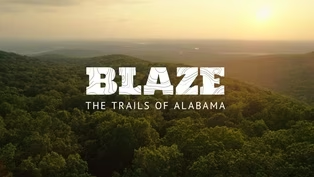
Preview: Blaze: The Trails of Alabama
Preview: Special | 1m 44s | A documentary celebrating Alabama’s diverse trail systems from the coast to the mountains. (1m 44s)
Providing Support for PBS.org
Learn Moreabout PBS online sponsorship New Episode
- Drama

Hugh Bonneville stars in a crime drama inspired by one of the largest robberies in British history.


 New Episode
 New Episode
 New Episode
 New Episode
 New Episode




Support for PBS provided by:
Alabama Public Television Presents is a local public television program presented by APT