Oregon Field Guide
Blister Rust: How science is saving Crater Lake’s whitebark pine trees
Clip | 8m 46sVideo has Closed Captions
A scientist helps save Crater Lake’s whitebark pine trees from an invasive fungus.
In 2002, “Oregon Field Guide” told the story of how an invasive fungus called blister rust was killing Crater Lake's iconic whitebark pine trees. Park ecologists feared the trees would be wiped out by mid-century, but scientists were testing a possible solution. More than 20 years later, we check up on this story and explain why these trees now have a much better chance of survival.
Problems playing video? | Closed Captioning Feedback
Problems playing video? | Closed Captioning Feedback
Oregon Field Guide is a local public television program presented by OPB
Oregon Field Guide
Blister Rust: How science is saving Crater Lake’s whitebark pine trees
Clip | 8m 46sVideo has Closed Captions
In 2002, “Oregon Field Guide” told the story of how an invasive fungus called blister rust was killing Crater Lake's iconic whitebark pine trees. Park ecologists feared the trees would be wiped out by mid-century, but scientists were testing a possible solution. More than 20 years later, we check up on this story and explain why these trees now have a much better chance of survival.
Problems playing video? | Closed Captioning Feedback
How to Watch Oregon Field Guide
Oregon Field Guide is available to stream on pbs.org and the free PBS App, available on iPhone, Apple TV, Android TV, Android smartphones, Amazon Fire TV, Amazon Fire Tablet, Roku, Samsung Smart TV, and Vizio.
Providing Support for PBS.org
Learn Moreabout PBS online sponsorship- [Narrator] For Richard Sniezko, the scenic rim of Crater Lake is also a battleground.
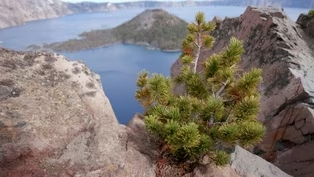
- This is a white bark pine, and it's right on the rim of Crater Lake.
and you can see this branch has a major canker from the white pine blister rust disease.
- [Narrator] He's fighting to save these trees from an invasive fungus called blister rust that came from Europe.
- Well, here's another one, so geez.
There's one, there's one, there's one, there's one, there's one.
They will grow down to the stem of the tree and infect it stem of the tree.
They will then girdle the tree, and they can kill the tree.
Those spores are orange and so it looks like a blister, and so it's called blister rust.
- [Narrator] The white bark pine trees at Crater Lake National Park are iconic.
(wind whooshing) They're one of the only tree species built to survive the harsh conditions on what's left of Mount Mazama.
And Richard is on a decades-long quest to keep them there.
- We're kind of the triage.
We've got to fix the problem, so to me, it's a puzzle.
This will be another one that we're following.
And people who know me, I leave kind of no stone unturned.
- [Narrator] The threat of blister rust is nothing new for Crater Lake National Park.
Field Guide detailed the problem way back in 2002.
- [Narrator 2] Park ecologist, Dr.
Michael Murray says, small warts on white bark pine trees are as deadly as chainsaws.
- [Michael] The way I see it right now, the extinction of white bark pine in the park is imminent.
I expect us to lose about 90 percent of the white bark pine in this park at least.
- [Narrator 2] Unfortunately, there's nothing anyone on the park staff can do to stop trees from dying.
- There's no doubt that we're being beat here (sighing) - [Narrator] Back then, the outlook was bleak, but not everyone believed there was nothing they could do.
You can see a young Richard testing a possible solution by intentionally infecting young pines with the blister rust fungus.
- [Richard] We collect leaves of currants and gooseberries from the wild that are infected with the disease of the blister rust.
These are the spores that will be dropping on the pines that will infect the pine trees.
- [Narrator] So now, more than 20 years later, we're checking up on this problem.
Are the trees surrounding Crater Lake still doomed?
- [Richard] This is one that shows the orange.
- [Narrator] First off, the work really hasn't changed.
(crew chattering) - Richard still grows lots of white bark pine trees in the same greenhouse using seeds collected from the forest.
(plastic crinkling) - Ready?
- [Narrator] Then he tries to kill them.
(nozzles hissing) - [Richard] This fog chamber provides the optimal environment for the disease to progress, for the spores to fall and infect the pine.
Yeah, we'll go down here first.
- [Narrator] Richard then watches the trees for years to see how they respond to blister rust infection.
- This is white bark pine.
What you're gonna see now is which seedlings have cankers and which ones have needle spots, and which ones don't have cankers.
This one probably has about 10 different cankers on it.
There's a canker, there's a canker, canker, canker, canker.
Probably in three months, the oldest cankers will grow together, and then next spring or summer, the seedling will die.
Within a year, we know the most susceptible ones, okay, 'cause they're usually 100% cankered, they will start to die soon after that.
But just looking over here, you can see massive mortality from blister rust.
- [Narrator] But not all of the trees die.
- [Richard] And our best white bark pine might have seven survivors left out of 10.
- [Narrator] At this point, he's grown tens of thousands of trees from forests across Oregon, Washington, and California to test them for genetic resistance to blister rust, and he's found quite a few survivors.
- As we started seeing the level of resistance there, I think that surprised almost everybody.
- [Narrator] The growing a forest of surviving trees requires some extra work.
These tree climbers are part of a plan to cross-breed the surviving trees.
- [Tree Climber] You like it, Evan?
- [Narrator] Testing shows this tree and its offspring- - All right, you're on.
- [Narrator] Can survive blister rust infection.
So tree climbers scale the tree to pollinate it with pollen from other resistant trees.
- [Tree Climber] Slide this right through where your carabiner is.
- Right there?
- Yeah.
- [Narrator] They cage the pine cones to keep them from getting eaten by birds.
(bird chirping) The Clark's nutcracker depends on eating their seeds.
They collect the resulting cones to grow more seedlings.
(needles crackling) - Got all their cones still in cages.
These are the first crosses made out in the wild in Oregon and Washington between two resistant trees of white bark pine, and you can actually see a seed in there.
- All right, so this is a good spot right here.
You can see it growing here just fine.
So we chose this, we would go down further, but it's too dangerous.
This is the spot.
(shovel thudding) - [Narrator] Thousands of the surviving seedlings have been planted on the landscape over the last 10 years.
Park biologist, Thomas Allen, is tasked with planting 600 of them this year.
White bark pine is critical to the ecosystem at Crater Lake National Park, and these trees are still in decline.
(shovel thudding) The park staff hope to plant enough new resistant trees that they'll replace the older trees as they die.
- Hopefully it grows up to live many hundreds of years.
It's exciting, you know, trial and error.
Some days it's one step forward, two steps back, but then we can have these little aha moments and say, "Well, this is working."
It's a hope.
- [Narrator] This ancient pine is known as the Grandmother Tree.
- You can only estimate just how old it is, how majestic it is.
I'm thinking 6 to 800 years.
It's so beautiful, we don't want to see it go.
We see no signs of blister rust here.
I mean, it's just a grand, old lady.
- [Narrator] Thomas says this is the future he wants for the trees he's planting.
These resistant trees were planted in 2009.
They're part of a future forest that's more likely to withstand the blister rust invasion.
- I think there's 302 trees that were planted here, and there's now something like 76% survival.
- [Thomas] A lot of them are holding on and looking good.
- [Narrator] Richard and park staff are still watching these trees and learning from them, especially when they get infected.
- How many of these will survive over time?
And so we have an expectation, but out in the wild, it could be completely different, and it could happen over 20 or 30 years if this is happening.
So it's not something that you have the results in five years.
- [Narrator] White bark pine was listed as a threatened species in 2023, and other threats still loom for them, especially in a warming climate with declining snowpack - like the mountain pine beetle that killed this tree.
- And if we go over here... - But thanks to decades of genetics work by researchers like Richard, they're no longer facing imminent extinction, here at Crater Lake National Park or across the Northwest.
- Blister rust, in many areas, will be more a minor nuisance rather than a major problem that threatens the existence of the species.
It's gratifying to have that type of accomplishment.
You can say, "Hey, you solved the blister rust problem."
(no audio)
 Now Playing
Blister Rust: How science is saving Crater Lake’s whitebark pine trees
Video has Closed Captions
Clip | 8m 46s | A scientist helps save Crater Lake’s whitebark pine trees from an invasive fungus. (8m 46s)
Video has Closed Captions
Clip | 10m 50s | An exploration of the geologic wonderland that is the Owyhee river canyon. (10m 50s)
Video has Closed Captions
Clip | 8m 7s | The art of the blacksmith is making a come back in urban Portland. (8m 7s)
Video has Closed Captions
Clip | 6m 55s | We visit Friday Harbor to see mysterious illuminated creatures known as noctiluca (6m 55s)
Video has Closed Captions
Clip | 9m 29s | A look at the isolated, storm-battered lighthouse on Tillamook Rock. (9m 29s)
Video has Closed Captions
Clip | 8m 2s | There's a growing population of mountain goats around Mt St Helens. (8m 2s)
Video has Closed Captions
Clip | 12m 17s | A packrafting expedition through the heart of the little-known Wenaha wilderness. (12m 17s)
Video has Closed Captions
Clip | 7m 23s | Enterprise rancher Erl McLaughlin's museum is a diamond in the rough. (7m 23s)
Video has Closed Captions
Clip | 5m 41s | A new program is testing outdoor schools for early childhood education. (5m 41s)
Who's Watching Oregon's Wildlife
Video has Closed Captions
Clip | 9m 18s | Who is watching and protecting the 600 sensitive species in Oregon? (9m 18s)
Video has Closed Captions
Clip | 5m 25s | How do slot canyons like Oneonta Gorge and Valhalla form? (5m 25s)
Video has Closed Captions
Clip | 9m 50s | Can the Northwest's huge runs of eulachon smelt be preserved? (9m 50s)
Video has Closed Captions
Clip | 9m 41s | Join us for a tour of Wasco County and get a look at small town living with the residents. (9m 41s)
Video has Closed Captions
Clip | 8m 21s | 98 year old Frankie Dugal carries on a ranch tradition of horse-hair “mecate” ropemaking. (8m 21s)
Video has Closed Captions
Clip | 10m 27s | We investigate why natural meadows are disappearing from the Pacific Northwest. (10m 27s)
Video has Closed Captions
Clip | 16m 10s | Bar pilots brave weather & dangerous seas on the treacherous Columbia bar. (16m 10s)
North Fork Lewis River Photo Essay
Clip | 3m 6s | A visual tour of forests and waterfalls along the north fork of the Lewis River. (3m 6s)
Video has Closed Captions
Clip | 12m 35s | A stand-up paddleboard adventure down the John Day River. (12m 35s)
Video has Closed Captions
Clip | 11m 50s | Behind the scenes of our largest, most dangerous expedition ever. (11m 50s)
Nature Break: Night Skies Over the Oregon Coast
Clip | 1m 7s | Nature Break: Night Skies over the Oregon Coast (1m 7s)
OFG Nature Break: Silver Falls State Park
Clip | 51s | Silver Falls State Park is the largest state park in Oregon and one of the most popular. (51s)
Behind The Scenes with Michael Bendixen
Clip | 2m 40s | Oregon Field Guide's videographer shares secrets of scuba diving in a frozen lake. (2m 40s)
Behind The Scenes on Oregon Revealed - Coastal Wonder
Clip | 6m 50s | A behind the scenes look at the making of Oregon Revealed - Coastal Wonder (6m 50s)
Video has Closed Captions
Clip | 1m 18s | A short clip with Ed Jahn and Nick Fisher on the importance of creating a sense of place (1m 18s)
Reflections of Summer: Getting that Iconic Snow Geese Shot
Video has Closed Captions
Clip | 1m 13s | Producer Vince Patton tells all on filming wildlife (1m 13s)
Reflections of Summer: The Secret of Filming Elk
Video has Closed Captions
Clip | 1m 19s | Discover how the Oregon Field Guide team gets great shots of elk! (1m 19s)
Reflections of Summer: Wild Kiger Mustangs
Video has Closed Captions
Clip | 44s | Chief videographer Todd Sonflieth looks back on one of his favorite stories (44s)
Reflections of Summer: Behind the Scenes on the Chetco River
Video has Closed Captions
Clip | 1m 49s | Behind the scenes of the Chetco River story (1m 49s)
Reflections of Summer: S.O.A.R.
Video has Closed Captions
Clip | 52s | Executive Producer Steven Amen and Producer Jim Newman talk about one of their favorites. (52s)
Reflections of Summer: Diving at Crater Lake
Video has Closed Captions
Clip | 1m 1s | Oregon Field Guide shares what it takes to film deep in Crater Lake (1m 1s)
Reflections of Summer: Canyoneering
Video has Closed Captions
Clip | 53s | Behind the scenes with Michael Bendixen, Oregon Field Guide's 25th Anniversary Special (53s)
Reflections of Summer: Car Camping!
Video has Closed Captions
Clip | 8m 14s | Join host Steve Amen and his family on a camping adventure! (8m 14s)
Reflections of Summer: Behind the Scenes: Waterfall Kayaking
Video has Closed Captions
Clip | 6m 3s | We share a behind-the-scenes account of a story that will take your breath away. (6m 3s)

Video has Closed Captions
Clip: Special | 10m 39s | 10 years after the Biscuit fire, scientists have uncovered a treasure trove of surprises. (10m 39s)
Oregon Revealed Willamette Valley
Video has Closed Captions
Clip: Special | 53m 29s | A showcase of Oregon's Willamette Valley from the McKenzie river to Willamette Falls. (53m 29s)
Oregon Revealed Water Around Us
Video has Closed Captions
Clip: Special | 59m 10s | From the coast to the Wallowa mountains, tour the spectacular aquatic landscape of Oregon. (59m 10s)
Oregon Revealed: Coastal Wonder
Video has Closed Captions
Clip: Special | 58m 36s | Discover the amazing Oregon shore line like you have never seen it before. (58m 36s)

Behind the Scenes Mount Saint Helens Glacier Caves
Video has Closed Captions
Clip: Special | 10m 33s | A behind-the-scenes look at Oregon Field's story on Mt St Helens and Glacier Caves. (10m 33s)
Video has Closed Captions
Clip: Special | 11m 21s | Warner Canyon Skiing (11m 21s)
Video has Closed Captions
Clip: Special | 5m 32s | A look at the beauty and unique ecology of the aspen on Steens Mountain. (5m 32s)
Video has Closed Captions
Clip: Special | 4m 26s | Smith Rock State Park reopens. Climbers face down Covid-19 related fears through climbing. (4m 26s)
Video has Closed Captions
Clip: Special | 11m 34s | Sport climbing at Smith Rock is 30 years old now. We take a look back. (11m 34s)
Video has Closed Captions
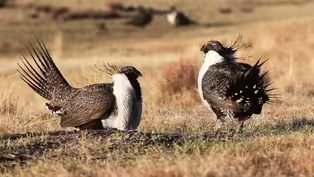
Clip: Special | 10m 41s | Ranchers and biologists act now to prevent endangered listings for sage grouse. (10m 41s)
Video has Closed Captions
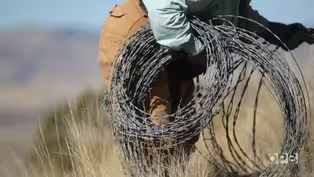
Clip: Special | 4m 51s | Volunteers remove miles of barbed wire fence around the Pine Creek Conservation Area. (4m 51s)

Video has Closed Captions
Clip: Special | 11m 44s | Oregon Prison Sagebrush Project (11m 44s)
Providing Support for PBS.org
Learn Moreabout PBS online sponsorship















Support for PBS provided by:
Oregon Field Guide is a local public television program presented by OPB