In the Arena
Brandon Johnson: Turning a Safety Challenge Into a Startup
Episode 4 | 26m 4sVideo has Closed Captions
ShotHawk co-founder Brandon Johnson shares the challenges of building a safety startup.
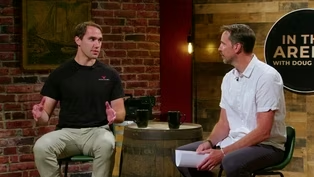
Doug Cruitt meets Brandon Johnson, a Bradley University engineering graduate and co-founder of ShotHawk. Johnson discusses developing technology intended to respond to armed threats, learning from early setbacks, finding the right advice, pursuing investment, and taking his startup to the SXSW Pitch stage.
Problems playing video? | Closed Captioning Feedback
Problems playing video? | Closed Captioning Feedback
In the Arena is a local public television program presented by WTVP
In the Arena
Brandon Johnson: Turning a Safety Challenge Into a Startup
Episode 4 | 26m 4sVideo has Closed Captions
Doug Cruitt meets Brandon Johnson, a Bradley University engineering graduate and co-founder of ShotHawk. Johnson discusses developing technology intended to respond to armed threats, learning from early setbacks, finding the right advice, pursuing investment, and taking his startup to the SXSW Pitch stage.
Problems playing video? | Closed Captioning Feedback
Where to Watch In the Arena
In the Arena is available to stream on pbs.org and the PBS app.
Providing Support for PBS.org
Learn Moreabout PBS online sponsorship(bright rhythmic music) (bright rhythmic music intensifies and fades out) (upbeat music) - Every generation inherits a set of problems.
Some are small, some are frustrating, and some are so complex, so painful, and so deeply woven into society that they begin to feel permanent.
But every now and then, someone looks at those problems differently.
Instead of accepting it, they become curious.
Instead of looking away, they lean in.
And instead of waiting for someone else to solve it, they ask a simple but dangerous question: "What if I tried?"
Theodore Roosevelt once wrote that, "The credit belongs to the person who is actually in the arena, the one whose face is marred by dust and sweat and blood, the one who strives valiantly, the one who comes up short again and again because there is no effort without error."
Our guest today embodies that spirit.
Not because he claims to have all the answers, but because he and his team are willing to step toward a difficult problem instead of away from it.
And that's a place many of us know well, because whether you're building a company, pursuing a dream, raising a family, or trying to leave the world a little bit better than we found it, there eventually comes a moment when we must decide: Will we stay in the stands or will we step into the arena?
I'm Doug Cruitt and this is "In the Arena."
(upbeat music continues) (upbeat music fades out) I'm excited to welcome our guest today, Brandon Johnson.
Brandon.
- Hey.
- Welcome to "In the Arena."
- Nice to be here.
- Yes, so we usually start by talking about the past.
Now, you're one of our younger entrepreneurs that has come onto the show.
That doesn't mean you haven't experienced ups and downs of entrepreneurism.
So first, tell us, who was Brandon before you started to maybe build or create businesses?
What were you doing as a kid?
- Well, before that, I think I was like most kids.
I was, you know, staying busy outside, playing sports, hanging out with friends, doing, you know, what just about everyone else does.
I, you know, had a pretty good childhood, but I was looking back on it.
I'm actually lucky enough to have some great life experiences that I was able to pull into starting my company and use as some extra motivation.
- Mm-hmm.
So beyond the sports, I've heard that you and your dad play tricks on each other in how you deliver (Brandon laughing) presents at times.
How long has that been going on?
- That's been an escalating thing ever since, well, so, you know, back when XBOX was a big thing.
Well, I think it's kind of on the comeback now, but we're talking like Xbox 360 kinda days.
- Okay.
- They got me a game for Christmas, and they wrapped it a littler harder than usual with some duct tape and it kind of escalated from there.
Now we're to the point of cementing in each others' gifts and putting 'em in locked safes.
So.
(Doug laughing) It's gone quite a ways.
- Well, whenever you have shared that short story with me earlier, it kinda just makes me think of that sort of upbringing that you seem to have had where it's the creativity, but also fun combined together.
- Lots of fun, I mean that, and then, you can't forget about Halloween with the haunted houses too.
Like, that- - Okay.
- That was a lotta fun, and you know, you come up with a lot of ideas in those that you'd be shocked come back later on and it's like, "I think I've been in a scenario like this before where I had to build something for the haunted house."
It's like, "I wonder if those same principles will work in, you know, trying to make an idea elsewhere."
- Mm-hmm.
So as a young kid, did you have any sort of revenue-generating business, whether it's the stereotypical, did you have the lemonade stand or?
- Mine wasn't quite in that way.
I think learning the business side of it has been a big aspect for me.
I was always very interested in business, but I didn't partake.
I was kind of on the sidelines, you know?
I was really interested in watching the stock market.
I was very interested in, you know, what companies were doing to, you know, have M&As happen.
That was a little weird for, you know, being a kid, but you know, it was kinda what I Googled in my free time.
- Yeah.
(Brandon and Doug laughing) - Just being completely honest.
And then, you know, I always found the tech piece quite interesting, 'cause my father was an engineer and then I had several really creative friends that, you know, they always put thought to action.
And that forced me to do the same as well.
- That's wonderful.
Now, so you went to Bradley University and you got a degree in?
- [Brandon] Mechanical engineering.
- Mechanical.
- So surprise, surprise.
(Doug and Brandon laughing) - So how has that, like the mindset of a mechanical engineer?
You also work with other entrepreneurs, both on the creative side and the engineering, the business side.
In your own words, how do you describe an engineer's brain versus more that creative brain?
And how do they compete but also collaborate?
- It's a blessing and a curse.
Because on the beneficial side of it, you understand what it's gonna be like when you bring a product to full-scale production.
But when you need to get more creative and dirty, you know, the engineer in you wants you to have this very fine comb and go through all the details.
When in reality, the creative people, they're like, "We just need to throw this together and get it to work."
So you know, learning to let go a little bit.
But you know, with our product, as we'll speak about later, keeping an eye on some compliance stuff and some scenarios is very important from the early detailed stuff.
When you have a bit of that engineering background, that can help with, you know, "Hey, do you wanna pay attention to those details?"
And sometimes you do in some areas.
Other times, it's like, "Let's just innovate fast."
- Yeah, yeah, and that's, I think that the saying, I don't know who to attribute it to accurately, but you know, "Don't let perfect get in the way of done or of launching."
- Well, look behind you, Doug.
It says, "Keep it simple," on the board back there.
- Ah yes.
(Brandon laughing) Brilliant.
And it's interesting to hear an engineer say keep it simple.
You know, design can be simple, but as you're saying and as we'll talk about in a little bit, your product needs to have safeguards in place and for good reason.
But we're not gonna get to that quite yet.
I wanna keep talking about going into this entrepreneurial mindset.
Because, you know, some of our guests are in their 40s or beyond and you're in your mid-20s?
- [Brandon] Yeah.
- Yeah?
- Yeah.
- Like getting there?
- Like 24, 25- - (laughing) Yeah.
- Area, so.
- So early on the journey as far as, you know, years in the arena, if you will, and so it's important, I think, to get your perspective, kind of a real-time analysis from within the arena as you're going through your journey.
So at what point did your business officially start?
And this will bleed right into kind of present day, but let's talk about kinda the why behind it first.
- Yeah.
So the why behind our business was we saw a problem.
We grew up when the problem was kind of evolving.
And as we'll speak about later, you know, it's dealing with active shooting, specifically school shootings, and just attacks in general.
But you know, we saw a problem, really felt the need for the problem after a world event, Uvalde, happened.
So we're talking September 2022 era.
And then, fast forward to February of the next year, and all of a sudden, you've got a company.
So really, it was a lot of, you know, brainstorming and trying to figure out what is the right way to attack this, even after we started the company.
There was some pivots that had to be made, and you know, what is truly something you can bring to market and the customers would be willing to pay for- - Right.
- As opposed to a neat engineering concept or a fun hypothetical.
- Right.
Now, let's talk more about, you know, the world in which you grew up in is different than the world in which I grew up in.
- Oh yeah.
(laughing) - Where the difference in age.
And your generation has, unfortunately, grown up where the concept and the events of school shootings is fairly regular, I think, is a fair thing to say.
And so is that something that was kind of always in the back of your head, in the back of your mind?
Or was it one of those things where it was just like, "That's just how it is.
Every couple weeks or every couple months, we're gonna see a news article about something."
- Well, so to be honest with you, and you may not know this, even though we've known each other for quite a bit, but there is a little bit of background here on this story.
So when I was in high school, I had an engineering teacher that challenged the whole class to solve the problem with school shootings.
And that was a very unique challenge, 'cause before that, it was like, "Hey, let's make these nameplates for teachers.
Hey, let's, you know, make some robotic stuff."
And then, evidently, the school had held, you know, like they had held like a teacher conference, and they were like, "Hey, we're taking any ideas that teachers have."
And so he just came straight to his class and deferred it to us.
Now, obviously, at that point in time, technology was further behind.
There wasn't like- - Right.
- As many things, so it was mostly just us coming up with locks.
And so fast forward to college, and it's like, I had, you know, begun to see, I had been exposed to what, you know, some of the technology like AI could do.
And then, you know, robotics, of course, was fast forwarding.
And you know, some of those concepts began to resonate with us as the idea and concept for our business began to build.
- Mm-hmm.
And then it sounds like that one tipping point, if you will, was September of 2022.
- Yes, and it sparked a conversation between my now co-founder and I that ultimately led to the idea that created our company.
- What was different about that event that really was the catalyst?
'Cause I'm sure there were other school shootings earlier in that year.
But what was it particularly about that one?
- You know, I think it had to do with the timing of where the technology was at at that time.
Because before, it was like, you know, you got very frustrated.
And you know, I'd had similar conversations with that same friend and now co-founder and even other friends before about that topic.
It's just that the conversation never really turned to tech.
But we were both really tech-based people and felt that there could be some kinda solution there.
And you know, up until the Uvalde point, we just didn't have enough background.
Maybe it was stuff we were learning in engineering school.
Maybe it was, you know, there was more visibility on it, just in society in general, and kind of some of your more college student circles.
(Brandon laughing) - Right.
- I'm not real sure what it was, but you know, for whatever reason, we were able to put two and two together.
And after Uvalde was kinda the first time where it was like, you know, the problem was significant enough to where we were already talking about it enough.
And then, well, you know, the potential solution was also getting to a point of technical maturity where we could begin having those discussions.
- Right, and so the name of your company is?
- ShotHawk.
- ShotHawk.
Good job repping the brand.
(Brandon laughing) - I always have the merch, Doug.
- Yes, that's what it's about.
(Brandon laughing) But it's a very serious solution to a very serious problem.
So let's talk about that ideation stage.
So whether knowingly or unknowingly, you and your friends, given your generation, you're absorbing the environment around you and you're seeing, you know, this recurring problem in society.
And you have a certain level of expertise and experience, and you're college kids at this point in time.
What kinda, what was that next step to, "We need to build a prototype or we need to make up a schematic or we need to come up with a business plan?"
- So to be completely honest, we had no idea how entrepreneurship worked.
We thought it was, "Oh, you make an idea and you go pitch it, and then you get money to build it."
We didn't realize that there was a scrappy in-between phase.
And you know, being people that didn't come from as entrepreneurial backgrounds, it was like, "Well, how does this really work, you know?"
When you're in a company and you pitch ideas, you kind of get budget that appears out of nowhere to build it sometimes.
(Doug and Brandon laughing) With this, it wasn't really that way.
You know, we took it to some pitch competitions, got laughed at.
Now, granted, the idea wasn't as evolved, but we were told by people that now support us, actually, that it couldn't be done, it was sci-fi.
And you know, we later created a demo device, as we'll speak about later that, you know, won a lot of people over.
- That's good.
I think now might be the time to share with the audience of what ShotHawk is.
- Yeah, yeah, so ShotHawk is a company that, quite simply put, makes devices that can respond to armed robbers and active shooters.
So basically, after it's been signaled that there's an emergency, it can autonomously engage an assailant with a non-lethal of an institution's choice.
So that could be pepper gel, could be acoustic amplifier, could be a light blinder, or maybe someday, projectiles.
- Mm-hmm, but it is targeting that one individual?
It's able to use AI, use the technology you guys have built to identify, here's a weapon that is being used in a bad way.
- Yes, and for full clarity, the device is mounted on a wall or ceiling, and it plugs in to an existing security system.
So it leverages a lot of the assets that places are already putting money into.
So like, you know, there's a lotta places in many states where there's this thing called Alyssa's Law where they have to have panic buttons.
A lotta places have it, whether it's physical or on your phone, you know?
Hey, hit the emergency button in the app, stuff like that, all that kinda stuff, and somebody, we'll hopefully be able to tell our device there's an emergency, plus external weapon detections.
But you know, we'll get into that a little later too.
(laughing) - Yeah, yeah.
So you have an idea.
You're building a product or a prototype.
You're pitching the idea to people within your local sphere.
And you're building a team as well, right?
- Yes, a team where this is, so there's a couple things.
Number one on the team side, this is where we had to learn a lot.
You know, how do you build a team that's gonna be in it for the long haul?
And I think, you know, at the time, when we were building our team, we're just like, "Quick, draft a kickball team," kinda style instead of like, you know, more like, "Is this gonna be a long-term fit team?"
And you know, that was a lesson we had to learn and iterate over time with.
And then, another major thing when you're talking about the evolution of our idea, we had to be very careful on, you know, whose feedback to take.
Early on, we took everyone's feedback.
- Yes.
- And you get conflicting ideas that begin to clash, and you know, it's hard.
Because when we initially started, we actually started with an autonomous drone concept.
Then we moved to, all right, let's have this thing on a rail track where it can move back and forth.
And the ultimate thing that we were missing there was, we did not have it to where it was a cost-effective solution for the customer.
And had we jumped into customer discovery earlier on- - Right.
- And gotten the right feedback, we could have made the adjustments earlier, where, oh, it's just a single mounted device.
And you know, in our minds, we were like, "Oh, well, you'll need a ton of those."
But what we didn't realize is, if you get that customer feedback over and over and over again, you know, you'll be able to design something lean enough where it can be cost-effective for the customer.
And then they can get a bunch of 'em, 'cause you get the, you know, economies of scale and everything.
- Right.
Yeah, and going back just a little bit in what you just said.
I think it's really important for our viewers to hear that again, is that, you know, you're gonna get, especially if you're a first-time founder and you're not really coached on, there's different degrees of advice.
There's great advice, there's horrible advice, and there's a lot in between.
And what do you listen to?
So as someone that's still early on as an entrepreneur, you've been in it for a couple years now, so you're not a newbie by any means.
- Yeah.
Four years of, you know, sitting on the sideline for like the first six months, then jumping in for the past 3 1/2.
- Yeah.
So how have you kind of come up with your own ways in which to filter out advice?
Like is it, "Oh, this person has a specific title and 50 years experience in this industry, so he or she must know what they're talking about?"
Or how do you kinda tune out the noise that you think will just detract you from your mission, as opposed to going straight towards something you know will be much better?
- We used to be very title-focused and that was a big mistake.
- Mm-hmm.
(Brandon laughing) - You know, part of the thing with titles is, is especially if they're not from your industry, it's not gonna be good advice.
And sometimes even if they are from your industry, you've gotta ask yourself, "Why did this product not exist in the industry?"
It's because people were stuck in their old ways.
- Right.
- You know?
Our industry literally just came up with the term of the segment of the industry we were gonna be in, at the time of this filming, three to four months ago.
- Right.
- (laughing) And we were obviously way ahead of that.
So it's like.
- Yeah.
- It's like, you know, you gotta keep an eye on the advice that's coming in from everyone.
You gotta properly vet it.
You gotta ask yourself, "Is what this person is saying, does it have validity?"
If it does, you can begin to evaluate it and be like, "Well, maybe we should be looking at this."
But honestly, at the end of the day, you gotta trust your gut and you gotta make judgment calls based on, you know, data and then a little bit of, "Do I think it's the right call?"
- Right.
Yeah, and then especially, everything becomes more complex when you build a team.
You know, now you have a shared vision and are we in alignment and is there clarity of what that is, and what are each person's expectations.
And then it becomes even more complex whenever you get married with investors.
Now, you have another set of, you know, accountability and responsibility and priorities from that.
Now, you guys, if you wanna share with the audience, you don't have to give amounts or anything, but you're in that phase of, you know, going after investment.
And how's that going?
- Well, you know, it's a bit of a challenge.
'Cause right now, at the time of this filming, everyone is still very focused on, you know, AI solutions where everything's more software-focused and the venture thesis fits.
So for people who don't know what venture thesises are, the venture firms that could be investing in you, they have ideas already about what the companies are that they wanna invest in.
And if your company doesn't fit that, just don't waste your time in talking to them.
(laughing) So we're kind of at the phase right now where, in talking with a lotta people in the venture network, it seems like certain thesises are getting built where it will benefit us in the long term.
Because people are becoming to the realization that, "All right, well, not everything can stay in software forever.
At some point, it's gotta come back to the real world through physical AI."
- Right.
- And that's exactly where we lie.
So it's like, we like where we're sitting right now because we're hopefully gonna have a fully developed product ready to go to market right at the time those thesises turn.
So that's putting us in a prime spot.
With that, in the meantime, what we're trying to do is, you know, you gotta be careful about how you navigate, you know, grants, angel funding, and then, of course, institutional investment.
And you know, trying to find what's the right balance for you as a founder can be difficult.
We've honestly gone for a mix of grants and angel, and then we bootstrapped it the rest of the way.
- Right, and that's, so real quick, how many VC, venture capitalists, have you talked to in the last, say, six months?
- Talked to in a one-on-one conversation or talked to in general?
(laughing) - Either/or.
- Probably in a one-on-one conversation, I'd say somewhere in the neighborhood of 20 to 50.
And keep in mind, that's like doing after hours.
- Yeah.
- Kind of like one-off conversations, you know?
Some you have multiple conversations with.
And really, at the end of the day, what you gotta realize is, you know, if you're not getting an immediate response back from 'em, it's probably not a fit.
- Right.
- And there's something that they're seeing in your company where it's like, "Hey, this company needs to get this amount further, and then all of a sudden, we're really interested."
'Cause keep in mind, no one wants to be the first one to jump in.
They all wanna jump in right when the company's about to take off.
Like, if this is your, you know, level of acceleration, they wanna hop on right here, right before it starts going up.
- Right.
- And they wanna ride the roller coaster up with you, and then of course, you know, enjoy it.
- Mm-hmm.
Now, one opportunity that you and your team recently had was to stand on a literal stage and pitch on what many believe to be one of the number one stages to pitch on on the planet Earth.
And that was down in Austin, Texas at what's known as South by Southwest Pitch.
Where 10-plus thousand people apply from all around the world.
It gets narrowed down to 800 or 900 usually and then down to 45-ish.
You were one of those 45 that got put on a final stage.
Can you tell us about that experience?
- Yes, and jokingly here, it puts a little more pressure on us, because the statistics when you look at South by Southwest, you're more likely to succeed after going to that- - Exactly.
(laughing) - As you are to fail.
I think it's like an 85% (laughing) success rate.
So it's like, I don't wanna be the 15% here.
(Doug and Brandon laughing) So it's like, yeah, at the same time, it was an awesome environment to be in.
- Mm-hmm.
- But when you look at what got us there, it was that very mission that drove us there.
You know, people are like, "Well, how do you even get into something like that?"
Well, it takes a little bit of luck, quite a bit of luck and a lot of hard work.
And you know, it wasn't the first stage we had been on.
We had been on several stages before that, including TechCrunch and Summerfest, which are both really great steps up to that.
But you know, at South by Southwest, we learned a tremendous amount about, you know, other founders' journeys and what it was gonna take, you know, for us to take it to that next level.
And I think, you know, being in that kind of environment, it really gives your startup just an energy of like, we're' doing this.
(laughing) - Yeah, yeah.
- We're doing this and, you know, we don't care what anyone else thinks.
We're gonna go head down and, you know, after that, we really realized the importance of, "All right, we need to get these first customer deployment dates down like right now."
Turned around immediately after that, made a call to someone that we assumed was gonna be our first customer.
Spoiler alert: Yes.
(Dough and Brandon laughing) And- - Nice.
- You know, we're gearing up for that.
- Great.
We just have a few short minutes left.
And I wanna talk about your vision for the future, but real quick, back here, as we pointed to earlier, something that strikes me is how you've come to describe what it is that you do with ShotHawk.
And you've compared it to sprinkler systems.
And I just think for the audience, that's just such a good, simple way to understand what it is you do.
- Yeah, except we're not blanket spraying people like sprinkler systems do.
- Right.
- So there's a little bit- - Yeah.
- Of a difference there.
But at the same time, yeah, you have this very controlled response to fire.
Like, when the fire alarms go off, you know what to do.
We're trying to make it the same way for an active threat scenario.
Where it's like, "Okay, we know the process and then this is what device is gonna mitigate it."
So very similarly to how a fire sprinkler mitigates a fire, our device will mitigate the active shooter.
- While we wait for human first responders to show up.
- Exactly.
Like, we're not even trying to, yes, we'd love to stop the person.
If we can slow them down, in many cases, that's all you need.
Like, if it gives someone, you know, five, 10 seconds to get around a corner, you just saved a life, maybe several.
And it's like, in these kind of situations, that's very empowering.
Because you know, it's a terrible thought about what coulda happened otherwise.
- Mm-hmm.
So where do you see ShotHawk in three to five years from now?
- Well, five years from now, we hope it's becoming a standard across many buildings in the United States.
Three years from now, you know, we hope we're scaling pretty well.
- Yes.
Well, I wanna thank you so much for coming on the show today, for being bold with you and your team, for seeing a very serious problem and then instead of just accepting it for what it is, like showing up in the arena, putting in the work, the effort.
'Cause you're four years into this journey, and you're still building and you're still in it.
So thank you for how you're showing up as an entrepreneur so that our viewers see that as well.
And we wish you the best of luck.
- Thank you.
And one last thing in your closing monologue there.
That thing about the team, really important.
- Mm-hmm.
- I think that is just, you know, one of the most important parts of building a company.
We've got a fantastic team.
- Yes, yes you do.
Brandon, thanks so much for joining us "In the Arena" today.
- Thank you, Doug, great being here.
- As I reflect on Brandon's story, I'm struck by something that seems to show up in nearly every founder's journey.
The people who build meaningful things rarely start with certainty.
They start with curiosity.
They start with concern.
Today we heard from someone who looked at a difficult problem and chose not to simply accept it.
Not because success was guaranteed, but because he believed it was worth trying.
I hope you'll have the courage to move toward the things that matter, and I hope when your moment comes, you'll chose action over apathy, courage over comfort, and possibility over fear.
Stay curious, stay courageous, and keep stepping into the arena.
I'm Doug Cruitt and we'll see you next time.
(light music) (light music fades out) (logo chiming)
Providing Support for PBS.org
Learn Moreabout PBS online sponsorship New Episode
- Science and Nature

Explore scientific discoveries on television's most acclaimed science documentary series.



 New Season

 New Season

Support for PBS provided by:
In the Arena is a local public television program presented by WTVP