
Busy Bees
Season 2 Episode 8 | 26m 47sVideo has Closed Captions
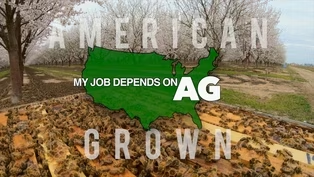
The importance of bees to our food supply are often overlooked and misunderstood.
The importance of bees to our food supply are often overlooked and misunderstood. The fascinating world of honey bees is explored from various experts.
Problems playing video? | Closed Captioning Feedback
Problems playing video? | Closed Captioning Feedback
American Grown: My Job Depends on Ag is a local public television program presented by Valley PBS
Busy Bees
Season 2 Episode 8 | 26m 47sVideo has Closed Captions
The importance of bees to our food supply are often overlooked and misunderstood. The fascinating world of honey bees is explored from various experts.
Problems playing video? | Closed Captioning Feedback
How to Watch American Grown: My Job Depends on Ag
American Grown: My Job Depends on Ag is available to stream on pbs.org and the free PBS App, available on iPhone, Apple TV, Android TV, Android smartphones, Amazon Fire TV, Amazon Fire Tablet, Roku, Samsung Smart TV, and Vizio.
Providing Support for PBS.org
Learn Moreabout PBS online sponsorship(peaceful music) - This is an established hive.
They have apparently been in this location for a long time.
The dairy manager, Kyle, told me that they found honey running down the walls, which is a sign that it's been there for a good long while.
- Well, the crops that bees are needed for in California start off with the almonds and then the blueberries about the same time, then the cherries follow after that.
- One thing I like to do is I like to tuck my pants into my socks just because honeybees are curious.
When you open up a hive or you're transporting them, they crawl all over you.
They get up on the suit.
They crawl on your arms and they are really curious about feet.
- With 1.3 million acres of almonds in production, we need about 2.4 million hives of bees that come from all over the country.
- There's two important things to produce almonds.
First, you need water and second, you need bees.
- This is the largest man-made pollination exodus in the world.
- [John] In commercial agriculture, over 90 crops strictly rely on bees for pollination.
- Our kids really were not very much involved.
They didn't really like getting stung.
- Ow, ow, ow.
- Oh.
- If it goes horribly wrong, try to edit it together so I look like I know what I'm doing, okay?
Well, you want to go find some bees?
(bees buzzing) - [Narrator] Production funding for "American Grown - My Job Depends On Ag" provided by James G. Parker Insurance Associates, insuring and protecting agribusiness for over 40 years.
By GAR Bennett, the growing experts in water, irrigation, nutrition, and crop care advice and products.
We help growers feed the world.
By Golden State Farm Credit, building relationships with rural America by providing ag financial services.
By Brandt Professional Agriculture, proudly supporting the heroes that work hard to feed a hungry world every day.
By Unwired Broadband, today's internet for rural central California, keeping Valley agriculture connected since 2003.
By Hodges Electric, proudly serving the Central Valley since 1979.
And by Valley Air Conditioning and Repair, family owned for over 50 years, proudly featuring Coleman products, dedicated to supporting agriculture and the families that grow our nation's food.
(upbeat music) - My name is Jake Wenger.
I am the Assistant Professor of Entomology in the Department of Plant Science at Fresno State University.
I think the general public understands that bees are important to the food supply.
I think we've had great messaging on that for the last couple of years, and with the trouble that honeybees have been having, a lot of people are aware of bees.
I think where there's a little bit of confusion is that some people feel that if we didn't have bees, we wouldn't have food.
And what it really comes down to, though, is that honeybees are more important for the diversity of food.
- My name is John Ballis, and we've been in the beekeeping business since the late '70s, early '80s.
We started with a few hives, and right now we're small in the beekeeping world.
We run about a hundred hives.
- And I'm Lynette Ballis, and we've been working as a team for most all of these years.
I stayed home while we were raising our kids, didn't go out with the bees, but now that we're able to, we work together as a team and go work our hives and do all of that stuff.
- Yeah, right now there's 1,260,000 acres of almonds in production and usually it takes about two and a half to three hives per acre, and so almond growers last year spent roughly $700 million for bee pollination.
- So, this time of year is usually when we prepare for the almond bloom.
The almond bloom last several weeks out of the year.
It comes pretty fast, lasts a little while, and leaves.
The earlier varieties mature any day now.
We're getting our bees prepared and in place so that we're prepared for the almond bloom.
Without bees, you don't have almonds.
They're the livelihood of most agricultural crops.
Without them, we don't have pollination.
- So we as beekeepers are always work through the year so we have strong bees come February.
(bees buzzing) - So we just have a wild beehive show up and they built an established colony inside one of the walls that separates our commodity bay.
It's gotten big enough now that it can be hazardous to my employees.
So I thought it would be time to remove them.
(country music) - So yesterday I received an email from Kyle Thompson, our Dairy Director and Faculty of Dairy Science, and he had a situation where in one of their commodity barns, where they store cattle feed, they had a bee hive in the walls.
- [Kyle] Tell me now what you were just saying.
You're worried about if the hive's a little big.
Why is that?
- Oh, I only brought one hive box with me.
So if we have more than about 10 frames of brood in there, then I'm going to either have to get another box cleaned out and get it all ready to go or start having to make hard decisions about what I want to save and what I don't.
All right, let's see what I got.
(door shuts) Pretty cut and dried.
And you can see over here, up on that wall, there's some remnants of old comb, right?
So that's going to be very attractive to bees.
Honeybees, they prefer to nest in places with the old brood comb.
They can smell it, the brood comb being the comb that they've raised their young in.
And so if they were to just leave these up, and they've got holes in the wall like you can see here, they're probably just going to keep getting bees over and over and over again.
The honeybees, when they establish their hives, one of the things they cue in on right away is smell of old brood comb, and so if we tear this one out, you're likely going to get bees in this wall again.
- Yeah.
- So I don't know if you could...
I know money's tight at the moment, but yeah, if someone- - [Kyle] I could seal the holes.
- Yeah, just seal up the holes.
That's all we really need just to discourage them.
All right.
- So I've got a ladder.
- You're tucked in.
You got a ladder.
- I've got crowbars.
- I got crowbars.
This is gonna be fun, this is gonna be so much fun!
(bees buzzing) (gentle music) - [Woman] Like that last one.
- Okay.
- Yeah, he just likes that last one.
What was the last one?
- So that's the one Toki Summer Wildflower.
That's from Reedley area.
- All through the year to keep hives healthy, starting in July, August, we start treating for the Varroa mites, which really, if you don't treat for that, it really decimates the hives.
So we're feeding patties, which is a pollen substitute, syrup, and medicating to knock down the Varroa before we go into winter, when the hives are semi dormant.
- Yeah, a traditional almond orchard will have multiple varieties in it, somewhere between two and four varieties.
And the predominant variety is nonpareil.
And so that would be planted in one row, and then the row next to it would be a different variety, which we call pollinators.
And so in order for the nonpareil to be pollinated, the bees will have to carry the pollen from one variety to the next variety, and by doing that, then the whole orchard becomes pollinated.
- So essentially bees only have two food sources.
They have nectar, which is their carbohydrate, their sugar.
And they have pollen, which is their protein.
And a functioning hive needs both of those.
Now so when a bee is pollinating a flower, chances are they're searching either for nectar or for pollen.
They're not usually looking for both at the same time.
So when a bee comes up to a flower, it's either already looking for pollen or nectar.
It lands on that flower, and then if it's looking for nectar, right?
What it'll do is it'll scrabble down to the bottom of the flower, and it will look for the nectar in these natural repositories of sugar solution that the flowers make to encourage the bees to come.
And they'll feed on that.
Now plants have evolved so that the stamen, right, that carry the pollen and the pistils that receive the pollen to reproduce are set up so the bees really can't avoid them unless they go all the way down into that nectar.
So they have to touch that stamen and get some pollen on them in order to get that nectar.
- The bees use these roads here, just like we use a road, and I like putting bees on this end of the orchard when the trees are running this way because the bees will go down the rows of trees just like we would walk down them.
So in that way, they get good pollination.
Another good place to put the bees is in the center of an orchard 'cause they'll fly up and over the trees and then they can drop down in to pollinate all the flowers that way, so they use specific routes, and when you set down a hive, you can't move them even a couple of feet because they'll go back to that exact spot.
So that's why we move them at night, so they're all back in and we have to move them at least a mile or two so they don't come back to this exact spot.
- So I've been involved in the almond industry for over 20 years, and almonds, the flexibility of the almond over the last 10 or 15 years, and consumption has grown not only in the United States, but worldwide.
80% of the almonds grown in the United States, primarily 90% are grown in California that we ship overseas.
And almonds is a very flexible nut.
It's good in ingredients as far as almond flour, and it's in the baking industry.
Snack food is a segment that's really increasing.
It's got a high protein.
It's got over nine grams of protein per ounce.
It has a shelf life of over two years.
And so, you know, we're seeing almonds growth in third world countries, South America, Asia, Vietnam.
The main importers have been India, the middle East.
We sell a lot into Western Europe.
And then China, up until recently with the tariff situation, was a large importer of almonds.
(music ends) (bass guitar music) - They initially evolved as cavity bees inside of trees.
And so they (smoke hissing) evolved a response to forest fires that, you know, if there's a forest fire that comes through, it might burn down your tree where your cavity is.
And so when bees smell smoke, their natural response (smoke hissing) is to basically get ready to flee, in case they have to reestablish the hive somewhere else.
So one of the first things they do is they gorge on honey (smoke hissing) and build up their fat reserves and the like.
And when they're doing that, it chills them out really nicely.
All right, let's get that ladder set up.
You may have seen a clump of bees sitting out on a tree branch, right?
Or a fence post or on the side of a house.
And that's a bee swarm.
When bees come out of the winter, they are at their very lowest population size.
And when the spring, when the first blooms come out, what the bees do is they start pollinating like crazy.
They go out there, they gather nectar, they gather pollen.
They bring it back to the hive and they put all of that food into making baby bees, right?
Building that brood up.
And the hive grows and grows and grows until it peaks in the early summer, late spring.
Now what can happen is in some hives, that population can get so big that there are too many bees for the queen to manage.
The queen kind of manages the bees through the use of pheromones and behaviors.
And if the hive gets so large that her pheromones cannot be effectively distributed, she'll get feedback that the hive is very large.
And what she will do is she will deposit an egg into a queen cell, which will develop into a new queen.
Right before that queen cell emerges or hatches and produces the new adult queen, the old queen will take about 40, 60% of the workers in the hive, which could be 20, 40,000 bees.
And she'll take all those bees and she will flood out of that hive, take all those workers with her to go and establish a new hive somewhere else.
They'll fly around.
They usually stay relatively close, maybe 500 yards from the original hive and they'll land on a tree limb, you know, a fence post, something like that, hang out there while the workers search around for a hive site, and once they find a hive site, they will come back to the swarm.
They'll do a little waggle dance to show where the site is, and that whole swarm will basically pick up and fly off to the new site.
The new queen takes over the old hive site.
The old queen creates a new hive somewhere else.
- They're entirely on the other side of the next stud.
- Oh okay, yep.
(wood creaking) - Holy (beep).
(smoke hissing) - For the almond pollination, this Sylvan Oaks, they hired me to pollinate their crop.
And so we're bringing our premium or strong hives so that we pollinate the blooming flowers for the almond crop.
So basically these are all the future generation, the capped bees right here.
So they're going to hatch soon because the capping's dark.
The baby bee larva is still in the cell.
If you look inside, it's like a white color.
(country music) - All of this honey that we have here is all grown between Fraser and Shaver.
There are no chemicals, no pesticides of any kind.
It's 100% pure raw honey unprocessed.
I've been here in this one location here for six and a half years.
I get people from San Diego, from all over Los Angeles, from Reno, from San Francisco, from Oakland, and Bakersfield, all around, come by here.
They know exactly where I'm at 'cause I never change locations.
I'm here seven days a week.
Any honey that you choose here is gonna to be good for energy or allergies because it's 100% pure.
- Honey is a sugar solution.
It's also bee vomit.
That's what it is.
My four-year-old is fond of saying that it is his favorite insect vomit, which my wife does not care for.
But essentially what honey is, is it's super concentrated nectar.
Nectar is a sugar solution that is a reward the bees receive from the plant for pollinating.
The bees take that nectar back to the hive and then they regurgitate it into the cells.
They suck it up and they regurgitate it multiple times.
That aerates it, that helps it evaporate, but it also adds some important enzymes.
And what those enzymes do is they take complex plant sugars and they break them down into sucrose and glucose, very simple sugars.
And they also add some hydrogen peroxide and some antibacterial compounds.
You may have heard of medicinal honey, right?
Medicinal honey, which you can apply to cuts, and it's essentially an antibiotic and a major component of that is that honey has low amounts of hydrogen peroxide in it, which is antibacterial, antifungal.
- Now we have different varieties of honey.
We have the mountain wildflower.
We have the pomegranate.
We have the alfalfas.
We have sage.
We have avocado.
- [Man] Avocado honey?
- Yeah, avocado honey.
- [Man] What's that all about?
- It's honey, it all comes from the flowers.
It's not a real sweet honey.
It's kind of mild, but a lot of people just love it.
- [Man] Now, Joe, do you eat the honey?
- Yes, sir, I came to Richard about four years ago.
I used to suffer with terrible, terrible migraines.
I went to the doctor.
He gave me all kinds of medicine for the migraines.
Nothing made it go away.
Somebody in the church told me about honey, raw honey.
And I saw Richard when he was over there on Scheels.
And I started buying the honey from him.
He told me how to take it.
The headaches are gone.
Within like six months, they were completely gone.
I haven't had a migraine headache since.
- Now your sage and your buckwheat are the two highest in healing properties.
They good for tea, for coffee, for energy, for allergies, for cooking, for baking, for female problems, for ulcers, for colon problems.
They're all around.
And your dark honeys are very, very good for iron.
- Well, one of the first stages of making wine, obviously, is when the vineyards start leafing out and they actually flower.
Very few people know that there are grape flowers, and it's a heavenly scent, and grapes don't need bees to pollinate.
They're self-pollinating, but the bees don't know that.
So while we're out there during the flowering stage, the bees are profuse, and you would think since we have six different varieties, that they're a cross pollination of Cabernet Sauvignon with Cabernet Franc, with Malbec, with Merlot, with Petite Verdot, with... would change the flavor of the wine every year.
But if you think about it, what are the bees doing?
They're pollinating the flowers.
It does not change the offspring, but it does change the seed within all of those grapes.
Those grapes say the same.
They don't change.
But the seeds, now if you were to take the seeds out of those grapes and plant them, you'd get an entirely different vine than anything in the vineyard because it would be cross pollinated.
The seed, the embryo itself is what they cross-pollinate.
- So what we're seeing, right, is up there along the top of this beam, they've built their combs.
You can tell that this hive's been here for awhile.
See all this folded up stuff at the bottom?
Those are old collapsed combs that they don't use anymore.
Those, probably in the summer heat, they lost their adhesion to the top beam and fell down or maybe there used to be a hive here that was abandoned, died out, and those ones aged and fell down.
But either way, it's a decent sized comb.
What we're seeing out on this outside edge, that's all honeycomb.
That's where the leakage was coming from.
You can see all those nice white-capped cells.
That's all mature honey that's ready to be consumed.
There were a couple of problems with the hive.
One thing was we opened it up and there was no evidence of brood, that is immature bees.
The queen will lay her eggs inside of cells inside the hive, and they will develop and they will be kept.
And when you just look at a hive, if you know what a comb looks like, you can easily tell when there is an active queen that is laying healthy brood.
And we did not see any evidence of that.
Probably had a swarm come in earlier this season.
They smelled all that old cone that was down at the bottom.
They established a hive.
They did okay for a little while, got a couple of generations, and then something happened that killed the queen.
Who knows what?
But once the queen dies, if there's already some brood in there and some eggs, you've got about three, four weeks before they're going to emerge as workers and then those workers are going to live for another 50, 60 days.
And so the fact that we opened that up, there's virtually no brood except for the drones, which are the longest living, the longest developing brood.
But there's a lot of workers in here.
My guess is it's just all the workers that are leftover from that initial hive.
And they're just living off of the stored resources.
That's sort of the unfortunate thing.
When you don't have the queen, they're not going to follow her.
And so there's not a whole lot you can do about it at that point.
They're just going to...
It's basically a done-for hive.
- The reason the bees are along roads is because that's where the growers want them.
And everybody knows you're just slaughtering bees when you drive through there, and you have all the honey and nectar on your windshield.
And so if they could move them in a couple rows where they're in the trees, that'd be great, but the beekeepers set them where the growers want them, and if they're outside the orchard a little bit, they get more sun, so the theory for that is they fly sooner.
- People have also been interested in honeybees just because they're an interesting social model, right?
If you look at bees, they all operate together in such a cohesive fashion, and it almost can, it feels like a mirror of human society.
There are essentially three castes of honeybees.
There is the queen bee and there's only ever one queen bee.
And the queen bee is the reproductive.
She lays all the eggs.
She also, you know, basically keeps the workers as a cohesive whole through pheromones.
There are workers which are also females.
Workers are unmated females.
And they do all the work in the hive.
And workers have lots of different jobs that they transition through as they age.
Right after they're born, workers typically become nurse bees.
They live in the brood comb and they take care of their young sisters who are just being laid and are developing.
But ultimately what all worker bees will become are foragers that go out and search for resources.
And beyond that, then there are the drones, and drones are male bees and male bees don't do anything.
(Jake laughs) Male bees mate with the queens and that's it.
Otherwise, they hang out in the brood comb and they kind of eat the pollen, and they're... - [Man] They're just kind of laying on the couch, watching TV.
- They are, and it's a cozy life right up until autumn when the hive is preparing for winter and they basically, they don't want to support these lazy drones all winter when they can't get more resources, and so they kind of push them all out.
It's a bad time to be a drone, unfortunately.
- [Man] Say that again.
- Richard is almost 90 years old, 88, right?
- No, in November, I'll be 90.
- [Man] You'll be 90 this year.
- Yeah, November.
- 90 years old.
Well, that's a pretty good testimony, right there.
- He sets this up every day.
He takes, it, puts it up every day.
Every morning he comes, sets it up, and evenings, he picks it up, and then he bottles it in the evenings.
So he's quite a man.
Honey's working.
(man laughs) - [Cameraman] That's awesome, guys.
(upbeat music) - [Narrator] Production funding for "American Grown - My Job Depends on Ag" provided by James G. Parker Insurance Associates, insuring and protecting agribusiness for over 40 years.
By GAR Bennett, the growing experts in water, irrigation, nutrition, and crop care advice and products.
We help growers feed the world.
By Golden State Farm Credit, building relationships with rural America by providing ag financial services.
By Brandt Professional Agriculture, proudly supporting the heroes that work hard to feed a hungry world every day.
By Unwired Broadband, today's internet for rural central California, keeping Valley agriculture connected since 2003.
By Hodges Electric, proudly serving the Central Valley since 1979.
And by Valley Air Conditioning and Repair, family owned for over 50 years, proudly featuring Coleman products, dedicated to supporting agriculture and the families that grow our nation's food.
(engine revs) (upbeat music)
Preview: S2 Ep8 | 1m 45s | The importance of bees to our food supply are often overlooked and misunderstood. (1m 45s)
Providing Support for PBS.org
Learn Moreabout PBS online sponsorship
- Science and Nature

Explore scientific discoveries on television's most acclaimed science documentary series.

- Science and Nature

Capturing the splendor of the natural world, from the African plains to the Antarctic ice.











Support for PBS provided by:
American Grown: My Job Depends on Ag is a local public television program presented by Valley PBS