
California’s Food Waste Crisis
Season 8 Episode 2 | 23m 8sVideo has Closed Captions
The struggle to reduce food waste and help the environment.
Even as people go hungry, millions of tons of often perfectly edible food is thrown away annually. We explore how people are fighting back by rescuing food before it gets trashed, turning food scraps into valuable composting and more effective shopping and home kitchen organization.
Problems playing video? | Closed Captioning Feedback
Problems playing video? | Closed Captioning Feedback
Earth Focus is a local public television program presented by PBS SoCal
California’s Food Waste Crisis
Season 8 Episode 2 | 23m 8sVideo has Closed Captions
Even as people go hungry, millions of tons of often perfectly edible food is thrown away annually. We explore how people are fighting back by rescuing food before it gets trashed, turning food scraps into valuable composting and more effective shopping and home kitchen organization.
Problems playing video? | Closed Captioning Feedback
Where to Watch Earth Focus
Earth Focus is available to stream on pbs.org and the PBS app.
Providing Support for PBS.org
Learn Moreabout PBS online sponsorshipNarrator: Every year, Americans spend about $2.5 trillion on food.
And just a small portion of that massive food economy can be seen here in LA's busy produce district in the early morning hours.
The bounty that arrives here daily from distant farm fields will end up in supermarkets, restaurants, and home kitchens where it will be prepared and eaten.
But entire mountains of food will also go to waste, thrown into garbage cans and dumpsters, while it's still perfectly edible.
That food will eventually rot in landfills, creating powerful greenhouse gasses that help fuel climate change.
Man: This program was made possible in part by a grant from Anne Ray Foundation, a Margaret A. Cargill Philanthropy.
[Machine humming] Narrator: Increasingly, cities and counties are trying to find other uses for all these organic refuse, like capturing it so it can be turned into cleaner burning biofuels to power vehicles.
But that's only part of the solution.
Activists see opportunities both in organic waste and getting food to hungry people.
Nancy: Today, we're at our Friday distribution here at Tellefson Park in Culver City.
And we are bringing food from grocery stores that our drivers have collected this morning and distributing it here in the park.
The beauty of it is we are doing two things with this one type of work we do.
We're both feeding people and we're doing something that's really important for climate change.
Tammy: Martin... [Laughs] Pull the lever.
Martin: Volunteer!
Tammy: ...pull the lever.
Martin: Any volunteers over here?
Help me unload, please.
Tammy: Grab a cart.
These guys have been out doing pickups at the stores this morning.
So they start about five o'clock.
Um, they go do their routes, and then, they all come back here.
And we have about 30 to 45 minutes to get everything out and processed on the tables, and opening the line up.
'Cause once we start to go, that's it.
We won't stop until the line is finished.
Nancy: FoodCycle's mission is to feed people, not landfills.
And basically, what we're doing is create an infrastructure to ensure that all the food that is edible goes to feed people instead of getting thrown into the landfills.
Tammy: Unload them quick and you've gotta go right back in.
Man: What would have happened to this food ten years ago, 20 years ago?
Tammy: It would have gone into the landfill.
Everything would've gone into the landfill.
Nancy: Yeah, that's something [Indistinct] [Tractor beeping] Nancy: One of the reasons that FoodCycle exists is that here in the US, it's estimated that between 30% and 40% of our edible food is getting thrown away, so this is millions and millions of pounds of food.
And we started doing this work more than 20 years ago at a time when we would go to grocery stores, and even though we would show up every day, they would still throw food in the dumpster.
Zoe: Reducing waste is the most important thing that we can do to reduce our greenhouse gas footprint.
Organic waste is anything that when it ends up in a landfill, it produces methane.
So it can be your food scraps, it can be your yard waste.
It can also be cardboard or textiles.
But food and yard waste are what break down the quickest and generate the most methane in landfills.
So by keeping them out of landfills, by first recovering them for human consumption, if possible, and then recycling what can't be rescued, that-- we're keeping that material out of landfill and so reducing the greenhouse gas impacts of that material as it's rotting in the landfill.
[Indistinct chatter] Martin: Today, we're gonna go to a few markets and, uh, pick up some donations of food.
We'll hit three stores, four stores at the most.
And then, we'll come back and unload and distribute the food.
It's hard for people to pay their bills and do this when, uh, they could have some food and make sure that no kids or anybody's starving or hungry, and they get fed.
Nancy: The laws here in California that have been requiring businesses to donate food, to not throw away food, that's the reason why we're able to, uh, collect more than 11 million pounds of food now.
This went from one dumpster to us, you know, doing 11 million pounds of food a year because of the support of legislation.
Zoe: Senate Bill 1383 requires that 75% of organics are diverted from landfills.
Those organics are everything from food and yard waste, to cardboard, to textiles, so anything that when it's in the landfill produces methane.
It also requires that 20% of edible food is rescued to feed people instead of landfills.
And that's critically important because one in five Californians are still facing food insecurity.
Nancy: What we found with SB 1383 in particular, which requires businesses to donate food and requires cities to help enforce that, as it became clear that they didn't have any choice, we saw a huge shift.
We saw that businesses that had been throwing things away in the past now started to donate.
And a lot of businesses, it inspired them to make it a priority for themselves and their staff to get this food to people.
Tammy: Remember, everything that we have on the tables is all that we have, so be very considerate of that.
And, uh, try to move through quickly so that we can get the main line open.
Man: Why do supermarkets even give this stuff to you?
It looks perfectly good.
Tammy: It is perfectly good, yeah.
All of this stuff, it has to be edible food.
They can't just give us their garbage.
So there's nothing wrong with this food.
Some of the food may be close to expiration or it could be overages that the stores have.
A lot of the stores don't have the additional storage space inside of the markets, and it doesn't make financial sense for them to take it back to their warehouse and redistribute it.
So that's the type of stuff that they donate to us.
And we work really hard with the grocery stores so that they understand what types of donations they can give to us and what types of donations they should be composting.
Zoe: If we were to have done anything different, what I think that would have been is getting that education campaign front and center along with building the program, because one of the biggest obstacles we've seen is this need for behavior change.
Nahed: So kind for you to help the planet.
I learned that we're wasting a lot of food, and we shouldn't, 'cause there's so many people that need it.
I think about it at my house, how I can save food and not, uh, just, uh, throw food away.
Sheena: At home, I tend to cook more, honestly, instead of wasting food.
You know, I don't just let it sit there.
When I go grocery shopping, I'm more, "Am I--am I really gonna use this or is that-- do I want it just because it's on sale?"
So, yeah, definitely just being more mindful of what I'm bringing in the house, mindful more of what I'm putting in my body, too.
Nancy: I think people need to know more about success stories around the environment to also understand that it's possible to move the needle, uh, instead of feeling like, you know, "It's so big, let's walk away."
It's not too hard.
[Chuckles] It just needs to be one step at a time.
And the past 20 years have shown me that.
Narrator: We've met the people who rescue perfectly edible food and make sure it gets to those who need it the most.
But what do we do with all the food scraps and other organic waste produced in our home kitchens that few would ever want to eat?
Enter the people who see compost gold in your kitchen waste bin.
Ryan: We have a food waste problem in LA County.
We send over a million tons of food scraps to landfill each and every year, and something's gotta change because when food rots in landfills, it creates a climate pollutant called methane.
Methane gas is warming the air way too quickly.
And so, we'd like to do is take a hard pivot.
Instead of sending that food to landfill, compost it instead.
Woman: You gotta make it [Indistinct] like a fancy compost spa.
Ryan: Compost is the process of recycling organic material into a fertilizer.
Composting is a beautiful process.
It's basically just decomposition.
We set those food scraps aside, and compost is that process of layering food scraps and yard trimmings, and watching that decompose, stewarding that space, and making sure we're creating a rich soil amendment that can then be applied locally.
LA Compost recycles food scraps into healthy soils, and we do that to better the environment, to better our neighborhoods, and to bolster the local food system.
This is one of our community compost hubs where folks are coming together to take climate action and process food scraps into healthy soils.
Elena: So this is, like, the very last and final stage of the compost process that will turn this, like, more heavy and sort of chunky stage into a much finer ground stage that can be applied to plants and trees and gardens.
We have some decomposers here, too, which is a great sign of a healthy compost, eating and, you know, doing their thing in producing the final material.
Alejandra: During the time of COVID, a friend posted that they had seedlings available here at the garden.
I came by, and I live, like, three streets down from here, and I was amazed at what was on what-- in my backyard.
So I stepped in here, I told my dad about the space, and we learned about composting, and I was amazed that we could do this ourselves.
And together, we've been collecting our scraps, and then, we also opened up a space in our home to plant some of the crops here.
And it's been beautiful to have that symbiotic relationship between our home, and then also our local community hub here.
[Francisco speaking Spanish] Erica: So this is compost that we already sifted.
So this is what the final stage of the compost and that's gonna be given to a community member.
Um, and it's--it looks so good, it's so rich and dark and moist.
And you can tell compost is good when it holds its, like, shape like this.
And it just adds so much more life to your soil.
[Indistinct chatter] Ryan: The most typical participant with LA Compost sets aside their food scraps when they're preparing a meal, and then they bring it to us at farmers' markets.
We're at 25 farmers' markets across LA County.
Ashley: One of my favorite things specifically about our farmers' market is we also have LA Compost here.
And so, by providing the opportunity for people to bring their food scraps, their, um, older fruit and veggies, they can just drop it off here, and then we turn that into compost so they can go ahead and use for plants, and that also helps decrease the footprint.
Let's say you have to buy, like, a big box of, like, 30 strawberries, and you know you're not gonna eat 30 strawberries, and so you only eat ten.
And then the rest of those go bad, and then you're actually contributing to the decline in the ecosystem because you have to throw away the plastic that those strawberries came in, you have to throw away those strawberries.
And, like, yeah, I've been that person, too, until I started working at the farmers' market.
Then, my entire world changed where I'm like, "Oh, I'm more mindful about what I'm consuming and how it actually contributes to the environment."
Pamela: When they set up the booth and told me what it's--what it's for, compost, you bring your scraps here, I'm like, "Yes."
You know what?
The--it would sadden me when I see all these food going to waste.
So I started gathering up the food that-- from the school and also from my home, and I bring it here.
And, oh, my gosh, now nothing ever goes to waste.
Ryan: All of those food scraps collected there travel a very short distance to this location where we're able to compost and decompose all that good waste together in community.
Andres: At this point, we are just turning a compost pile, so making sure it gets aerated and also gets rehydrated all over again.
So--'cause we don't want the pile to just dehydrate and then just left alone, so we do at least once a week a flip, uh, which includes, uh, adding the water and also airing it.
So as it gets flipped, also oxygen gets trapped in each of the layers so it's easier for the microbes to breathe in and out.
So you don't get a dead compost pile and instead you get a live active compost pile like we have right now.
Ryan: Composting has been around for many years, dating way before the Stone Age.
People have been building piles and watching things decompose and managing that to be able to grow more food.
What's different today is we've grown very disconnected from this process.
Our neighbors are disconnected from each other and we are very disconnected from the soil.
And so, what LA Compost seeks to do is to bring people back together and build those bonds once again.
Woman: I've learned that from right here.
Ana: I think what brings us together is just kind of like that wanting to give back and wanting for-- longing for connection.
I think this city is so big and, um, a lot of the times, we're moving really quickly all over the place.
And this space just really allows you to stop.
You're admiring this beautiful process where you're seeing transformation of life and death and renewal and growth.
So that was always really inspirational to me, too.
I'm so grateful for LA Compost because it's really changed the trajectory of my life.
Ryan: It's very, very important that no one feels left out of this climate-positive activity.
There were a lot of decades there where folks thought that environmentalism was for the polar bears and not really worried about our neighborhoods.
The wonderful thing about community composting and the movement that's been built around this work is that we're able to do something differently by involving people up close and personal in their neighborhoods and keeping resources here, we're able to see ourselves as part of that change.
Being connected to the process of soil and the cycle of life is not a privilege, it's a right.
We all can see how much beauty is available to us when we get this right.
Narrator: Composting food scraps is an important solution to food waste.
But so is how we shop for food, as well as what we do with it when we bring it home from the grocery store or farmers' market.
One woman has dedicated her life to tackling those issues.
Florencia: It's about 500,000.
Where I begin with my kitchen activism is the meal plan.
This is the foundation.
This is where it all begins.
So what I'm thinking about always with meal planning is how do I reduce my food waste, one, and the second thing is how do I shop my kitchen first.
That's the very first thing I'm thinking.
What do I have in my kitchen that I need to utilize?
I have some snap peas and broccoli in there.
There's absolutely a disconnect with our food.
At all different levels, there's a disconnect of the food that we choose and the impact it makes in all things, whether it's the economy, whether it's our health, the health of the planet.
There's just a--there's just this disconnect.
And then, the other piece, too, is that we are facing this global climate crisis, water scarcity issues.
I mean, these are big things.
And I feel like-- at least for myself, I felt like I needed to tackle it in really big ways.
The other piece that makes this really easy, 'cause I don't want you to think, "Oh, my God, how am I gonna think about all of these days for dinner ideas?"
is I kind of think about them in themes.
So Mondays are--mostly, I'll have it stir-fry Mondays.
It's an easy way to use up all of my produce.
And then, if I know that I need something-- 'cause I shop my kitchen first, if I need something, I go-- I'll write it down here on this chalkboard.
Man: We got Pink Ladies, we got Fuji apples, anybody wanna give it a shot?
We got good fruit, good fruit.
We got good fruit right now, come on through.
Florencia: This is the Oxnard farmers' market.
We're right at the harbor.
And this is my favorite spot.
This is where I grew up, in Oxnard.
I have a list of the things that I want at the farmers' market based on what I'm planning to cook this week.
If I'm just picking up things without any plan, whether it's at the farmers' market or at the grocery store, then oftentimes it'll go to waste.
In fact, the home kitchen, we're wasting about 43% of our food.
That's huge.
But that also gives me hope because that means with just some simple fixes, we can reduce that food waste tremendously.
I need to get a pound of walnuts today.
Woman: Absolutely.
Man: There you go.
Woman: Absolutely.
Florencia: This is where we can align ourselves with the folks who are doing what we want in the world, like what is the vision that we have for our planet.
And these are the guys who are doing the work every day.
They are at the forefront of climate action, water sustainability.
These are pesticide-free?
Woman: There are--everything that we grow is pesticide-free.
Florencia: Even though I don't see, like, an organic symbol.
Woman: Yeah.
We're not certified organic.
Florencia: But you are-- Woman: But we grow--uh-huh.
Florencia: You grow using no pesticides?
Woman: No pesticides or herbicides, yup.
Florencia: About 98% to 99% of all farmland in the world is conventional.
They are using pesticides, they are using conventional farming methods.
So, the farmers' market is a way where we align ourselves with these small scale farmers who are building soil health, who are growing more nutritious foods, then we are partnering with the solution and we're growing them.
That's what we need to grow, small scale farms in our communities.
Let me get--let me get this, um... Man: Oh, okay.
You wanna get another one or... Florencia: Yes.
We just pick up the food, right?
And we just pick up the onion and we just think, "Oh, I just need an onion."
But where did this onion come from?
What was the water that was utilized?
Did it pollute water systems or did it help to regenerate land?
Like, all of those pieces are connected to anything that we buy.
Once I understood the power that my food holds to change the shape of our planet, oh, my gosh, it comes alive after that.
And everything changes.
Wherever you shop, whether it's at the farmers' market or at the grocery store, we need a plan.
We need to have a meal plan so that there's a structure in place so that we begin to reduce our food waste.
These are the things that I brought back from the farmers' market.
So now it's about storing it in a way that I know I'm gonna utilize it during the week, and it'll make it easy for me.
So, for the lettuce, I wash it and I cut it, and I have it ready for salad.
The same with cabbage, I have it already shredded and ready to go, so then that I can easily grab some and put it onto the garnish for my taco with some lime or lemon, or placing it also as an ingredient in my salad, 'cause a-- that's another great theme is salad bar.
The goal is zero waste.
But again, this is not perfection and this isn't a place to beat ourselves up because we don't do that.
It's just getting closer to that.
That's the goal, is zero waste.
And wherever we are in moving closer to that is fantastic.
[Laughs] Our refrigerators were designed to reduce waste.
But it's actually the biggest food waster in our home kitchens.
So this is a huge place that we can all work together to reduce our food waste with really simple things.
One is not to stuff it full with things.
If you noticed, I have a lot of space in here and it's because I'm meal planning.
So I'm buying what I need so that by the end of the week, I'm ready to go out and purchase for the following week and not have a lot leftover.
I have everything labeled with the date.
Man: I have a question.
Florencia: Yes.
Man: How do you feel with sell-by and use-by date?
Florencia: Oh, sell-by and use-by dates.
I ignore them.
That is the biggest reason we throw away food is because we're basing it off that little date.
If I throw a food away, I'm throwing away money, I'm throwing away water, I'm throwing away other natural resources that went into making that food.
[Water trickling] Florencia: So much of the solution lives in our kitchen.
It really can be turned into a vehicle of environmental change.
We feed ourselves every single day.
We choose how to store food every single day.
We shop all the-- you know, every week.
Those things just add up.
And if we're--if we're thinking about connecting the big picture global issues down to our small basic decision-making, then we close the gap between the vision that we have for the world if we're--we want to partner with the solution, environmental solutions, and what we have right at our fingertips.
Narrator: There's that old saying, "We are what we eat."
But as we've seen, all the food that we don't eat has a huge impact on both our environment and the fight against hunger.
Thinking more carefully about the food we throw in the garbage and finding other uses for it could make a big difference in helping others and protecting our planet.
Man: This program was made possible in part by a grant from Anne Ray Foundation, a Margaret A. Cargill Philanthropy.
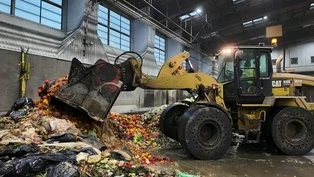
California’s Food Waste Crisis (Preview)
Video has Closed Captions
Preview: S8 Ep2 | 30s | The struggle to reduce food waste and help the environment. (30s)
Providing Support for PBS.org
Learn Moreabout PBS online sponsorship












Support for PBS provided by:
Earth Focus is a local public television program presented by PBS SoCal