Oregon Art Beat
Calligrapher Sora Shodo breaks traditional Japanese rules.
Clip: Season 27 Episode 3 | 10m 7sVideo has Closed Captions
Japanese calligraphy artist Sora Shodo breaks the rules of traditional calligraphy.
Japanese calligraphy artist Sora Shodo taps into nature’s beauty to create intricate works of art that break the rules of traditional calligraphy.
Problems playing video? | Closed Captioning Feedback
Problems playing video? | Closed Captioning Feedback
Oregon Art Beat is a local public television program presented by OPB
Oregon Art Beat
Calligrapher Sora Shodo breaks traditional Japanese rules.
Clip: Season 27 Episode 3 | 10m 7sVideo has Closed Captions
Japanese calligraphy artist Sora Shodo taps into nature’s beauty to create intricate works of art that break the rules of traditional calligraphy.
Problems playing video? | Closed Captioning Feedback
How to Watch Oregon Art Beat
Oregon Art Beat is available to stream on pbs.org and the free PBS App, available on iPhone, Apple TV, Android TV, Android smartphones, Amazon Fire TV, Amazon Fire Tablet, Roku, Samsung Smart TV, and Vizio.
Providing Support for PBS.org
Learn Moreabout PBS online sponsorship(music) (grinding) - There is a Japanese phrase, "Shuhari" means rules, break.
When I grow up, I follow Japanese calligraphy rules learning skills.
I am now breaking rules and then making my own art.
(music) (paper rustling) (music) (paper scraping) I think Japanese calligraphy is something about the meditative practice that's human needed.
That I think the society needs, expression using your hand and heart and your body.
(music) Japanese calligraphy and the sumi ink is 2,000 years old.
I am connecting from ancient to the present moment.
This is my teacher's in Japan writing and I'm creating from his copy to my style.
Competition is coming, so I do every night, three or four.
(music) We're writing characters.
Each character, we can read, and this is a poem.
But he said, "You are not only creating a character, talk with the space."
Judging looking for how good your writing flow, how the stroke is really natural plus what expression is in there.
So I write 7,200 of the same thing over and over again.
(music) When I do practices, I'm talking about who am I.
(music) When I was little, like three years old, my dad was grinding sumi ink.
(grinding) Sumi ink is made from soot of pine tree and he was grinding sumi ink and then I smelled that and I was playing with a brush.
And then that's how my calligraphy journey started.
When I was six, I learned from a professional instructor in my hometown, Usuki, Oita in Japan.
And then I get medal and then I was in the newspapers, so that's drove me to continue.
When I came to America, I met this mentor, Sekko Daigo.
I saw her art.
- Yeah.
- She was using Japanese calligraphy skill, but she was expressing herself using big brush.
And she's so tiny and she just write big Japanese character.
At that moment, "Oh, wow, who gonna take over this?
Maybe me."
And then next class I ask her, "I wanna do this like you someday."
And she said, "Yes, you can."
(music) Maybe next day, I saw the sky and the character was in the sky, which was Sora, she gave me that name.
And means universe and sky.
(music) (door scraping) I am now breaking rules and then making my own art.
(music) (paper rustling) (music) (brush scraping) (Speaking in Japanese) (music) (birds chirping) Nature, you can just concentrate your breath, your body, your warmness.
I don't think anything, I just need medication, and then those energy come together in one art at that moment.
(music) (music continues) (music continues) (brush scraping) (music) - Sora Sensei is really special.
The art that she's doing and the way she's doing it really is universal.
It speaks to humans because we're human.
It's really about the emotional center that we all have.
We live in a very polarized society now more than we've seen in a very long time.
And the more we dig into that, the worse it's gonna get.
We need something else and I think she's trying to provide some of that something else.
- (Sora) This one is mine, yeah.
Each stroke has meaning.
So like first part, we are together here and then in the middle part, it's a heart and then the last part on the ground means feet.
So, we are here standing together and you can see red and green and a gold, this water getting crazy, but if we help together, that becomes golden light.
(people chattering) - It's painting, it's dance, it's movement.
I think that's the really great thing about Sora's work is that it's an experience just as much as it is, that you see something from it.
(Sora speaks in Japanese) (music) (singing bowl resonant sounds) - (Sora) My performance, there's audience, there's atmosphere, there's a process of collaboration.
(singing bowl resonates) I wrote a little poem says, "I born in Japan but I'm here living in US and creating with sumi ink with people surrounding me and that is encounter."
(music) We can create together even you don't understand any language or any cultures and I think that harmony that moment... - [Brent] And gives you those spaces and the lines.
So, here where the brush opens and you see similarly on the semi curves there's another- - [Sora] They cannot read Japanese but they felt it.
Wow, how you feel?
- Japanese character and using black sumi ink bring people all together even the silence.
Just the sounds is my breathe and my brush stroke.
(bell clanging) (Sora exhales) Being full time artist, it's not easy journey.
But that moment made me.
I'm gonna continue.
(music) (no audio)
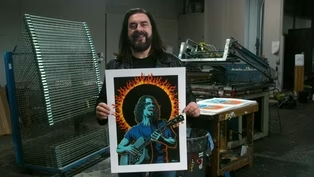
How Justin Hampton Turned ’90s Grunge Into Iconic Rock Poster Art
Video has Closed Captions
Clip: S27 Ep3 | 9m 42s | Behind the art of grunge: artist Justin Hampton’s journey through Seattle's music scene. (9m 42s)
Providing Support for PBS.org
Learn Moreabout PBS online sponsorship

- News and Public Affairs

Top journalists deliver compelling original analysis of the hour's headlines.













Support for PBS provided by:
Oregon Art Beat is a local public television program presented by OPB