Oregon Art Beat
Calligraphy artist Sora Shodo, Oregon Zoo X-rays, Rock Poster artist Justin Hampton
Season 27 Episode 3 | 25m 45sVideo has Closed Captions
Japanese calligraphy artist Sora Shodo, Oregon Zoo x-rays, rock poster artist Justin Hampton
Japanese calligraphy artist Sora Shodo taps into nature’s beauty to create intricate works of art that break the rules of traditional calligraphy. Zoo X-rays reveal hauntingly beautiful images. Originally from southern Oregon, Justin Hampton embraced the DIY ethos creating rock posters for bands that eventually became some of the most well known regional and national acts of the grunge era.
Problems playing video? | Closed Captioning Feedback
Problems playing video? | Closed Captioning Feedback
Oregon Art Beat is a local public television program presented by OPB
Oregon Art Beat
Calligraphy artist Sora Shodo, Oregon Zoo X-rays, Rock Poster artist Justin Hampton
Season 27 Episode 3 | 25m 45sVideo has Closed Captions
Japanese calligraphy artist Sora Shodo taps into nature’s beauty to create intricate works of art that break the rules of traditional calligraphy. Zoo X-rays reveal hauntingly beautiful images. Originally from southern Oregon, Justin Hampton embraced the DIY ethos creating rock posters for bands that eventually became some of the most well known regional and national acts of the grunge era.
Problems playing video? | Closed Captioning Feedback
How to Watch Oregon Art Beat
Oregon Art Beat is available to stream on pbs.org and the free PBS App, available on iPhone, Apple TV, Android TV, Android smartphones, Amazon Fire TV, Amazon Fire Tablet, Roku, Samsung Smart TV, and Vizio.
Providing Support for PBS.org
Learn Moreabout PBS online sponsorshipPart of These Collections
The Art Beat Classroom: Painting
OPB’s long-running arts series is pleased to offer stories of Oregon's painters.
View Collection
The Art Beat Classroom: Illustration
OPB’s long-running arts series is pleased to offer stories on Oregon's illustrators.
View CollectionProviding Support for PBS.org
Learn Moreabout PBS online sponsorshipSupport for Oregon Art Beat is provided by Jordan Schnitzer and the Harold & Arlene Schnitzer Care Foundation Endowed Fund for Excellence... and OPB members and viewers like you.
Funding for arts and culture coverage is provided by... [ ♪♪♪ ] [ ♪♪♪ ] There is a Japanese phrase, shuhari, means "rules break."
When I grew up, I follow Japanese calligraphy rules, learning skills.
I am now breaking rules and then making my own art.
[ ♪♪♪ ] I think Japanese calligraphy is... something about the meditative practice that's human-needed.
That, I think, the society needs.
Expression, using your hand and heart and your body.
Japanese calligraphy and the sumi ink is 2,000 years old.
I am connecting from ancient to the present moment.
This is my teacher in Japan's writing.
And I'm creating from his copy to my style.
Competition is coming, so I do every night, three or four.
We are writing characters.
Each character we can read.
And this is a poem, but he said, "You're not only creating a character.
Talk with the space."
Judges are looking for how good your writing flows, how the stroke is really natural, plus what expression is in there.
So I write 70 to 100 of the same thing over and over again.
When I do practice this, I'm talking about who am I?
When I was little, like 3 years old, my dad was grinding sumi ink.
Sumi ink is made from soot of pine tree.
And he was grinding sumi ink, and then I smelled that and I was playing with it with a brush, and then that's how my calligraphy journey started.
[ ♪♪♪ ] When I was 6, I learned from a professional instructor in my home town, Usuki, Oita, in Japan.
And I get a medal and then I was in the newspapers.
So that drew me to continue.
When I came to America, I met this mentor, Sekko Daigo.
I saw her art.
She was using Japanese calligraphy skill, but she was expressing herself... using a big brush, and she's so tiny.
And she'd just write big Japanese character.
And it was that moment: "Oh, wow, who's going to take over this?
Maybe me."
And then next class, I ask her, "I want to do this like you someday."
And she said, "Yes, you can."
[ ♪♪♪ ] The very next day, I saw the sky.
And a character was in the sky, which was "Sora."
That's-- She gave me that name.
And it means "universe in the sky."
I am now breaking rules and then making my own art.
[ speaks in Japanese ] [ all speaking in Japanese ] [ sighs deeply ] [ bird chirping ] Nature, you can just concentrate your breath, your body, your warmness.
[ exhales deeply ] I don't think anything.
I just need meditation.
And then those energies come together in one art at that moment.
[ ♪♪♪ ] [ breathes deeply ] Sora Sensei is really special.
The art that she's doing and the way she's doing it really is universal.
It speaks to humans because we're human.
It's really about the emotional center that we all have.
We live in a very polarized society now, more than we've seen in a very long time.
And the more we dig into that, the worse it's going to get.
We need something else.
And I think she's trying to provide some of that "something else."
SORA: This one is mine, yeah.
Each stroke has meaning.
So like first part, we are together here.
And then in the middle part, it's a heart.
And then the last part on the ground means "feet," so we are here standing together.
And you can see that in the green and the gold, this world is getting crazy, but if we help together, that becomes golden light.
WOMAN: It's painting, it's dance, it's movement.
I think that's the really great thing about Sora's work, is that it's an experience just as much as it is that you see something from it.
[ ♪♪♪ ] [ low vibrating tone ] SORA: My performance, there's audience, there's atmosphere, there's a process of collaboration.
[ Sora breathing heavily ] I wrote a little poem that says, "I was born in Japan, but I'm here, living in U.S.
and creating with sumi ink with people surrounding me, and that is an encounter."
We can create together, even if you don't understand any language or any cultures.
And I think that harmony of that moment... MAN: --you those spaces and lines here where the brush opens.
You see similarly on the semi-cursive, there's... SORA: They cannot read Japanese, but they felt it.
SORA: Yeah, how'd you feel?
GIRL: I just think it's easier.
SORA: Japanese characters and using black sumi ink brings people all together... [ bell ringing ] ...even the silence, just the sounds of my breaths and my brush stroke.
[ exhales deeply ] [ ink dripping ] Being full-time artist, it's not an easy journey, but that moment made me... I'm going to continue.
[ ♪♪♪ ] [ ♪♪♪ ] [ chitters ] My name is Carlos Sanchez.
I am the head veterinarian at the Veterinary Medical Center at the Oregon Zoo.
Part of my exam is to move the leg back and forth, back and forth.
I manage a team of three veterinarians, five technicians, and we take care of all the medical needs of the zoo collection for all animals, from the little frogs to the big elephants.
We are responsible for over 2,000 animals of all kinds.
They fly, they swim... we take care of all of them.
One day we're checking up a tiger, and the next day we have to check a butterfly, so it's always different, and that's what I like about it.
[ ♪♪♪ ] So, we use radiographs very often to evaluate different systems and organs in the body of all animals.
From the radiographs, we are able to tell if there is anything abnormal, whether it's in the joint, if the animal is starting to develop arthritis, sometimes we are able to detect cancer at an early stage where we can do something about, something we just do routine exams.
Isolate out these digits.
This female bat is an 18-year-old bat, which is like, you know, an equivalent of a 75-, 80-year-old person, but for her age, she looks pretty healthy.
We can see, for example here, this is actually an old fracture that healed.
These bones are very, very thin, very small, so sometimes just by flapping into something hard, they can break the bones.
But then also they have a great regenerative capability.
And you can see, it's almost straight.
[ ♪♪♪ ] We love seeing the radiographs, not just from the diagnostic point of view.
You can actually argue that these are pieces of art very unique for that animal.
So something that I do enjoy from purely the artistic point of view is the diversity of things that we can see.
You can see the bats, in the fingers, are so thin and spread out.
And then you look and compare it with a bear, and you see these massive digits.
So for me, the comparison between the species is something that fascinates me.
I love it.
I wish sometimes to be able to print them in a big size and hang it on the walls because they are so unique and they are so majestic that it makes me happy to look at them.
If I walk in the building and I see a radiograph of an animal, to me it's just like looking at a nice painting.
[ ♪♪♪ ] You know, when you're doing a poster for a band, there’s a lot of expectation.
Hey, how's it going?
I don't think in terms generally of like, what's gonna sell necessarily as much as, "Here's what I am feeling, here's what I wanna do."
One of my favorites is... I started off doing screen prints for bands back in the day.
There’s a lot that goes into it.
It's a very tactile, artisan kind of craft in that it's all hand-done.
You know, the colors are custom mixed by hand.
[ ♪♪♪ ] Everything’s signed and numbered, limited editions.
This is the early stage of creating these two characters that are different that come together as one image.
And then to further that, I just put on an overlay and tracing paper.
This is sometimes how it starts for me, and I use the light table to just kind of keep building on it.
And this is a look at the final poster, but that was a pretty fun project, and I got a copy that's signed by all the band members.
My early inspirations in small-town America was basically, uh, pop culture, TV, movies.
But also comic books, as a little guy, kind of really opened up my mind.
I would try to copy these things, you know, as a kid.
I started sending samples to Marvel comics, just like age 14.
And so by the time high school came to a close, I wasn’t getting the responses that I wanted.
You know, they were all like, "Cool, keep going, keep going."
You know, "Keep sending us stuff."
But I wanted to get out of Medford.
I finally decided to go to art school ’cause I needed to do something.
[ ♪♪♪ ] So when I first moved to Seattle, I literally had no idea anything was happening.
Even though it was the very beginning of the grunge era, 1987.
It was just a weird, like, confluence of things that brought me in that moment to just be in Seattle and experience all these local bands.
In Seattle, in the early ’90s, one of the main ways that bands got the word out for their shows was to put up flyers.
And, you know, 11x17, was the biggest you could get at Kinkos.
In my last quarter of school, I was asked to do this final thing for a typography class.
And I was going to a Nirvana show, and so I was like, "Why not just do a flyer?"
I see these flyers on poles everywhere, and I didn’t get anyone’s approval.
I was just like, "I’m just gonna do this thing."
So I designed it and I put up a few.
That's literally the first flyer that I ever designed was just my own guerrilla-style Nirvana flyer.
[ ♪♪♪ ] I started getting asked to do flyers for different people that, you know, whether it was a band or a promoter or whatever, for an event, and it was, you know, really nothing.
It was like 25 bucks and like, you know, some free beer that night at the show or something, you know, maybe food.
And so I never really thought of myself as becoming a poster artist.
In fact, I didn't think that it was possible to be a working poster artist and make money.
The telephone poles were getting covered with flyers, and they’re bulging, but that was the way that bands got the word out.
And then, around '93, the "no poster" ban went into effect in Seattle.
And so Seattle City Council had decided that basically that flyers were not beautiful and that they were, like, making the city ugly.
And so they made it a law that it was illegal to put up flyers.
Promoters decided, "Okay, we need to make more impact with a single image that's only gonna be maybe in a handful of shops."
I started getting commissioned to do screen-printed posters.
[ ♪♪♪ ] So around that time, I saw the ARTROCK catalog, which had become something that was floating around nationally.
Then I started getting in those catalogs.
And before the Internet, that was the way that stuff got seen and money made was through those catalogs.
I started getting paid decent, so that became a thing where I was like, "Okay, maybe I'm a poster artist, I guess, or at least it’s one of the things I do."
My 1995 PJ Harvey poster was probably the first big splash that I made in the poster scene where I had developed that relationship with ARTROCK.
It was that moment that really kind of put me on the map.
Vintage.
This is one of my very first screen prints.
But this was, yeah, 1994.
This is the Sabertooth original.
This is the Kurt Cobain original.
This is the Royal Blood original.
The process of making a poster basically starts with a sketch.
And then you move on to the final art, which for me is still hand drawn.
And then I scan that into the computer and build layers in Photoshop.
[ ♪♪♪ ] So each color is its own layer.
Each layer is gonna be built into something over the span of the printing process.
So you print a hundred of them one color... and then they're put on the rack to dry, and then you bring 'em back and you print the second color, and that's put on the rack to dry.
If it's five, six colors, that goes on and it can take days.
But then the final result when the black goes down is you have this, you know, beautiful screen print.
Around '98, I made it my mission to build a website and get my stuff up and started talking to local printers that were like, "You can pay me on the backside after you sell the posters."
Made it viable for me to suddenly go, like, "Okay, I can print my own posters, I can publish my own posters.
I don’t need a catalog.
I can do this all myself."
And so that’s when things really started clicking.
I'd say around 2002, I was really taking off in the world of becoming, like, completely self-sufficient.
It was pretty revolutionary.
It was a pretty amazing time, for sure.
[ ♪♪♪ ] After I'd been in Seattle for 20 years, I saw that the change coming to Seattle was so intense and it was evolving so quickly.
I loved the late ’80s through the ’90s Seattle.
And watching it disappear was kind of hard, you know?
So in the late 2000s, I decided to move to Portland to be closer to my family down in Medford.
I now had a kid, Miles.
It just made sense to do something different.
I’ve been here for now, like 17 years.
I’ve had people request that I do a book for quite a long time.
And then I think I finally came to a point where I just felt like now might be the time to start putting it down on paper.
All right, let's see what we got.
It took from starting the book to it actually being here now six years.
And it turned into 444 pages, a huge 11x14 retrospective book.
The book basically is just my entire history as an artist from, you know, growing up in Medford, Oregon, to going to Seattle and getting started.
It’s the story as well as the art.
There’s photos, there’s sketches.
Lots of different tales of, you know, meeting and hanging out with different band members.
So I really kind of delved deep into the relationships that I’ve had with different promoters and other artists.
It’s not just a picture book.
It’s definitely a storybook too.
Feel free to look through the whole thing.
It's a lot.
I’ve never had a book signing before, so that's pretty cool.
So I’ve already got six set up.
I’m having three shows in Seattle.
It's definitely going to be really cool to see a lot of old-school friends and people that will appreciate the tales, that will recognize having been there themselves.
Nice.
I appreciate it, man.
I'm always seeing new talent and see people that I’m like, "Oh, wow, that’s really good."
Whatever part I played in it, it’s cool to see it continue on.
So it’ll be here long after I’m gone.
[ ♪♪♪ ] To learn more about Oregon Art Beat, visit our website... And to see what we're working on now, follow us on Facebook and Instagram.
Support for Oregon Art Beat is provided by Jordan Schnitzer and the Harold & Arlene Schnitzer Care Foundation Endowed Fund for Excellence... and OPB members and viewers like you.
Funding for arts and culture coverage is provided by...
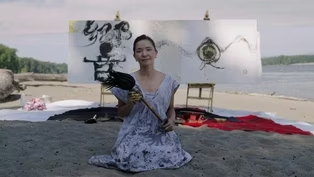
Calligrapher Sora Shodo breaks traditional Japanese rules.
Video has Closed Captions
Clip: S27 Ep3 | 10m 7s | Japanese calligraphy artist Sora Shodo breaks the rules of traditional calligraphy. (10m 7s)
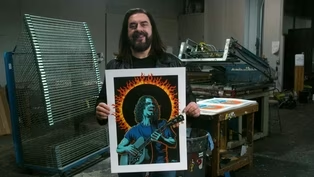
How Justin Hampton Turned ’90s Grunge Into Iconic Rock Poster Art
Video has Closed Captions
Clip: S27 Ep3 | 9m 42s | Behind the art of grunge: artist Justin Hampton’s journey through Seattle's music scene. (9m 42s)
Providing Support for PBS.org
Learn Moreabout PBS online sponsorship













Support for PBS provided by:
Oregon Art Beat is a local public television program presented by OPB