Prairie Yard & Garden
Camphill Village
Season 39 Episode 8 | 28m 45sVideo has Closed Captions
Explore the heartwarming and inspiring world of Camphill Village, a unique, intentional community.
Host Mary Holm explores the heartwarming and inspiring world of Camphill Village, a unique, intentional community in Minnesota. In this episode, viewers will get an inside look at how individuals with and without developmental disabilities live, work, and thrive together on 525 acres of land. From cultivating their own food in vibrant gardens to crafting homemade goods.
Problems playing video? | Closed Captioning Feedback
Problems playing video? | Closed Captioning Feedback
Prairie Yard & Garden is a local public television program presented by Pioneer PBS
Production sponsorship is provided by Shalom Hill Farm, Heartland Motor Company, North Dakota State University, Friends of Prairie Yard & Garden, and viewers like you.
Support provided by:


Prairie Yard & Garden
Camphill Village
Season 39 Episode 8 | 28m 45sVideo has Closed Captions
Host Mary Holm explores the heartwarming and inspiring world of Camphill Village, a unique, intentional community in Minnesota. In this episode, viewers will get an inside look at how individuals with and without developmental disabilities live, work, and thrive together on 525 acres of land. From cultivating their own food in vibrant gardens to crafting homemade goods.
Problems playing video? | Closed Captioning Feedback
How to Watch Prairie Yard & Garden
Prairie Yard & Garden is available to stream on pbs.org and the free PBS App, available on iPhone, Apple TV, Android TV, Android smartphones, Amazon Fire TV, Amazon Fire Tablet, Roku, Samsung Smart TV, and Vizio.
Visit the Prairie Yard & Garden Website
Do you love gardening? Consider becoming a friend of Prairie Yard & Garden to support this show and receive gifts with your contribution. Visit the link below to do so or visit pioneer.org/donate.Providing Support for PBS.org
Learn Moreabout PBS online sponsorship(cheerful music) - Tom and I have college friends who married and had three children.
One of their children had Down syndrome, and their Michael was such a character.
He loved the NDSU Bison and attended games whenever possible.
He was outgoing, well-known in the community, and was a real blessing to his family for the 34 years of his life.
Today, "Prairie Yard and Garden" is going to visit another community, dedicated to caring for the special needs of all its members.
- [Announcer] Funding for "Prairie Yard and Garden" is provided by Heartland Motor Company, providing service to Minnesota and the Dakotas for over 30 years in the heart of truck country.
Heartland Motor Company, we have your best interest at heart.
(cheerful music) North Dakota State University, through its Field to Fork educational program, providing research-based information on growing, preparing, and preserving fruits and vegetables.
(cheerful music) Mark and Margaret Yackel-Juleen, in honor of Shalom Hill Farm, a nonprofit rural education retreat center, in a beautiful prairie setting near Windom, Minnesota.
And by "Friends of Prairie Yard and Garden," a community of supporters like you, who engage in the long-term growth of the series.
To become a friend of "Prairie Yard and Garden," visit pioneer.org/pyg.
(hopeful music) (cheerful music) (cheerful music continues) - A few years ago, one of my garden club members gave me a newspaper article about a place called Camphill Village.
It talked about how people with and without developmental disabilities live together to care for each other.
It sounds like they try to grow and produce as much of their own food as possible.
Well, I always thought gardening is for everyone.
And I wanted to find out more, so I called Annie Welck, who said we could come for a visit.
Thanks so much, Annie, for letting us come.
- Yep.
Mary, I'm so excited to have you here.
- Tell me, what is Camphill Village?
- So we are a life-sharing community, made up of about 50 individuals, some with developmental disabilities and some without.
And everybody lives and works together on our 525 acres of land.
We do things.
Like this orchard here, we grow this food.
We have our gardens, we have our farm animals, and then we have various other workshops that everybody takes part in.
- [Mary] Is Camphill Village a nonprofit organization?
- [Annie] Yes, we are.
We are a 501c3 nonprofit.
We get funding through multiple different avenues.
Because we do have individuals with developmental disabilities here, we do get some Medicaid funding, but the bulk of our money is coming from contributions made by donors that have been supporting us, both new and old, for many years, as well as some foundational support.
- [Mary] Then do you try to use some of the enterprises you mentioned to sustain the village?
- [Mary] Yeah, so we can proudly say that we grow a harvest process, about 70% of our entire food consumption, here on location.
So that means we are pretty much fully, two-thirds, self-sustaining.
- [Mary] Do some of the people that live here work offsite?
- [Annie] Some do, yes.
We offer the opportunity for individuals to go out into the greater surrounding areas, and to work at different places there, consignment shops, things like that.
A few hours here and there every week.
We also have members from the community that are part of like local organizations, like the Lions Club, and things like that.
- Then do you offer tours here too?
- We do.
You can call ahead, call me, or email me at outreach@camphillmn.org, and I can set up a tour for you to come and check out this beautiful site.
We also have an open house every fall, where we welcome people from all over to come, share the day with us.
We do a community meal that's free of charge.
We do hay rides, face painting.
We sell some of the items that we make here onsite.
And there's a band.
It's just a lot of fun.
- [Mary] Is that then open to everybody?
And do you let everybody know?
- [Annie] We try to let everyone know.
Everyone is welcome.
Bring your friends and your family.
- Do you have other outreach events that you have?
- At this point, we don't have a ton of other outreach things that we have specific to here, but what we do is a lot of farmers events, farmers markets, and we do other events like that, such as the Garlic Festival, or last summer, we did a lot at the Richmond Farmer's Market as well.
- [Mary] What are the products you take to the festivals and the farmers markets?
- We sell a lot of our cookies.
We make all of our organic cookies here onsite.
We also make homemade organic bread.
And we just recently started making our own bagels here.
So those have been selling really well at events.
Additionally, we sell items that are made in our weavery, where we use 100% recycled materials to make things like rugs, tote bags, table runners.
And we just reopened our pottery workshop, where they're making tons of amazing products, like mugs and spoon rests, and herb strippers, and things like that.
And we also have a woodworking workshop, where individuals are making things and painting things like bird houses and charcuterie boards.
- So are the residents involved in making all of these things?
- 100%, and that's why the volunteers that are here are here to support them in creating these things to the best of their abilities.
- [Mary] Then do you have to do fundraising too?
- [Annie] We do fundraising as well, yes.
That's kind of what my key role is at this point in time, is to reach out and try and to get our name known, and see if we can generate some excitement about our community.
- [Mary] These apples are gorgeous.
- [Annie] I absolutely love our apples here.
We use 'em to make a ton of baked goods in our bakery.
On top of that, we also have an amazing vegetable garden.
- [Mary] Oh, can we go see that?
- [Annie] Let's go and meet Tomi.
He can show us around.
(cheerful music) - Have you eaten any beans lately?
Many of us shortchange ourselves on fiber, and beans can help.
You can start with canned beans or with dry beans.
Beans contain insoluble fiber that helps with digestion, and also soluble fiber, that could lower your blood cholesterol level.
One of the advantages of starting with dry beans is that they're very low in sodium content.
On the other hand, if you use canned beans, you should rinse them, because that can reduce the sodium content by about 40%.
So today, we're making a speed scratch item.
It's called sizzling baked beans, and it's really easy.
And you can personalize it for your family.
We start with 28 ounces of beans.
You can use your favorite flavor of beans.
There's lots of available types in the grocery store.
Next, we're going to add some beautiful chopped red peppers.
These are great sources of vitamin C, as are green peppers.
We need about a half of each.
If you wanna use yellow, you can do that as well.
And then we're going to add some onion.
I have about a medium onion.
Now, we season it up a little bit with ketchup, one and a half tablespoons, one and a half tablespoons of molasses, and your choice of seasonings.
I have a little salt and pepper to add.
Finally, we just mix it all up.
We top it with cooked turkey bacon or your favorite type of bacon, pork bacon, vegetarian bacon.
And lastly, we pop it in the oven.
This recipe makes 12 side dish servings, with 100 calories and four grams of fiber.
Enjoy it at your next gathering.
This is Dr.
Julie, bringing you from Field to Fork.
Until next time.
(cheerful music) - [Mary] Thanks so much, Tomi, for visiting with us.
- [Tamas] Thank you for coming.
- What is your background, Tomi?
- So I am originally from Hungary.
That's where I went to school.
I graduated in Waldorf School, which is also an anthropological education.
And through the Waldorf education, I learned about Camphill, and I started in Scotland 13 years ago.
We found Camphill Village in Minnesota, and then we decided to come back to camp here.
- [Mary] Looks like you have a huge garden here.
- [Tamas] So our life separates into home life and work life.
And in the work life, we call it workshops.
And in that workshops, you know, people work together, presidents or coworkers, and one of them is the garden, the farm.
- [Mary] And what happens to all the produce from this garden?
- [Tamas] So during the summer, we have fresh produce, but during that time, we have a commercial harvest kitchen.
- [Mary] And then does everybody help with the gardening?
- [Tamas] So land work, farm, and garden, it's a physical work.
So, you know, people who physically not there, they don't work on the land.
That's what we have other inside workshops.
But most of the people, yes, they work in the garden.
- [Mary] So are there certain people that just work in the garden, and certain people that just take care of the livestock, or does it rotate around?
- [Tamas] So we have land workers, co-workers, who come specifically for the land for the summer, for three months most of the time.
They are university students most of the time.
So, you know, they arrive end of May, leave end of August.
So they only work on the land, you know, help with the cattle.
Most of the time in the summer is the garden that we have.
- [Mary] Do you have some of the same land workers that come back year after year?
- [Tamas] It happens time to time.
Like right now, I have a farm apprentice who was here for last year, and he came back for the summer.
- [Mary] Tomi, how do you decide what to grow here in the garden?
- [Tamas] So during the winter, we usually, land workers go through like a questionnaire for the community.
And in this questionnaire, we ask, you know, what people would like to see in the garden to grow this year.
So we have that list, and then our gardeners order the seed, and then they just grow like sweet corn, zucchini, beans, tomatoes.
- [Mary] Do you start the plants yourselves, or do you buy in plants?
- [Tamas] Yeah, so in March, we open the greenhouse, and we start everything from seeds.
- [Mary] And then who transplants everything, and who plants the garden and tills, and everything?
- [Tamas] We have designated gardener, the garden manager, who start organizing and tilling, and start planting.
We don't move anything outside before end of May, since our official frost day is May 31st.
So once that day pass, that's when really the planting production starts.
- [Mary] Why do you like living here in Minnesota?
- [Tamas] I really love the surroundings.
I really love the land here in Minnesota, especially in Central Minnesota.
I grew up in a big city.
And to live in art, in the nature, it's really everything for me.
- [Mary] Well, can I find out more about the lifestyle here too?
- [Tamas] Yeah.
The best person to talk to is Seamus.
- [Mary] Well, that would be wonderful.
Thank you so much.
- Hi, Mary.
I'm Seamus.
I've lived at Camphill Village, Minnesota, for eight years now.
I was supposed to be here for three months, and I decided to stay long term.
(laughs) And I am a house leader and a community leader.
- So explain what that is.
- So we are a intentional community, first and foremost.
And we were founded to live with people with developmental disabilities.
We live and work on 525 acres of land.
And we have a garden, a farm, but we also have seven houses on our property, where we live and work together 24/7.
Basically, we're here for the people and for the land.
- [Mary] So how many people live together per house?
- [Seamus] So we are licensed for four people with special needs in our houses, and then all of the rest of us are support.
We're all here on a volunteer basis.
The only employees that we have are office staff and a couple of employees, who help with kitchen management and a few of the specialty things that we need to have someone with good experience with.
- [Mary] Do you fix your meals in your own home, or do you have community meals, or how does that work?
- [Seamus] So we have community meals most days at lunch.
And once a week, we will have cooking in our own homes, and we'll have people come and help us cook those meals, and we eat them in our homes.
Breakfasts and dinners, we eat primarily in our own homes as well.
- Does everybody fix the same meals each day?
- No.
(laughs) (Mary laughs) It's kind of up to whoever is heading those activities.
We have people from all over the world, so they bring a lot of different cuisines into play.
We have people from India, from Bangladesh, Germany, Brazil.
So we have a lot of people with a lot of different culinary backgrounds.
- [Mary] Do you kind of have like a dietary advisor, whatever, that kind of says, "Okay, we've got lots of cucumbers ready in the garden now.
Let's try to fix meals geared towards that"?
- [Seamus] Absolutely.
Our garden manager keeps us apprised of all of the things that we have coming in from harvest.
And then during the winter, we try and check with our kitchen manager to see what we've preserved, and how much of everything we have left, and what she really needs to push.
Usually, it's zucchini or kale, but, you know?
(laughs) (Mary laughs) - So what is life like in the house?
- So we stay pretty routine.
A lot of people with special needs really approve of routine, and it helps them get their day in order.
You know, the structure really helps them.
So we usually will get up, we'll have breakfast, we usually go and start our activities about 9:00 AM, and then we have lunch at about noon, and then we have a short break in the middle of the day for about an hour, we call it our rest hour, and then we go back to work for another two and a half hours, where we're doing all sorts of activities on the land, and artistic and culturally.
And then after that, we have our after-hours time, and that's with when dinner.
And then afterwards, we get together, we play games, we do a lot of house things together.
- What are some of the responsibility of the residents?
- So we try and make sure that all of our residents are able to be as independent as they're able.
So some of them can help with a lot of the household chores and can help wash dishes, cook.
A lot of them, you know, they need a little bit of extra help, and that's what we're here for, as volunteers, is to help them like do smaller things, like set the table, or pour water before meals, or cleaning their bathroom.
So there's a lot of that.
We try and encourage people to learn life skills, so that they're able to do those things more independently, like doing their own laundry and things like that.
- Do people here participate in events also?
- Well, we have events that are in the village.
We have a lot of festivals which correspond with the seasonal changes of the year.
So we have a lot of different festivals that we participate in during those times.
We also have our annual Open Day, or our Fall Festival.
And a lot of people come from the surrounding areas to come and do that, and they actively participate in preparing for that and putting it on, and then, yeah, of course, clean up afterwards.
(laughs) But, and then we participate in a bunch of different things in the outer community as well.
Whenever Sauk Centre or Long Prairie has like festivals or things going on in town, yeah, we'll go, and we'll get everybody loaded up into the vans, and we'll all go together as a group, so.
- Do people here participate in activities onsite?
- Absolutely.
We have a fully functioning weavery, where we do a lot of textile arts.
We have a bunch of hand looms and floor looms, and they produce rugs, they also produce bags and things from recycled materials.
All of the stuff that we use in there is from donations that people have given us.
We also have a working woodshop.
We also have a pottery studio that was just started a little while ago, and people are really enjoying that.
And then, of course, we also have our processing, which is from our garden harvest.
And we also have a bakery, where we bake bread and cookies, which we sell to the populace.
And people seem to enjoy that.
- [Mary] Where do you sell these products at?
- [Seamus] So usually, we will do tabling events more locally.
So we'll go to like, you know, vendor events and things like that, where we're allowed to sell baked goods, and we'll do that.
And we're working on trying to get our cookies into like co-ops and things like that.
- Who determines what the activities are?
And do they change throughout the year?
- So there is a group of longstanding volunteers here who are house leaders, I'm included, who get together on a weekly basis to kind of oversee the scheduling of the week and the months ahead.
We're also house leaders.
And so every house is represented, and we all have a very good idea of what people are capable of and what their interests are.
And that way, we're able to come up with a schedule that benefits everybody and also the needs of the community at large.
- Okay, so tell me what some of the activities might be in the summer versus in the winter.
- [Seamus] So in the summer, we tend to stay more outside, of course, as all Minnesotans do.
We have our garden, and we also have a lot of land activities.
We have a herd of cattle that we take care of.
We also have an herb garden, where people go, and they help our resident herbalist pick and process those things.
We also have an orchard, which, right now, is booming.
So we have a ton of apples for people to process and eat.
So we have a lot of different outdoor activities for people to participate in.
In the wintertime, we bring everything back more into the home.
But we also have a lot of artistic and crafting aspects.
We have what we call Rhyme, Rhythm, and Reason, which is where people go, they'll do a poetry, they'll do plays, they'll do things like yoga and movements, a lot of really interesting stuff with that.
And then, of course, we do have pottery and woodshop, things that are more indoors and a lot more cozy.
Yeah, and so those are the things that we usually do during the wintertime, along with, you know, all of the holiday stuff.
We all have holidays within our homes, where we live, yeah, with all of our volunteers from overseas, who don't get to go home for those things.
So we try and keep it nice and happy.
(laughs) - Would it be possible to visit with one of the residents too?
- Oh, absolutely.
I think that Jeffrey would love to speak with you.
(cheerful music) - I have a question.
Should I mulch around the new trees I planted in my yard?
- So mulch is one of the easiest ways that you can provide a healthy growing environment for your trees, and to lower the environmental stresses that trees have to endure, things like drought, flooding, also heated-up soils, cold soils, and winter damage.
Now, what can you do to mulch?
There's a lot of different kinds of mulches.
There's wood chips, which are literally chips of wood.
There's also shredded wood mulch, which kind of knits together.
That's a good choice if you have slopes.
And also you can use a rock, provided that you put a landscape fabric underneath it.
There's also cocoa bean mulch, there's synthetic mulches, all sorts of different things.
All the mulches are fine.
The rule of thumb is, if it's an organic mulch like wood, you don't need an underlayment like landscape fabric.
If it's a mulch like rock, you would wanna put that under your rock mulch, so that you're not allowing that rock to work its way into the soil.
So what are the benefits of mulch?
One of the benefits is, it holds in moisture.
That's helpful when it comes to watering trees, and not having to water them as often.
Another benefit of mulch is that it protects those feeder roots.
Feeder roots of trees take up minerals and nutrients and water, and send it up to the rest of the tree.
So they're really important.
They're in the top 12 to 18 inches of soil, so they're right below the soil surface.
Mulch helps to protect them from compaction, but also from damage.
Mulch also helps to moderate soil temperature.
In other words, as we go into the winter and the soil tends to get colder, it helps to gradually allow that soil temperature to drop, which is less stressful to the trees.
On the reverse, in the spring, it also allows the soil to gradually warm up, so that, again, it's less stressful for trees.
Now, how do you mulch?
You wanna have at least a six-foot ring diameter around the tree.
That allows for mowing, it allows for the tree to really expand and grow.
You also wanna be sure you don't pile mulch up against the trunk of the tree.
You wanna leave a space, so that you can see the root flare of that tree.
And leave that open, and that's important for the health of the tree.
We don't want mulch piled up along the trunk, tends to break down the trunk tissues.
It can also be a great place for critters to live.
So there are a lot of benefits for mulching young trees, newly planted trees, but also your established trees as well.
(cheerful music) - So, Jeffrey, tell me, how long have you lived here at Camphill Village?
- 32 years.
- Really?
Where did you live before?
- In North Minneapolis, by the Jordan Neighborhood, Jordan Elementary School.
- [Mary] So what's your favorite thing about living here at Camphill Village?
- [Jeffrey] What's good?
It's been safe.
- [Mary] It's safe, okay.
And then do you like the people that you live with too?
- [Jeffrey] I do.
- [Mary] Then what's your favorite food that you have here?
- I love we have pizza.
I like pizza.
I like we have lasagna.
We have enchiladas.
It's all kinds of food.
- Well, and it all sounds really good.
- It does.
- So what is the job that you have to do here that you don't really care for?
- [Jeffrey] It's the garden, it's the garden, because of the sun.
- [Mary] Okay.
- [Jeffrey] It's health, health reasons.
- [Mary] Okay.
So what's your favorite job to do here?
- [Jeffrey] It's the weavery.
- [Mary] Do you do that quite a bit?
- [Jeffrey] I do that, I think, for now, it's just once a week.
See, it's gonna be more and more when winter comes.
- [Mary] Then do you take some of the things that you have made and take them to sell them?
- [Jeffrey] Right.
In Fall Festival, Open Day.
- [Mary] Okay.
So do you work away from Camphill Village too?
- [Jeffrey] No, just in the village.
- Okay, well, I appreciate you talking to us so much.
Thank you.
- You're welcome.
(cheerful music) (cheerful music continues) (cheerful music continues) - [Announcer] Funding for "Prairie Yard and Garden" is provided by Heartland Motor Company, providing service to Minnesota and the Dakotas for over 30 years in the heart of truck country.
Heartland Motor Company, we have your best interest at heart.
(cheerful music) North Dakota State University, through its Field to Fork educational program, providing research-based information on growing, preparing, and preserving fruits and vegetables.
(cheerful music) Mark and Margaret Yackel-Juleen, in honor of Shalom Hill Farm, a nonprofit rural education retreat center, in a beautiful prairie setting near Windom, Minnesota.
And by "Friends of Prairie Yard and Garden," a community of supporters like you, who engage in the long-term growth of the series.
To become a friend of "Prairie Yard and Garden," visit pioneer.org/pyg.
(hopeful music) (cheerful music)
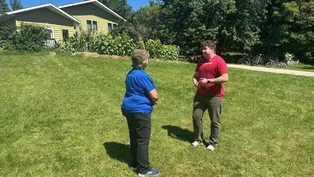
Preview: S39 Ep8 | 30s | Explore the heartwarming and inspiring world of Camphill Village, a unique, intentional community. (30s)
Providing Support for PBS.org
Learn Moreabout PBS online sponsorship

- Home and How To

Hit the road in a classic car for a tour through Great Britain with two antiques experts.












Support for PBS provided by:
Prairie Yard & Garden is a local public television program presented by Pioneer PBS
Production sponsorship is provided by Shalom Hill Farm, Heartland Motor Company, North Dakota State University, Friends of Prairie Yard & Garden, and viewers like you.