Un-Wine'd
Cana Vineyards of Middleburg
Season 4 Episode 2 | 26m 47sVideo has Closed Captions
Rosé wines are the focus with winemaker Melanie Natoli of Cana Vineyards
Rosé wines are the focus with winemaker Melanie Natoli of Cana Vineyards of Middleburg. Host, Tassie Pippert prepares easy recipes of Jerk Shrimp with Grilled Pineapple, Grilled Chicken Breast with Creamy Basil Sauce and Pasta and Flat Bread with Arugula Pesto.
Problems playing video? | Closed Captioning Feedback
Problems playing video? | Closed Captioning Feedback
Un-Wine'd is a local public television program presented by VPM
Un-Wine'd
Cana Vineyards of Middleburg
Season 4 Episode 2 | 26m 47sVideo has Closed Captions
Rosé wines are the focus with winemaker Melanie Natoli of Cana Vineyards of Middleburg. Host, Tassie Pippert prepares easy recipes of Jerk Shrimp with Grilled Pineapple, Grilled Chicken Breast with Creamy Basil Sauce and Pasta and Flat Bread with Arugula Pesto.
Problems playing video? | Closed Captioning Feedback
How to Watch Un-Wine'd
Un-Wine'd is available to stream on pbs.org and the free PBS App, available on iPhone, Apple TV, Android TV, Android smartphones, Amazon Fire TV, Amazon Fire Tablet, Roku, Samsung Smart TV, and Vizio.
Providing Support for PBS.org
Learn Moreabout PBS online sponsorship>>I'm here in Middleburg, Virginia, where I'll meet with winemaker, Melanie Natoli and talk about her beautiful Rosé program.
We'll have some great food and lots of fun so go grab that glass.
It's time to un-wine'd.
>>Production funding for Un-wine'd was made possible in part by >>The Virginia Wine Board, promoting the interests of vineyards and wineries and the Commonwealth through research, education and marketing.
There's a movement growing in Virginia's vineyards, discover more at virginiawine.org >>And by (jazz music) >>I'm here at a beautiful winery today in Middleburg, Virginia, where I'll taste some incredible wines, including this wonderful Cabernet Sauvignon Rosé.
I'll also try a Merlot Rosé and some wonderful Albarino.
Back in the kitchen, I'll pair up with some foods of my choice.
A wonderful pesto on flat bread with some Burrata cheese.
Next we'll pair up a wonderful jerk shrimp.
All that you won't want to miss with some grilled pineapple, a little red roasted pepper, and then last but not least, a gorgeous pasta with grilled chicken and basil cream sauce.
So you won't want to miss a minute of today's show.
Let's head back to my kitchen in Harrisonburg and see what we're going to make next.
I'm just going to dust my board and I have this dough that I allowed to rise and then fall.
And I love to do it that way because it gives that wonderful yeasty flavor to the bread.
And then it also gets these wonderful little bubbles in it that I just love.
So I allowed it to rise and then fall.
That takes about an hour and a half.
If you want, you can just allow it to rise for about 45 minutes and then roll it out.
It also gives you a wonderful product.
So I've got this great dough and I'm just going to stretch it out.
I want this to be kind of rectangular rather than round.
Now the difference between flat bread and pizza, in general is that pizza has a crust edge and flatbread simply doesn't.
Now I'm going to take a little bit of cornmeal and I usually use cornmeal for this when I'm using the grill.
If I'm using a pizza stone, I like to use a little bit of cornmeal mixed with flour because it seems to bake better, but on the grill, a little cornmeal will do it.
And then let's just lay it right out, on that peel.
Once our dough is on the peel and the grill is nice and hot, I need to oil that grill and then I'm going to slide that dough gently onto those grates.
That flatbread has a little bit of color on it.
I just want to remove that for a minute because we're going to flip this over.
That will be the bottom.
The grilled part is actually going to be the top so that we know that's completely cooked through.
This way, we'll be grilling the bottom and we know that both sides are cooked completely.
Now, while that's happening, I'm going to grill some tomatoes.
Now I love to use these little copper sheets that go on the grill, but you can also use a grill pan that has very tiny holes.
And then we're going to put some cherry tomatoes on that as soon as it gets warm.
So now I have all my components for my wonderful flatbread that we're going to serve with this wonderful Albarino.
Now I have my flatbread here, I'm going to flip that over.
You can see that one side is grilled, the other side is still not, not grilled, sort of what we would call par-baked.
And I'm just going to flip that over.
Now on that, I want to go ahead and put my Burrata.
Now, Burrata is a wonderful cheese, that is mozzarella, but it's mozzarella on the outside, mozzarella curd on the inside.
So it's a beautiful cheese that has a lot of texture.
So you can kind of see how that is really, really curd-like on the inside.
And I want to go ahead and put that on my flatbread.
And I'm going to use two balls for each one of my flatbreads.
And remember, this recipe makes two.
So this is about a pound of Burrata cheese.
It usually comes in a container that's about a pound and let's go back to the grill and grill this up and then we'll finish it with our tomatoes and our delicious pesto.
You can see that we're not going for a full melt on this Burrata.
I want this flatbread to have some texture.
So the next thing I want to do is to add some of this wonderful pesto and I'll just kind of dollop around.
Anytime you're using Albarino, I think of green when I think of Albarino, it's a wonderful acidity.
Oh, just this freshness, that's incredible.
So if you think green with Albarino, try these wonderful green things with it.
It's just so incredibly delicious.
Now a young Albarino on the vine will have a little bit of a flavor of grapefruit.
There will be lots of citrus.
As soon as you start to process it, it starts to take on a little more flavor.
Now, Albarino, a lot of times, you'll see with a little bit of carbon dioxide, continuing in the bottle, that little bit of effervescence, which is just delicious, and it just reminds you how crispy this wine can be with this acidity.
All right.
There's our beautiful flatbread.
What a tribute to Italy, the red, the green and the white and with Albarino, I'm going to expect some wonderful acidity, hmm, some beautiful, beautiful fruit, citrus, a little apple.
Now I want to just try it with this flatbread.
So while I do, let's head up to visit with my friend Melanie Natoli, who has a real way with Albarino and Rosés.
(country music) So Melanie, thank you so much for being with us here at this beautiful, beautiful winery.
I can't get over the views here.
And tell me a little bit about how you came to this winery and, and what it is that you brought here?
And I know part of the Rosé program is- >>Absolutely.
So I've been here at Cana since 2015.
I started in the winter.
So I was here for that entire growing season, which was great.
So all through that season, I helped develop the estate wine program here, that was our first harvest from the estate, so the vines were a little bit young and needed a little bit extra love to produce, and that was our first year to bring fruit in from the estate.
So that was really important here.
And then, yeah, my true passion is Rosé.
So I made that a big focus of the wine production here at Cana.
>>And I love your Rosés and you feature some interesting ones with Merlot and Cabernet Sauvignon.
So how did you decide that that was your baby?
>>Rosé or the grapes?
Rosé?
>>Yeah.
>>You know, it's just something that you feel, it's something I fell in love with.
Rosé is so special because it is a wine that on first sip and first glance can seem simple and light and joyful, which it is, but there's so much more to that.
There's a complexity that you don't always see, where you don't always taste unless you're looking for it, which is great.
So it can give you whatever you want it to, right?
>>Right.
>>It's one of the only wines where the color is a really important piece of it.
You know, you ferment a red or a white, and you're going to get whatever shade that grape's going to give you, you know, for that ripeness and the vineyard.
Rosé something different, you know, when you taste Rosés from around the world, you line them up and you have this gorgeous rainbow of pink.
It's just beautiful.
And it depends on the grape you use and how ripe it is.
What was that season like?
How did you produce the wine, you know?
How did you ferment it?
How long was it in contact with the skins?
There's a lot of pieces in the cellar and the wine-making that don't play into producing other wines that do in the Rosé world.
>>Well, and I know with Rosé, because you keep it on the skins such a short time.
And the skins really give you a lot of flavor.
How do you impart that flavor in your wine?
>>Well, the skins will give you lots of flavors and sometimes if you're picking a Rosé grape earlier, which you typically would, because you want to maintain that bright, fresh acid in that wine, that's the part of the white wine making piece that you have, the skins aren't as ripe.
So you don't want to leave him in there too long because some of the flavors you could get could be a little bit bitter and not developed.
Earlier picking, those fruit flavors are there, they're just a different spectrum.
So instead of blueberry or dark cherry or current, your strawberry and your peach and you know, on the skins, just enough time to, to kiss it and pull that out.
>>Yeah.
So we have Rosé of Cabernet Sauvignon, what is your haiku?
>>So the haiku is secret garden path, harmony of stone and thyme, Birdsong and peach light.
>>Huh, excellent.
>>That was tasting together and kind of putting our feelings into it, and then Alison in our tasting room doing our wordsmithing for us.
So she, she wrote our poetry so well.
>>That's amazing.
>>You know, it brought us to an old garden with that, that stone path and the garden.
And we're in the herb section of the garden because you get some herbal notes in this wine, you know, and the peach, because it's one of our flavors, so >>Yeah.
So it's the peach flavor in essence, also with peach color, >>Yeah.
>>which is perfect.
All right.
Well, Melanie, let me try that beautiful.
Thank you so much.
So what are your favorite foods to serve with some of your Rosés?
>>Grilled pizza every Tuesday in my house, for sure, in the summer season.
Goat cheese, we've made a nice goat cheese mousse with some fresh lemon basil, crostini and that's all you need, anything off the grill, chicken, shrimp, scallops.
>>Yeah.
It'd be great even with burger.
>>Yep, absolutely.
(Tassie laughing) The great thing about Rosé is that it pairs with everything or nothing, if you don't want it to.
>>Yeah, yeah.
>>I love this Rosé that is made with a lovely Cabernet Sauvignon grape.
It has the little strawberry, little watermelon.
Oh my gosh.
It's just so incredible.
And the color is so beautiful and it's perfect with this dish.
I'm making a grilled chicken that I'm going to serve with a little basil cream sauce and some lovely pasta.
So the first thing I'm going to do is heat up my fry pan.
And while I do that, I'm just going to put a little butter in it and just let that start to sizzle.
And I'm going to get my chicken on the grill.
Now I've put my chicken in a little bit of olive oil and season it with just a touch of salt and pepper.
I don't want a lot of seasoning on this because I want to be able to season it more with the sauce.
While that chicken is grilling, let's get some aromatics going.
So I've got some wonderful onion.
This is about half of a large onion that I've chopped.
And then a little bit of red bell pepper, about a half of red bell pepper.
I want this for the color and for the flavor.
I'm going to saute those for just a minute until they get nice and soft while my chicken grills.
All right, our vegetables are nice and soft.
Now at this point, I'm going to add a few things that also will give some great flavor.
So, first of all, some garlic.
I've finely minced this.
And then I want to add a little bit of chicken bullion paste.
And I like to use the paste for this, whoops, because it gives a lot of extra flavor and it also serves as a little bit more fat.
Let me get it off my thumb.
Even I am a messy cook all the time.
And then last but not least, some smoked paprika, and this will bloom in this wonderful fat and really get a lovely, lovely flavor going on this sauce.
Mmm.
I love smoked paprika.
So I'm going to let that stir and cook for about 30 seconds to a minute, while I get the goo off my thumb.
Now I'm going to add some cream and some water at this point and just bring it to a simmer so that I can put in some Parmesan cheese to just melt it.
So this is about a cup and a half of heavy whipping cream and a half cup of water.
Now, if you prefer, you can use two cups of milk in this.
Now let's give that a stir, bring it up to a simmer.
And while I do that, I'm going to chop up some basil for this incredible sauce.
Now, this basil just needs to be chopped, it doesn't need to be finely minced, but don't leave it in a chiffonade because it gets just a little long and unwieldy when you do that.
Now, what I'm looking for here is about a cup and a half.
Now, I just want to bring my temperature down to a nice simmer, and I'm going to add some wonderful, freshly grated Parmesan cheese that will really thicken up the sauce.
I've had people ask me, so you don't put any flour or any cornstarch in your sauce?
No, this all comes from that amazing Parmesan cheese, and then a little bit of red pepper flake.
And you can adjust this according to the way that you like your spice.
I like the red pepper flakes in this, I think it works really well with this particular Rosé, because normally with Cabernet Sauvignon, you'd never dream of putting a lot of heat in anything.
The tannins are just too much, but when you're working with a Rosé, the tannins are seriously reduced because the tannic acid mostly comes from the seeds, the stems and the skins of the grape.
But when you're making a Rosé, you only let the skins touch the wine for just a very short time.
So if they are just barely kissing the wine, they don't impart a lot of tannic acid, thus being able to use the heat.
Now let's stir in this basil and I'm going to turn the heat off and stir in some hot pasta as well.
Now I've got about 12 ounces here, but I'm only gonna use about eight ounces for this.
The pasta can be made in advance if you want.
You can make it actually a day in advance and then just cool the pasta, add a little bit of olive oil, and then it's ready to go the next day.
All you have to do is warm it with some hot water for about 10 seconds and your pasta is ready.
Right, I have four, about five ounce chicken breasts here, and I like to buy them so that they don't have the tenderloin with them.
And then they cook so much faster on the grill.
I'll just give them a nice slice.
I want these to kind of mirror this Penne pasta.
You can also do this in such a way that you cut up the chicken breasts and you lay it right on top of the pasta that's mixed.
But I really like to get a lot of that sauce on the chicken.
I just think it really imparts a great flavor.
So we have this beautiful pasta and let's just plate it up.
Now, when I plate up something like this, that has basil in it, I just love to use the tops of my basil if I have it.
So I picked this out of my garden and now it is ready.
And I have this gorgeous basil top that I can use as my garnish.
Now let's just put one of my pretty basil tops on there.
Oh, who wouldn't want that?
Oh my goodness.
I just love it.
And let's try it up with this wine.
This is a beautiful Cabernet Sauvignon Rosé.
It's just lovely.
It's light.
It's acidic.
So Cabernet Sauvignon tends to be an acidic grape and as a Rosé, it's particularly crisp and acidic.
Beautiful hints of strawberry and hmm lovely fruit, lovely fruit smell.
And when you serve something that's acidic like that, it's great with a creamy pasta dish, something cream that cuts through that acid.
Oh, that's wonderful together.
Hmm.
I know you're going to love this dish.
So I'll be back with another one in just a moment, a lovely shrimp.
(upbeat music) I love this Merlot Rosé, and it is perfect with this wonderful jerk shrimp recipe.
So if you love that wonderful island spice, I hope you're going to really enjoy this recipe.
Now this jerk recipe makes a lot so you can store it and use it all summer, all winter long.
It's wonderful.
So I have some brown sugar and a little bit of rubbed thyme, some cloves and allspice, some cinnamon, I have a little bit of smoked paprika, some chives.
Oh my goodness.
I've got everything on this board.
So what I want to do is just mix it all up.
Oh, look at that.
Just this beautiful spice.
There's just a little touch of salt in there.
Just a little bit of garlic powder.
Hmm, it's wonderful.
And you just want to mix that up until it's all blended through and then put it in a container where you can hold it dry to use anytime you need it.
If you have a little lumps in your brown sugar, make sure that you get those out.
So in my little dish here, I've already zested one lime and one orange, and I'm just going to zest another lime.
So what you wanna do with this is just pull that, just the green part and just the orange part on the orange, off of that lime and off of that orange.
Now I'm going to take the juice from both of those.
Let's just make sure it's nice and soft.
Yeah, that's great.
And for this, I'm actually going to use a reamer to really get down in there and get all of that lime juice out.
Now, this marinade will make enough for a pound, to a pound and a half of shrimp.
And I'm using really big shrimp.
When you're marinating shrimp, you want to make sure that you don't marinate it too long in acid because it will cook through.
So if you're planning to grill it and not serve it as Ceviche, make sure that you give yourself just a short amount of time to marinate.
This is about half tablespoon of honey.
Sometimes I use brown sugar.
Either is great in a jerk recipe.
All right.
And I want to take a little olive oil, about three tablespoons.
You don't want too much olive oil because you don't want flare ups with this.
And then I'm going to take about two tablespoons of my jerk seasoning.
Now I know how much in my hand is a tablespoon.
I love that because even when I'm someplace where I don't have a spoon, like when I'm camping, I know how much that seasoning is.
Okay, that, stir that really, really well.
You want to get that honey up out of the bottom.
Let's just pour that in and stir it around.
Oh, this just, oh, smells so good.
It's just like the islands, but I'm going to make it even more island-ish with my next ingredient, which is pineapple.
So let's let those sit to marinade for about 15 minutes or so, while I break down this pineapple.
All right, I have an awesome pineapple here.
How do you tell your pineapple's ready?
Well, sometimes you'll look at it and you can see the color.
Sometimes you can smell it and oh yeah, this smells like a pineapple, but is it ready?
Well, if you take a couple of the leaves from the top and just give a little tug, if it comes out too quickly, it's probably overripe.
But if you just have to come out with just a hint of a tug and not pulling it like this, it's a ready pineapple and we've got a ready pineapple.
So I want to first take off the bottom of this pineapple and always make sure that you wash your pineapples before you cut them.
You just don't know what is on that outside.
And in some grocery stores, some places they may handle this with dirty hands, so let's just make sure.
I'm going to take off the top and the bottom, those top and bottom away.
And then we're just going to cut down on the outside of our pineapple, like this.
It's so much easier if you have taken the top and bottom off and everything is nice and level and even.
There we go.
Just take the peel off and you want to make sure you get the eyes off.
These are called the eyes, those little brown pieces that are right there.
And if you don't take those off, they're really hard to eat.
Let's just cube this up.
So we want to take the knife straight down through the center, through the core, so it looks like this, and then let's quarter it, the very same way and just kind of lay those pieces to the side.
Let's do it with this one and just kind of go around, make sure you have all those eyes out, just do a little trimming.
And then what you're going to do is just with the knife, come down and remove that core.
There we go.
I want to just get some pieces about this size.
So they're an eighth sphere and then I'm cutting them about three quarters.
So I have my pineapple, I've got some chunks of onion and some chunks of red pepper.
While that shrimp is still marinating, I'm going to get started on some skewers.
Now what I have here are some skewers.
They're about eight inches long, and I just want to get those started.
I'm going to start with a little piece of red onion and I'm bringing it about halfway down.
I don't want the stick to come out of the top of the shrimp.
If you're serving this, particularly as an appetizer, which I'm doing for these, you don't want your guests to see part of that stick sticking out.
It's really kind of dangerous and they can always move the food up.
All right, now let's put on a piece of pineapple.
Mmm, yummy.
And then a piece of this beautiful red bell pepper.
Now I've got that one ready for my shrimp to go right on.
And I've soaked these skewers overnight in water.
If you put boiling water on them at least three hours before you use them, that works great.
And then I'm going to show you a little secret to keep that stick from burning.
Now let's just give those shrimp another stir through and we'll get them just ready for the grill.
Now, I want to take my shrimp and kind of come from the curved bottom.
So the body side.
So the tail is up and I've just given a skewer through.
And then I come back through the tail like this, that way, you've got that pretty C curve at the top and just move your fruit and vegetables down so that it fits just right.
So what I've done here is to set up a nice wide strip of aluminum foil from end to end where I know my skewers will be overlapping with the heat.
This will keep them from getting too burned.
So Mon, enjoy your shrimp.
And especially with this wonderful Merlot Rosé, oh, this has beautiful hints of citrus.
And it has just a lovely bouquet.
Oh my goodness, strawberry, I get in that, a little bit of cranberry.
So the taste may be tart cranberry.
It may be sweet cranberry.
Let's try.
That's a beautiful flavor balance between the tart cranberry and the sweet cranberry.
You get a little bit of that strawberry, a little of that citrus.
So let's try it with the shrimp.
Mm, what a pairing.
This is really delicious.
So I hope you'll enjoy this delicious jerk shrimp recipe with this lovely Merlot Rosé.
Thanks so much to my very special guest, Melanie Natoli, the wine maker at Cana Vineyards.
So until next time, if you want these recipes, go to vpm.org/unwind and go grab that glass because it's always time to Un-wine'd.
>>Production funding for Un-wine'd was made possible in part by >>The Virginia Wine Board, promoting the interests of vineyards and wineries and the Commonwealth through research, education and marketing.
There's a movement growing in Virginia's vineyards, discover more at virginiawine.org.
>>And by
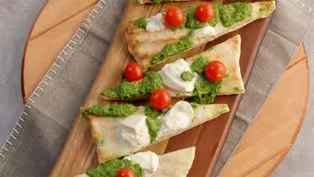
Burrata Flatbread with Arugula Pesto and Roasted Tomatoes
Video has Closed Captions
Clip: S4 Ep2 | 4m 37s | Flatbread is a hit for appetizers, lunch, or for a light dinner and easy to make. (4m 37s)
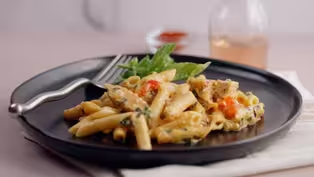
Creamy Basil Sauce with Chicken and Pasta Recipe
Video has Closed Captions
Clip: S4 Ep2 | 6m 25s | This creamy pasta is perfect with the acidity of the Cabernet Sauvignon Rose. (6m 25s)
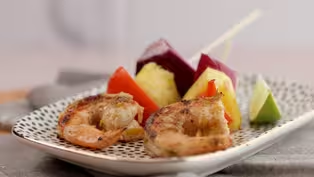
Jerk Shrimp and Pineapple Skewers
Video has Closed Captions
Clip: S4 Ep2 | 7m 57s | This rosé holds hints of cranberry and strawberry pairs with Jerk Shrimp or Chicken. (7m 57s)
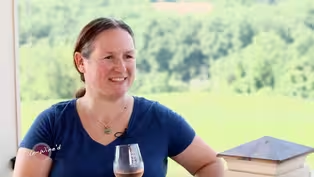
Melanie Natoli of Cana Vineyards and Winery of Middleburg
Video has Closed Captions
Clip: S4 Ep2 | 4m 35s | Winemaker Melanie Natoli talks about her best approach to making rosé wine. (4m 35s)
Providing Support for PBS.org
Learn Moreabout PBS online sponsorship
- Food
Christopher Kimball’s Milk Street Television
Transform home cooking with the editors of Christopher Kimball’s Milk Street Magazine.


Support for PBS provided by:
Un-Wine'd is a local public television program presented by VPM