
Carl Bernstein, Part 2
Season 14 Episode 10 | 26m 46sVideo has Closed Captions
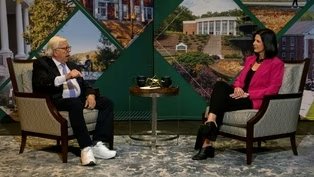
Alison concludes her conversation with legendary journalist Carl Bernstein.
In the second part of her conversation with legendary journalist Carl Bernstein, recorded in front of a live audience at Southern Adventist University, Alison dives into the Watergate era of Bernstein's career.
Problems playing video? | Closed Captioning Feedback
Problems playing video? | Closed Captioning Feedback
The A List With Alison Lebovitz is a local public television program presented by WTCI PBS
Funding for The A List with Alison Lebovitz comes from Chattanooga Funeral Home, Crematory and Florist.
Carl Bernstein, Part 2
Season 14 Episode 10 | 26m 46sVideo has Closed Captions
In the second part of her conversation with legendary journalist Carl Bernstein, recorded in front of a live audience at Southern Adventist University, Alison dives into the Watergate era of Bernstein's career.
Problems playing video? | Closed Captioning Feedback
How to Watch The A List With Alison Lebovitz
The A List With Alison Lebovitz is available to stream on pbs.org and the free PBS App, available on iPhone, Apple TV, Android TV, Android smartphones, Amazon Fire TV, Amazon Fire Tablet, Roku, Samsung Smart TV, and Vizio.
Providing Support for PBS.org
Learn Moreabout PBS online sponsorship- [Narrator] Funding for this program was provided by... - [Narrator] Chattanooga Funeral Home, Crematory, and Florist, dedicated to helping you celebrate your life, or the life of a loved one, for over 85 years.
Chattanooga Funeral Home believes that each funeral should be as unique and memorable as the life being honored.
- [Narrator] This program is also made possible by support from viewers like you.
Thank you.
- [Alison] Last time on The A-List.
- No, I took the typing test and the next day, I got a call from this guy, and he said, "Boy!
"You didn't tell me you could type like that."
And he hired me, $29 a week, and that was when I went to work in this exciting, fabulous place, where I learned pretty much all I know about this trade, including that truth is not neutral and about life.
- Join me for part two of my conversation with journalist and author, Carl Bernstein, coming up next on The A-List.
(upbeat music) (upbeat music) If you tuned in last week, you caught part one of my conversation with Carl Bernstein at Southern Adventist University.
We talked about his formative first years at the Washington Star when he was just a teenager, and how the early lessons he learned there set him on the path to make history with his reporting.
This week we'll learn how Carl and Bob Woodward uncovered the Watergate scandal, and we'll talk about why, in a world saturated with clickbait and the 24 hour news cycle, the truth still matters.
- So we have to then acknowledge the irony that this kid who spends all of these years chasing history ends up making history, and the journalist, who's going after the story, now has a million stories written about him and his writing partner.
How does that happen?
I mean, what...
I mean, right.
So in a million years... And goes to work for your biggest rivalry, right?
We're talking about against the Washington Post.
You end up at the Washington Post, and you and Bob Woodward end up becoming famous for your reporting, the gold star of what investigative journalism becomes in this country.
Did I oversell it?
I mean, it's... - Well, you went to the end of the story, and yeah, it was daunting.
It was a kind of awe, I think, that we both had when we sat together and watched Richard Nixon announce that he was gonna resign and the idea that yes, we had a role in this, but it's a myth that we brought Richard Nixon down.
Nixon brought himself down, and-- - But tell us about when you first met Bob Woodward.
- Well, wait, well, let me go back to this point that you've raised, and that is about luck.
Woodward and I have been so lucky.
And we were lucky to be in the right place at the right time on the day, on June 17th, 1972.
And we were told, or...
I won't go through the whole thing of how we got onto the story.
Woodward was sent down to the court where the burglars were being arraigned.
I was the chief Virginia correspondent at the time.
I could see that the story I was writing about the gubernatorial race in Virginia was not quite as interesting as this bugging that the people on the city desk were talking about at the Democratic headquarters.
And I went up to the city editor and said, "Hey, I'll make some calls."
And I made some calls, and got hold of the burglars' wives, and I learned some stuff about them and the CIA, and Woodward was learning about the CIA.
But I think what it's all about, and it's like anything else, if you're lucky enough to be at the right place at the right time, it's what you make of it.
And so, we've been so lucky, but we also have had this proximity, starting with Watergate, and we've been able to do something with it.
And yeah, I mean, I think both Bob and myself... Look, the two of us, on the 50th anniversary of Watergate, were on CNN, sitting next to each other, doing commentary on the January 6th Committee.
And we looked at each other and said, "Can you imagine a half century later, "the two of us are doing this?"
And it's very moving.
I'm not gonna kid you.
And luck.
- So I say to our kids all the time, though, I love the quote that "luck is when preparedness meets opportunity."
- Well, that's great.
That's the same same deal I'm talking about.
- Right, but okay, so...
I mean, we could literally spend three hours, or more, just talking about how Watergate went down and 'All The President's Men.'
What I really wanna know, and I think what everybody wants to know, right?
Dustin Hoffman, did you get to choose him to play you?
(audience laughing) - No.
- I mean, the resemblance is uncanny, I will say.
I don't know how Woodward got Robert Redford, but we won't go there.
- Once again, luck.
But how many people here have seen the movie, 'All The President's Men'?
The luck of having that movie made because people in this country know about Watergate, and know about all the things you're talking about, and the book... And the movie follows the book very closely because we insisted, and we sold the rights to Redford.
And we debated whether we were selling out by doing it.
And of course, we both sort of knew, "Okay, we're really gonna do this."
And...
But the publisher, the great publisher of the paper, Katharine Graham, she was... Really didn't want it to happen.
And Ben Bradlee, the great editor, probably the greatest editor of our era, he was really uncomfortable about it.
But we insisted to both the director, Alan Pakula, and the screenwriter, William Goldman, and Redford, producer, that it had to follow the book, absolutely had to be true and accurate.
And so, then they... Redford was gonna play Woodward, I won't even get into the irony of that, and then it was decided that Hoffman would play me.
But that movie is the reason, not just that Woodward and I have had this attention much more than the book, it's 50 years later, it's the movie.
Because of that movie, people in this country know what happened in Watergate, as well as what the role of the press was, not about our personal lives.
There's no love story in there, no women who are girlfriends or anything, just the reporting.
And so, without mythology based on fiction, here we were able to have...
I mean, how many people here can remember what's in the book of 'All The President's Men?'
One, two, three, so the power of that movie.
And it remains, it continues.
- Well, to that point, one of my favorite scenes is a pivotal moment when you're trying to convince Ben Bradlee... Well, they are trying to convince Jason Robards, who plays Ben Bradlee, to really go forth with the story.
And he says, "Okay, but nothing's riding on this except "the First Amendment of the Constitution, "freedom of the press, "and the future of this country."
Did that really happen?
- The words are compressed and the impression is not an exaggeration.
We had just learned about how this conspiracy went to the President of the United States and all of the principle aids to the President of the United States.
This mysterious source known as 'Deep Throat,' who we had revealed in the book of 'All The President's Men,' had told us that people's lives were in danger, possibly including our own.
And we went to Bradlee's house in the middle of the night, woke him up, he looked at us like we were crazy, and he said, "Come on in."
And we said, "No, you gotta come outside "because we've been told "that everybody's under surveillance."
And we went out on the front lawn and Ben's words were longer than that.
And did he say specifically "the future of the country is riding on this?"
I don't think those were his exact words.
Pretty much the others were all in there and the fact... And I can't remember the exact words, but he conveyed that, "Look, what's going on "in the country now, to some extent, "is gonna depend on what we do here."
That was what was conveyed.
- So with those words hanging on you, not just during Watergate but post-Watergate, for years after, for the past 50 years after, if the pen is indeed mightier than the sword, how do you responsibly wield that power?
- You report the truth.
And let me say something also about...
But that's the answer.
You report the truth wherever it falls, regardless of what the political implications might be, regardless of what side in an argument might benefit from the story.
But one of the things about the reporting on Watergate is, back to luck, we had the greatest publisher in the business, as well as the greatest editor in the business.
We had the support of this amazing journalistic institution.
I'll give you an example of Katharine Graham, this publisher, who took over the paper when her husband killed himself, shot himself to death, because he... Today, he probably would've been able to be treated for mental illness.
Whatever the case, her family owned the newspaper, she became the publisher, and entrusted the future of the newspaper to a 28 and 29 year old kid, Woodward and myself.
And the stakes were very high, very early.
Our fellow reporters, most of the national reporters in Washington, didn't believe what we were writing and reporting for a good while.
And early on, the Nixon Reelection Committee filed a suit, and the real purpose of the suit was to get our notes and to find out our sources.
And one day, I got a call from the guard at the desk downstairs, at the entrance to the paper, and he said, "There's a subpoena server here "with a subpoena for your notes."
I said, "Keep 'em there.
"Don't let 'em upstairs."
And I went to Ben Bradlee and I said "There's a subpoena server downstairs "who wants our notes."
And he says, "Keep 'em downstairs."
And he says, "let me go talk "to Katharine Graham," the publisher of The Post.
About five minutes, Bradlee comes to my desk, and looks at me and he says, "Katharine says they're not your notes, "they're her notes.
"And if anybody's gonna go to jail, "it's gonna be her".
It's, to this day, as emotional a moment as I've ever felt in journalism.
And then Bradlee, who was a very expressive guy, as you know from the movie of 'All The President's Men,' he looked looked at me and said, "Just imagine that!
"If our gal got sent down "to the women's house of detention "and walked out saying "she's gone to jail for the First Amendment, "and you took a picture of that.
"That would be on the front page "of every newspaper in the world.
"Our gal walking into that courthouse."
And it was really a brave and great moment.
- So where has that sense of trust gone, not just between an editorial staff, the publisher, its writers, but the public and the media?
And I know, even for you, you didn't just turn from a journalist to someone who the story's now written about, but really to a media critic, and someone who's, and I know Bob is the same, about holding the media accountable, yourselves included, for responsible journalism and what that looks like.
But how do journalists now navigate these waters where everybody's yelling fake news, where people are, admittedly, and I know I'm guilty of this, we're polarizing ourselves because we've isolated ourselves into these little bubbles where, instead of informing us of the news and the truth, we're reinforcing things that we already think are true?
- Well, that's the point.
I don't know...
I hope reporters aren't doing that.
It seems to me that... We make a mistake when we think of both politicians and journalists as separate entities from the rest of the culture in this country.
We are part of the culture of this country, we don't exist apart from it.
And one of the things that we have to recognize is that our audience... An example, at the time of the Watergate break-in, 25% of the people...
When the first facts were developed, 25% of the people, the polls show, thought, "Well, Nixon was probably guilty of this "and he ought to be prosecuted."
And eventually, you had this event where his tapes were discovered, and you'd had the so-called 'Saturday Night Massacre' where he fired the top officials, or the top officials of the Justice Department were forced to resign by Nixon.
But slowly the number of people, by the time of impeachment, something like 65, 70% of the people in this country believed that Richard Nixon had to go.
And in a minute, we should talk about Republicans and how they were the crucial heroes of Watergate at the time of impeachment.
But by that time, 70% of the people in this country believed, based on the best obtainable version of the truth, that Nixon had to go.
Today, people...
I can't give you a figure but I would say overwhelmingly, people of all political beliefs are looking for information to reinforce what they already believe.
Their religious prejudices, their political preferences, their... All aspects of the politicians they like.
They are looking not for the best obtainable version of the truth, but rather information to reinforce their already-held beliefs, so that the atmosphere in this country... You talked earlier about polarization.
One of the factors in polarization is there's not an openness to the truth similar to a couple generations ago.
I can't measure it, I can't give you a metric, but I know it's the case.
So that's a partial answer.
- And I will say we are lucky enough to live in a community, in Chattanooga, with the Chattanooga Times Free Press, where we still have and hold sacred two different opinion pieces, right?
I was talking to Chris Vass tonight and we were saying this is important because we've lost that sense of balance, where we need to understand and listen to other sides.
And I say this because I know we have so many incredible young minds with us tonight, emerging leaders, these are our future storytellers, these are our truth-tellers, what advice do you have to them as they navigate this?
- Let me first go to your point, "We've lost our sense of balance."
I'm not sure that that is the case of most reporters in this country, or most news organizations in this country, legitimate news organizations.
I think there's some real truth, if you look at news organizations that start with a point of view and not committed to the best obtainable version of the truth, I think people here might or might not like this, I think Fox News is in that category.
It's not open to the best obtainable version of the truth.
It's not an objective of Fox News to pursue the best obtainable version of the truth.
That's true of some other news organizations in this country, not necessarily on the left or the right.
But no, I think that most news organizations are looking for balance in the sense of "What are the facts?
"What is the context?"
I don't quite accept the premise that our news institutions and reporters, by and large, are swinging to one side or the other.
- Is the country balanced?
- Again, the country is what it is.
It's the people of the United States.
It's not just the politicians in Washington, It's not just the Journal, it's the people of the country.
And what we are terrible about is covering the people of the country and what's on their minds.
Therefore, we were so... A lot of people were so surprised in the media when Trump won.
There was a lot of evidence out there that he was gonna come close, or even perhaps win the election.
Another thing about reporting is there are too many reporters, particularly in Washington, who come from the two coasts, who go to fancy schools.
I think there ought to be more dropouts who are reporters, I'm serious, who experienced life in a different way than people who went to Ivy League schools, who may be closer, especially in their communities, to what goes on in the streets than some 21 year old right out of Yale.
I think we need people from Nebraska, from Wichita, from all over the country, to be at the New York Times and the Washington Post.
I think the idea that... One thing that the people of this country, again, I don't know the metric, but I think there are an awful lot of people in the country who believe, with some justification, that there is an elite at our newspapers, or news organizations, television.
I think there's really something to that.
- And so, to the students watching this, listening to this tonight, what's your advice?
- Get hired to go to work at a news organization, that's the first thing.
Start at the bottom and get your foot in the door, whether it's a weekly suburban newspaper, whether it's going in at a.... To the local television station, the PBS station, whatever there is where you're simply running errands, get there.
Find a place to go to work.
But really, the other thing, be a good listener.
I think that reporters very often tend to be lousy listeners.
I think most people will try to tell you their truth, may not be the best obtainable version of the truth.
You'll find that out as you try to check out what one person is telling you.
You go to multiple sources.
But I think there's a tendency among reporters, and I've noticed it since I was a kid, to go to somebody involved... Let's take an obvious example today, the Senate of the United States.
You got a reporter, he's got a notebook, you see him on camera, he goes up to Mitch McConnell and says, "Mitch McConnell, what do you think "of this horror that the Democrats "on the other side, in your view, are doing?'
And he gives you a great quote, McConnell.
Then you go to the Democratic leader, you go to Schumer.
You say, "Senator Schumer, "what do you think of this horror, "as you put it, "that's going on over in McConnell's party?"
And they trade words and you've got 'em in your notebook.
They get in front of the camera, they give this manufactured controversy, and that's the story.
It's not an exaggeration, really, what I'm saying.
It's not the story.
The story is to find out "what does the legislation mean?
"What does this vote really mean?
"What's really going on in committee, etc, etc?"
Too much of what we do is manufactured controversy, but we need to be good listeners.
We need to let people tell their story, and then go check it out.
Now, I think that the example I just gave, instead of wanting to listen to people who could tell that reporter what's going on, that reporter really had very little interest in it.
- So if you could imagine, perhaps, the final story about your life as a collective, what do you hope the headline will say?
- I'm not even going there.
(audience laughing) Come on.
One of the things I haven't conveyed perhaps enough about... Or maybe I have when I was at The Star though, is the excitement, the drama.
You talk about the kids here, the drama that you're surrounded by, there's an excitement to it.
And even if you're covering local politics, there's an excitement to it, about learning what's really going on.
You really are learning what's happening and that's an exhilarating thing to do.
And also, it is a real service.
The notion of service, without being too highfalutin, that's a great thing.
Anyway, enough of that.
- No, it is a service.
And Carl Bernstein, thank you for yours.
We appreciate it.
- Thank you.
(audience applauding) (upbeat music) - [Narrator] Get access to even more of the shows you love with WTCI Passport on the PBS video app.
Download it today.
- [Narrator] Funding for this program was provided by... - [Narrator] Chattanooga Funeral Home, Crematory, and Florist, dedicated to helping you celebrate your life, or the life of a loved one, for over 85 years.
Chattanooga Funeral Home believes that each funeral should be as unique and memorable as the life being honored.
- [Narrator] This program is also made possible by support from viewers like you.
Thank you.
Preview: How was Dustin Hoffman cast as Bernstein?
Preview: S14 Ep10 | 3m | Discussing the relevance of All The President's Men (3m)
Providing Support for PBS.org
Learn Moreabout PBS online sponsorship

- News and Public Affairs

Top journalists deliver compelling original analysis of the hour's headlines.













Support for PBS provided by:
The A List With Alison Lebovitz is a local public television program presented by WTCI PBS
Funding for The A List with Alison Lebovitz comes from Chattanooga Funeral Home, Crematory and Florist.