
Northwest Profiles
Casa Cano
Clip: Season 39 Episode 6 | 5m 42sVideo has Closed Captions
This husband and wife duo share a love for food and prioritize sustainable farming.
Casa Cano Farms is owned and operated by Jorge Cano and Madyson Versteeg. This husband and wife duo met while they were in high school and bonded over a love for food and farming. They incorporate pasture-raised livestock and intensive minimal-till vegetable production, resulting in more nutritious and better tasting food. Madyson and Jorge wish to better our community and our land.
Problems playing video? | Closed Captioning Feedback
Problems playing video? | Closed Captioning Feedback
Northwest Profiles is a local public television program presented by KSPS PBS
Funding for Northwest Profiles is provided by Idaho Central Credit Union, with additional funding from the Friends of KSPS.
Support provided by:

Northwest Profiles
Casa Cano
Clip: Season 39 Episode 6 | 5m 42sVideo has Closed Captions
Casa Cano Farms is owned and operated by Jorge Cano and Madyson Versteeg. This husband and wife duo met while they were in high school and bonded over a love for food and farming. They incorporate pasture-raised livestock and intensive minimal-till vegetable production, resulting in more nutritious and better tasting food. Madyson and Jorge wish to better our community and our land.
Problems playing video? | Closed Captioning Feedback
Where to Watch Northwest Profiles
Northwest Profiles is available to stream on pbs.org and the PBS app.
Providing Support for PBS.org
Learn Moreabout PBS online sponsorshipFarming inspires me because I am able to grow food for my community and for my family, while also taking care of the earth.
It's kind of turned into like my big art project, so everything we've done has become an expression of ourselves.
Jorge Cano and Madyson Versteeg are the husband and wife duo behind Casa Cano Farms, located in Valleyford, Washington.
A lot of families come here weekly.
They get to interact with us and walk around the fields and go up to the livestock and get to see it for themselves and ask questions to us.
People are really excited to come out and actually pick what they're eating.
It's just turned into a really nice environment.
Jorge and Madyson met while they were still in high school and bonded over a love for food, farming, and living off the land.
I was thinking back, our first date was picking up chicken food at Northwest Seed and Pet for his backyard chickens.
Both of us were inspired in an environmental studies class, and just wanted to know everything about what I was eating and how to make it and where it came from.
So we both went to the University of Montana and graduated with a Bachelor of Arts in their Environmental Studies program.
Our senior year, we started a farm for a nonprofit in Missoula.
And then the Clark Fork flooded that year and washed all the top soil away.
And you can see the pan of where I had roto tilled everything and it's like it was hard as concrete, and you can see the waves from the roto tiller.
And so that was the start of our no till journey.
Tilling allows moisture and air to permeate soil, encouraging seeds to germinate and roots to grow.
But long term and frequent tilling can cause a host of problems.
Tilling can make soil vulnerable to wind and water erosion, damaging a farmer's property and polluting the watershed.
No till farming, direct seeding, and other sustainable practices.
Enriches soil with organic matter.
Increases water holding capacity, and protects crops during periods of drought and flooding.
When we terminate the crop, we cut it out, leave the roots in the ground, and then plant our next crop.
The biology that's on the old root system can jump to this new living root system and keep the cycle going.
And over time, it's become exponential the amount of biology we have.
Very good.
This is the garlic.
So we planted this in the fall.
So since this is no till we just drilled holes and then put each bulb and in the hole.
And then we moved to a second cutting alfalfa and gives it the fertilizer it needs for the season.
So this is where a lot of the magic happens.
We start all of our seeds for the plants that we're going to plant out into our own fields.
And then we also start a lot of plants for home gardeners in the spring.
A lot of the microgreens are going to Luna and Wild Sage.
We also sell to Gander and Ryegrass, South Perry Pizza, Latah Bistro.
I can show you some bugs if you want, but you can see right here.
All of these are called aphid mummies.
So they're aphids that were parasitized by a parasitic wasp.
And so out of each one of these is going to hatch a new parasitic wasp that will go and parasitized more aphids.
So this is like natural bug control that's just native here.
We haven't introduced these.
Which is pretty cool.
To me sustainable farming is being able to farm in an ecosystem and be able to do that, like indefinitely.
To have that sustain.
The fact that people are interested in this on the thousands of acres scale is really exciting.
Having them be able to take some of the stuff that we've been doing for years on our farm and lots of small farms around the country, and apply that to a lot of acres, improves water quality for all of us.
There's just an element of magic.
Planting seeds and seeing them germinate.
It's pretty amazing.
And so I think that continues to give me hope.
I'm excited to see how we keep growing with it, evolving.
The environment we've built here on the farm is is a happy place.
We like to think it's just because of the practices and kind of all the work we've put into it, speaks for itself.
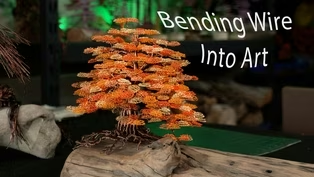
Video has Closed Captions
Clip: S39 Ep6 | 5m 31s | Watch as North Idaho wire artist Morgan McBride creates art that celebrates Bonsai. (5m 31s)
Video has Closed Captions
Preview: S39 Ep6 | 30s | Casa Cano Farms, Bonsai in Wire, Calgary's BUMP Festival, and Revolutionary Sons and Daughters. (30s)
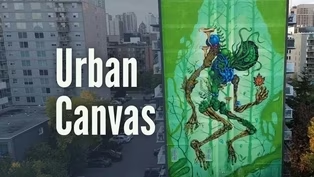
Video has Closed Captions
Clip: S39 Ep6 | 7m 33s | BUMP is one of Canada’s leading mural festivals and has transformed how Calgary looks and feels. (7m 33s)
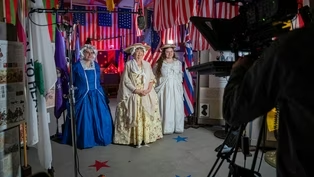
More Than Tea and Costumes: The Real DAR and SAR
Video has Closed Captions
Clip: S39 Ep6 | 6m 55s | Discover the real work of the Sons and Daughters of the American Revolution in the Inland Northwest. (6m 55s)
Providing Support for PBS.org
Learn Moreabout PBS online sponsorship











Support for PBS provided by:
Northwest Profiles is a local public television program presented by KSPS PBS
Funding for Northwest Profiles is provided by Idaho Central Credit Union, with additional funding from the Friends of KSPS.