
Northwest Profiles
More Than Tea and Costumes: The Real DAR and SAR
Clip: Season 39 Episode 6 | 6m 55sVideo has Closed Captions
Discover the real work of the Sons and Daughters of the American Revolution in the Inland Northwest.
Far from the stereotypes seen on TV, the Daughters of the American Revolution (DAR) and Sons of the American Revolution (SAR) are dedicated to historic preservation, education, genealogy, and supporting veterans. Learn how members in the Inland Northwest are preserving America’s past in surprising and meaningful ways.
Problems playing video? | Closed Captioning Feedback
Problems playing video? | Closed Captioning Feedback
Northwest Profiles is a local public television program presented by KSPS PBS
Funding for Northwest Profiles is provided by Idaho Central Credit Union, with additional funding from the Friends of KSPS.
Support provided by:

Northwest Profiles
More Than Tea and Costumes: The Real DAR and SAR
Clip: Season 39 Episode 6 | 6m 55sVideo has Closed Captions
Far from the stereotypes seen on TV, the Daughters of the American Revolution (DAR) and Sons of the American Revolution (SAR) are dedicated to historic preservation, education, genealogy, and supporting veterans. Learn how members in the Inland Northwest are preserving America’s past in surprising and meaningful ways.
Problems playing video? | Closed Captioning Feedback
Where to Watch Northwest Profiles
Northwest Profiles is available to stream on pbs.org and the PBS app.
Providing Support for PBS.org
Learn Moreabout PBS online sponsorshipOh, yeah, I'm in DAR.
And they say, oh, you mean like on the Gilmore Girls?
And I say, no, it's not like that.
[Laughs] On Gilmore Girls, The Daughters of the American Revolution is portrayed as an exclusive high society club, complete with teas, parties and at times, elitist attitudes.
While entertaining for TV, the depiction of the DAR as an organization only for East Coast socialites couldn't be further from reality.
The mission of DAR is, all built on the pillars of historic preservation, education and patriotism.
With nearly 200,000 members spread across the country, DAR members like Janelle Braithwait volunteer millions of service hours each year.
Even right here in the northwest, thousands of miles from the battles of the American Revolution.
There is something for everybody, no matter what your interests are.
If you like genealogy, DARs for you, if you like patriotism and you like to serve veterans, DAR is for you.
If you like to work with schoolchildren and promote education and literacy, DAR is for you.
It has something for everyone.
It's not an exaggeration.
However, there is an important requirement to join.
They have to prove their lineage clear back to a patriot.
Okay, so maybe it's just a little exclusive.
This is where the work really starts.
You can spend a lot of time on this because this is going back through every generation, back to your patriot, which for me that's eight generations back.
This would be my dad and this would be my patriot.
So this can be a long process to get all the data.
But we've got great people to help you.
So then once it goes off to National and they bless you, then that's your primary patriot, they call it.
You might be surprised to learn there is enough direct lineage to the Revolutionary War here in our region to support four local DAR chapters, as well as a separate organization for the men.
[Stan] I am a member of the Sons of American Revolution and have been for 20 years.
Stan Wills is also the curator of the Spokane Flag Museum.
During the American Revolution, George Washington was elected head of the army, and he had his own flag.
Essex Hopkins was elected the head of the Navy, and he had his own flag.
So we have 13 stripes and 13 stars.
The museum was a labor of love for Wills and the other members of the SAR after seeing a need.
We had a booth set up at a local fair, and we were asking history questions for kids and they couldn't answer the questions.
So we decided we would start a program to educate the community about the history of the American flag.
The Spokane Flag Museum is just one way these organizations help educate youth.
One of their favorite things to do is to show kids what their life would have been like 250 years ago.
Kids are fascinated with the toys that they would have played with.
The toothbrush.
How they made combs, how they made bowls.
They want to know the living history of our country.
So, that's our goal is to teach them about what it was like to be a kid in 1776.
Members are also passionate about supporting active duty military and veterans and preserving historic sites and monuments.
This is a Patriots Plaza.
Patriots Plaza not only honors our region's patriots.
It was completed at the perfect time to serve as an educational tool for America 250.
Each of these bricks is the name of a patriot.
Mostly of the people in Washington state who are members of the Daughters of the American Revolution.
We did get some extra funding.
So there's like, Andrew Jackson, George Washington, and the ones that we know who are historically important.
The others are all family members of ours.
These folks do a lot for their local communities.
And as you've probably noticed, they do it in style.
I get a lot of comments.
Oh, I love your dress.
You know, stuff like that.
And these girls at Gonzaga we're going, I love your dress.
Oh my God.
And they're running up to me.
And and they just loved it.
Hi.
My name is Joanne Heye.
I am a member of the May Hutton chapter of the DAR.
This is my collection of reenactment clothing from the 18th century, primarily 1775 to about 1790.
What women would have worn during the colonial period in the 13 original colonies.
We'll start at the skin.
The only thing that was worn next to the skin, other than maybe stockings, was the shift.
And this is a call to stay.
Not a corset, there is a difference.
Corsets came along much later.
Its amazing how much gets tied under your clothes you never see.
But these would go here.
But... back in that time, they didn't have purses.
They had pockets.
And these pockets would be tied around underneath.
Before you put all your petticoats and stuff on, you would put this pocket, tie it around your waist.
You could put your money and stuff or Kleenex or tissues or whatever you need.
But you can see the opening on the side.
That's where you would go for your pocket.
It would be through this.
And then you'd reach in for your stuff, for your money and things.
It's all done very complicated for a very simple purpose, but it works.
It's definitely a learning curve when you start doing this.
But it's more than playing dress up.
Getting noticed is the point.
It actually, attracts attention.
That's that's the truth.
We want them to pay attention to what we're doing there.
We're marching in the parade to get the word out about our 250th anniversary, to get the word out about DAR and SAR, to get the word out about flags and the proper use of flags.
And so if we're just wearing our normal clothes, that's okay.
But... they really pay attention to what we're doing if we're dressed in costume.
And there's no better time to pay attention and reflect as we celebrate America's founding.
And look ahead to what the next 250 years might hold.
Our goal, above all else, is to make sure that our history is not forgotten, that the stories of our patriots stay alive and the stories of their descendants stay alive, so that we can continue to know our history and grow from our history and grow into the future.
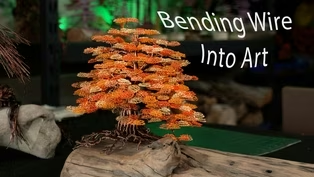
Video has Closed Captions
Clip: S39 Ep6 | 5m 31s | Watch as North Idaho wire artist Morgan McBride creates art that celebrates Bonsai. (5m 31s)
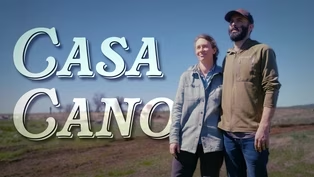
Video has Closed Captions
Clip: S39 Ep6 | 5m 42s | This husband and wife duo share a love for food and prioritize sustainable farming. (5m 42s)
Video has Closed Captions
Preview: S39 Ep6 | 30s | Casa Cano Farms, Bonsai in Wire, Calgary's BUMP Festival, and Revolutionary Sons and Daughters. (30s)
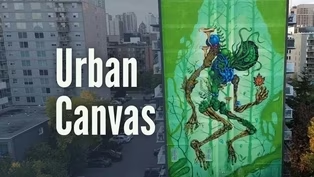
Video has Closed Captions
Clip: S39 Ep6 | 7m 33s | BUMP is one of Canada’s leading mural festivals and has transformed how Calgary looks and feels. (7m 33s)
Providing Support for PBS.org
Learn Moreabout PBS online sponsorship











Support for PBS provided by:
Northwest Profiles is a local public television program presented by KSPS PBS
Funding for Northwest Profiles is provided by Idaho Central Credit Union, with additional funding from the Friends of KSPS.