Virginia Currents
Celebrating 30 Years - Inspiring Places
Season 30 Episode 9 | 26m 46sVideo has Closed Captions
Look back at just a few of the inspiring places Virginia Currents has visited
Celebrate the stories and storytellers of Virginia Currents by looking back at a few of the inspiring places we have visited over the years. Learn about the St. Philip School of Nursing - one of the first schools in Virginia to provide medical education to African American women. Travel to a Correctional Center with a unique training program that pairs incarcerated individuals with shelter dogs.
Problems playing video? | Closed Captioning Feedback
Problems playing video? | Closed Captioning Feedback
Virginia Currents is a local public television program presented by VPM
Virginia Currents
Celebrating 30 Years - Inspiring Places
Season 30 Episode 9 | 26m 46sVideo has Closed Captions
Celebrate the stories and storytellers of Virginia Currents by looking back at a few of the inspiring places we have visited over the years. Learn about the St. Philip School of Nursing - one of the first schools in Virginia to provide medical education to African American women. Travel to a Correctional Center with a unique training program that pairs incarcerated individuals with shelter dogs.
Problems playing video? | Closed Captioning Feedback
How to Watch Virginia Currents
Virginia Currents is available to stream on pbs.org and the free PBS App, available on iPhone, Apple TV, Android TV, Android smartphones, Amazon Fire TV, Amazon Fire Tablet, Roku, Samsung Smart TV, and Vizio.
Providing Support for PBS.org
Learn Moreabout PBS online sponsorship(gentle music) >>At the height of the trade, 10,000 individuals a month were sold down river.
>>We were losing 25 to 30 feet of shoreline a year there and they completed that one in 89 and we haven't lost an inch.
>>My parents advice was you just have to know who you are.
As long as you know who you are don't worry about who they think you are.
And that's what got us through.
>>Rescuing these dogs means a lot to me personally because I feel like we as being in prison, we deserve a second chance, where these dogs do too.
(upbeat music) >>Thank you for joining us as we celebrate 30 years of Virginia Currents.
I'm Amy Lacey.
Over three decades we've had a chance to visit and learn about so many inspiring places and a few stick out.
The trail of enslaved Africans is a walking trail that tells Richmond's part in the trafficking and enslavement of Africans to Virginia until 1775.
And away from Virginia to other locations in the Americas until 1865.
The Elegba Folklore Society and Unlocking RVA share their experiences.
(ominous music) >>It's really disturbing that the history of African-American people is so insignificant to the recorders of history that the trail was just someplace in the woods of that river.
It's sorta like when people say, "I don't see color."
Well if you don't see color, then you don't see me.
Elegba comes from the Yoruba cosmology and they have a spiritual path called LFA.
And inside LFA there are Orisha or intercessors or aspects of nature.
And Elegba or Eshu-Elegbara is one of those Orisha.
And his job is to open the roads to bring clarity out of confusion.
(drum music) So as an African center cultural arts and education organization here in Richmond, the place where more Africans came through than anyplace else and that revolving door of an economic market that furnished the whole entire deep South of unpaid labor.
We hope that our programs are road opening experiences.
>>I was doing a walk with Bon Secour a couple of years ago and the question was raised, how could you do this?
How could your people survive this?
And the young lady said she asked that question to her grandmother.
And the grandmother said, "Because I knew you were coming."
We have to always know that there is someone coming behind us and how we handle that.
When I first started doing this work I didn't have grandchildren.
And I would say, "I'm doing this work for my grandchildren."
>>Our intention is to elevate the level of importance of aspects of the African diaspora.
>>Consider the language that we use when we talk about enslaved individuals.
If you notice, you haven't heard me use the word slave.
When I talk about slave, I talk about it from an institutional standpoint.
The institution of it.
But when I talk about the individuals, I use the word enslave.
>>And so that's why even though the official name of that geography is the Richmond Slave Trail.
We at the Elegba Folklore Society and we have encouraged others and some have call it the trail of enslaved Africans because these were people who were caught up in the condition of enslavement.
They had hearts, they had minds.
They had families that they left behind.
Many of the locations no longer exists.
So you have to just say it was here.
We got out the research, finding the narratives of our ancestors so that people could hopefully feel something when it's in a head space you can just kind of toss words around.
You're still distanced from what has occurred.
>>This is the actual site where the Lumpkin's jail compound was.
>>And we're at a depth of between 10 and 14 feet below the parking level grade here right now.
And we're actually beginning to find evidence of variety of features that relate to the Lumpkin's Slave Jail complex.
We found a large area of cobble paving.
We know from the historical descriptions that there was a large courtyard area in the center of his property.
And we found evidence of that.
>>The jail would often hold enslaved individuals that were bought into Richmond to be sold.
But Robert Lumpkin's apparently fell in love with one of his enslaved individuals.
Her name was Mary Lumpkin's.
He willed his property to the mother of his children.
In 1867, a baptist minister by the name of Nat Daniel Kovar came to Richmond to find a place to start a school for free blacks.
Someone referred that Nat Daniel Kovar to Mary Lumpkin's.
Mary Lumpkin's leased this place that was formerly called the Devil's Half Acre to Nat Daniel Kovar.
And he started the Kovar institution.
A couple of years later, that institution merge but they form what we know as Virginia Union University.
(instrumental music) (singing in foreign language) >>Richmond is a place where the pebble dropped.
And if we can get our social, cultural, historical and therefore economic realities straightened out in Richmond, just like Richmond helped to shape America's evolution.
Then it can help to get it straightened out now.
(singing in foreign language) >>For more information on Janine's organization, Elegba Folklore Society, visit efsinc.org.
Also visit unlockingRVA.com.
Tangier is an Island in the Chesapeake Bay that was settled by native Americans prior to John Smith's arrival in 1608.
Having shrunk by approximately two thirds since the mid 1800s, Tangier faces continuing loss of land due to erosion and sea rise.
Despite these odds, residents are resilient.
(boat engine roaring) (instrumental music) >>Our shore line is just soft sand material and constant wave action just chews it up.
I mean this erosion is nothing new.
It's been going on for years but it's gotten to the point we can't give up anymore.
There used to be a community out there.
It was called Oyster Creek.
It was connected to the main Island, Marsh land along here.
And then it came up to high ground.
Trees and homes out there.
And the marshland eroded, left an Island out there and eventually the Island went away but I would say back in 1852, the island was three times larger than it is now.
(Instrumental music) One lady told me, she said, "You need to find an endangered species."
I said, "We have one, our waterman."
We're not just talking about a piece of land.
We're talking about a culture, a way of life.
>>It is an endangered place.
It's more than just threatened, it's on the verge of extinction and it's not only the climate that's the problem.
It's the whole way of life is disappearing because of our aging population.
People aren't staying here because there's no jobs.
It's really refreshing when someone moves back because they went to the real world and they found out they didn't like it.
And they'll come back and make it work.
(instrumental music) >>So I moved off the Island in the hopes that I was just gonna be a rock star and make it work and found out that without an education, I was very very limited.
My son hated it off the islands.
So we came back and I really, really wanted to do something to make something of myself and show my son how important it was to further one's education and to have goals and dreams.
And so I finished my degree when we got back and I also opened this business.
When I came back, I was very appreciative of what I had left.
(water splashing) >>And here folks were very self-reliant but this erosion thing is something too big for us to tackle on our own.
And we stay positive and tell the folks don't lose hope.
So we remain optimistic and keep fighting for the same role.
It's just keeping the waves away from the shoreline.
The government is in the process of giving us another section of sea wall in the winter time in December.
That should pretty well shore up the West side of Tangier.
What we're gonna do next winter, we'll protect the Harbor area, and some of the land (indistinct) And I think we'll be in good shape on the West side.
And we'll kind of focus on the East side.
Tangier islands are healthy, thriving, working waterman's community.
And we harvest a lot of seafood, soft crabs, hard crabs, oysters.
Seafood is what it's all about out here.
And if you're there are crabbers and oysters are doing good, then the economy good on the Island.
And it's good for the folks who went into tourist business.
They create jobs for some of the folks on the Island.
And folks enjoy coming out of here.
>>I'll fix a lawnmower for somebody or I'll fix a washing machine for somebody and they're Waterman.
So they'll bring me a bushel of crabs.
I'm overjoyed with that because it's an amazing feeling.
You can really help people.
My wife's family and my family think we're crazy for moving out here.
Why would you move to a place that is clearly endangered by storms and by sea level rise and by the cultural problems.
And that's one of the reasons we moved here.
That's one of the things that endeared us to the Island is the fact that it is more of a place where you literally have to think about life.
This is really is a village of people and everybody chips in.
I mean, our police officer on the Island is also the trash man on Tuesdays and Fridays.
Everybody has a second job to take care of things because without that the island won't survive.
And that's one thing that we've lost as a culture that the Island still has and that's what drew me here.
(motorcycle engine roaring) >>Born and raised here.
My father was a crabber grandfather, great-grandfather.
My older son's a crabber.
Since world war I, we've had a lot of folks.
I don't know what the number is that served in the military from here.
And they gave up everything they had to serve in the military.
And now we're in need of help from the government.
And we were important enough then to sent our boys from Tangier to fight for the country.
We would hope we're important enough now to save it.
We've been out of here for a couple of 100 years.
We'd like to stay for a couple 100 more anyway.
(instrumental music) (bird chirping) >>The St. Philips school of nursing for African-American women closed it's stores in Richmond in 1962 and integrated it students with the white students at MCV school of nursing.
In this 2006 segment, former students are Arlethia Vaughan Rogers, Vivian Harris Bagby and Virginia Roane recount challenges and rewards that occupied their paths as independent and forward-thinking nurses in a time of racism.
>>Although we were segregated, I think the same standards were set for our school that had been set for the MVC school nurses.
There were very few same full of nurses who failed the state board.
>>We had to improvise and reuse what else they recycle and reuse.
That's what we did.
That's exactly what we did.
We didn't have linen to change beds sometimes.
And the nurses talk about having to sharpen the needles instead of having needles available to change when you gave injection.
>>Disposable needles.
We didn't have disposable needles.
>>We didn't even have disposable anything.
You had to wrap up, do all the syringes and use the sterilizer.
>>It was either 67 or 68.
I was working as a staff nurse at St. Philips hospital.
When they got a call from Washington and told them they had to integrate in 48 hours else they were gonna take the Hill-Burton grant away.
That's a big grant that came from the federal government for medical facilities.
So they literally rolled the patients through the tunnels.
There are tunnels that could connect these buildings.
They literally rolled them.
White patients to the black side and the black patients to the white side and the nurses had to do the same thing.
And I remember coming to work that next day and my supervisor approaching me, asking me to go to the 15th floor of MCV.
I had a lot of admiration for her.
She was quite an influence in my life.
And I think I mostly did it because she wanted me to do it not because I wanted to do it.
It was difficult.
There were a lot of rejections over there, but I wasn't rejected by everyone because I was the only black nurse on the floor.
But I remembered what Ms. Lacey told me, you are going over there to give those patients the best care possible like you're doing these patients over here.
I kept that in my mind.
And that helped me forget the rest of it.
>>If I went to go out to get something to eat you couldn't sit down in the restaurants.
If you went in to order something, you would order it, you'd stand and you'd wait for it and you'd leave.
But one time we went in this little ice cream parlor that was right up on broad street near the campus.
And we were ordering for several people back at the dorm.
So we went in there and my friend didn't sit on the stool but she leaned against it.
And the lady was in the midst of fixing all of this.
And she said, "You can't sit down in here."
So we waited until she had finished all of these things.
And then we told her to keep them.
And we went out and just laughed.
And every time we walked by there and would see her, We would just wave (laughing).
>>There was one instant of a cancer patient who had pain.
And I guess this was around five or six o'clock that he needed his pain medication.
But he didn't realize I was the only one on the floor who could administer the drug.
And he just said he couldn't take it from me.
So he just turned it down until 11 o'clock.
11 o'clock a white nurse came on to relieve me.
And he just stayed in pain until she got there.
I felt sorry for him because I knew he was in pain.
(air swooshing) >>I was traveling with my husband.
I stopped at the service station to get gas.
And I saw this white man looking at me and I go, "What do he want?"
So he came to the car and he said, "Aren't you a nurse at the St. Philips hospital?"
And I said, "Yes."
And he said, "Oh, hold on just a minute."
And I thought, is he going back in and then to come out what is he going to do?
He went in there and he brought me out a four set of glasses.
And he said, "I had wanted to get "buying you and give you something."
Because he said, "People think that people "of color can't do anything."
He said, "But I had the best experience "that I can ever have in a hospital."
And I thought that was awesome.
I didn't even remember him, but he remembered me.
>>There are a lot of mean ugly people in this world.
And they're mean and ugly for different reasons.
Some of them are taught that way.
White friends who tell me later, who have told me later in life that had they never met me and decided to become my friend, they would've never seen blacks in that perspective.
>>If I held grudges, it hurts the person who's mad.
It doesn't hurt the person that you're mad at.
So, and I never wanted to live my life that way.
Things happen, the times were different.
Things have changed now, but I'm always wanting to speak out so that, that will not happen to anyone again.
>>We caught up with the three women before they attended a garden party for the St. Philip alums at the VCU school of nursing.
The garden actually retains a bit of history, a cornerstone of the old St. Philip hall, which has long since been torn down.
For more on the VCU School of Nursing, visit nursing.vcu.edu.
>>Participants in the Pixies pen pals program have something in common.
Both are locked up, so to speak and rely on each other for life-changing skills.
Select prison inmates are educated by professional dog trainers and then train shelter dogs that have a record of behavioral or obedience issues.
At the Goochland County Virginia Correctional Center For Women, we meet Daisy and Ryder who just a few weeks earlier were not able to follow simple commands like stay and sit.
>>Hi.
>>Hi.
>>May I say hi to your dog?
>>Now face her, straight on.
There you go.
Now take a breath.
(breathing heavily) There you go.
Now turn, actually like, there you go.
Now release her to come say hi.
Hi sweetie (indistinct) >>The name of the program is Pixie's Pen Pals.
It's run by Fetch A Cure and 2 Speak Dog.
And the mission is to pull dogs out of shelters that would have otherwise been euthanized and rehabilitate them to teach them both behavior and obedience.
Make them good family pets.
The other side is the human side, is to teach the offenders a life skill that they might be able to use when they get out, to teach them better communication skills.
To give them a purpose and a feeling of self-worth and a reason to keep doing their best every day until their sentence is over and really just improve their lives both inside and once they get out.
>>Ryder makes me feel like I'm needed.
That I'm useful, that I'm needed that I'm not just sitting in prison doing nothing.
I'm actually helping them and they're helping me.
They give me companionship, you couldn't do this.
He was not gonna tolerate any kind of body handling, any kind of closeness.
He was not.
So as you have taught us, take a deep breath and it actually it'll calm him down.
>>There's a team of two per each dog.
They room together.
And the dog has a crate in the room.
The handlers feed them, bathe them, brush their teeth, clip their nails.
It's 100% on them.
I'm only here for two hours once a week.
And they do all the training all the rest of the time seven days a week, they're working with the dogs.
>>What makes this so special is the human element in it.
Giving them responsibility, empowering them to take onus, gives them the satisfaction of saying, "Hey "I'm doing something great.
"And I'm getting unconditional love "and I'm giving it back and I'm adding to society."
It just gives them so much more self esteem.
And that part is important to me to watch them grow.
All right Valerie, I want you to take me through the adoption process.
>>Okay.
>>All right, I just wanna-- >>The work skills I've learned honestly are patience and being able to be more compassionate with people.
>>She jumps on the kids.
What do I come out and say down?
Or did the kids say down?
>>Well, I think that they should say down, but I think that that would be good.
If you're showing them, then teach them how to show her to do things.
I've learned better skills at trying to tell people what they can do for a dog and what a dog can do for them and how to teach their dog this or how to teach their dog that.
We have officers come to us and say, "When my dog's doing this.
"What can I do?"
>>Can we just teach the cross your arms, stay still freeze, right?
So you can tell the kids to freeze and say down because she knows that cue.
When they hear down the first time that's parent cue to come in and then back that up, okay?
>>Okay.
>>Leave it, leave it.
>>There you go.
Stand over it if you have to, good.
And then walk on.
Let's go.
>>Let's go.
>>Yeah.
So this is not surprising, right?
>>Right.
>>There's a bag full of dog treats that he loves, he's there.
Good, reward that luck.
>>Good boy.
>>Yes.
>>That was a good boy.
>>And then see if he'll walk past.
Let's go.
>>Let's go.
Leave it.
Good boy.
Yes, good.
>>That's a good boy.
>>Get the ball.
It has saved my life and it has made me a much better person.
The person I used to be just gives you such self-esteem and helps us to grow in that way too.
So they've really taught me that and that I'm a good person.
I may have done bad things.
I may have done something wrong and made mistakes but I'm not a mistake.
And I can actually be a person that can help these animals.
>>The best thing about this program is it's not only helping us, it's helping the women here too.
Some of the women come in from work, because we have jobs here.
They come in from work.
And the first thing they wanna do is just pet a dog.
And it actually brings their anxiety level way down.
And it does for us also.
>>I feel very blessed and proud that I can send a dog out to a home.
And they're gonna have a family pet because of what I've done.
Let's say our prayers.
I can't even begin to put it into words.
Amen.
>>I get to see dogs that I picked from a shelter that were downtrodden and depressed and they come out of the program and get a new family.
And we get pictures of the dogs at the beach and on hikes.
And it's so rewarding.
It's the most amazing thing in the world.
>>Can I have a kiss?
Thank you.
>>It's not just, I saved a dog.
It's I changed a family.
I changed a person, >>Good girl.
>>Not long after the interview, Daisy and Ryder were adopted by two loving families.
To find out more about the Pixies Pen Pals program, visit fetchAcure.org Thanks for joining us for this look back at just a few of the highlights from 30 years of Virginia Currents.
I'm Amy Lacey.
(upbeat music) (instrumental music)
Video has Closed Captions
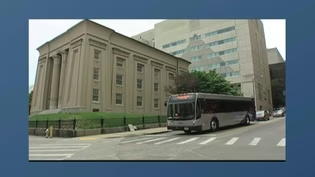
Clip: S30 Ep9 | 9m 15s | Learn about an early school in Virginia that provided medical education to Black women (9m 15s)
Providing Support for PBS.org
Learn Moreabout PBS online sponsorship















Support for PBS provided by:
Virginia Currents is a local public television program presented by VPM