
Celebrating America 250: Made With Love
Special | 56m 38sVideo has Closed Captions
Explore America’s founding spirit through the works of modern artisans keeping traditions alive.
Explore America’s founding spirit through the works of modern artisans keeping traditions alive. From boatbuilders to blacksmiths to a glassblower remaking the ancient art, these creators illustrate the many cultures that built this country. A commemoration of the 250th anniversary of the Declaration of Independence, the series crisscrosses the country to profile these dedicated artisans.
Problems playing video? | Closed Captioning Feedback
Problems playing video? | Closed Captioning Feedback
Support provided by:

Celebrating America 250: Made With Love
Special | 56m 38sVideo has Closed Captions
Explore America’s founding spirit through the works of modern artisans keeping traditions alive. From boatbuilders to blacksmiths to a glassblower remaking the ancient art, these creators illustrate the many cultures that built this country. A commemoration of the 250th anniversary of the Declaration of Independence, the series crisscrosses the country to profile these dedicated artisans.
Problems playing video? | Closed Captioning Feedback
Where to Watch Made With Love
Made With Love is available to stream on pbs.org and the PBS app.
Buy Now
Made With Love
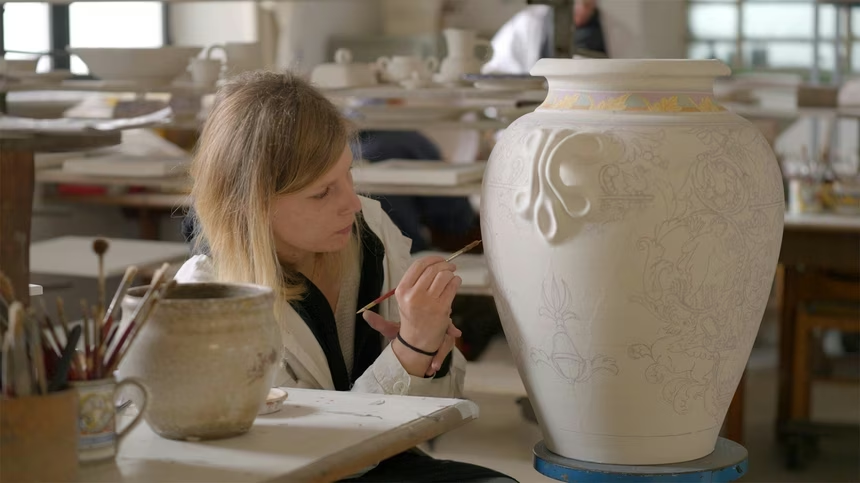
Made with Love celebrates the artisans keeping age-old traditions alive — an intimate journey into their workshops, kitchens, and the passionate hands behind extraordinary craft. Without them, a piece of our shared heritage would be lost.Providing Support for PBS.org
Learn Moreabout PBS online sponsorshipNarrator: America... ♪ a nation sparked by courage and conviction, shaped by revolutionary ideas... ♪ and built on promises of freedom, equality, and justice for all.
While the Founding Fathers laid out this vision, a group of dedicated artisans helped to make it a reality one era to the next.
These makers led the way into new frontiers... [Hiss] uniting the country in times of change and finding glory in their creative passion.
♪ Today, a new generation of creators are bringing their work into the modern age along with the shared values of our Founding Fathers as we celebrate America's 250th anniversary.
♪ ♪ America started with the fight for independence... ♪ as a small group of underdogs faced off against the army of a global superpower.
Man: Fire!
[Soldiers shouting] Massachusetts was the site of the Revolutionary War's first battles and the heart of the Colonial resistance.
The area's fishermen were key to the fight.
They armed and manned the first American Navy and Coast Guard units.
Coastal trade routes here were used as military supply lines.
Small fishing boats transported troops and supplies.
♪ After the war was won, similar boats revolutionized cod fishing in New England, and it is said that they were pioneered right here at Lowell's Boat Shop.
♪ Man: Lowell's Boat Shop is the oldest boat shop in America.
Narrator: Lowell's has been making boats since George Washington was president.
In 1793, the Lowell family began making the dory.
These affordable, easy-to-build boats were soon used all along the Northeastern coastline.
Man: Historically, dories were mainly used for fishing and getting about, so they were pretty ubiquitous.
Narrator: By the early 20th century, Lowell's was turning out more than 2,000 a year.
By the mid-20th century, the dory had given way to more modern fishing vessels, but after more than two centuries... [Hammer pounding] Lowell's boat shop is still in business in part thanks to Graham Mackay.
I'm Graham Mackay, and I'm a boat builder from Amesbury, Massachusetts.
Narrator: Today, Lowell's is a historic landmark and an active boatbuilding workshop.
Graham: We still build boats commercially, but part of the mission is to carry on the craft and the business.
Narrator: Graham educates visitors about the historic importance of the dory and also helps build them.
♪ Graham: So the building process starts with the bottom of the boat... and the bottom really dictates everything.
Narrator: These dories are made with traditional tools and locally sourced wood just as they were in the 18th century.
♪ Graham: Building these boats using some modern materials is necessary, but really, you can't mechanize the process too much because it's all handwork.
Narrator: They often shape the boats' design using plans handed down from one boat maker to the next.
Graham: This is a type that would have been built here in the 1880s and 1890s.
Narrator: They trace a pattern for the bottom of the boat... ♪ cut it out... ♪ Then start to create the frame.
♪ The old blueprints are just a starting point.
[Pop pop] Graham has to rely on his own eye... [Whir, pop] and instincts to finish the job.
[Whir, pop pop] Graham What you're trying to work from is your own knowledge of what works and what looks right, and that really only comes from having built a number of these things.
Narrator: It can take up to 500 hours to build a dory.
Near the end, they add finishing touches like seats and make sure the nails are flush in the front rail.
Graham: This whole setup was because the fishermen would be standing in the boat fishing over the side, and if you see an old dory that was actually used, it's got a bunch of wear marks from the fishing line going over the side.
Narrator: At last, the boat is as sturdy as any classic dory.
Graham: A boat's never really finished.
You just run out of time, so there are little nitpicky things that I could spend hours and days doing to continue to work on this boat, but at some point, you have to call it done.
Narrator: When it's done, Graham takes it out for a sea trial.
♪ Graham: I'm incredibly happy with the way this boat turned out.
♪ ♪ Narrator: On July 4th, 1776, the United States officially made its break from England with the Declaration of Independence.
Within days, this extraordinary document was shared all across the colonies thanks to the printing press.
By printing the declaration in newspapers and on fliers, The Founders could share their vision for this new nation, including their belief in life, liberty, and the pursuit of happiness.
By the early 19th century, the printing press had put books in the hands of more people than ever before, especially in cities like Boston.
With the demand for books growing, this became a publishing hub, home to a growing industry of publishers, printers, and bookbinders.
Man: We're doing these in full goatskins, navy blue.
Mm-hmm.
-That'll look really nice.
-Beautiful.
Narrator: Harcourt Bindery opened its doors in 1900, binding first editions of memoirs and letters by Ulysses S. Grant, Winston Churchill, and Martin Luther King.
Today, they're the oldest and largest hand bookbinder in the United States.
Man: We're handcrafters.
It's the counterpoint to mass production, and 250 years ago, they were binding the same way as we're binding today.
Narrator: Their mission is to help preserve this classic American craft, as well as some historic and very rare books.
So this right here is "The Writings of Thoreau."
Thoreau grew up or actually lived right close to here in Walden Pond, and it's still preserved.
Narrator: Every part of the bookbinding process is handled by a specialist.
First, there's someone who sows the pages together.
Man: There's really not any other shops that still have the division of labor that we have... [Woman humming] like the 19th century and early 20th century shops had.
Harcourt really is the last of those.
Narrator: Then it goes to the next station... ♪ where a hollow tube is added to protect the book's spine.
When you start off, you might be doing the same thing over and over again, and it's boring at first, but you get very good at that thing.
Narrator: They also cut and shape a piece of leather to form the cover.
It's a process Frank has done thousands of times.
Frank: I love my job.
Creating things and binding, just act of binding is what I love.
[Light tapping] Narrator: Many early American bookbinders learned their trade in Europe.
The first known American bookbinders started working in Boston in the 1600s.
It's likely that these early binders worked on religious books like The Bible, as well as almanacs.
♪ Special glue is used to attach the leather cover, which is flexible even after it dries.
I'm gonna take off some of the excess paste that's on here, which has now gotten into the-- hopefully into the pores of the leather.
Narrator: With the boards for the book cover lined up, the leather is put in place, and the edges trimmed.
Then it's off to the gold finishing department.
♪ Using tools more than a century old, the finisher heats them to about 350 degrees, lets them cool, and then adds gold to the spine.
Woman: I have to be careful that I don't accidentally burn the leather because if the leather is too wet when I put the gold down, then it will get burnt by the tools.
♪ Narrator: The finished book is a classic work of art, one shaped by ancient techniques and modern passion.
Frank: Every single one of them is a story that gets imparted to the next generations.
Matthew: I think it's always about preserving the past, and that's why it's so important in the 21st century to do that.
If we forget about our history, we forget about where we were, we'll maybe forget about where we're gonna be in the future.
♪ Narrator: Philadelphia.
Some call it the birthplace of America.
It's where the Declaration of Independence was signed and the Constitution written.
It's where the Founding Fathers set out their vision for a republic built on the promise of liberty and equality.
Philadelphia is also considered the place where a striking symbol of this new nation was created, the American flag.
Legend has it one of the first American flags was created right here, and today, it sits across the street from a company that's carrying on this flag-making tradition.
Humphreys started producing flags in 1874, making it one of the oldest flag makers in the United States.
Man: I bought the company in 1975, and I've been making flags ever since then.
Narrator: Over the years, Tim and his team have made more than 50,000 flags, including the world's largest American flag, the Superflag, which hung over the Hoover Dam for the 1996 Summer Olympics.
Today, Tim's son Matt works here, too, drawing on his father's skills.
-I'm Matt.
-I'm Tim.
Matt: We're flag makers.
Tim: From Philadelphia.
♪ Narrator: This father-son duo has made flags from all eras of American history, and today, they're working on a classic.
Tim: What we're making here is a 4x6-foot Betsy Ross flag.
It's just like an American flag with the blue field and the red and white stripes except there's only 13 stars.
♪ Narrator: While fighting the Revolutionary War, American soldiers flew many different types of flags.
Then, in June 1777, the Continental Congress passed America's first flag law.
It spelled out broad ideas for how the nation's new official flag should look.
No one's quite sure how this version of the flag came to be, but according to popular legend, George Washington brought a design to Betsy Ross, a Philadelphia seamstress, who created these 5-pointed stars and sewed the earliest flags.
♪ Tim: The first star is gonna be right in the middle on top.
Narrator: The stars are laid out, one for each of the original colonies.
You see, I'm gonna go up here now.
Yeah.
Keep your count because you don't want 14 stars.
♪ Good.
Narrator: With the stars set, they add pins and staples to keep them in place.
Then it's time to cut the stripes, 7 red and 6 white.
Tim: The short stripes are gonna be 46 inches long.
That's the dimension of each stripe.
Narrator: As America changed over time, so did its flag with several new stars and two more stripes added.
In 1818, Congress vowed that the flag should return to just 13 stripes to represent the original colonies... Tim: Now I have two more red stripes to cut.
Narrator: with new stars included as more states joined the Union.
Finally, all the pieces of the flag are carefully stitched together.
♪ With the flag fully assembled, Tim and Matt admire their handiwork.
Tim: I feel a sense of pride when the finished product is out for display.
It just feels really good.
Narrator: Making this flag links them to a long line of craftspeople and to the earliest days of America itself.
Matt: In Philadelphia, people have been making this exact same flag for 250 years, and each one is as important as the last one, and altogether, they make up just this wonderful, rich history of the United States.
♪ ♪ Narrator: In the late 1700s, New York City, America's capital after the Constitution was ratified, had a fast-growing population, and all those people needed something to wear.
At the time, most clothing was handmade with tailors playing a key role in the city's garment trade.
By the mid 1800s, a wave of Jewish immigrants came to New York with tailoring skills learned in Europe.
Soon, the city's Lower East Side became home to a booming garment industry.
Man: And they came here with nothing, and to survive, they started sewing, and they started making clothing and working as tailors.
Narrator: That tradition has left a lasting impact and served as the inspiration for one innovative tailor.
I'm Yosel Tiefenbrun.
I'm a tailor from New York City.
Growing up in a Jewish family in London, Yosel always had a passion for clothes.
I really started paying attention to what I was wearing and how I was wearing it and wanting to stand out more in my clothing.
Narrator: Yosel also went on to become a rabbi, not a tailor, but he never lost his love of fashion.
Yosel: And I said, "You know what?
I just have to go for it."
Narrator: After doing an internship at "Harper's Bazaar," he went on to train at London's Savile Row.
Now he has his own studio in New York's Tribeca, once a hub of the city's textile industry.
So that would be 37.
Narrator: Today, he's making some unique formalwear for a client's wedding.
First, he needs to get all the measurements.
Raise your arms just a little bit.
Perfect.
Like that.
♪ Narrator: Then he starts to draw the pattern for what will become a double-breasted tuxedo.
Yosel: And here, I was just fixing the exact size of the lapel, which we're gonna start off with 4 inches, and then at the fitting, we'll decide if it's the right size for him.
Narrator: He cuts out several pieces for a pattern he'll use to make a toile, a rough draft of the finished tuxedo.
Yosel: We want to kind of be quite precise based on the measurements that we gave, so we can get a quite accurate fitting.
Narrator: The client tries on this version of the tux... Let's see how we do.
Narrator: which gives Yosel another chance to make adjustments.
Yosel: So this is to tell me-- this mark is telling me that we're gonna go one inch longer.
♪ Narrator: Yosel is one of a long line of tailors and designers in his family and in the Jewish American tradition.
♪ That legacy includes influential figures like Ralph Lauren, Donna Karan, and Calvin Klein.
Yosel: They helped shape New York as one of the greatest fashion capitals of the world.
Narrator: Based on his new round of measurements, Yosel begins to trace the patterns on the fabric for the finished tuxedo.
Yosel: So sometimes I go a little bit more angled, sometimes less.
Sometimes, I give a little curve, as well.
Narrator: Then he cuts out the fabric.
♪ This is where I'm going pretty exact now.
♪ Cut out the front body, and we cut out the side body.
This will be attached to here, and then we add the pocket.
Narrator: He even adds some personal touches like a lining printed with letters from his client's fiancée.
Yosel: And we'll put it on the inside of the jacket.
Narrator: As he stitches the jacket together, he makes sure the fit is exact.
One of the main parts of a bespoke jacket or any garment, is that you want it to kind of-- to flow in harmony with the body.
Narrator: At last, the tuxedo is ready for the client to try on.
Eli: I look great, I feel great.
I hope I look great, but I feel great.
Dani--she's the best thing that ever happened to me, and Yosel is the second.
Ha ha ha!
-Thank you.
Thank you.
-Thank you for that.
Thank you.
At the end of the day, when your client is happy and he walks out, there is something really special and meaningful about having made that piece from scratch.
Narrator: Even with his focus on his clothing career, Yosel still works at the intersection of fashion and religion.
Yosel: I think as a rabbi, you're dressing the soul, the inside, and as a tailor, you're dressing the outside, and I think that both come together because it's--both of them are needed.
♪ With the Louisiana Purchase, in 1803, New Orleans joined the United States.
This former French colonial city had a rich blacksmithing tradition with the French and Spanish, as well as enslaved and free Blacks, all practicing this trade here.
♪ I am Darryl Reeves, a blacksmith from New Orleans.
Narrator: Darryl is one of a handful of blacksmiths who restores classic metalwork in New Orleans.
Darryl: I've worked on projects going back to the 1700s.
Not too many people can actually say something like that.
Narrator: Darryl is a long-time student of metalwork, and for him, there's always more to learn.
Darryl: So when I tear something apart, it's like having a conversation with the person that put it together.
I'm getting educated, and I still get educated because I still find new techniques that I haven't seen before.
Narrator: New Orleans still has metalwork ranging from the 1700s to the mid 1800s, when many blacksmiths were enslaved people.
Some even used this trade to buy their freedom.
These artisans forged a new style, mixing European techniques with African influences.
They also brought in something known as Adinkra symbols, traditional West African symbols with cultural and spiritual meaning.
Darryl: So if you're coming down here in New Orleans and you're walking through the quarters, you need to educate yourself with these symbols because you'll see it all over the city and in the state... in other states where they had Africans living.
Narrator: Darryl infuses his art with these symbols to form a bridge between past and present as with this bird symbol.
Darryl: By looking back on its tail, it's basically telling you to look back in the past.
Look back in your family's ancestry.
Learn from it.
Respect it.
Von Paul, Darryl's son, says that message is central to his father's worldview.
Nice weld.
Von Paul: He always drove me to keep pushing forward and learning more about the history of not only where I come from, but also being well-rounded from different cultures.
♪ Narrator: Together, Darryl and Von Paul work on another Adinkra symbol.
Darryl: All right, Von.
It's all yours.
Von Paul: All right.
Narrator: They heat and reheat this piece of metal, slowly forming what's known as an S-curl.
Darryl: Turn around.
There you go.
Narrator: After heating, the metal is only pliable for a few minutes.
Then they have to start the process again.
Darryl: That should do it.
Put it back in the fire.
♪ Then I put a handle on the bottom of it.
Just roll it around and put it in my vise.
Narrator: This Adinkra symbol translates to "Come and get it," another reminder to learn from the past.
It's a lesson Darryl takes to heart working here in his hometown, where past and present blend so seamlessly.
I have a lot of pride in what I do, and I enjoy what I do.
I've raised my family and supported myself with this livelihood, but it's a livelihood that I really enjoy doing, and that's me.
That's just the way I am.
♪ In the 19th century, settlers from France brought the skills that infused perfume making to New Orleans.
Merchants have sold sweet-smelling scents here since at least the 1840s, and that business is still thriving today.
I am Amy van Calsem Wendel.
And I'm Morgan Wendel.
And we are perfumers.
From New Orleans.
Narrator: Here at Hové Perfumeur, mother Amy and daughter Morgan specialize in handcrafted perfumes.
Morgan: It takes a lot of passion and a lot of love for the act, the art of making a perfume.
Narrator: Hové was founded in 1931 by Amy's great aunt, who drew inspiration from a trip to Europe and her French Creole heritage.
Amy loved coming to visit the shop.
Amy: I loved it.
I fell in love with it.
I was just amazed with the perfume-creating process and the smells and the store.
Narrator: Now she and Morgan work side by side to keep this family enterprise going.
Amy: I'm very, very thrilled that Morgan is part of the business.
Narrator: To make a new perfume, Amy and Morgan start by mixing together different scented oils.
OK, Morgan.
We're gonna do... one dram of the patchouli oil.
That right there?
-Yeah.
-Yeah.
And we'll get this over here.
All right.
Mix this for me.
♪ Narrator: Like chefs creating a recipe, they record the exact amount of every ingredient.
You write it down, you keep very good notes, and you tuck them away, and then you keep it a secret.
Narrator: After the oils are mixed, they add alcohol to help carry the scent, and the liquid is filtered to make it less cloudy.
It's very, very time-consuming.
Just one drop at a time, and it takes a lot of patience.
Narrator: Then the bottles are poured by hand.
You have to have good, steady hands for sure.
Very steady hands.
Narrator: The finished perfume is a sensory delight.
It smells fabulous.
Patchouli dried down with lavender.
Very green.
It's very nice.
They balance each other out.
They do.
Narrator: Balance is key in the perfumes they make and in their relationship.
We respect each other, and we stay professional whenever we're working, and we love each other.
If we work in the store together, maybe we'll bicker, but that's just what mom and daughter do.
-Not in front of customers.
-Not in front of anyone.
♪ Narrator: By the early 20th century, the United States had spread west with Kansas City smack in the middle of a sprawling nation.
Its central location made it an important crossroads, roughly the midpoint between the East and West Coasts, and a place where a uniquely American artform would soon flourish-- jazz.
Jazz, which traces its roots to African musical traditions, emerged in New Orleans in the late 19th century.
Man: A lot of people will say that jazz was born in New Orleans, but it grew up here in Kansas City.
Narrator: During Prohibition, Kansas City had lots of speakeasies and nightclubs to draw traveling jazz musicians and broadcast their music to the entire nation.
Man: We were the first city that could have a radio station heard coast to coast because we were right in the middle, and our antenna could get to the East Coast and the West Coast.
Narrator: Today, Kansas City's musical heritage lives on as one local resident shares his passion for music with a new generation.
♪ I'm Mike the Horn Doctor.
I'm a brass instrument maker from Kansas City.
Narrator: Mike Corrigan is the founder of a company that provides musical instruments to schools and nonprofits and makes custom designs for world-class musicians.
His specialty is the trombone.
Mike: Trombone is really the instrument that connects with me personally and is the most fun for me to make.
Narrator: Mike always knew he wanted to work with music, and a high school band director suggested he study instrument repair.
So with some guidance, I pursued a job apprenticing with a custom trombone maker out in the Boston area.
Narrator: Later, Mike struck out on his own, and ultimately he brought his skills for repairing and making instruments to Kansas City.
♪ Mike: And when I got here, there was no trombone makers in the Kansas City regions, so to end up in the historic jazz district for me is just something that feels like it was definitely meant to be.
He named a line of custom trombones the Paseo after the Kansas City street where many iconic jazz musicians played.
♪ I don't know.
I'm not as good as those guys.
Narrator: Today, Mike and his team are building a new custom trombone for a very special client.
They begin by tracing and cutting out a simple piece of brass from a pattern.
Mike: The pattern Will help define how much the bell is gonna stretch in certain areas of the bell.
♪ Narrator: They then anneal the brass, heating it and working with it when it's cool to make it more malleable.
Mike: So by annealing it, I'm relaxing the molecules and getting the material soft again.
Narrator: Once the bell is hammered into shape, it's spun on a lathe to refine it further.
Man: That helps determine how the horn's gonna play.
Different shaped bells will play differently.
Narrator: When the bell reaches its final shape, excess material is trimmed off.
Then they add a wire, or bead, to the end of the bell.
Man: The bead gives it structural support for the bell rim itself, and it also helps the sound projection.
Narrator: The finished bell gets tested for sound quality.
Checking for any loose vibrations in the bell bead itself.
Sounds good.
[Ping] Narrator: Now it's time to work on the next part, the main tuning slide crook, which also affects the trombone's sound.
♪ The tuning slide along with the loop counterweight, which helps balance the horn, is soldered on.
Each part of the slide needs to be perfectly aligned.
♪ Then he assembles the outer and inner hand slide.
These control the notes the trombone will make.
Man: So I'll put it in and spin it around 360 degrees and just find the point that has the least friction and the smoothest moment.
♪ Narrator: After the slide is assembled, an engraving is added, and all the pieces are joined together.
At last, the trombone is ready, and who better to try it out than 3 of the world's top trombone players?
♪ Feels good.
It feels good.
I'm used to a King 3B.
That's what I usually play on.
It has that similar feel.
It's got the similar build, as well, so it's a nice horn, very nice.
Narrator: Christopher Crenshaw, Vincent Gardner, Elliot Mason are part of the Jazz at Lincoln Center Orchestra.
Vincent: We're fortunate.
We travel a lot and play concerts all over the world, and there are people that love the music everywhere.
Jazz is--you know, it's worldwide, and it's had a lot of exposure for a long time now.
Narrator: These musicians know that if they want to hit just the right note, the person to see is Mike the Horn Doctor.
Every once in a while when we were in Kansas City, I'd make the trip over here, and he'd ask me what I like, what I don't like, and we finally got to a point where he picked this one, brought this in, and as soon as I played it, I said, "OK.
That's it."
Narrator: For Mike, putting the right instrument in the right hands is the payoff for all his hard work.
I love my job.
I don't have a job.
Heh heh.
I--yeah.
I don't have a job.
I have a life that I'm living, and it's amazing.
♪ Narrator: As Americans moved west to places like Kansas City, settlers relied on weavers to make clothes, blankets, and textiles.
Over time, European techniques blended with Indigenous traditions, made-in-America materials, and new technology, helping this craft to evolve for every era.
♪ I am Debbie Barrett-Jones, and I'm a weaver from Kansas City.
Since I was a child, I always loved making crafts.
Anything I could get my hands on, I would try to make something with.
Narrator: While pursuing a nursing degree, she yearned for a more creative life and applied to the Kansas City Art Institute.
Debbie: My first day of my sophomore year in the fiber department there, I was put into a room full of looms and colored yarn, and my life just, like, completely changed.
Narrator: Debbie fell in love with weaving, a craft she's been practicing for the last 20 years.
Debbie: Seeing a white cone of yarn and seeing the possibilities that you can do with that, it's just magical.
Narrator: Today, she makes big art projects and also smaller, more intimate ones like these scarves.
I just really love how the touch and the feel of it.
I was gonna say this is always very soft.
Mm-hmm.
Yeah.
I've done a little bit of, like, the smaller things.
Narrator: Debbie's daughter Cora is also an artist.
She and her sister grew up watching their mom at work on the loom.
Debbie: I was determined to be an artist, be a weaver, and also be a mother, so they were always a part of my art-making and the process that goes into art-making.
Debbie: Yeah.
Cora: Yeah.
These ones have always been some of my favorite ones just because the color pops out so much with the white.
-Yeah.
Cora: I think it's amazing.
I really like color, and I think that definitely comes from her.
♪ Narrator: To make a new scarf.
Debbie starts by warping the yarn, wrapping strands onto this warping board.
♪ She uses colors inspired by the natural world and dyes the thread herself.
Debbie: So I right now just have 3 colors that I'm working with.
Narrator: Then she starts to weave, using a loom she bought when she was first starting out.
She's since woven hundreds of scarves on it and thinks of it as her anchor.
I feel definitely part of the loom, like we're working together.
I don't take full credit for-- for the things that I make because I'm just thankful for the loom and what it provides.
♪ Narrator: It takes about 3 hours to finish weaving a scarf.
♪ Then she trims off the extra threads... ♪ and irons it.
Debbie: It softens up the yarn when you heat it like that.
Narrator: The finished scarf is both fashionable and a piece of wearable art.
Debbie: I love that I can make them quicker than the larger art pieces, and I get to make each scarf different and learn from that, and then hopefully, they're able to be enjoyed out in the world.
♪ My work is definitely made with love.
Yeah.
♪ ♪ Narrator: After the Civil War, thousands of cowboys began pushing west, leading cattle drives into remote places like Montana.
Riding hundreds of miles on horseback, they relied on mental toughness, roping skills, and well-designed saddles.
Man: The saddle has been a very important part of a cowboy's life right from the beginning.
He couldn't do what he did without a saddle.
I am Marc Brogger.
I am a saddle maker from Three Forks, Montana.
Narrator: Marc is a fifth-generation horseman, who's worked on ranches much of his life.
He loved the idea of becoming a saddle maker.
Marc: When I got done with school, I couldn't see myself putting on a suit and tie and going to work in a bank, so anyway, that's what I decided to do.
Narrator: Marc learned the craft of saddle making from various mentors, but his experience riding horses has also taught him a lot.
Marc: And you come to realize what works and what doesn't work and gain an appreciation for practicality.
Narrator: Over the years, he's made hundreds of saddles, but the one thing he hasn't achieved-- crafting the perfect saddle.
Marc: Oh, gosh.
If I ever make a perfect one, I'll let you know.
You're working with materials that are not perfect.
They stretch, they shrink.
They do all kinds of funky things on you.
You literally put your blood, sweat, and tears into it.
You do.
Or I do anyway.
Narrator: Making a new saddle begins with tracing a pattern onto leather.
♪ Then the leather is flattened.
♪ So you can see how it's evening out.
This piece was thicker here and here than in the center.
Narrator: Next they apply glue that's flexible, waterproof, and durable.
This binds the leather to what's known as a saddle tree.
And this is, in my opinion, the most important part of the saddle because this determines the shape of your seat.
Narrator: Getting the contours of the seat right is crucial for comfort, performance, and preventing injury.
The saddle is then skived down with excess leather shaved off.
Marc: So what I'm basically doing now is smoothing everything out.
♪ So I'm saying this feels about right.
Narrator: For Marc, the saddle's design is about how it works for both rider and horse.
Marc: We're looking for a seat that makes it easy for you to sit up.
That puts you in balance with the horse.
Narrator: A gullet hole cut into the saddle will make it easier to carry, but it's tricky work.
♪ Marc: We're cutting through a lot of layers of leather here.
Narrator: At this point, decorative elements are added with the design carved into the leather.
Flower stamping like this has signified power and status since the glory days of the cowboy.
♪ Finally, the billet is sewn together.
♪ This strap will help to hold the saddle in place.
♪ Marc: Looks good.
♪ Narrator: At last, the saddle is done.
All it needs is someone to ride it into the sunset.
Marc: Well, I'm-- I'm happy with it.
If I wasn't happy with it, I wouldn't go out the door.
I enjoy what I'm doing.
I want to be the best I can be.
When it's all said and done and it's over with for me, I hope that people say, "He was one of the best."
♪ Narrator: For thousands of years, many Native nations have called Montana home.
To navigate its rugged terrain, they used what's likely among the first shoes worn in North America, moccasins.
For Indigenous people, this footwear was practical, offering protection and comfort, as well as an expression of identity and creativity.
Today, one Native artisan honors this tradition by making her own moccasins and handing this legacy to the next generation.
I am Shauna White Bear.
I'm a moccasin maker from Bozeman, Montana.
Narrator: Shauna has Indigenous heritage, but while she had experienced crafting dreamcatchers, she never expected to make moccasins.
Shauna: I got my start when I was working at a cobbler shop downtown Bozeman called Carter's Boots and Repair, and I was curious what was happening behind the scenes.
Narrator: After getting a glimpse of shoemaking, she decided to try it for herself.
Shauna: And I found a beautiful piece of bison leather, and that's when I decided to make my first pair.
She started making moccasins on her own and learned as much as she could about shoemaking from her coworkers.
Shauna: The whole experience of working with these craftsmen and the relationship I built was something very unique, and I wanted to create my own version of that.
Narrator: Since starting her own shop, she's taken on a series of Indigenous apprentices, passing on the ancient tradition of moccasin making.
Shauna: Honestly, it's like the best feeling to have my own workshop and then having them have their own little area and a place for them to create.
It's a really good feeling.
It's like, "Wow.
I created this."
Narrator: Today, Shauna is working on a style of moccasin she designed, what she calls the Mocc Jane.
Shauna: So it's a Mary Jane style moccasin.
Narrator: First, she cuts a piece of bison hide for the heel.
Shauna: So this particular one kind of is a little bit-- a little bit more oil to it.
It wears really well.
Narrator: Then she makes the vamp, the section that covers the top of the foot.
Shaunda: So this is buckskin, deerskin.
♪ It's a lot thinner than bison.
Narrator: By sprinkling cornstarch, she marks the spots where she's going to punch holes for stitching.
Shauna: It's a boot-making technique.
Narrator: Wax thread is used to stitch together the heel, the vamp, and the sole.
Shaunta: I think when you're in a nice flow state, when you're really excited and wanting to finish a pair, I think it's meditative.
Narrator: Mae, one of Shauna's apprentices, has worked here for almost 5 years.
Mae: It's definitely different than any other job, especially because our relationship is not like a regular boss-employee relationship.
We're more kind of like family now... Shauna: Yeah.
Mae: so it's really good.
Narrator: Once the pieces of leather are stitched together, they add finishing touches.
Look at that.
They look good.
Look perfect to me.
I have an idea, and I make it happen, and so what I love about this work is that I can really express myself.
I do love my job.
♪ Narrator: When California became a state in 1850, Los Angeles was still a small frontier town.
Around 1880, it began to grow quickly thanks in part to the arrival of the Southern Pacific Railroad.
In the years that followed, many of its new buildings had ceramic tiles and roofs, a look that echoed the architecture of an earlier era in the Golden State.
I am José Nonato, ceramic tile maker from Los Angeles, California.
Narrator: José is a third-generation ceramics maker from Mexico City, who came to the United States in 1998.
José: I got here in 1998 with $5.00 in my pocket.
That was all I had, and I went to study English because that was the first thing that I needed to do, and then I started looking for ceramic companies.
Narrator: After working for other ceramic companies, he started his own in 2001.
His specialty is making tiles.
José: What I love about the tiles, it's the glazing part.
I mix my own glazes, and we make our own tiles, and most of them are gonna be one of a kind.
Narrator: While José loves making original tiles, he's also an expert in re-creating the look of historic tiles.
José: For me, it's like there's a respect for those artisans that made those beautiful tiles back in those days, so my goal is to make them look like they were made back in those days, as well.
Narrator: By the early 20th century, the look of the city's 18th century missions was highly influential with widespread use of tiles in rooftops, fountains, and walls.
Today, José is hand-making new floor tiles with the classic style.
The first step is mixing powdered clay and water.
José: So when it doesn't stick to your hands, then it's gonna be ready for the next step.
♪ Narrator: The tiles are rolled and shaped by hand like dough.
♪ They'll shrink after they're fired in the kiln, so José makes them slightly bigger than needed.
♪ José: So this is actually my template.
That way, I can cut the tile... ♪ the right size that I need it and remove the leftover.
Narrator: The tiles dry for about two weeks before they're ready to go in the kiln.
If they're too wet, they can crack or explode.
José: Sometimes if the tile breaks, you have to come back and actually make the tile again and pray to the gods of the ceramics so they don't break in the kiln.
Ha ha ha!
♪ Narrator: The tiles bake in the kiln for up to 9 hours.
After cooling, they're painted by hand in the chosen design, then fired again.
They can turn out about a hundred custom tiles a day here.
♪ The finished tiles are works of art, and making them is José's idea of play.
♪ José: It's not work for me.
It's really something that I would do my whole life if--without being paid.
Ha ha ha!
I totally love what I do.
♪ Narrator: After World War II, Los Angeles was a hub for experiments in glassmaking, a tradition with roots in Venice, Italy, where artisans have worked glass for centuries.
Many of the techniques they perfected there are still widely used today.
I am Kazuki Takizawa.
I'm a glass artist from Los Angeles, California.
♪ Narrator: Kazuki has been making glass sculptures for about 20 years.
Kazuki: It's a very challenging artform.
It requires a lot of your-- all your senses all at once, and so I find that I just keep coming back to the hot shop because of that reason.
Narrator: At times, the process can look like a dance with every move carefully choreographed.
Kazuki: It does look like a performance.
It's just everything-- all the experience that we accumulate as the glassblower, it all shows up in the glass.
Narrator: Kazuki first saw glassblowing on TV as a teenager.
Kazuki: Instantly I was intrigued by the fire, and I went to Hawaii to study glass and art in general, and so, um, yeah, the rest is history.
In the early 20th century, American glassmaking had many commercial and scientific uses, but by the 1960s, it began to move into private studios as artisans used traditional methods and also pushed glassmaking in new and unexpected directions.
♪ Kazuki: I definitely feel grateful for all the knowledge that has been passed down from generation to generation, and I specifically love certain techniques that were handed down in, like, Italian culture or, like, Venetian glass.
Narrator: Kazuki and his team will use these techniques to create a new piece for his minimalist series.
Each one is its own challenge.
Kazuki: Overcoming is kind of, like, the part of the process that I love, every time I have something, a hurdle that I have to go over, and when I do go over that hurdle, I really enjoy it and savor that moment.
Narrator: They start by heating molten glass, stretching it into long pieces of cane and cutting it down.
It's a process known as pulling cane.
Kazuki: That was good.
Awesome!
Narrator: It takes about 50 pieces of cane to form what's known as a murrine.
The glass is heated to 1,000 degrees Fahrenheit... ♪ Worked... and then heated again.
♪ Kazuki: OK.
It's not stuck yet, so we're gonna do that one more time.
♪ Narrator: The murrine is squeezed to remove any gaps and ensure everything fuses together.
If bubbles are left behind, that will cause the glass to weaken.
Kazuki: Nice.
Narrator: Next, they make a rounded post.
♪ The murrine needs to be carefully wrapped around it.
Kazuki: The glass is always falling.
Has to stay above a certain degree in temperature.
If it falls below and it gets too cold in certain parts of the glass, it will crack.
It can't take the weight of the glass, so it'll just fall off the pipe.
♪ So all the countless hours of work that we did, it's all encapsulated in this, you know, tube of glass.
Narrator: Slowly, they work on closing the end of the piece and keep molding the glass using a mix of breath, heat, motion, and gravity.
Kazuki: Point down a little.
Beautiful.
Narrator: If the glass is too cool at this point, it can shatter, but too much heat can make it too thin.
Kazuki: So this is where I really need to focus on looking at the temperature of the bubble.
Otherwise, it'll collapse and then we end up losing sometimes, like, the whole week's worth of work, you know?
Narrator: The end of the piece is closed, and after heating one last time, this work of art is ready.
Kazuki: I think it looks great.
All the patterns, like, blown out just perfectly, and, uh...I'm excited.
♪ Narrator: After adding water to cool it, they free the glass from the pipe.
It comes off.
Grab it, please.
All right.
You got it?
Narrator: Finally, the murrine goes into the oven to cool for up to 48 hours to prevent cracking.
[Kazuki clapping] Kazuki: Nice!
Awesome!
Thank you, guys!
♪ I think the secret to making a beautiful glass piece is that there's no secret.
It's just about persistence and just believing and taking little steps along the way and cherishing the little moments of wins that you have and being just kind to yourself.
I think that's gonna take you far.
♪ Narrator: For 250 years, artisans have embraced the revolutionary spirit of this nation, rooted in their belief in duty and honor, using skills as durable as this country's founding principles.
They work hard to preserve the legacy they've been given, and they do their jobs with strength and dignity, producing works that stand as signposts of freedom, each one envisioned with hope and made with love.
♪ ♪
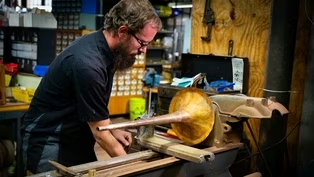
Celebrating America 250: Made With Love Preview
Video has Closed Captions
Explore America’s founding spirit through the works of modern artisans keeping traditions alive. (30s)
Providing Support for PBS.org
Learn Moreabout PBS online sponsorship











Support for PBS provided by: