
Champions of Courage
Clip: Season 16 Episode 1 | 6m 20sVideo has Closed Captions
Omaha Technical High School basketball coach Neal Mosser challenged racial inequity.
Neal Mosser is regarded as one of the greatest coaches in Nebraska high school history. During his tenure as Head Basketball Coach at Omaha Technical High School (1948–1968), Mosser openly challenged racial inequity by starting games with all-Black athletes. In 1994, he was inducted into the Nebraska High School Sports Hall of Fame.
Problems playing video? | Closed Captioning Feedback
Problems playing video? | Closed Captioning Feedback
Nebraska Stories is a local public television program presented by Nebraska Public Media
Champions of Courage
Clip: Season 16 Episode 1 | 6m 20sVideo has Closed Captions
Neal Mosser is regarded as one of the greatest coaches in Nebraska high school history. During his tenure as Head Basketball Coach at Omaha Technical High School (1948–1968), Mosser openly challenged racial inequity by starting games with all-Black athletes. In 1994, he was inducted into the Nebraska High School Sports Hall of Fame.
Problems playing video? | Closed Captioning Feedback
How to Watch Nebraska Stories
Nebraska Stories is available to stream on pbs.org and the free PBS App, available on iPhone, Apple TV, Android TV, Android smartphones, Amazon Fire TV, Amazon Fire Tablet, Roku, Samsung Smart TV, and Vizio.

Do you have a Nebraska Story?
Do you have a story that you think should be told on Nebraska Stories? Send an email with your story idea, your name, your city and an email address and/or phone number to nebraskastories@nebraskapublicmedia.org. Or, click the link below and submit your information on nebraskastories.org.Providing Support for PBS.org
Learn Moreabout PBS online sponsorship(upbeat music) -[Announcer] Number 13, Neal Mosser!
(crowd cheering) -[Neal] Throughout my like childhood, my dad has always had me around basketball.
He coached for a while.
And then he always had me watching basketball.
And then when I finally got to the age where I had the ball in my hand, I just fell in love with it and kept going.
-[Narrator] Millard North's career three-point leader and single-season free-throw percentage record holder, Neal Mosser grew into an all around talent on the court.
(crowd cheering) -[Stu] He was basically as a freshman, a spot up three-point shooter, but he developed his game.
He rounded it out.
He got better on defense.
He got better attacking the basket.
And I think great-grandpa would be very pleased with that.
-[Narrator] Neal comes from a long lineage of standout basketball players dating back to his great-grandfather, Hall of Fame coach and namesake Neal Mosser.
To say the game is in his blood would be an understatement.
- I wouldn't say there was pressure, but they definitely put the ball in my hand at a early age just to see how I liked it.
It had a huge impact in sharing like these stories of my great-grandpa, and even my grandparents.
It's just the long lineage in our family.
Just hearing these stories makes it even more special.
-[Narrator] In the history of Nebraska high school sports, few coaches, if any, can match the record of developing top tier athletes over a 20 year span like Neal Mosser did.
His style went well beyond just coaching.
(upbeat music) - He's a mentor, he's a teacher, (upbeat music) he's a family man, and a competitor.
-[Stu] Neal Mosser was a coach ahead of his time.
(upbeat music) He coached in an inner city school, was not afraid to break the color line, defended his athletes to the core, and he is one of the legendary coaches in Nebraska high school sports history.
He was a stabilizing factor within the school.
I think he was well respected.
Again, he would defend his kids.
-[Neal] He was all for his team, and he was not gonna let anybody mess with his team, whether it was refs, whether it was other people, whether it was fans, coaches.
Those guys were his dudes, and he wasn't gonna let any anybody get to them.
-[Stu] He was one of those pillars of Tech High that, even though the school closed in the mid-80s, will be remembered forever in Omaha history.
(upbeat music) -[Narrator] Omaha Technical High School, founded in 1923, integrated both academic and vocational training to nearly 3,000 students before closing its doors in 1984.
It was the largest high school ever built in Omaha.
It stretched about two city blocks.
It had first OPS swimming pool, and they had one of the best basketball gyms for seating.
So a lot of the key games are played in the Tech gym.
(movie film clicking) -[Narrator] Bob Gibson, (upbeat music) Bob Boozer, (upbeat music) Ron Boone, (upbeat music) Fred Hare, Joe Williams were just some of the famous names Neal coached.
With all the wins recorded, it didn't come without challenges.
-[Stu] It was the makeup of his team (upbeat music) being most in a inner city setting.
African American Black players, they felt discrimination at times.
They would have issues even going out in the state and finding accommodations at night.
He'd have to vouch sometimes that they were with him (upbeat music) to get hotel rooms.
-[Mitch] Starting five African Americans on a basketball team wasn't something he thought about from a political standpoint.
He was competitive and wanted to win.
-[Stu] The most notorious infamous situation was the '62 state final Lincoln Northeast, Omaha Tech.
There was a charge block call that went against Tech.
(upbeat music) It escalated from there.
There was pandemonium in the gym afterwards.
That played an impact both within the team and within basketball at large for what came the following year and maybe Nebraska's greatest team of all time.
(upbeat music) Tech only lost two games that year.
And they came to state, and the title game was 91-73 over a very good Creighton Prep team.
So it was a relief, maybe some vindication, you know, not only for that '62 team but for all these teams.
-[Mitch] I'm not sure he was out there beating his chest, being an advocate.
He was doing what he thought was right and right for kids and supporting and advocating for student athletes.
-[Neal] He definitely challenged societal norms at that time, so I mean, just that shows the type of person he was.
I think what he would, if he was sitting here today, his biggest achievement was he loved his wife.
Very family oriented.
He would dote on his four sons and very proud of the fact that they all graduated from college and all became educators.
-[Narrator] He'd also be proud of his great grandson and his accomplishments in high school.
From playing in four straight title games to winning two of them, the younger Neal continues to be thankful for his opportunities and for his connection to Nebraska high school history.
-[Neal] It was great.
My first year, I didn't know really what to expect with a loaded team behind a lot of talent.
I got to learn from those older guys.
Won the state championship.
It was great.
And then we just kept going back, and it just kept becoming more special to me as I started playing more and building different relationships with different teammates.
But every single team we had something special that the last team didn't, so it was fun.
-[Announcer] Long three by Mosser.
Makes it dead on.
-Big shot by Mosser.
-Really big shot.
(crowd cheering)
Video has Closed Captions
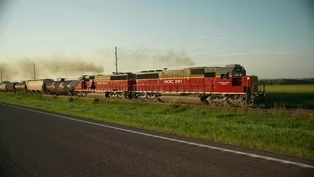
Clip: S16 Ep1 | 5m 17s | A lifelong train enthusiast, Sam Read is living his dream as a locomotive engineer in Nebraska. (5m 17s)
Providing Support for PBS.org
Learn Moreabout PBS online sponsorship

- News and Public Affairs

Top journalists deliver compelling original analysis of the hour's headlines.













Support for PBS provided by:
Nebraska Stories is a local public television program presented by Nebraska Public Media