Call The Doctor
Child Socialization in COVID-19
Season 34 Episode 14 | 25m 41sVideo has Closed Captions
It has been more than two years since the world practically shut down for COVID-19.
It has been more than two years since the world practically shut down for COVID-19. The pandemic changed so much about how we do business and may have even affected our relationships. Experts are now watching what's happening to children who experienced that same lack of socialization but may have been affected in different ways than the adults in their lives.
Problems playing video? | Closed Captioning Feedback
Problems playing video? | Closed Captioning Feedback
Call The Doctor is a local public television program presented by WVIA
Call The Doctor
Child Socialization in COVID-19
Season 34 Episode 14 | 25m 41sVideo has Closed Captions
It has been more than two years since the world practically shut down for COVID-19. The pandemic changed so much about how we do business and may have even affected our relationships. Experts are now watching what's happening to children who experienced that same lack of socialization but may have been affected in different ways than the adults in their lives.
Problems playing video? | Closed Captioning Feedback
How to Watch Call The Doctor
Call The Doctor is available to stream on pbs.org and the free PBS App, available on iPhone, Apple TV, Android TV, Android smartphones, Amazon Fire TV, Amazon Fire Tablet, Roku, Samsung Smart TV, and Vizio.
Providing Support for PBS.org
Learn Moreabout PBS online sponsorship(upbeat music) - [Voiceover] The region's premier medical information program, "Call the Doctor".
- [Julie] It was difficult enough for adults during the COVID-19 pandemic, everything changed; how we work, how we shop, how we socialize.
Now imagine all of that through a different perspective; a child's.
Children did not receive the socialization they may have otherwise enjoyed.
Possibly they didn't receive challenging schoolwork, or even proper medical care.
Where do we go from here?
And is there any way of making up for lost time now?
We'll discuss it with the professionals right now, on "Call the Doctor".
And hello, and welcome to "Call the Doctor", I'm Julie Sidoni, I am the News Director here at WVIA.
And I'm going to be the moderator for "Call the Doctor" this season.
Now, as you heard there in the open, what we're talking about is the lack of children's socialization in COVID-19, but not just that, all the things that might have happened in the pandemic from the perspective of a child.
And we've invited a couple of pediatricians on the show today to help us wade through this.
Again, it's a pretty big topic, but I'd like to welcome both of you.
And the first thing I'd like to do is give you a few moments to tell people who you are, where you've come from, and where they might be able to find you.
Dr. Georgetti?
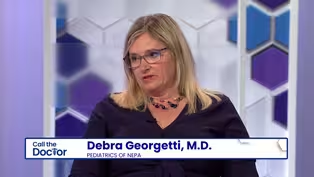
- Okay, yeah, my name is Debra Georgetti, I'm a private pediatrician at Pediatrics of NEPA in Dixon City.
I am Scranton born and raised, attended Temple University, School of Medicine, at St. Christopher's Hospital, for children residency.
And I've been in private practice here for the past 20 plus years.
- [Julie] All right, welcome, thank you you for coming.
And what about you, sir?
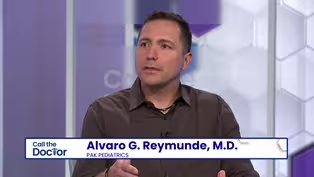
- So my name is Dr. Alvaro Reymunde, I'm a pediatrician also in private practice.
I work at PAC Pediatrics.
And my background is I'm Puerto Rican, so I actually went to school in Puerto Rico.
I went to undergrad at Penn State University though, and then I did medical school in Mexico, and then I finished in New York.
And then I did my residency in pediatrics back in Puerto Rico.
And then I came back to PA, so now I'm here to stay, now I'm good here, so... - Glad you found us here in Northeastern Pennsylvania.
It's good to have you both.
- [Alvaro] Thank you.
- This is a topic, it's...
The more I look into it, really, the worse it makes me feel, honestly, as a parent.
There's a lot that happened during the pandemic for everybody, of course, but I'm curious what pediatricians saw in particular.
So Dr. Georgetti, we'll start with you.
I know earlier you had talked about a couple of bullet points that you thought really stood out to you, what would be some of those?
- So, you know, going back to the beginning of the pandemic, which, unfortunately, has been going on for several years now, I think the first and most dramatic thing we saw was a huge drop-off in office visits.
And so essentially, you know, when everyone locked down, visits in our office went to almost nothing.
And I'm sure that you were the same way.
People were just scared.
No one knew what COVID was about, how it was transmitted, what would happen if they get it, and they were afraid to go anywhere.
So not only would they not come in for sick visits, but they were missing their wellness visits.
And for a period of time, you know, we weren't really seeing any wells in the office, you know, only sick people, and only small amounts of them, because we also didn't understand what was going on.
But even when we started to gain a better understanding and things opened up, people were very, very hesitant to come in for their wellness appointments.
And so we saw a huge drop-off in people coming in, and getting developmental screenings, getting the immunizations that they needed, maybe neglecting problems that they otherwise would've brought to our attention.
Which might have been small problems in the beginning, and then ended up being bigger problems later on.
- Did you see the same thing?
- [Alvaro] Yeah, absolutely.
I think it was very hard to find a good balance between being safe in keeping, you know, COVID at bay, but at the same time, bringing kids in, so that we can do those screenings, and do those evaluations, and provide those immunizations.
It was definitely a work in progress, and it took a little bit of time to get there.
But thankfully, I think we did, you know, through hard effort and work, but we were able to do it.
But there was definitely a period of time there where it was definitely lacking, unfortunately.
- Are you still working through that backlog of people trying to come in now, and get those immunizations and get those, you know, records back to where they should be?
- Yeah, I think so, I think for the most part it's... we are pretty much caught up.
There are still a few patients that are a little hesitant to come in, but we're working through those.
And I think that part is getting a little bit better.
I think now is the issue... now the issue, I think, is recovering from the damage of COVID, and, you know.. - I'd like to get into the mental health piece a little bit, because I'm not sure we've wrapped our heads around this for adults, let alone children.
But it was something that you mentioned, Dr. Georgetti, that you saw the mental health piece was really something concerning to you.
- Right, and I think it's pretty safe to say we're in a little bit of a mental health crisis right now, as far as pediatrics go.
And what we saw is the incidents of mental health really sore during the pandemic.
We saw anxiety at a much, much higher rate, depression at a much, much higher rate, eating disorders, like we talked about earlier, much, much higher rate.
You know- - I think even the numbers are for depression, one in four children.
- [Julie] Children, one in four?
- One in four children are depressed, and one in five have a diagnosis of anxiety, some sort of anxiety.
- [Julie] Goodness.
- And that those numbers doubled since pre-pandemic.
- Was that lack of school, little bit of isolation, a big soup of all of it?
- I think it was isolation for sure.
Pretty much everything came to a halt, kids were no longer going to school, kids were no longer participating in clubs and activities, where they received a lot of their socialization, daycares were closed.
So I think that was definitely a part of it.
I think stress was another big part of it.
Families were stressed, they were either stressed about losing their employment, or stressed about what... how they were gonna find childcare, while they still went to their jobs, or parents were working at home.
And so, they were at the same time, trying to be, you know, functional in their job while taking care of their children.
And it was a stressful environment for everyone that was involved.
- [Julie] At what age are you now seeing depression and anxiety in children?
- I mean, I see them as young as 4, 5, 6 years old, in the office, honestly, you start seeing signs.
Kids are little magnets, you know?
They absorb everything, and if they sense the parent is anxious, or depressed, or something's wrong, kids really catch up on that.
And they may not know that they're depressed or anxious, but you can see, there are some certain screenings that you can do, some sort of certain tells that you can tell.
- I wanna get into the screenings a little bit later, 'cause I'm interested in maybe what parents can start to look for.
But I mean, therapy is often recommended for adults.
Is that the same recommendation for a child?
And what are some of the issues with getting a child into therapy right now?
Dr. Georgetti, I'll ask you first.
- Yeah, so therapy, definitely recommended, a little bit hard to come by sometimes, but definitely cognitive behavioral therapy, to kind of talk these kids through some of this stuff.
With the littler kids, it's more play therapy, but with the older kids, it's sort of just someone neutral to bounce things off of.
You know, but there are only limited mental health providers.
And so, you know, a lot of times these parents and these kids are facing sort of long wait-lists to get in to see somebody.
- [Julie] Was it your practice that are...
I think your practice hired some psychologists there to be... - Yeah, so me personally, I'm a huge advocate for mental health.
I think, not just for some adults and some children, I feel everybody should be seeing a mental health specialist, because life can be hard sometimes.
And we need those tools to help us cope with stressors in life.
Certainly during the pandemic that was heightened.
I mean, everybody was stressed and anxious, so we definitely saw a need for that.
And we definitely saw that our patients were having a very hard time getting those services.
So we did end up creating a little mental health, kind of like scope in our practice, where we hired two pediatric psychologists, and a licensed social worker to help our patients out.
- I guess we should, like, we can talk about the screening now.
How can a parent tell if their child is suffering from anxiety and depression?
I'm sure there are some very big red flags, but there have to be a lot of smaller ones too.
I'll let each of you take a go at that, 'cause I think there are a lot of people who are worried about this one.
- Yeah, I think, I mean, honestly again, I think parents should use their mommy and daddy instincts on this, they know their kids best.
If they have any inkling, or sense that something might be a little bit off, bring them over to the office.
We have specific screening tools per age group that will let us know if he or she is at-risk, or is actually in depression, or anxiety, or whatever right now.
But it's...
I feel that any little inkling is just enough to come into the office and get it checked out.
- [Julie] Right.
- And I think that the thing that's important for parents to remember is, especially in the younger kids, depression and/or anxiety can really present in a different way, than it does in adults.
And so you might see some more subtle signs, a change in appetite, a change in sleep patterns, and so kids have difficulty falling asleep or staying asleep.
They're not really eating, they're more withdrawn, they wanna stay in their room all the time instead of coming down to sort of socialize with the family.
And so what I always tell parents is like, someone who's eight is not gonna sit down next to you, and say, "You know, I'm really stressed about this pandemic," because they just don't have the mental capacity to do that.
So it's gonna come out in different ways.
Anger is a big one, too.
- [Julie] Anger?
- Right, and so they'll start to act out, you know, and a kid who has never acted out will start to act out.
And if you kind of look under the surface, past the anger, you'll see that that's really coming from a place of fear.
- I imagine that existed before COVID, but how much more does that exist now, than ever did before?
- [Debra] Yeah.
- [Alvaro] Definitely much more evident.
We get many calls, and I don't wanna say complaints, but concerns from parents during the visits, that, you know, "My child's acting out more, tantrums are more noticeable," or, "My second child is being more tantrum-y, or being more aggressive than my first child."
And the difference being that the more recent child lived through the pandemic for most of his life or her life.
- You touched on no more sports and clubs, and things like that, or at least getting out of the house, exercising a little bit.
Which goes to a point that you had made earlier, too, about body weight changes, BMI.
What did you see?
- Yeah, so we saw, once things started to open up, and kids came back into the office, we saw a huge jump in BMI for a lot of kids.
I mean, we definitely saw an increase in eating disorders, and that's kind of one end of the spectrum.
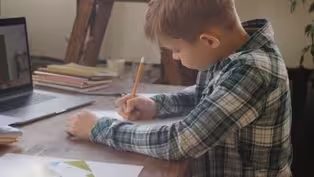
But on the other hand, you know, we saw a lot of kids who were home for their homeschooling, free access to food all day.
Sometimes the parents were at work, and the kids were kind of doing school at home by themselves, and said they weren't really monitored.
So you add that to the fact that they're now not participating in sports, or doing activities like they did.
And so it was sort of a sedentary lifestyle with not great food choices, and it sort of showed in, you know, weight gain that was disproportionate.
So to that end, we actually, once things started opening back up, we focused on developing a wellness program for our office.
We actually developed a wellness program called the Level Up Program.
So we're starting to bring kids in, in small groups every six weeks, and sort of teach them about wellness.
So we talk about nutrition and different types of activity.
We talk about mental health, and how that can contribute to it.
And so we're trying to reverse some of those changes that we saw over the past two years.
- [Alvaro] I like that, I like that, I love, love, love, it's cute.
- You bring the child in, or the child and the parent, or parents, or how does it work?
- So I would say child and parent for the younger kids.
And so we do two age groups, the first age group is like a 6 to 11 year old age group.
And that's sort of parent and child, because obviously the parent is controlling a lot of what happens.
For the older kids, like 12 to 18 year olds, it's really more focused on the child, because they're spending more time independent of the parents, making their own food choices.
They're a little bit more mature, and so we really wanna teach them to make responsible choices, and sort of be responsible for their level of activity.
- Interesting that you mentioned, you know, obesity and the connection there with homeschooling, but you also saw that there were other food issues that happened, kind of on the other side.
What did you mean when you said "the other side"?
- Yeah, definitely, so I... we also saw a lot of BMI increases during the pandemic, but more concerning to me, at least, were those patients that dropped a lot of weight.
Because those patients often go unnoticed, because in our society, unfortunately, if you're thin, it means everything's good.
- [Julie] "Oh, you look great, you look fantastic."
- "You look wonderful, you look great, you're thin, you look great, what are you doing?
You're doing fantastic."
But really, I mean, that's a huge red flag whenever that BMI starts dropping significantly.
There's huge red flags for mental health issues and disorders, and a lot of times they go unnoticed because everybody thinks it's okay, it's a good thing that you're losing weight, but it's truly not.
There could certainly be an eating disorder there.
- What about the piece on, perhaps, child abuse or issues that may be in the home, even if the child wasn't abused, maybe they're being exposed to some sort of a dangerous situation.
What about that change during COVID?
- Yeah, so again, during COVID, there were a lot of changes for kids and adults.
A lot of parents have had also increased stress levels, because they're either decreased hours at work, or they're being laid off.
So stress levels in the home, in general, have been high, which unfortunately does lead to more child abuse.
And unfortunately, since they were coming into the office less, we were unable to catch those because we're not seeing them.
And then as well, they're not... they weren't going to school and no sports., so they had less access to mandated reporters.
So, I don't think that there's data out yet, but I'm sure that child abuse reports decreased during the pandemic, but in reality, they probably had increased.
- [Debra] But probably the incidents had increased.
- [Julie] So what does that do for, say, you are in a practice like yours, or have you had conversations about, "Okay, now we have to look out for X, Y, Z, in addition to A, B, C." I mean, does it change the way you're doing anything?
- Not a lot, because I think we're always... had a high index of suspicion for that anyway, so that was a big part of our job all along, you know, was to look for not only abuse, but also neglect.
And so we're following how kids are gaining weight, how appropriately they're taken care of, whether or not there's any physical signs on exam, you know, of abuse.
We're always kind of mentally screening the parents, you know, to make sure that they seem like they have it all together, especially with the younger kids.
And there's not other social issues that we might be able to help them with, so that they can then take care of their children.
- Yeah, there's a lot of, quote unquote, "behind the scenes" thought process in a pediatrician's mind when we're in a visit.
The parent probably sees, "Oh, he just came in, checked his eyes and ears, asked me a few questions and they're gone."
But behind the scenes, we're like checking head to toe.
We're like...
The questions we ask have purpose and meaning, we're not just curious.
- And we're watching the interaction, you know, between the parents and the kids.
- So that's why it's so important to keep your well visits.
Just because, to me, "Doesn't need a shot this year," doesn't mean you don't get to skip.
- Right.
- So anecdotally then, it seems like you are able, because of your positions, to catch quite a bit, when they're smaller problems before they get to bigger problems.
Do you have an example of that?
I mean, obviously nothing in particular, but you have... has that happened to you?
- I think it happens quite often.
I think with our screenings, we're able to catch, not only diseases like diabetes...
I had a patient recently, a young patient, that had to diagnose with diabetes, who was not in crisis or anything.
But, you know, if a kid may be behind in speech a little bit, why is he behind in speech?
Is it because there's some neglect going on, or is he just developmentally a little bit behind, or is there some sort of speech impediment?
So there's a lot of things that happen on the daily basis that are just little nuggets.
- One of you said something about a child being a little sponge.
Do you think that parents who even think that they've done a good job of hiding their stress from their children, have not done as good of a job as they think they have?
Are you able to see that in a children's visit?
- You are, and I don't know if it's possible to really hide your stress.
- [Alvaro] Yeah.
- You know what I mean?
I think kids read body language, and they read how you're interacting with them.
And so even if you're trying your best to make sure everything is okay, I think they pick up on other cues.
And they definitely sort of feed off of that a little bit.
- I feel kids are really good at sensing energy.
You can't hide that.
- How do you get parents to trust you then?
How do you get parents to really come in, to say, or even a child really, to say, "I think I need some help here."
- Well, I think that the nice part about being in private practice is building a relationship with your families.
So don't forget, we're seeing these kids, from the time that they're babies, quite frequently.
If you have multiple kids in a family, two or three kids in a family, sometimes you're seeing them over the span of 20 years.
Sometimes you're in the position where you took care of these kids when they were younger, and now they're having kids.
And so you're taking care of the second generation.
And I think that you build trust over time, and being sensitive to their needs also.
- Yeah, I think just speaking to the parent like they're real people, 'cause they are, and like, we're real people, you know?
And I think, I mean, at least me, in my practice, you know, I share with them and they share with me, and we just... we want it to be...
So visiting your pediatrician should really be like visiting a family member.
You should be like really comfortable with them.
That's the only way that these screenings are gonna work.
If the parent confides in you and trusts in you, 'cause otherwise, they'll never give the real answers, or the truthful answers on those screens.
So it's our job to really get to know that parent and just gain their trust.
And you just do that by being a nice person.
- And sometimes all you have to do is ask the right question.
- [Alvaro] Yeah.
- And then the floodgates open, you know, and something that they've been holding inside of them, that they so wanted to say, it just sort of gives them the vehicle to say that.
And then... - And then- - And then the rest kind of takes care of itself, yeah.
- I'm anxious to hear more about the screening part of it.
I know we've brought this up already, but is it a questionnaire, or is it something that your practice comes up with, and a checklist you follow?
Or is this more something that you develop, personally, over the course of practicing, how to read what's going on in a child's mind?
How to read what a home life might be, how to figure out what they might be needing because of the pandemic, right?
- So the screens themselves are standardized, they're vetted, they're researched.
So there are set questions that we use that are designed to screen for depression, anxiety, alcohol abuse, you know, all these different... Maternal depression is another one that we screen for.
So those are all already like done and vetted, but at the same time, it's how you ask those questions.
Right, we can't just like read the questions from the sheet, because it's not personal, you're not gonna get a good answer.
So it's our job then, to kind of ask those questions in a way that's gonna invite an honest answer.
- I guess what I'm getting at there, is there a way for other adults in a child's life, not just parents, not just the doctor, is there a way for other adults to pick up on things like this?
Or are there, I don't know, some sort of tells?
Or is it just not that simple and that's the issue?
- No, I think they often do pick up on it, don't you think?
- I think they do, yeah.
- Yeah, if a parent is pretty invested and involved, I think a lot of times, the way the conversation starts is the parents will bring the children to us, with some type of concern, you know?
And then we'll talk a little bit about that together.
Talk to the children separately, especially if they're older, but I think they're pretty good at sort of picking up on changes.
- [Alvaro] Yeah.
- They may not know exactly what's wrong, but they know that something's wrong, it's that parental intuition.
And then I think it then becomes our job to sort of help them sort through that.
- I mean, if they want your help and they're there, even if they don't know what the issue is, yeah, I see that.
- And sometimes they'll mention it, kind of like in conversation, we're like, "Oh, he's been very emotional lately," or "He cries over everything, but we give him his tablet and then he's fine."
- Well, gosh, that is an entire other show.
(doctors laugh) How much on the tablets and the phones and the video games.
And I think that's a very concerning piece actually, because now children are sort of living in this world they might not have had before.
- And it adds to the anxiety 100%.
- Give me a little bit more on that, just a little.
- I feel that there's a...
I didn't do any studies, but I feel that there's a positive correlation between screen time and anxiety levels.
Whether it's adults or children, meaning the more screen time you have, the more anxious you feel.
It's just too much information going into your brain.
- I feel that as an adult, let alone my children.
- [Alvaro] Yeah.
- [Debra] Right.
- I'm curious, Dr. Georgetti, as we're kind of wrapping up here, where we go from here?
We talked about, a little bit earlier, are there topics that we've brought up tonight that we can get back on?
It might not... it might take a while, but we can get everybody caught up, or are there... do you fear that there are just... there's just a big black hole here, and some children might have missed something in the years?
- So I think that it's a two years that we've never seen before in our life, a weird two years, that none of us ever anticipated.
I think that COVID is probably gonna be around for quite some time, and this is gonna be our new normal.
And so the best advice that I can give people is to sort of learn how to live with that, right?
And schools are open, activities are back, people are back to work.
Everything's, you know, pretty much getting back to normal.
And so it's time to move forward.
So it's time to, you know, get back to school, and start sort of making up for lost time, and start to deal a little bit with the anxiety and depression symptoms.
Which I think, you know, getting back to normal will sort of take care of itself, and just plowing through.
I think it'll take a while to sort of get back to normal.
"What is normal?"
People would say that, right?
Or the new normal, what it's gonna be, but definitely it's not not reversible.
But definitely something parents have to have a sort of high index of suspicion for, and be motivated to help their kids through it.
- Yeah, I 100% agree.
I think we can definitely move forward as a society.
I think we just need to really try and push forward, but be smart about it too.
Like if you're sick, stay home, but if you're not, then yes, go enjoy your life.
Go to work, go to school, go to sports.
- [Julie] Same goes for your kids.
- Yeah, absolutely.
- [Debra] Right, so do your thing.
- Yeah.
- [Debra] Test when you feel sick, wear a mask when you feel sick.
- And then going back to the mental health piece, don't ignore the symptoms.
If you're feeling sad, if you're feeling anxious, if you feel off, go see your doctor if you're an adult.
Go see your pediatrician or your baby's doctor if you're younger.
If you're having trouble with food insecurity, for example, if you feel like food isn't lasting the week, or you're concerned that maybe next week, you won't have enough to buy food.
Food insecurity even means that you used to buy Oreos, and now you have to buy the generic Oreos.
That's still food insecurity.
Go find a program.
Don't be too proud to not go to a food pantry, or get some help.
- [Julie] There's help out there.
- [Alvaro] There's help out there, at PAC Pediatrics, every month we hold a food pantry that's open to the public.
You don't have to be a patient of PAC to come.
You literally drive by, we fill your car, and you go home.
- [Julie] Gotta help each other.
- We gotta help each other, absolutely.
- Thank you to both of you.
I feel like we could have this discussion for a lot longer.
I really appreciate your time.
And that's really gonna do it for this episode of "Call the Doctor", thank you so much for watching.
I'm Julie Sidoni, and for all of us at WVIA, we'll see you next time.
(mellow music)
Child Socialization in COVID-19
Preview: S34 Ep14 | 30s | Airs Wednesday, June 1st at 7pm on WVIA TV (30s)
Providing Support for PBS.org
Learn Moreabout PBS online sponsorship
- Science and Nature

Explore scientific discoveries on television's most acclaimed science documentary series.

- Science and Nature

Capturing the splendor of the natural world, from the African plains to the Antarctic ice.












Support for PBS provided by:
Call The Doctor is a local public television program presented by WVIA