
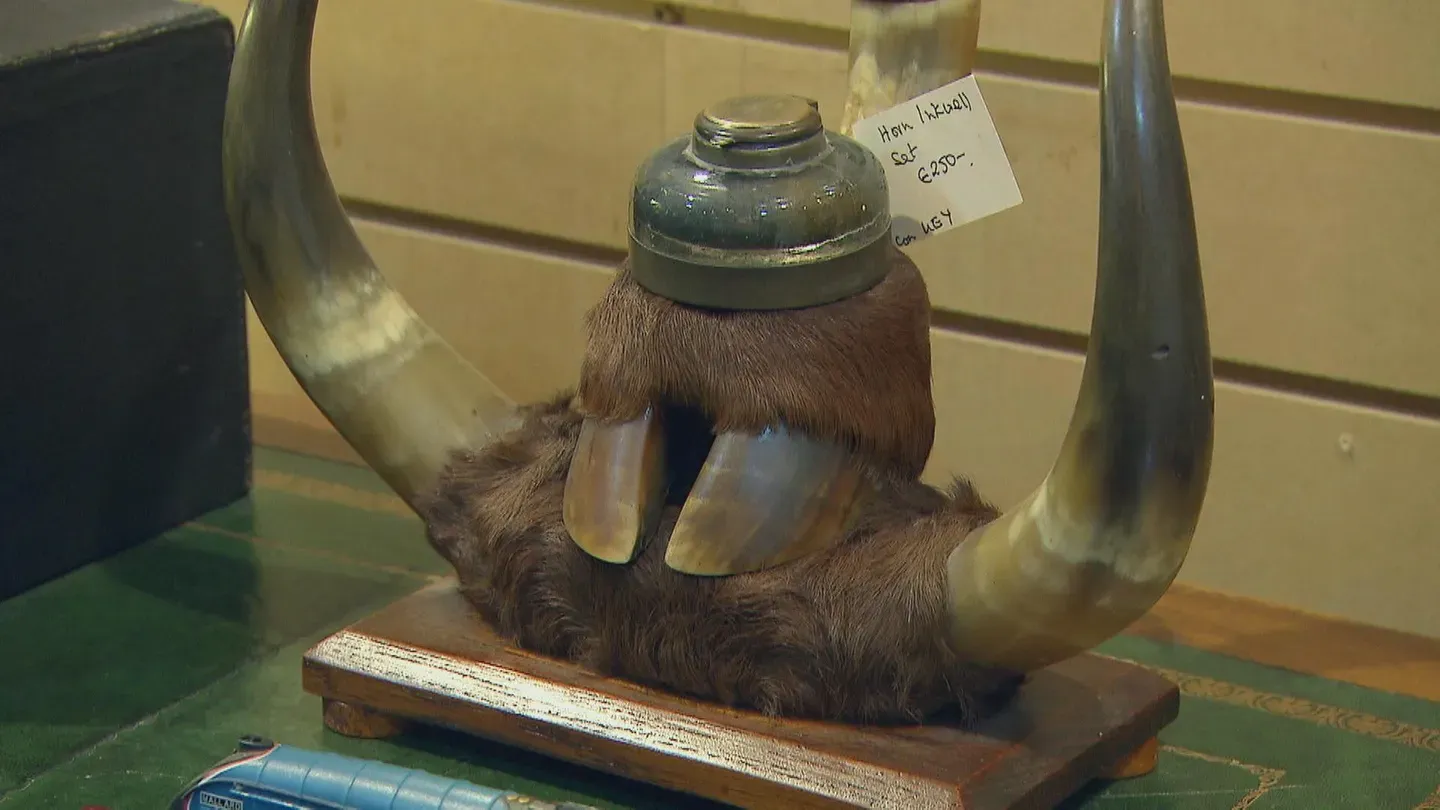
Christina Trevanion and Thomas Plant, Day 1
Season 12 Episode 16 | 43m 45sVideo has Closed Captions
Christina Trevanion and Thomas Plant are hunting for treasure to auction in County Offaly.
Antique experts Christina Trevanion and Thomas Plant begin their Road Trip in the Republic of Ireland. Starting from Cashel, County Tipperary, in a 1962 Bedford van, they hunt for treasures to take to auction in Birr in County Offaly.
Problems playing video? | Closed Captioning Feedback
Problems playing video? | Closed Captioning Feedback
Christina Trevanion and Thomas Plant, Day 1
Season 12 Episode 16 | 43m 45sVideo has Closed Captions
Antique experts Christina Trevanion and Thomas Plant begin their Road Trip in the Republic of Ireland. Starting from Cashel, County Tipperary, in a 1962 Bedford van, they hunt for treasures to take to auction in Birr in County Offaly.
Problems playing video? | Closed Captioning Feedback
Where to Watch Antiques Road Trip
Antiques Road Trip is available to stream on pbs.org and the PBS app.
Providing Support for PBS.org
Learn Moreabout PBS online sponsorshipVOICEOVER (VO): It's the nation's favorite antiques experts.
This is beautiful.
That's the way to do this.
VO: With £200 each, a classic car and a goal to scour for antiques.
Joy.
Hello.
VO: The aim - to make the biggest profit at auction.
But it's no mean feat.
(LAUGHS) (GAVEL) VO: There will be worthy winners and valiant losers.
Sorry, sorry!
VO: So, will it be the high road to glory or the slow road to disaster?
The handbrake's on.
VO: This is Antiques Road Trip!
Yeah.
Today we begin a very special Road Trip, starting right here in the Republic of Ireland.
Oh yes, this'll be a treat for our top auctioneers Christina Trevanion and Thomas Plant.
What a combo.
THOMAS (TP): Your impressions of Ireland - you've been here before, I've been here before.
CHRISTINA (CT): You can go anywhere in the world and... you can go visit countries and they're beautiful, but it's all about the welcome that you get, isn't it?
TP: D'you know, yeah, absolutely.
It's wonderful.
And the people are so friendly and so accommodating and so sweet.
VO: Hey, I love the Wedgewood blue wheels, guys!
Their quirky 1962 Bedford Van was manufactured before it was compulsory to fit seat belts, so it's legal to drive without them.
CT: Do you know what slightly worries me?
TP: What?
CT: That's the engine!
It is the engine, isn't it?
And it's quite nice as a heater.
VO: It was originally built as a crew van for workers and survivors of its type are rare.
CT: I did a bit of research about this last night, and they are the most amazing utility vehicles.
This was the basis of the ambulance, ice-cream vans!
CT: Yeah.
TP: Amazing!
VO: Our jewelry and silver buffs start their trip with £200 apiece, but as they begin in Ireland, they'll kick off with 285 euros.
Geddit?
Starting in Cashel in County Tipperary, they'll gad about Ireland, hop across to North Wales, whiz around England, then end up over 700 miles later in Stoke-on-Trent.
This first leg will see them travel from Cashel, towards the opening auction in Birr, County Offaly.
Third, darling, third.
Hang on a minute!
Come on.
Well done!
VO: Those two are like an old married couple already.
Remember to look out the window once in a while, guys!
CT: Look, there's a castle!
There's castles everywhere.
There were kings and queens and clans and everything here.
VO: At the southern end of Ireland, County Tipperary is known as the subject of a world-famous song.
It became popular with the British army after young Irish soldiers began to sing it as they marched into battle at the start of World War One.
# It's a long way to Tipperary... # VO: However, it's not far to Thomas's first shop of the trip.
CT: See you later.
Bye.
TP: See you later.
You look marvelous.
VO: Owner Ruth Barry's in charge here.
Looks like she does more than antiques too.
Bit of lotus, maybe.
TP: You're Ruth?
RUTH: Yes I am.
I saw your name on the door.
Yes.
And it said "giver of hope".
I'm a yoga teacher and when you do your teacher training, they bestow a name on you, and that was Asha, giver of hope.
Well I hope you're going to give me hope today!
I hope so, I hope!
Make yourself at home, and if you need any help, just give me a shout.
I will do, thank you.
RUTH: Alright.
Thank you.
(BANG) VO: Oh, careful!
Ruth only opens for al-fresco shopping in good weather.
Ha-ha!
So enjoy it while it lasts, Thomas!
Ha-ha!
I just totally... ..love these tambour-fronted cabinets, and what's even better is this here.
Wait for it.
Oh!
And it's all hidden away!
VO: This early 20th century oak cabinet is 490 euros, way over Thomas's budget.
Looks like that's not his only problem now.
Oops.
Has he broken it?
Ruth, um, is there a key for this?
I'm afraid not.
What did you do?
I just pulled it down and it locked.
Well, you really should have asked for some help with it, Thomas.
Now you've broken it.
I don't think I've broken it.
VO: A bit awkward, this.
It has happened before, so Ruth knows how to fix it... thankfully.
VO: Meanwhile, Christina has headed just half an hour north, still in Tipperary, to the small village of Templetuohy.
VO: Her first shop is Larkin's Antiques, a family-run affair that's been on the go for over 30 years.
Hello!
Hello.
Hello, good morning How are you, Christina?
Very well, thank you, nice to meet you.
I'm Christina.
And I'm Mary.
Mary Larkin.
Lovely to meet you, Mary.
My goodness, what a shop!
CT: So tell me, Mary.
MARY: Yes.
I'm going in completely blind, I know nothing about the Irish auction market, so what are people buying?
Lovely sets of china.
China is in big time in Ireland.
Are people buying furniture over here?
Oh, they are, yeah.
Antique furniture.
I'll go and have a wander and I'll see you in a bit.
Absolutely.
Alright.
VO: Well, neither sell brilliantly in the UK at the moment.
Just goes to show that local knowledge is key.
Clever move there, Christina.
Right, so china is selling well.
That's interesting, isn't it?
Tea sets, my goodness.
That's rather fun, isn't it?
This isn't early enough, sadly, to be a George Jones piece.
It's quite interesting, though, isn't it?
It's certainly got a look, and we're finding that in the UK... ..majolica is selling incredibly well.
VO: George Jones began manufacturing this type of elaborately molded ceramics in the late 1860s.
However, this was made long after George Jones died and that's why it's called "majolica style".
What have you got on that, Mary?
Well, I could give you that for... ..40 euros.
Well, it's certainly got a look to it.
Oh, absolutely, yes.
Ooh.
OK, so that could be a possibility because I quite like that.
It's gorgeous.
VO: But Christina's only scratched the surface of Mary's wares.
Oh, that's quite fun.
How much is on that?
Do we know?
MARY: Mike?
CT: Hello, nice to meet you.
I'm Christina.
Very nice to meet you.
You're in charge of the furniture, are you?
Yes.
How much is on your chair that needs some TLC, Michael?
Er, that's 100 euros.
100 euros?
It does need a lot of TLC.
MARY: It does.
VO: Indeed.
At least the frame of this Victorian carved chair is still in pretty good condition.
Is there any flexibility on that price, Michael?
Ah, maybe a little bit.
Erm... 85?
85 euro.
OK.
I quite like that.
It's definitely a possibility.
Thank you, Mike, you're a gentleman.
I will give it some thought.
VO: Back in Cashel, Thomas has been doing some al-fresco browsing.
Can I go inside?
Of course you may, yes.
VO: He's onto something, look.
TP: I love these.
These are fab.
RUTH: They're gorgeous.
We've got burgundy, we've got chartreuse.
Yes.
I have another one inside.
Do you?
Yeah, hang on.
VO: By the turn of the 18th century, decanters were popular in the homes of both the middle and upper classes.
The labels indicating the liquid contents were originally called bottle tickets.
RUTH: Look, Cura-ko!
VO: Curacao, actually.
In perfect condition.
TP: So they're on copper with enamel.
RUTH: They're enamel.
And how much are these each?
RUTH: 10 each.
TP: 10 each.
They're a giveaway.
OK. We'll talk about that.
Oh, right.
God!
And how much are these?
This one is 12, and these two little ones are eight.
RUTH: I mean... TP: One, two, three, four, five, 50 euro.
62.
RUTH: OK. TP: 78 euros.
RUTH: You're good at the maths.
How about we start at 40 euros and then we work somewhere... Oh my God, no!
But where can we meet in the middle?
Thomas, really!
Come on, you're not gonna sell them to me at 40, I get that.
OK, 65.
Oh!
That's far too much!
No!
TP: Yes, it is.
RUTH: This is... RUTH: These are beautiful!
TP: They are beautiful.
RUTH: You never see these.
TP: I love them.
RUTH: They're gorgeous.
TP: You couldn't say 60 and it's a deal?
Oh OK, for you.
Yeah?
You think so?
RUTH: Yeah.
TP: Let's do it.
Yeah, alright.
VO: 60 euros for the eight silver-plated and enamel decanter labels.
Before I go... You are a yoga teacher - is there any moves you can teach me to sort of bring me any Zen on my trip in Ireland?
I think the best thing you can do is to practice your breathing.
As you exhale, simply make a "ha" sound at the back of the throat.
I think that grunting would kind of annoy Christina quite a lot!
But it's quite funny, I'm going to do it!
VO: Lucky Christina!
Speaking of which, back in Templetuohy, she's enlisted Mary's help once more.
CT: I thought these were quite fun.
MARY: Oh, you've lovely taste.
Aren't they beautiful?
I mean, typically, sort of 1830, this body to me looks like a Coalport body.
But that's really unusual decoration, isn't it?
MARY: Isn't it fabulous?
This is what we call a spur handle, isn't it, that typical spur handle, about 1830.
Is there any more of the tea set?
I have.
It's so funny.
I have.
Have you?
VO: And Mary's secret stash is in a drawer behind the counter - obviously!
What else have you got in that drawer?
No, nothing else!
I can't show you what's in my drawers, Christina!
CT: Oh my goodness!
VO: Crikey, there's loads of it, look!
Are they not fabulous?
They are fabulous.
Are they not the nicest you've ever seen?
I love the fact that you've got CT: the breakfast cups... MARY: Yes.
And you've got the coffee cups.
MARY: I have.
CT: I love that.
VO: The tea and coffee service isn't complete, but there's so much of it that you could make easily a full set of six.
With spares.
MARY: I need 180 euro.
CT: Oh!
Which is nothing, because it's a beauty.
Christina, you're never... Christina, you're never going to see another one.
Never.
CT: Can we do... ..200 for the tea service and the chair?
MARY: You have a deal.
Look... CT: I'm still quite tempted by your majolica.
Can we say 210 for all of it?
For the tea service, the chair and the majolica.
She's hitting me the whole time.
You're a hard woman.
Go on.
Will you?
A smile.
Will you?
Yay!
Thank you, Mary!
VO: Christina's certainly gone big and bold on day one, parting with 210 euros for three items.
She's now taking a break from the shopping, heading north, crossing into County Offaly to the Irish Heritage Town of Birr.
Its 17th-century castle was once home to a hotbed of world-famous scientific discovery.
This magnificent contraption was once the world's largest telescope, known as the Leviathan of Parsonstown.
It was the brainchild of William Parsons, the third Earl of Rosse, and put Birr on the global map.
Christina's here to meet the castle's current resident, the third earl's great-great grandson, Brendan Parsons.
Also known as Lord Rosse.
Welcome, Christina.
Thank you so much.
Welcome to the great telescope of Birr.
VO: This amazing feat of engineering and invention played a major role in astronomical discovery.
CT: What was he trying to do with this telescope?
He wanted to see further into space than anyone had ever been able to see before, and he wanted to build bigger.
Mm-hm.
How does it work?
It works as a reflecting telescope...
Right?
..with a mirror in the big black box at the bottom.
Right?
The eye piece picked up the image received in the huge, huge six-foot mirror at the bottom.
At the bottom.
VO: Armed with an idea and a degree in mathematics from Oxford, William Parsons and his team, made up largely of locals from Birr, spent three years inventing and building the telescope's component parts in the castle workshop.
So did he build the telescope, did he get somebody in to design it and build it for him?
He had to think it all up himself, and make it all himself, every single thing.
He had to start by setting up foundries in the moat, fired by the fuel from the turf from the local bogs.
Aha.
VO: Their biggest challenge was constructing the central piece of the telescope - its huge mirror.
I would imagine that in the 1840s... ..creating a six-foot-diameter mirror was not easy.
It was impossible to create a mirror of anything like that size in glass, as one would expect today.
The first mirrors cracked because the outside cooled before the inside.
CT: Can you imagine the disappointment?
But there was far greater determination.
VO: And the determination paid off.
In 1845, work was complete on the 54-foot, 16-tonne telescope.
Its fame quickly spread around the world.
What did they discover?
His greatest discover was what's now called the Spiral Nebula.
VO: It was groundbreaking at the time and for the next few decades, hundreds of the world's greatest minds came to Birr to observe the new discovery.
Three years after unveiling his telescope, William Parsons became president of the Royal Society, a world renowned scientific organization.
When he died in 1867, his telescope was still the largest in the world and would remain so for a further 50 years.
Birr became a global center for astronomical research, spurring on further generations of the family.
Most notably the fourth earl, who focused his attention on the moon.
What do we have here, Lord Rosse?
This is a machine that was made by the fourth earl in 1867.
Did he inherit the telescope?
So, he inherited the telescope and the passion for astronomy, but focused it slightly more on measuring the heat of the moon with this instrument.
Measuring the heat of the moon?
Yes.
He spent years and years trying to measure the heat of the moon, only to see his measurements dismissed at the time as the madness of... a typically mad Irish earl.
He was thought to be wasting all his time.
VO: Amazingly, it wasn't until man finally stepped on the moon that the fourth earl's calculations were tested, and found to be more accurate than originally thought.
So this is a letter from Neil Armstrong?
That is a letter to my mother... CT: Yeah.
BRENDAN: ..after his visit here, and sharing with her the temperature of the moon as he found it, as it related to the temperature of the moon as measured by my great-grandfather, the fourth earl, with that instrument there.
So the fourth earl... And it wasn't as mad as was dismissed at the time - in fact, it was accurate to within about 4%.
So almost 100 years later, he was proved right.
Yes, yes.
VO: Through the ingenuity of the Parsons family, Birr Castle was a hub of discovery and innovation.
Now, with its modern-day science center, they hope to continue inspiring budding astronomers to follow in their footsteps.
I have to say, it's been absolutely fascinating learning about your astronomical family, so thank you so much.
Thank you, Christina, for your interest.
VO: Meanwhile, rival Thomas has joined Christina in Birr, County Offaly.
But he's here to shop!
Hi Thomas, how are you?
Very well.
What's your name?
Breda.
Breda.
Nice to see you, Breda.
VO: Indeed.
Nice place you've got here, too.
Lovely office chair.
Just a bit more than I've got to spend.
There's loads to look at, so hopefully I should be buying something.
VO: The question, of course, is what.
What a cool cocktail shaker.
Drinking is always a popular thing, and certainly cocktail shakers evoke that sort of vintage style.
It's silver-plated, and one puts your mixers in there.
It's got a cork stopper, which means that none of the mix will fall out.
Rather lovely, really, with a handle.
And it just...
It just looks rather good fun.
VO: Not a bad option though, but I'm sure there's more temptation somewhere.
This is an extraordinary thing.
Being marked sterling means it could be American.
Cuz that's how the Americans stamp their silver, with a sterling mark rather than our British hallmarks.
British and Irish hallmarks, one should say.
I'm not going to spend 95 euros on something I don't know what it is.
VO: Perhaps Breda does.
What is this?
It's a cake breaker.
If you have a very fresh sponge, what the Victorians... ..and they had something for everything, as you know yourself - they'd push it down through it, and it would stop the cake literally from breaking, and they'd slip the knife in and then you'd have a perfect slice.
VO: Oh yes!
Cor, those Victorians certainly knew how to prevent their cakes from being squashed!
What an interesting object.
And in the right sort of climate, really.
BREDA: Yeah.
TP: Baking is quite popular these days, isn't it?
VO: Another one to ponder, then.
Some soda siphons.
We could make a sort of cocktail lot.
"Mineral Waters Distributors Limited, Dublin".
So an Irish soda siphon.
And there's a pewter one there.
Here we are.
A & R Waits & Co.
There's no price on those.
They're obviously free.
VO: Hey, time to do some buying.
You're needed, Breda!
TP: The cocktail shaker.
OK, yeah.
What can that be?
Um, there's a price of 45 on it, isn't there?
TP: Yeah.
Yeah.
BREDA: OK.
I was thinking maybe 25.
Well since you're such a nice gentleman and you obviously need it... Yeah, I do.
OK. You have a deal.
25 for that?
OK, great.
So that's that, that's one thing out of the way.
VO: What about that rather unusual cake-breaking thingy?
What could you do that for?
Well, it's 95.
TP: Yeah.
BREDA: Hmm.
TP: What about 45?
Now it is nice, and it is silver.
It is, yeah, yeah.
I would be very happy with 55.
55?
I think you've got yourself a deal.
OK, very good.
I like it very much.
VO: He's clocking up the purchases in here, and those soda siphons are still an option.
Pub is very much in vogue at the moment, a lot of people collect it, and they're going away from the contemporary-looking pubs and they're actually doing them up in the old style.
Are they?
How much can the three of them be?
30?
Five?
BREDA: No, I didn't have that number in my head, no!
40 then?
Well, as I said, you're such a gentleman, yeah, OK, 40 would suit me, yeah.
TP: Would that suit you?
BREDA: Mm-hm.
TP: Deal.
That's another deal!
BREDA: You're very welcome.
VO: Good work, Thomas.
That's the art-deco cocktail shaker, a sterling-silver cake breaker and three soda siphons for 120 euros.
Well, a successful sort of day, really.
We've got mainly drinking and eating items.
Tomorrow I've got to buy that surefire profit!
VO: And with that, it's time for our experts to head off to the land of nod.
Night-night!
VO: Another glorious day in Ireland!
I keep on going for the steer stick here!
It's here, darling.
I know, I know.
The stick gear is here.
The stick is here, Thomas.
Well done.
And third, go on, go on, you can do it, go on!
Go on, go on, go on!
TP: Third is easy.
CT: Yay!
VO: Fortunately, Thomas is better at dealing than driving.
Yesterday he secured some decanter labels, a cocktail shaker, three soda siphons and a cake breaker for 180 euros, leaving him 105 euros.
VO: Christina spent big, blowing three quarters of her budget on a tea and coffee service, a Victorian chair and a majolica-style jardiniere, so she has just 75 euros to spend today.
TP: How was your shopping?
It was good.
However, I did feel that maybe I spent a little bit too much money.
But Mary did also give me some good tips about what was selling in Ireland and what wasn't.
Well, what is selling well in Ireland?
According to Mary, anything that's not selling in the UK apparently sells very well in Ireland.
Oh, that's superb.
So I bought brown furniture and tea sets!
(THEY CHUCKLE) VO: But will Mary be proved right come the auction?
This morning our duo are starting at Portlaoise.
Where were we yesterday?
Where were we yesterday?
We were in County Tipperary, weren't we?
CT: And where are we today?
TP: Portlaoise.
# We're a long way from Tipperary... # It's a long way to go.
# (THEY CHUCKLE) VO: And on that rather terrible note - ha!
- Portlaoise, in County Laoise, is an attractive, rapidly growing market town.
TP: Don't buy too well.
CT: Enjoy.
Don't break it.
I won't break it!
VO: Christina's next shop is run by David Keane and Robert Collins.
Good morning, how are you?
Good morning, I'm very well.
Good morning, guys.
You're very welcome to the Store Yard.
Thank you.
What's your name?
Robert.
I'm Robert.
Lovely to meet you.
You are?
And this is David.
CT: David, hi.
DAVID: Very pleased to meet you.
This is amazing!
It's a sort of hidden world.
It's a treasure inside.
VO: Oh yes, it's big enough and rammed with architectural and decorative items.
I know nothing really about the Irish market.
Because we're selling at an auction in Birr, do you know about the auction houses here?
I do, yeah.
I do know the one in Birr.
CT: Oh good, I like that!
DAVID: It's a strong family auction house for years, yeah.
Brilliant.
Insider information, I like it.
DEALER: Yeah.
CT: Brilliant.
Do lots of rural bygones.
Quirky things also, actually.
CT: OK. DAVID: A good house.
What about... fairly knackered old chairs?
Do you think that would sell well there?
No.
Oh.
Really?
VO: Oh, Christina.
Perhaps you can spread the risk with some more items.
I think it's the most beautiful antiques shop CT: I've ever been into.
DAVID: Thanks very much.
I think I'm in love with it.
It's wonderful.
VO: David and his team often provide pieces for sets of period dramas.
Oh, beautiful.
Gosh, it's like an alleyway of gorgeousness isn't it?
Look at those colors.
VO: They can kit out entire rooms for certain periods.
This is beautiful.
VO: Even down to wall coverings, like this room of 18th-century American pine paneling.
CT: Is this room for sale?
DAVID: Yes.
CT: Just stunning.
Oh, I love it.
How much would it cost me to buy this room?
Erm...
The price of a bungalow in Ireland at the moment.
Oh, really?
Yeah, I definitely haven't got that in my budget!
VO: Ha!
I bet you wish you had more than 75 euros left, eh Christina?
CT: That's quite nice.
Oh yeah, that's a nice little thing actually.
It's priced very well, there is some damage.
But it's nice Florian Ware.
Florian Ware obviously was the company that Moorcroft started working for...
Correct.
..before he started his own factory.
And you've got "WM des", so William Moorcroft, designer.
Nice Florian Ware stamp.
CT: 25 euros?
DAVID: Yeah.
I mean, yes, it's got some damage to it, but I still think for a Moorcroft collector, that's a really nice thing, isn't it?
Good thing, yeah, very good thing.
Well, that's a distinct possibility, David, I like it a lot.
OK. Shall we keep wandering?
Yeah.
VO: Sounds positive.
Let's leave Christina to explore her new favorite shop, and join our other intrepid antiques hunter.
He's taking a breather from shopping to find out about one of Ireland's great heroes, a world-renowned explorer, and pioneer of the heroic age of Antarctic discovery.
Thomas is visiting Athy Heritage Centre, just a few miles from the birthplace of Sir Ernest Shackleton.
Thomas is here to meet head of the Shackleton Society Seamus Taaffe.
Seamus, we're here because you have a famous hero, a man of great note.
Yes, we're very lucky, we have one of the greatest explorers of all time, Ernest Shackleton was born in Kilkea.
VO: As the eldest son of 10 children, Shackleton was expected to help support his family, but instead at 16 he went off to sea and became a master mariner.
He charmed his way onto Captain Scott's Antarctic expedition in 1901, gaining experience that led to his own endeavors into the then uncharted continent.
So we know Shackleton had lots of expeditions - which one is the one we all know?
The greatest expedition is obviously his 1914 Imperial Trans-Antarctic Expedition.
Now bear in mind, at this stage, the pole has been reached by Amundsen-Scott in 1913.
So he comes up with a plan that he's going to cross the Antarctic, from sea to sea.
The South Pole?
The Antarctic?
SEAMUS: Yes.
TP: Cross it?
SEAMUS: Yes.
But from the very start, it all goes terribly wrong.
VO: The mission was to sail from South Georgia to the Weddell Sea.
Once they hit land, they would continue by foot and sledge until they reached the Ross Sea.
It had never been done before, and when they got near, disaster struck.
The 28-man crew got stuck in ice in the Weddell Sea.
Their ship, Endurance, eventually sank, forcing them to set up camp on the ice.
20 months after setting out, the ice finally melted and starts pulling them in the wrong direction.
How did they survive?
They've kept three lifeboats from the ship, which they're pulling across the ice towards the direction they want to go, but the ice is still drifting.
So eventually, to get into open water, they decide to go for the only place there were - a place called Elephant Island, a destitute rock in the middle of nowhere in the south Atlantic.
And they spend about seven days, the three boats, until they get to Elephant Island.
How are they doing that?
Under sail or rowing?
A bit of both.
VO: But there's no hope of being rescued from this small, inhospitable island.
Shackleton knows to stand a chance of survival, he must take his five best sailors in one lifeboat and travel over 1,000 kilometers back to the inhabited island of South Georgia.
The other 22 men are left behind.
The south Atlantic, it's a miserable place to be, the southern ocean, it's the worst season... Big waves.
Big waves, daylight is very poor, it's very hard to read.
And after 70 days, they reach South Georgia.
An extraordinary boat journey, there's nothing to compare it to.
VO: Despite their incredible achievement, they arrive on the wrong side of the island.
The boat is battered and the crew exhausted.
So Shackleton then has to lead his team across uncharted, rough, icy terrain by foot to get to the whaling station on the northern side.
They spend 36 hours crossing it, non-stop.
At one point, the men are very tired, so Shackleton says, "We'll have a sleep."
And he lets them sleep for five minutes, and he wakes them up, and he says, "You've had a great sleep.
"That was an hour, lads, that's great."
He was always very clever in how he managed his men.
But eventually they get across to Grytviken and they hear the sound, the steam whistle of the whaling station, kind of, in the morning, they know they've reached safety.
VO: But Shackleton couldn't rest until he'd saved all his crew from Elephant Island.
He mustered boats from Norway and Chile to make several rescue attempts, but it wasn't until the 25th August 1916 that he reached his remaining 22 men.
They'd been stranded for almost four months with very little in the way of provisions, but they all survived.
So Seamus, what have we got here?
This is actually one of the few relics we have of the Endurance expedition.
This is the last biscuit that Shackleton had in his pocket crossing South Georgia.
The last bit of food he had left to feed himself and his men with.
And I think he kept it as a reminder to himself for the rest of his life of how close they came to death at that time.
That's marvelous.
VO: Although Shackleton didn't achieve his scientific goals, his heroism has gone down in history.
He set off on what would be his final Antarctic expedition in late 1921, this time aiming to circumnavigate the continent.
Is this the album of his last voyage?
SEAMUS: It's images from the expedition from the very get go.
This album is kind of in some ways a sad relic of the exhibition, because that's where he died.
At the scene of his greatest triumph, South Georgia is where he rescued his men from that... TP: Died there.
SEAMUS: He died there.
VO: Shackleton died of a heart attack in January 1922 and was buried on South Georgia.
His courage and skill in keeping everyone alive on his Trans-Antarctic expedition has become his enduring legacy.
VO: Back in Portlaoise, Christina is still shopping in heaven.
That's quite smart, isn't it?
Yeah, nice little pond yacht, actually.
CT: I mean, it's typically sort of early 20th century, isn't it, little pond yacht.
I mean, can you imagine the hours of fun that someone's had with that?
Absolutely, yeah, exactly.
Pure enjoyment.
Yeah.
Exactly.
Yeah.
And the sails are all original.
Sails are original.
Have you got the stand?
I don't have the stand, unfortunately, but the condition is good.
CT: I do love these things.
DAVID: Yeah.
What have you got on that, David?
125 we have on it, but I will do something on it.
Could you do... quite a lot on it?
Do I have to sit down?
I think you might have to.
Tell me!
I really don't have much money left, and I don't want to offend you, but I love the Moorcroft.
DAVID: Mm-hm.
CT: I mean, would you... Would you really, really, really, really, really throw me out of this beautiful place - please don't because I love it - if I said 50 euro for the two?
DAVID: (GASPS) I'll do 60 for the two.
Is that fair?
60 for the two?
I think that is more than fair.
Very good.
You're incredibly generous.
VO: That you are!
That's 60 euros for a reasonably priced but slightly damaged Florian Ware butter dish and a late Victorian or early Edwardian pond yacht.
VO: Meanwhile, Thomas has one last chance to shop in Kilkenny, at Darcy & Ralph Antiques.
TP: Hello.
DEALER: Hello.
I'm Thomas.
Tom, I'm George Ralph.
George, nice to see you.
Have you got anything particularly sort of Irish-related?
I bought something yesterday, but I've none out not today.
I've got some Belleek there.
Some Belleek over there, is there?
VO: Yes, there's a bit of Belleek, and a lot more besides!
TP: Doesn't sort of stop, does it?
You've got pictures, mirrors, guitars, fans.
I need to cool myself down.
Scales.
This is what George mentioned, a bit of Belleek.
VO: Belleek's founder, John Caldwell Bloomfield, set up the Northern Irish pottery business to provide employment after the potato famine in the mid 19th century, and has been producing fine china ever since.
Ooh, look at this.
County Fermanagh.
DEALER: Yeah, that's right.
County Fermanagh.
Marked Ireland.
DEALER: Green mark.
Hm?
Green mark.
The green mark, so the later one?
Yes, it is, yeah.
VO: A possible, then.
Or there's this Irish transfer-printed dinner service.
Look at that.
Made in the Republic.
You can have it for 40.
40?!
Yeah.
Are you having a laugh?
TP: 40?
DEALER: Mm.
It's perfect, though, isn't it?
Arklow pottery.
Yeah.
(CLEAR RINGING) Good ring.
There's more there!
VO: In fact, George has got tons of it.
But it's not a complete dinner service, and there is some damage.
I do like this Belleek because it is known and although it's modern, it's luster, it's rather smart.
Very fine porcelain.
(CLEAR RINGING) Sounds good.
Yes, you get a good jingle out of it, yes.
A little chink on it, a little bit of paint there, but it's not the end of the world.
So would you take 20 euros for this?
DEALER: I will.
Yes.
TP: You would?
DEALER: I will.
TP: You have a deal.
DEALER: Yes.
TP: Thank you, you're a star, TP: I'll give you some money.
DEALER: Thank you.
VO: Swift business.
20 euros for a Belleek jug and bowl.
DEALER: I wish you good luck.
TP: Thank you.
DEALER: Yeah.
Thanks a million.
TP: You're a star.
Thank you.
Thanks a lot.
VO: And with that, their first shopping trip draws to a close.
Christina spent 270 euros on a rather worn Victorian chair, a majolica-style jardiniere, a tea and coffee service, a Florian Ware butter dish and a pond yacht.
VO: While Thomas paid out 200 euros for eight decanter labels, an art-deco cocktail shaker, a cake breaker, three soda siphons and a Belleek jug and bowl.
So, what do they think?
I think this is going to be really interesting, cuz there's a couple of things Christina's bought which I would never have entertained.
There seems to be quite a common theme to Thomas's purchases, doesn't there?
I think the Irish black stuff might have slightly gone to his head.
He's bought a lot of sort of alcohol-related ephemera.
I don't know if he's trying to build himself a little category in the auction maybe to attract some buyers.
One thing I think should be consigned to the hole of hell of antique buying - that's that reproduction jardiniere.
I mean, what?!
The cocktail shaker is just Thomas through and through.
It's sleek, it's a bit glam, it's quite suave.
I think it's fabulous, I love it, I'd buy that, I think it's great.
VO: After setting out from Cashel, our experts are now heading for their first auction back in Birr, County Offaly.
Which is OFFALY nice.
So did you enjoy our first Irish buying leg?
I did, I loved it.
I just want to stay here.
I don't want to go back to the United Kingdom.
VO: But will he be saying that after round one of Trevanion versus Plant?
So first leg, first outs, literally both of us straight out of the box - who's going to be victorious?
Er, Christina, I think you might come out of this one better than myself... ..although you have risked more... CT: Yeah.
I have.
TP: ..on bigger lots, which might bomb.
I'm not confident about any of my lots, I have to say.
I'm not confident.
VO: Too late now, Thomas!
TP: Aw, there you are!
CT: Well done, Thomas.
You have mastered this vehicle now.
Well I knew I would.
I'm quite proud.
Right, neutral?
You're quite proud?
TP: Yeah, I'm in neutral.
CT: Off?
TP: It's off.
CT: Handbrake?
Handbrake on, come on!
TP: Ladies first.
CT: Thank you!
VO: Welcome to 45-year-old Purcell Auctioneers.
Today's guy with the gavel is Conor Purcell.
What does he think about our experts' treasures?
The chair, yeah.
I really don't see the demand for that at all.
The pond yacht is a nice decorative thing, lovely in a man-cave or somewhere like that.
The set of decanter labels are lovely and pretty, but I don't think people leave alcohol that long, so... might struggle.
The cocktail shaker's a nice collectable thing.
I would imagine it will certainly...
It'll do OK. VO: Time to find out who has the luck of the Irish.
VO: First up is Thomas's Belleek jug and bowl.
20 anywhere for this lot?
20 anywhere?
10, let's see what happens.
Any advance on 10?
CT: Oh, 10, it's got 10.
12.
CONOR: 12.
Any advance on 12?
14 online.
Any advance on 14?
Oh, come on.
Any advance on 16 in the room?
16.
Still in the room at 16.
It's against you, online bidder.
The bid is in the room, last chance you all, I'm selling in the room at 16.
It's a shaky start, but it can only get better.
VO: Easy for you to say!
VO: Let's see if Thomas's art-deco cocktail shaker can turn his luck around.
And commission's here with me, 30 and two and five and eight and 40.
And two.
A profit.
45 online, 45, 48.
CT: Very glad, rightly so.
TP: Yeah, go on.
Commission at 48.
All done, it's here to be sold and selling at 48.
Oh!
Well done!
See?
Yes.
So I've made back that 4 euro loss.
CT: And some!
TP: And a bit more.
Yeah.
You're doing well.
So that's a good profit, really, there.
TP: Mm.
Well done.
CT: Are you feeling... CT: Nervous, yeah.
TP: ..happy about that for me?
Not really!
VO: All's fair in love and antiques.
Thomas has almost doubled his money on the cocktail shaker.
VO: Now it's over to Christina's majolica-style jardiniere.
Lovely squirrel handles there.
CT: Ah!
TP: Lovely squirrel handles!
80 for it?
50?
Have we 40 anywhere?
See what happens, folks.
40 bid online, 40 bid.
Christina!
Any advance on 40 bid, at 42, lady's bid, 42.
45.
45, 48, 50 bid, 50 bid online.
CONOR: At 50 bid.
TP: Well done!
At 50 bid.
Any advance?
55.
60 bid.
Two bidders now.
They can stop now, it's fine.
60 bid.
Any advance on 60?
65 bid.
At 65.
Any advance on 65?
Still there at 65.
Online bidder winning.
At 65 and selling at 65.
High Funf, young girl, high Funf!
Well I'm going to lose it all in a minute.
VO: Have faith m'lady, have faith!
Next up it's Christina's biggest spend, the tea and coffee service.
Loads of it.
50 anywhere for this lot?
50, 60, 70, 80 online.
See?
90 now.
90 bid, 90.
Oh, come on!
Come on, internet!
Any other hands in the room at 90?
Five.
100.
Still hugely losing money.
Doesn't matter.
120.
Still there, 120.
130 bid, 130.
TP: You see?
CONOR: 140 bid on the service.
At 140 bid.
All done at 140?
Online bidder.
150 bid, 150 bid.
Last chance to you all, online, in the room and elsewhere at 150 and selling at 150.
TP: Well done!
CT: (EXHALES DEEPLY) See?
All of that nervous... How do you feel?
You must feel exhausted.
CT: Relieved.
TP: Exhausted?
Hugely relieved.
VO: It's a lucky escape with only a small loss after auction costs.
VO: Now it's back over to Thomas with his three soda siphons.
Nice lot again, and straight in, 32, five, eight, 40, two, five, eight, 50 bid.
TP: That's a profit.
CT: That's a profit, isn't it?
CT: Ach.
TP: That's a profit.
At 55.
I'm out at 55.
In the room at 55.
Come on, more, more, more.
Any advance on 55?
60 bid, 60 bid, 60.
Oh my goodness.
CONOR: Any advance on 60?
TP: More, go on!
Last chance.
Going, going.
65.
65.
Go on!
Yes!
Stop it!
Any advance on 65?
Any advance on 65, with a little encouragement?
At 65.
One more!
They don't need any encouragement!
Selling at 65.
Well done.
Seriously, well done.
I'm amazed.
VO: Top job, Thomas, another solid profit.
VO: Now for Christina's bargain Florian Ware butter dish, but will the damage hold it back?
Commissions in again, 32, five, eight, 40 bid.
CT: Starting price.
TP: Two, five, six.
45, with me at 45.
48.
50 bid.
50 bid.
55, takes me out at 55.
Come on internet.
Come on!
CONOR: All done... CT: (GASPS) No!
..Five.
That should have made more than that.
I feel really bad for you, Christina.
That's OK, it's a profit.
It's a profit.
VO: Don't feel too bad - she's doubled her money.
VO: Christina's Victorian chair is up now.
Stand by.
Needs a bit of TLC.
Who will start?
Is there 80?
60?
50.
Have we 40 anywhere?
40 anywhere, 40.
Go on.
It's beautiful.
30?
Have we 20 anywhere?
20 anywhere?
Ouch.
20 anywhere for this one?
20 anywhere?
I think I might take that and be grateful for it.
20 all done around the room.
TP: It's not great news, is it?
CT: Come on!
(GAVEL) CT: No!
20 euros.
I can't really... Mary!
VO: It's not exactly in peak condition, Christina.
VO: Can the pond yacht do any better?
50 anywhere, 50 anywhere for the pond yacht?
40?
Start me at 30.
30 bid, 30 bid.
Any advance?
Come on!
32 online, 32.
35.
CONOR: Any advance on 35?
CT: Come on, one more, come on, come on, come on, come on!
Anyone else in the room at 35?
38 bid, 38 bid, 38 bid.
It needs to make a bit more than that.
Last chance to you all.
It's going, going at 30.
40 bid.
Hey!
Just there.
42 bid, in the room.
TP: 42 in the room now.
CT: Oh, it's in the room!
45.
48.
You can put the hammer down now.
That's enough.
CT: (LAUGHS) She's getting too big for her boots.
Selling at 48.
Well, I think you have done tremendously well.
Well done you.
That's it isn't it?
I'm done!
VO: That's Christina all out, ending with a nice little profit.
But Thomas still has two more items to go, starting with his sterling-silver cake breaker.
Commissions in at 50 and five and 60 bid.
TP: 60.
CT: What did you pay for it?
TP: 55.
CT: Oh.
The hammer up.
If you're bidding bid now at 65.
70 bid.
70 bid.
Ooh yes!
Any advance?
75.
80 bid.
It is rare, isn't it?
My commission buyer is winning.
At 80 bid, make no mistake, and I'm selling at 80.
Oh my goodness.
That was really good, well spotted.
It was really good.
Well, cakes are popular, people like baking at the moment.
But it would also be very useful if you forgot your hairbrush.
VO: Another little earner for him!
VO: Finally, it's Thomas's eight decanter labels.
Start me at 40.
30.
Nice things now, these.
30 anywhere?
Surely.
Oh, there we go.
20 anywhere for all the labels?
20 bid.
20 bid, any advance on 20 bid?
TP: Go on!
CT: Come on!
22.
22.
22 bid.
25.
CONOR: 28.
30 bid.
CT: Bidding war, bidding war!
TP: Bidding war.
CONOR: Any advance on 30 bid?
Any advance on 30 bid?
It's here to be sold.
Selling at 30.
Half lost!
Welcome to my world!
That's a horrible loss!
VO: This one could be a close call.
Let's go and check the figures and have a cup of tea, come on.
Or maybe we'll go and use your cocktail shaker!
Well I've sold it now!
CT: Oh, Thomas!
TP: It's gone!
CT: (LAUGHS) TP: Come on.
CT: Come on then.
VO: Thomas began with 285 euros.
After auction costs, he lost 4.02 euros, leaving him with almost 281 euros to spend next time.
VO: Christina started with the same sum.
After deducting auction costs, she made a profit of 7.16 euros, giving her the early lead and just over 292 euros.
My goodness, what a rollercoaster, eh?
Up and down.
Up and down, losses, profits.
I think we are almost on the level.
No, I made a little bit of a profit, and I have to say that because it hardly ever happens.
In you go.
And what happened to you?
I'm not telling you!
Get in!
Did you make a profit or a loss?
Get in, I'm not telling you!
CT: (LAUGHS) It was about equal, alright?
I don't think it was!
About equal, remember?
Do we have to talk about this?
CT: I think we do!
TP: It's not really fair!
VO: Next time on the Antiques Road Trip... Christina gets in a muddle.
Am I in the right place?
I'm...
I'm very confused.
VO: And Thomas takes a relaxed approach.
I'm feeling very confident, which is always a bad thing.
subtitling@stv.tv















Support for PBS provided by: