
Cimarron-Memorial HS students interview new CCSDPD Chief
Clip: Season 6 Episode 1 | 11m 1sVideo has Closed Captions
Get to know CCSD Police Chief Jeff Clark as students from his alma mater interview him.
The new Clark County School District Police Chief is a graduate of Cimarron-Memorial HS. Chief Jeff Clark is interviewed by students from his alma mater help us learn more about his experience and vision for the department.
Problems playing video? | Closed Captioning Feedback
Problems playing video? | Closed Captioning Feedback
Student Spotlight is a local public television program presented by Vegas PBS
Cimarron-Memorial HS students interview new CCSDPD Chief
Clip: Season 6 Episode 1 | 11m 1sVideo has Closed Captions
The new Clark County School District Police Chief is a graduate of Cimarron-Memorial HS. Chief Jeff Clark is interviewed by students from his alma mater help us learn more about his experience and vision for the department.
Problems playing video? | Closed Captioning Feedback
Where to Watch Student Spotlight
Student Spotlight is available to stream on pbs.org and the PBS app.
Providing Support for PBS.org
Learn Moreabout PBS online sponsorship(Alison) We're so happy to have you at Cimarron, Chief Clark.
Thanks for coming out here, and thanks for coming out on the 35th birthday of our school.
(Jeff Clark) It's crazy, 35 years.
I was here 30 years ago is when I graduated.
But, my gosh, it still looks the same as it did back then.
(Lexi) Well, our first question for you: Why did you want to become chief of police for CCSD?
Like, what motivated you, really?
-You know, what motivated me was to be a part of something that we could make great.
Clark County School District Police Department has always been very, very good, and I saw the opportunity to contribute to that and be a part of it.
As a fourth-generation Las Vegan, my family has been here since the Hoover Dam was being built.
Yes, this community means a great deal to me.
And as I mentioned, being a CCSD graduate, it just it was just such a great opportunity that really came out of nowhere.
I wasn't expecting it.
I have 21 years with the Las Vegas Metropolitan Police Department, and I was extremely happy and loving what I did.
But when this opportunity came along, I just knew it was something that I had to be a part of.
-You said that you were a CCSD alumni.
But since you were in school, how much has school safety changed?
-Oh, my gosh!
Well, the police officers don't ride horses to work anymore.
I'm just kidding.
[laughter] They did have cars back when I was here.
But there is such more of an emphasis now on safety, as there should be.
Things that have happened in the years since I've been in high school and college, you know, we can talk about things like Columbine or Sandy Hook.
You know, some of the worst incidents that have ever occurred.
So that really brought school safety and training to the forefront of what needed to be.
Fortunately for us, our day to day is mentoring students and being a part of that and being, you know, we talk about the destination district, that third pillar to provide safe and supportive schools.
And my officers are an integral part of that.
But really what I've noticed is-- I was thinking back, when I got your questions, about the school campus officers that I had here at Cimarron.
I'll be honest, I didn't really know them that much.
You know, they were there, but no one seemed, you know, they were kind of off to the side.
But what I've noticed now is the change.
And hopefully, this has been the experience of you and the people watching is they're much more involved.
They're around.
They say hi.
They're giving high-fives.
They're making you feel welcome and also know that you're protected.
-Well, as the students of Cimarron, we are concerned about traffic safety around the school.
So are there any major changes you plan on implementing in CCSD regarding pedestrian and traffic safety?
-You know, I'm glad you asked that because that's, unfortunately, it's not just an issue out on Tenaya and on Smoke Ranch and the surrounding streets.
It is an issue that plagues the entire Clark County and Las Vegas Valley.
People just aren't paying attention.
They're causing traffic accidents where people are dying on our roadways.
Let's just call it what it is.
So for me, there is an emphasis on traffic safety.
We know that the school zone will slow them down, hopefully, but really seeing a police officer there will as well.
So we will continue to have a focus on that.
I do plan on adding another officer to my traffic bureau using existing staffing to have that focus.
-So what do you plan on adjusting on how situations like involving violence in schools, or like firearm possession and things like that, are going to be handled now?
-When it comes to instances of violence, there will be a zero tolerance policy.
And that's what we've always had.
If people are bringing firearms to school or planning on hurting a lot of people, that is something that will be, you know, the criminal justice route.
But by and large, the incidents that my officers are going to, you know, fights, truancy, things like that, that'll be handled with the District personnel because I do believe, at such young ages, criminal justice and arresting are not really the answer in almost all cases, because they're still young, still figuring out, not fully developed, right?
So we don't want to put people directly into that what we call that "path to prison pipeline."
We don't want that.
We want people to learn from their mistakes and become better human beings and understand their roles in society.
-Yeah.
You've talked about the relationship that campus officers have with students, but do you think that it's equally as important for campus officers to have relationships with students as it is for them to deal with issues on campus?
-So their relationships when it comes to community policing, when you look at any jurisdiction across the country, I believe our slogan, which is on our vehicle, sums it up perfectly: Prevention before apprehension.
And why is that there?
Because if we have those relationships, when students and staff feel comfortable to talk to us and let us know that there might be something that's just not right with somebody, we can get there and hopefully prevent any incident, whether it be something violent or even not.
You know, students in this day and age have a whole lot more to deal with than I did 30 years ago.
You have social media all the time.
You have the constant pressure to be better and keeping up with the Joneses.
And so that can cause a lot of stress to any student.
And my officers should be there as a mentor to help guide them through that, to be an ear that they can listen to them and make it better.
So with those relationships, that is what prevents a lot of any criminal behavior that we would deal with but also things that administrators would have to deal with.
-Over the decades that you have worked for Clark County-- -"The decades."
Ouch!
I just...right to the core.
-Would you say that not just like the type, the amount of crime, but like the type of crime has changed significantly?
-You know, I thought about this question a lot.
And when it comes to the types of crimes, I don't know that anything is really truly different now than it was 30 years ago.
We still have violent crime, we have property crime throughout the valley, but through the partnerships of all the regional jurisdictions, we've done very, very well on keeping those crimes down.
And when they do happen, very high success of solving those crimes and making those people-- taking those people to justice.
But the things that have changed in the years, the decades, as you put it, since I was here, you know, I mentioned it earlier, the social media.
It's that access, the constant being plugged in.
Like when I was in school, if you had a bully, I just knew you had to deal with them during school and then that was it.
But the cyberbullying and what you guys have to deal with now if you're on the receiving end of that, it can be nonstop.
So that is a concern for me.
Well, you know, and there are crimes associated with that, but other crimes are regarding with social media and cell phones and computers are kids being exploited to do things that they shouldn't do and then using those against them to blackmail them or to make them, you know, do other stuff.
So it's very imperative that when people are texting, just remember there's always a log of whatever you text, whatever you Snapchat.
Even if they tell you it deletes, it doesn't.
And what you end up doing, if you are doing something that doesn't feel right to you, doesn't feel good to you, don't do it.
Tell one of my officers.
Tell one of the administrators, because the long-term ramifications of this kind of cyberbullying and nihilistic behavior can last and follow you for many, many years.
-Well, what words of advice do you think you would give to students who are concerned about the safety in their school, not just ours, and want to make a difference?
-What advice would I give?
The first thing is, you know, I only have 200-ish officers.
We can't be everywhere all the time, but you guys are.
You have eyes and ears, and you're force multipliers for us.
So if you want to make a difference, again, it's that see something, say something, let somebody know.
Because too often have I seen in all kinds of crime, whether it's on a campus or out in the public, there's always someone that will come forward and say, I knew that was going to happen.
Don't be that person saying after the fact, I knew that was going to happen.
Let somebody know ahead of time.
And at the end of the day, if it ends up being nothing, then at least you've been able to put it out there and a police officer or a principal or a teacher or a coach can help look into it and make sure everybody's safe.
-As chief of CCSD police, what do you-- what do you plan on doing in order to keep crime, the newer types of crime that you were talking about, and just good old fashioned crime-- -Good old fashioned crime?
- --out of schools?
-The way that we will fight crime is through these partnerships that I talked about.
It's being out.
It's walking.
It's for my officers walking around, making contact with the students, talking to them, going to football games to build that trust.
Because I get it that you see this uniform or any uniform walking down the street, you might be 50-50 what you think, right?
It can scare people, and my hope is it doesn't.
Like to me, this badge should be a bridge to making this community better, as opposed to a barrier.
So my officers know very clearly they need to be out.
They need to be knowing their students.
Comes to football games, for example, I don't want them bunching up in a corner.
I want them spread out, and I've put out orders to let them know that if they don't, there's going to be issues with me because these principals are paying for them to be there.
They need to be out and about cheering on the kids.
I was, you know, I go to-- I went to the home sideline of a game last week and I was cheering for them, and then I went to the visitor side and I was cheering for them.
It wasn't Cimarron.
Now Cimarron, I'll cheer on both sides, and I guess I'll just have to take that hit.
But that is what I expect of them.
But also, this police department is going to be better trained than it ever has been in its history.
Training is very important to me.
We have to stay up with search and seizure, with tactics and training, all the things that come out.
So they will now be training 12 months a year, where in the past the majority of their training was only in the summer.
So this is something that I've pushed out, and, you know, because with training and being innovative when it comes to technology, that's another pillar of making our school safer.
-Well, I think-- -That's it?
That was all that was written down, huh?
-That's all the questions that we have for you today.
-Well, thank you both very much for having me here.
You know, I look forward to be back on anything you guys need.
Being the chief of police for CCSD is an amazing honor, and I hold it very near and dear.
So the fact that you even took time to invite me out here to talk about it means the world to me.
So thank you very much.
-Thank you.
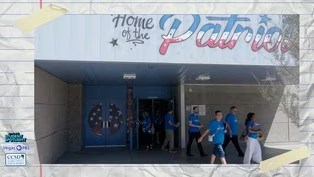
Bright Futures Community Walks Help Connect CCSD Students
Video has Closed Captions
Clip: S6 Ep1 | 2m 33s | Volunteers and staff go door-to-door to re-enroll students during Bright Futures walks. (2m 33s)
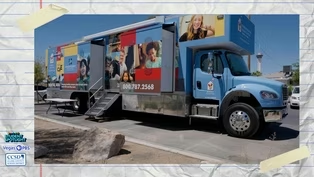
Dental care available at CCSD Family Support Center
Video has Closed Captions
Clip: S6 Ep1 | 3m 16s | The Ronald McDonald Care Mobile visits CCSD Family Support Center to offer dental care. (3m 16s)
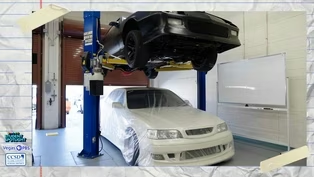
Go inside the Automotive Technology Program at Arbor View HS
Video has Closed Captions
Clip: S6 Ep1 | 3m 4s | Meet the teacher and students in the Automotive Technology Program at Arbor View HS. (3m 4s)
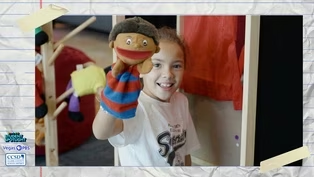
Go inside the new Helen Marie Smith ES Star Lounge!
Video has Closed Captions
Clip: S6 Ep1 | 3m 6s | The Helen Marie Smith ES Star Lounge helps motivate students to make good choices. (3m 6s)
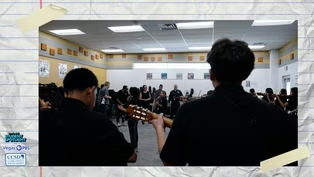
J.D. Smith MS students with news around CCSD - News Break 1
Video has Closed Captions
Clip: S6 Ep1 | 1m 33s | J.D. Smith MS students Noah and Adriel help report on news around CCSD for News Break 1. (1m 33s)

J.D. Smith MS students with news around CCSD - News Break 2
Video has Closed Captions
Clip: S6 Ep1 | 1m 14s | J.D. Smith MS students Maria and Aliyah help report on news around CCSD for News Break 2. (1m 14s)
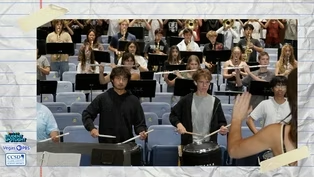
Meet the award-winning Foothill HS Band!
Video has Closed Captions
Clip: S6 Ep1 | 3m 40s | The award-winning Foothill HS Band is back from summer travel. Learn what is next! (3m 40s)
Providing Support for PBS.org
Learn Moreabout PBS online sponsorship












Support for PBS provided by:
Student Spotlight is a local public television program presented by Vegas PBS