
Cindy Sexton
Season 17 Episode 2 | 26m 46sVideo has Closed Captions
Alison dives into Cindy's path to becoming the longest-running TV news anchor in Tennessee.
Cindy Sexton has spent more than 40 years behind the news desk at Local 3 here in Chattanooga. She's a trusted source for keeping us informed, and a friend through the screen to so many. In this episode, Alison dives into Cindy's path to becoming the longest-running TV news anchor in Tennessee.
Problems playing video? | Closed Captioning Feedback
Problems playing video? | Closed Captioning Feedback
The A List With Alison Lebovitz is a local public television program presented by WTCI PBS
Cindy Sexton
Season 17 Episode 2 | 26m 46sVideo has Closed Captions
Cindy Sexton has spent more than 40 years behind the news desk at Local 3 here in Chattanooga. She's a trusted source for keeping us informed, and a friend through the screen to so many. In this episode, Alison dives into Cindy's path to becoming the longest-running TV news anchor in Tennessee.
Problems playing video? | Closed Captioning Feedback
Where to Watch The A List With Alison Lebovitz
The A List With Alison Lebovitz is available to stream on pbs.org and the PBS app.
Providing Support for PBS.org
Learn Moreabout PBS online sponsorshipThis week on The A List, I find out how this Tennessee broadcasting history maker got her start.
I really had a fear when I started working, that I would not be able to continue to work on the air as I aged.
And I remembe there weren't many women older And so often, you know the man would be sitting there in the anchor chai and he'd be old and gray or bald or whatever else.
And nobody cared but the woman couldn't look like that.
So I always had that fear that I would not be able to keep my job because that was sort of the way things were back then.
Join me as I talk with Local 3 News anchor Cindy Sexton, coming up next on The A List.
Hello, I'm Cindy Sexton Good evening, I'm Cindy Sexton.
And I'm Cindy Sexton.
Cindy Sexton is the longest running television news anchor in the state of Tennessee.
That's coverage you can count on.
Residents of the Tennessee Valley and beyond are no doubt familiar with Cindy Sexton.
For Local 3 viewers, Cindy is more than a TV news anchor.
She is a consistent and trusted friend that we rely on to keep us informed about our community and our world.
She began her tenure at Local 3 in 1985, and for more than 40 years we have tuned in to the evening news, knowing we can count on Cindy for her reliable reporting and a heart for the community she serves.
She is the longes running television news anchor in Tennesse and an icon here in Chattanooga, and I had the chance to visit the Local 3 studio to get to know all about the path that led her here.
Well Cindy, welcome to The A List.
Thank you.
I'm delighted to be here.
And a little scared.
No.
Oh, my gosh, you should not be scared.
You are the consummate professional.
And I am just thrilled to be in your studio shooting this.
How exciting.
Glad you're here with us.
But honestly, I'm usually the one on the other side.
I know, I know, this is a place of discomfort for you because you're used to reporting the stories instead of being told to tell your own story.
But I'm going to start right there, which is we hear so much from you about our community, our region, our world.
But I think what we don't get all the time is a little about you.
So give me sort of the story from the beginning about where you grew up and your childhood.
Okay.
That's way back.
Quite a while back.
But I was born in Memphis.
My mom and dad had met at Memphis State.
He had been, he was a veteran.
Had come back from World War two.
She was selling tickets to a football game and he said, well, I'll buy them if you'll go with me.
That's how they met.
On the steps of the library, there at Memphis State, and they both ended up getting their degrees.
And we, the three of us, my two brother and I were all born in Memphis.
And then dad was with Chrysler, and we moved to Texas.
And I grew up near Dallas in Richardson.
And then he was transferred again as an executive.
They move them around some and we, went to Saint Louis.
So I spent par of my high school years there.
I ended up at Murray Stat in college.
Am I going way back?
No, I love all of this.
I didn't, you know, it was so long ago that I wasn't real sure what I wanted to do.
Yeah.
And in my head if a woman majored in business, it involved being a secretary, and I couldn't type, I can type a little better now, since that's what we all do on our computers.
But I didn't have those skills, didn't want to do that.
But I saw what my dad did with his career in Detroit and in going all over the country with his job.
But, I wasn't really sure what I was going to do.
So I went ahead and said, oh, okay, I'll be a teacher, because that's what my mom was, and my grandfathe and other people in my family.
So I got certified to teach speech, theater and majored in English as well.
So and then I didn't go that direction.
When did you know teaching wasn't the path you wanted to take?
Probabl when I did my student teaching.
So pretty soon, pretty quickly.
But, you know, that's at the end of your college years.
You know, my senior year.
But I did teach, the basic speech class when I was working on my master's degree, and I don't think I ever reall said no, I don't want to teach.
But I starte just looking at other options.
Okay.
And I took a class in reporting.
I told my da I wanted to work in television, and I think he thought I just sort of had stars in my eyes.
And it was not really something to do.
And so he was really encouraged by the fact that I did the English major and, and got the other basics, and that did help me with what I wanted to do.
But I took a class in broadcast news reporting and loved it.
Loved it.
And I thought, well, I'm writing.
I was on the debate team, I can speak, I can combine all these skills and maybe I'll get a job as a reporter.
So it was har to break into the industry back then because you almost had to have an internship.
And I was way pas being able to do that because I already had my degree then.
So how did you break in?
The guy who taught that class?
Well, I was a school relation admissions officer at that time, and the guy who taught that clas was also the anchor in Paducah.
And, he and, he, he said, we have an opening, but it's a part time.
It's a weekend opening.
And I said, I want to do that.
And he said, okay.
And I had a friend who was coming up.
She was a senior and she was majoring in radi TV, and she and I went to Gary.
It was Gary Rhodemeyer.
We went to Gary and said, we'll be your weekend reporter, okay?
And he said, sure.
And she had taken this class too.
And that was what opened the door.
And then the competitio hired me with a full time job, which is what I really wanted to do in Cape Girardeau, Missouri, the CBS affiliate there.
So that was how I broke in.
So tell me about those first years of being on air.
Were you nervous?
Were you were you learning the ropes just by trial and error?
Did you have a mentor?
All of that.
Okay.
Really!
And, even though I said I had a speaking background.
Yeah.
When I got in the audio booth my voice went up about an octave I got nervous, and I sounded lik a little chipmunk or something.
I'm not sure what, but, but I had people coaching me and saying, you know, just do it.
Do it like you're on the phon with your mom, tell the story.
And that was where some of th best advice I had ever gotten.
And from Cape Girardeau I went to Huntsville, Alabama, and Bill Markham and I were co-anchors there.
Which is crazy!
The fact that you started in Huntsville together, and Bill, of blessed memory, and then came here and had such a long career together is extraordinary.
It's hard to believe when I look back on it.
But he was considerably older.
Not to not to say that, but he had already, you know, he had already been in Baltimore and and South Florida.
He had had a great career, but he's from Alabama, came back to this part of the country.
And I think he just really wanted to kind of just not start over.
Yeah.
But when he heard about the opening in Huntsville and he and I were hired at the same time because it was the CBS affiliate and the anchor team had been stolen away by the other station in the market.
And so he and I started at the same time.
And he would he would do the same thing with m as far as coaching and writing.
From writing scripts to getting comfortable in front of the camera.
Those early experiences helped prepare Cindy for a long and remarkable career behind the news desk.
And every lesson learned was another step toward finding her home right here in Chattanooga, where her former Huntsville co-anchor, Bill Markham had joined the team at Local 3.
So how how'd you get to Chattanooga?
Okay.
It goes around in a whole lot of tangles, and I apologize for that.
But my husband, who I met in Kentucky at Murray State, where I went to school, grew up all over the Tennessee Valley.
His dad was an engineer with TVA, but he ended up goin to high school in Marion County.
So Chattanoog was kind of always on his radar.
And I was working of course, up in Cape Girardeau.
And he came here to work for P Magazine when they started it.
Oh, PM Magazine.
Yeah!
Oh, and Channel 3 had such a good PM Magazine.
Yeah.
And he loved it.
It was so much fun.
And I would come visit of course.
And I was just really interested in coming to this part of the world.
And of course, I knew Bill Markham, you know, and in Huntsville, where we worked and Gil was already in Chattanooga, I went to Huntsvill and Bill got the job here first.
And I had meantime gone to work in Las Vegas.
And he called me one day and said, don't you want to get back to the South?
And I said, yes, I do.
I really do.
And Gil and I had been married about, about a year and a half at that point, and we said, yes, we want to come back.
So the job was open here for me to come back and work here, and I thought I'd stay two years.
I heard you signed a three year contract and you had an out in two.
Thats right.
Howd that work out for you?
It was great.
I didnt end up leaving.
Still no out right now?
No, no out.
I mean, last year.
And you continue to celebrate it year after year, but you celebrated being the longes running TV anchor in the state.
Isn't that crazy?
When you hear that, What does that make you think?
A couple of things.
Yeah.
Number one, I can't be that old.
I can't, you know, it just goes by in a blur.
I don't think of myself as that.
Whatever I'm supposed to be.
You know that person who's been here the longest?
I'm not that serious about everything.
The other thing is, I really had a fear when I started working, that I would not be able to continue to work on the air as I aged.
And I remember there weren't many women older and, you know, Barbara Walters and then a few others.
And then there were some pioneering women like Jane Pauley and some of the others who came along, and Jane still working.
But I remember thinking that it was scarce.
And so often, you know the man would be sitting there in the anchor chai and he'd be old and gray or bald or whatever else.
And nobody cared but the woman couldn't look like that.
So I always had that fear that I would not be able to keep my job because that was sort of the way things were back then.
Was there a time where you remember losing that fear, or has that just been constantly on your mind?
No, no, I just really hadn't thought about it that much.
Yeah, since then.
But I do remember that.
And I remembe one of the anchors in Paducah, I believe it was had been there quite a while, and I remember finding ou how old she was and I thought, wow, you know.
So it was kind of inspiring to know she'd been there already that long.
So that transition from being a job to really a calling, when did you know you were good at it?
It's one thing to say, I'm interested in this, and I find this fascinating and this thrills me.
It's another thing to have a true passion that turns into an acumen, where you know you are good.
I mean, there's a lot that goes into on air, right?
You have to be able I mean, I can't even read half the things in here without my contacts, right?
So it's not just aging, but it's right.
It's it's how we literally see and are seen.
Yeah.
Was there a moment was there a story where you remember going, oh, I've got this.
I'm not sure.
I'm sorry I, yo asked that great long question.
And I'm not totally sure.
I do know that when I first started I remember saying, this is so much fun.
This is the kind of thing I think when you're a student, sometimes you think, what do I want to do as a career?
And I remember always saying, I didn't want to work.
And of course I'm behind the desk here, but I didn't want to work at a desk all day.
I have a desk job, 9 to 5, whatever.
I wanted things that were interesting and different.
And that' what you get to do as a reporter and you get to tel all different kinds of stories.
Now, I do think some of the stories that inspired me the most are stories I did on Cancer Survivors.
And I lov telling and inspiring stories.
Somebody who overcame the odds and somebody who managed to make a wonderful life out of tragedy.
Yeah.
You know, we so often turn on the news and there's a joke, right?
Welcome to the bad news.
Right?
So much of it feels so heavy.
Yeah.
You are the consummate storyteller who has a responsibility every evening, right?
Many times to convey those stories many of them very hard hitting.
How do you maintain the emotional wherewithal to to literally shoulder the burden of that and also maintain grace and, really confidence while you're telling us what's going on in the world I'm going to take that to heart.
And I'm glad you said that.
And I'm I'm very honored and flattered you said maintain the grace or whatever it is.
I think.
I don't quit know exactly how to describe it, but I, I don't think it's like you compartmentalize it because that's not something you can do and still have compassion.
I think we all have had moments where it was going to be difficult to read the next story, but most of the time, because of the people I si on the desk with Bill Markham, David Carroll, Greg Glover, we we move on.
I mean, we're a we hold each other up.
We know we can go on to the next story.
I hope that makes sense.
It does, it does.
Over the course of her 40 plus years at local three, it's clear that the relationship Cindy has nurtured on and off camera have bee an important part of her legacy.
She and co-anchor David Carroll have the distinction of being one of the longest running news teams in the country, and their reputation for trusted reporting is supported by a close-knit staff here at Local 3.
So this is fu because nobody is saying a word right now.
It's like a library, and it's never like this.
Marissa's over there.
I mean, she's usually among the loudest talking about what's coming up.
Talk it up!
Talk it up!
Pretend we're not here!
These are all our reporters working.
They're working really hard.
And our producers as well.
So just walk through.
I mean, this is very exciting for me because I feel like we're getting to see behind the curtain.
Yes.
Yeah.
It's like being at Oz.
Yeah.
All right, so tell us about your typical day.
Okay.
And is it is it Groundhog Day?
Is it the same?
Not in terms of storytelling.
Right.
So so tell me your schedule.
These folks have already been really, really hard at work by the time I come in because I'm on the night side.
But I'll come in and look at the newscast and see what's goin on, familiarize myself with it.
And then we do the 4:00 newscast.
It's early and we didn't used to have all that.
Yeah, yeah.
So we have to be ready to do that.
But they have all been many of them working all day.
Okay.
And some of them since real early.
Our assignment desk is up there at the end you'll see that.
And now that we have digital, we have so much of our news is online.
And that's a big important part of what we do now in addition to television.
And some might argue that it's more important.
Is there someone you think about that you're talking to as you're reporting the news?
I used to think about my mom a lot.
No, I don't think anybody specifically okay.
In particular, unless it's a certain story about somebody I know.
Yeah.
Do you think about the fli side, though, that when people.
Very exciting.
I feel like an old phone.
It's an actual thing, is an actual phone.
We've gone back in time, that when people see you in publi or when people are watching you, they feel like they know you.
They're really nice.
I mean, it feels, you know, an I know that's not true, right?
We don't know you personally the way that, you know, you know, other people.
But because we see you, I' speaking as a collective, right?
We see you all the time.
There is a familiarity that you know, whether real or not.
Yeah, it feels real.
And I understand that because I have had the opposite happen.
I mentioned Gary Rhodemeyer?
The guy I took the class fro I remember seeing him one time at a show in Saint Louis and he was walking along with, you know, hey, hey, look, it's Gary Rhodemeyer!
And it was so funny.
It was before I had gotten into television.
But so I understand.
What do people say to you when they see you in public?
They're usually really nice.
Or sometimes they'll go.
One of my favorite ones was years ago.
Don't you work at Kmart?
And I said, no, but I used to work at Kroger.
I have I'm asked that sometimes work where?
How do I know you?
It's just the familiar face sometimes.
Yeah.
They don't know exactly where I'm from.
All right?
We can't end this.
We got to talk about David.
Carol.
Okay Tell me about that partnership.
Oh, yeah.
He's over there.
Where is he?
Is he on the phone?
He's on it.
Okay.
David!
remember when he first came over to channel three.
He was at channel 12.
Yeah.
And, I knew who he was.
We talked.
we were standing out there, I think, in the parking lot.
And he said, should I come over here?
And I said, yes, you absolutely should.
It was so exciting.
You know, I mean, but background he was in radio.
Yeah.
The guy is incredible.
He knows everything.
If we're missing something about something we don't know who who did that.
When was that?
You know.
And he'll remember it.
And it used to be that he would remember phone numbers like crazy.
I don't know if he still does, but, you know, of course, we all have him in our phones now.
Yeah.
But, you know.
Hey what's the mayor's phone number?
Oh, we set it up, and he just rattle it off.
But he's got a great mind.
And then he's also abl to convey it with a real warmth to our audiences.
Do you both acknowledg on a regular basis how special your partnership is, though, because you hear nightmare stories about people in the industry who do not get along and that has been career ending right from personal and professional conflicts.
Yeah, but the two of you, from what I know behind the scenes too, none of that.
None of that.
Yeah.
And no we don't convey it every day.
I'm going to make a note.
Because it's something, you know, we all need to do with everybody who's special to us.
But it's amazing and so lucky.
And you do hear the nightmare stories and they are awful.
Yeah.
They don't go.
People don't get along or they don't I don't know, they don't get enough airtime or they see this or that or whatever else.
And we all have different gifts.
So, you know, it all works well together.
Since we only see the forward facing you, we don't get to see this every day.
What do you wan viewers to know that we don't?
That we're working really hard to do a good job.
And sometimes a viewer will call in with to correct us about something, and we want to know if we get something wrong.
But I hope they all kno that we are working really hard to get the stories right and to tell them right.
That's so important.
From breaking news to community stories, Cindy has remained a trusted guid for audiences who have tuned in on air and online for decades.
As viewers, we've been fortunate to be alongside her for some memorable moments along the way.
What should we do with these scripts?
Do you want to toss them?
There they go.
All right.
And a supportive community has seen her through some big life changes as well.
Did becoming a mom chang the way you approached this job?
I think it's I think was so funny.
I became a mom later in life, much later.
And I remember a friend saying, oh, your life will never be the same.
And I said, I want that.
I don't want it to be the same.
It changes everything.
And it it made me realize, you know you do have to work differently and you have to make the hours work so your child gets the kind of guidance an attention that you want her to.
And, I was fortunate to be able to do that because I didn't come into work until the afternoons and when Gil, my husband, was in town, he could be with her.
And then we also had a couple of wonderful sitters who helped.
And then I was able to come home after the 6:00 news and be with her.
And I don't think sh really ever felt like I was gone very long.
I hope, and I think it changes everything.
I really do.
It gives you an understanding o what it's like to be a parent.
Yeah.
And as a single mom and then as a, later in life, mom, I think before all of that, I had an understanding somewhat, but not not like you do when you're changing the diaper, not when you see that child.
Did she learn pretty early on that her mom is famous and very, you know, very recognizable?
I don't think she thought of it as that.
But it was really funny if we'd go shopping or something.
Sometimes people would come over and talk and then, you know, I'd feel this little tug on.
Come on, let's go.
So she was very unimpressed with all of that.
But, but I think she also enjoyed it.
You know, she she's such a ham herself.
I mean, yes, she, she would steal this stage i she was here in about 10 seconds She knows I'm her biggest fan, so I remember in TJ Max, one tim we were at the checkout counter and she saw some woman looking at jewelry and she sounded like Jerry Lewis.
She said, hey, lady, you wanted to get her attention and talk to her.
I mean, she's just always so gregarious and so fun.
What's changed about the industry?
Everything.
What you're doing here with WTCI, this wonderful longform interview and program, you're able to do it.
We don't have anything like that.
Most of what we do is, a newscast and things that can be put also online so muc that we broadcast is changing.
Our audience is much smaller.
Our kids, our kids friends probably don't watch TV all that much.
We can send them a link to watch a story and tell them about it, and a lot of them are staying up on the news in other ways, but I think it's changed so much and that the industry itself, as far as what we can, what we can pay our people.
And I remember somebody explaining it to me one time that it it's a pie.
Everybody watching television or being entertained, playing video games, movies, whateve it is, it's still the same pie.
It's the population.
And that used to be NBC, ABC, CBS and PBS.
And that was it.
That was the pie.
And then along came cable and so many other things.
Video just, you know blockbuster, that kind of thing.
And now it's everywhere all the time.
Yeah.
You sit down to watch TV and you're not necessarily going to watch the news.
And, I think it's it's sad.
I hate tha in some for so many reasons, but it's it's hurt our it's hurt our country.
I think so many of our viewers or they're not our viewers because they don't watch but they're not informed.
Yeah.
I think it's a sign of the times.
So for someone who has spent a career telling other people's stories and we are so grateful for that.
Thank you.
What story do you hope people tell about you?
That I cared.
That' that's the most important thing.
It really is.
I'll tell you one, one story that I did right after we got here.
I guess 1985, I was doing some of the health stories, and I mentioned cancer survivors.
There's a young man named Mar Bartlett, and our photographer here told me about him, and he was very, very sick.
Suddenly diagnosed with leukemia.
They sent him to MD Anderson Hospital.
I was able to go down there with Mike Johnson and tell his story.
He got one of the very first bone marrow grafts in the world, and he's still alive today.
And I just get chills thinking about it.
But to be able to tell that story 40 years ago, and we will catch up with him one of these days.
I love those stories.
Well, I think people will sa that you cared and so much more, and I can't imagine.
entrusting the storytelling in this community with anyone else.
Thank you Cindy.
Thank you.
Watch even more of the shows you love any time with WTCI passport, an exclusive benefit for members of WTCI PBS.
Watch your favorite shows in passport on the free PBS app.
Download it today.
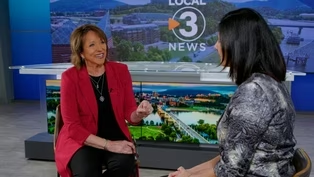
Cindy Sexton describes moving from teaching to broadcast
Clip: S17 Ep2 | 1m 50s | When Cindy started exploring teaching, she knew it wasn't right for her. (1m 50s)
Providing Support for PBS.org
Learn Moreabout PBS online sponsorship New Episode
- News and Public Affairs

Top journalists deliver compelling original analysis of the hour's headlines.
 New Episode
 From My Station
 New Episode
 New Episode





 New Episode

Support for PBS provided by:
The A List With Alison Lebovitz is a local public television program presented by WTCI PBS