
City Sprouts
Clip: Season 16 Episode 11 | 5m 54sVideo has Closed Captions
Cultivating change, one garden at a time
In 1995, Omaha City Sprouts planted a seed in Omaha, NE to promote urban gardening. 30 years later, that seed has blossomed into an organization with multiple education sites, and an urban farm which grows and donates over 15,000 pounds of healthy and culturally preferred produce each year. Through education and outreach they are cultivating food equity and having a huge impact on the community.
Problems playing video? | Closed Captioning Feedback
Problems playing video? | Closed Captioning Feedback
Nebraska Stories is a local public television program presented by Nebraska Public Media
City Sprouts
Clip: Season 16 Episode 11 | 5m 54sVideo has Closed Captions
In 1995, Omaha City Sprouts planted a seed in Omaha, NE to promote urban gardening. 30 years later, that seed has blossomed into an organization with multiple education sites, and an urban farm which grows and donates over 15,000 pounds of healthy and culturally preferred produce each year. Through education and outreach they are cultivating food equity and having a huge impact on the community.
Problems playing video? | Closed Captioning Feedback
How to Watch Nebraska Stories
Nebraska Stories is available to stream on pbs.org and the free PBS App, available on iPhone, Apple TV, Android TV, Android smartphones, Amazon Fire TV, Amazon Fire Tablet, Roku, Samsung Smart TV, and Vizio.
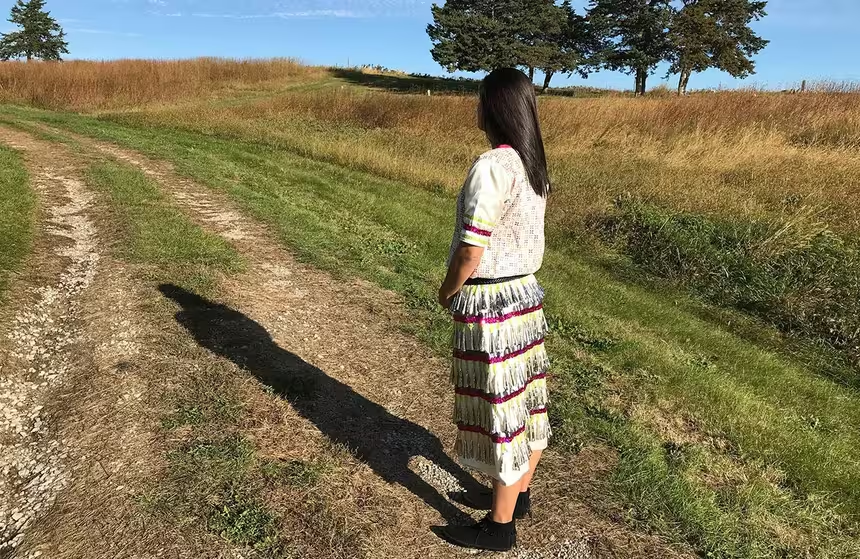
Do you have a Nebraska Story?
Do you have a story that you think should be told on Nebraska Stories? Send an email with your story idea, your name, your city and an email address and/or phone number to nebraskastories@nebraskapublicmedia.org. Or, click the link below and submit your information on nebraskastories.org.Providing Support for PBS.org
Learn Moreabout PBS online sponsorship(gentle music) - Yeah, yeah.
These are the right ones.
Have you had these ones?
(gentle music) -[Shannon] City Sprout started in 1995, and it was neighbors getting together and wanting to do something great with this empty space in the Orchard Hill neighborhood.
They decided on a garden, and then it's been growing since then, almost 30 years.
(gentle music) - It's been something I always wanted to do.
I always wanted to learn how to garden, and then I saw, you know, people gardening over here and, and so I started getting involved - Where there, it's like, there's mentorship, so like they'll help you get your garden started.
- I think people who don't live in the neighborhood that come here are like, whoa, I had no idea that this space was here.
And they're really inspired by that.
And maybe this is a part of town that they also haven't explored that much.
I feel like it's a big point of pride for the neighborhood.
I live in the neighborhood too, so speaking for myself, it's definitely a big point of pride.
(gentle music) This garden space is like this common thing that brings everybody together.
-[Lady] So right when Covid started, so they... -[Sebrina] I love, love to now, you know, I bring my grandkids.
It's the most beautiful thing ever.
When I saw them eating, being taught about a flower, that it was edible and they all tasted it and they was like, Ooh, tastes, tastes like a, kind of like a pepper.
So they kind of knew what that was.
It showed me that they're open-minded about being outside, you know, learning things.
(gentle music) They've done a lot to better, the gardening community to me is still, it's still City Sprouts.
It feels like home.
(gentle music) -[Shannon] It's always felt good to have a garden space where people can come and smell flowers and pick vegetables and all of that.
It's hard to see with the glare, but now we've gotten to a point where we're like, we need to really take this seriously and look at the big picture and see where we can continue to grow and share resources and like get our whole city to a place that is everyone's getting fed.
(somber music) (gentle music) (gentle music) -[Aaron] In 2018, moved back to Omaha.
moved back home and kind of helped, you know, bring City Sprouts from what was a, a little tiny, you know, 10th of an acre garden into, to what you see behind me here (gentle music) -[Edgar] Of pride and ownership, that you're doing something greater for, the community.
Greater for yourself.
You're not really just, it's mine.
It's the, you're sharing your crops, you're sharing your space, you're sharing your time with other people.
The gap between the affordability of, of healthy food is starting to become a large, large gap now where some people just have no access to be able to, to buy the food.
Even if they had the ability to, go to a store, they just don't have the money for it.
And that's even in some other neighborhoods, there's not even a grocery store.
-[Aaron] Looking at food as a justice issue is something that is really near and dear and core to what we do here at City Sprouts.
We're not just growing great produce, we're growing great produce for a reason.
And that reason is that we believe that everyone in Omaha should have equal access and equitable access to delicious healthy produce like this.
-[Shannon] We're kind of figuring it out and then helping support these other growers.
And I think the more people we can get growing food in the city, the better.
-[Edgar] Like by showcasing that you don't need a lot of land to be able to grow food.
I mean, for example, at our farm, we're able to harvest a little over 10,000 pounds of food, acre and a half ish, something like that.
When they see that, they're like, oh, this can be done in a small scale and this much.
It's like, yes it can.
And that's the biggest thing that we want to emphasize about land access is because it is difficult.
But if you can't give a small piece of land to work on, you can accomplish great things.
(gentle music) -[Aaron] So we could not exist and do our jobs without our partners at the food bank or without our partners at Whispering Roots.
And so if we didn't have them, we'd just be a bunch of weirdos out here growing kale, right?
So anyone that grows on the small scale knows how much time it can take.
And so our partnerships have really allowed us to get the knowledge, get the expertise on the distribution side, on the like food pantry side that we don't have the time to kind of dig into ourselves, right?
We're focused on growing as much food as we can here and we're so happy to be able to rely on our partners to be able to help fill in the the gaps.
- They survey the people that are coming to their pantry to find out what they want to eat and then we communicate with them and we're making sure that we're growing that kind of food.
So they're able to distribute like local, fresh, healthy produce that's also culturally relevant.
That's really huge.
(gentle music) Urban agriculture is gonna continue to grow.
I think they're gonna be more people growing food on lots of these empty lots that we have around town.
(gentle music) -[Edgar] The faster you put seeds down and the faster you watch 'em grow, the faster you're gonna learn and you're gonna realize that it does.
Seeds have been doing this for millions of years.
Plants themselves, they'll do the work for you as long as you provide 'em healthy food, a healthy soil, and you water them consistently, they'll do the rest.
It's not that difficult.
It's almost too easy really.
I think so.
(Edgar chuckles) (gentle music) (gentle music)
Video has Closed Captions
Clip: S16 Ep11 | 6m 46s | Music finds a new home in an unexpected place. (6m 46s)
Video has Closed Captions
Clip: S16 Ep11 | 4m 37s | Geier to Brockett, a 70-year no-hitter journey. (4m 37s)
Providing Support for PBS.org
Learn Moreabout PBS online sponsorship















Support for PBS provided by:
Nebraska Stories is a local public television program presented by Nebraska Public Media