
Clean Ups and Competitions
Season 1 Episode 25 | 26m 46sVideo has Closed Captions
Grappling with lead water lines and PFAS from air bases. Meet some Great Lakes Olympians.
One lakeside town struggles with PFAS pollution from a local Air Force base, while cities around the region race to remove and replace thousands of lead water pipes. And after a year-long delay, Great Lakes sailors head to the “2020” Olympics. Episode 1025
Problems playing video? | Closed Captioning Feedback
Problems playing video? | Closed Captioning Feedback
Great Lakes Now is a local public television program presented by Detroit PBS
Clean Ups and Competitions
Season 1 Episode 25 | 26m 46sVideo has Closed Captions
One lakeside town struggles with PFAS pollution from a local Air Force base, while cities around the region race to remove and replace thousands of lead water pipes. And after a year-long delay, Great Lakes sailors head to the “2020” Olympics. Episode 1025
Problems playing video? | Closed Captioning Feedback
How to Watch Great Lakes Now
Great Lakes Now is available to stream on pbs.org and the free PBS App, available on iPhone, Apple TV, Android TV, Android smartphones, Amazon Fire TV, Amazon Fire Tablet, Roku, Samsung Smart TV, and Vizio.
Providing Support for PBS.org
Learn Moreabout PBS online sponsorship- [Narrator] On this edition of Great Lakes Now, the struggle to get the Air Force to clean up toxic pollution.
- Every surface water we sampled, had the stuff in it.
- [Narrator] The race to replace thousands of lead water pipes... - [Karen] We are proactively removing the service lines, but not at a rate that we're comfortable with.
- [Narrator] And Great Lakes sailors head to the Olympics.
- [Stephanie] We are just really trying to do everything we can to be ready when we show up.
(upbeat music) - [Announcer] This program is brought to you by: The Fred A. and Barbara M. Erb Family Foundation, The Charles Stewart Mott Foundation, Laurie & Tim Wadhams.
The Consumers Energy Foundation is committed to serving Michigan from preserving our state's natural resources and sustaining our future to continuing business growth, academic achievement, and community involvement.
Learn more at consumersenergy.com/foundation.
The Richard C. Devereaux Foundation for Energy and Environmental Programs at DPTV.
The Polk Family Fund, Eve & Jerry Jung, The Americana Foundation, The Brookby Foundation, Founders Brewing Company, and viewers like you, thank You.
- Hi, I'm Ward Detwiler.
Welcome back to Great Lakes Now.
We've told you about PFAS contamination in drinking water, but PFAS has also polluted lakes and rivers in our region.
The source is often an airport or air base, like the former Wurtsmith Air Force Base in Oscoda Michigan.
- [Narrator] Oscoda is a small town along the shores of Lake Huron in northeast Michigan.
It is home to the Ausable River, Van Etten Lake, and countless rivers and streams.
For many years, it was also home to Wurtsmith Air Force Base, a strategic air command base that was an essential part of the community, until it was decommissioned in 1993.
The base has since become Oscoda Wurtsmith airport, but after the base closed, it was discovered that the Air Force left behind more in Oscoda than an airstrip.
The ground was contaminated with chemicals known as PFAS.
- So these chemicals, they don't break down.
I mean they dilute but they don't break down, so I know they're going to be as far away as the groundwater could take them.
- [Narrator] Bob Delaney worked for the Michigan Department of Environment, Great Lakes and Energy for thirty years.
He was the first person to sound an alarm about possible contamination from dangerous PFAS chemicals on military bases.
His first tests were at Wurtsmith.
- What we found was every single well that we sampled, every surface water we sampled, had the stuff in it.
I had never seen a site like that, and it was eventually about eight square miles of groundwater and surface water that's impacted here.
- [Narrator] PFAS or per and polyfluoroalkyl substances are a group of potentially harmful chemicals that were used in a variety of consumer products.
If it's non-stick, waterproof, or stainproof, it was probably made with PFAS.
At Wurtsmith and air bases around the world, crews trained with fire-fighting foam that contained PFAS.
The contamination seeped into the groundwater.
A high concentration of PFAS was found in Clark's Marsh, a wetland adjacent to the base near the fire training area.
When fish from the marsh were sent to a lab for testing in 2012, the results were shocking.
- The lab actually thought this is some kind of university experiment.
That we'd sent them fish from a fish tank that we had intentionally exposed to these things.
But it was really coming out of the marsh.
- Initially it was a record and it may still be for PFAS contamination in fish anywhere in the world.
- [Narrator] Garret Ellison, is an environmental journalist with MLive and the Grand Rapids Press.
He's been reporting on PFAS in Michigan since 2016.
- It's really just hard to fathom when you look around this beautiful marshland and you don't see any real sign of pollution, but the fish are that dangerous.
- [Narrator] But it wasn't just the fish in Clark's Marsh.
The Michigan Health Department posted signs warning not to eat the waterfowl and deer.
And the warning about the fish extended beyond the marsh to the Ausable River.
- What happened when that news came that you couldn't eat the fish in the Ausable River, that made it clear into Washington.
I mean the people at the top of the DOD suddenly knew where Oscoda, Michigan was and what was going on here.
- [Narrator] In 2015 the Department of Defense installed seven extraction wells along the edge of the former base that connects it to Clark's Marsh.
The wells pump water from the ground, filter it through granulated carbon, and then return it to the groundwater.
The Air Force plans to add five additional wells along the marsh.
This map shows the Clark's Marsh plume.
The current wells are indicated in blue and the proposed wells are yellow.
Although the water put back into the ground has nearly non-detectable levels of PFAS, some local residents are concerned that even with the additional wells, only a small percentage of the contamination is being captured and treated.
- There's a real question as to whether the wells being placed in Clark's Marsh actually substantially cover the plume that is present in Clark's Marsh.
- [Narrator] Congressman Dan Kildee, is the co-founder and co-chair of the bipartisan Congressional PFAS Task Force.
In 2020 he worked to secure $13.5 million in federal funds to help clean up the contamination near Wurtsmith.
- I want a more aggressive approach, I want an approach that that says, we're gonna do as much as we can, not as little as we can get away with.
I think it sets a really bad example when an agency of the federal government decides that it's gonna put itself in the same category as a polluter who has to be forced by regulators to clean up their mess.
That's not an acceptable answer for me.
There is currently no federal standard for PFAS in surface water, but states have set their own rules.
In 2020, Michigan adopted some of the strictest standards in the country, limiting seven of the thousands of PFAS compounds to low levels.
But the Air Force says it isn't bound by Michigan's rules under CERCLA, the Comprehensive Environmental Response Compensation and Liability Act.
They say they're only required to meet the EPA's much higher Health Advisory limit of 70 parts per trillion, and they say testing shows undetectable levels of PFAS anyway.
- With PFOS and PFOA, the lifetime health advisory allows us to consider under section 104 of CERCLA, this to be another pollutant and take some action.
The action is 70 because of the EPA Health Advisory, the result is non-detect because that's what the technology gives us.
- [Narrator] PFAS is detectable in Van Etten Lake, which borders the base.
In the summer of 2017, white foam started showing up along the beaches.
Tests confirmed it contained high levels of PFAs.
- It's not as concentrated of a problem as out here in Clark's Marsh, but there's a lot more human interaction with the environment there, so that makes that a big, big problem too.
And obviously the foam is a scary thing to people but because you can see it more but it's firefighting foam, basically, it's a dilute firefighting foam.
- For reasons I can't explain, the foam that's showing up on our surface water is getting worse.
So there are times when you can see the foam piling up and blowing into yards.
It's exposing children and animals and ourselves to this foam that we could possibly touch and has high, high levels of PFAS in it.
- [Narrator] Kathy Wusterbarth has lived in Oscoda all her life.
She is co-leader of a community action group called NOW, Need Our Water.
- On this beach here, I was a lifeguard for three years.
I spent a lot of time in this water and I believe that I may have been affected.
I developed cancer a few years after I worked in this location along with an immunological disease.
So it's possible that PFAS had a contributing factor to that.
- [Narrator] Greg Cole moved to Oscoda from the Detroit area in 2008.
He and his wife bought three cottages that they rent out on Van Etten Lake.
- I'm apprehensive of swimming, letting my grandkids in the water, very sensitive to that.
It's just, it's sad.
I'm around this lake all the time and you know, I tell my renters about contamination when they come.
We're straightforward with them.
We direct them, if they want to swim, they're going to town to Lake Huron, we have a beautiful beach there.
- [Narrator] PFAS contamination isn't unique to the former Wurtsmith Air Force Base in Oscoda.
It has been confirmed or suspected at over 700 military bases across the country.
To date the Air Force says it has spent almost 28 million dollars on the clean up at Wurtsmith.
A plan to address the plumes on Van Etten Lake is expected in the summer of 2021.
- You have to look at it from a health perspective, here we have the most dangerous fish in the world as far as eating them.
We have this foam coming up on our beach.
We have legitimate health concerns.
So this is one of the places where you put your money first, and by not acknowledging those dangers, the system gets broken.
- [Narrator] Tony Spaniola is one of the founders of the community group, NOW.
He owns a home on Van Etten Lake.
- Being the first military base in which PFAS was discovered anywhere in the world, that we do in Oscoda has an impact far beyond Oscoda.
Well, we want to set a precedent that makes them do things in Oscoda so they will do things elsewhere because they need to be done.
- You can find more coverage of PFAS at greatlakesnow.org.
The water crisis in Flint, Michigan that began in 2014 caught the world's attention and prompted other cities around the Great Lakes to take a closer look at their own drinking water.
What they found was shocking, some cities are now replacing water lines, and the costs are huge.
- [Narrator] In Milwaukee, a crew starts the process of replacing a lead service line.
Karen Dettmer is superintendent of Milwaukee Water Works.
- We're working on a single family property that is expected to cost about $7500 dollars total, for the lead service line replacement.
The city of Milwaukee has a little over 70,000 lead service lines.
That's out of our 160 plus thousand customers, and those are primarily in residential areas.
- [Narrator] To replace each house's lead service line, contractors dig two holes in the ground about eight feet deep, one at the water main, the other at the home's water meter.
Workers then push a cable from one hole to the other using a pneumatic torpedo, and use that cable to pull new copper pipe back through.
The new pipe is then hooked up at each end.
The work is completed in a matter of hours, and there's no need to dig a trench, which saves time and money.
- We are slowly but effectively working forward, proactively removing the service lines, but not at a rate that we're comfortable with.
- [Narrator] The goal is to replace each lead service line in the system, and that could take as long as 70 years.
Costs often fall on local governments, and it isn't cheap.
- We need more federal funding to make this a priority and effectively remove the lead service lines throughout the country, including the city of Milwaukee at a faster rate.
- [Narrator] And federal funding may be on the way.
45 billion dollars to speed up the removal of lead service lines nationwide is included in President Biden's massive infrastructure bill.
Still, the Great Lakes and St. Lawrence Cities Initiatives, Mayors Commission on Water Equity, says it isn't enough.
It's calling on Washington to spend an extra 12 billion dollars to address other sources of lead.
The scope of the problem is enormous, affecting tens of millions of people.
Water Policy Expert Seth Siegel wrote the book, "Troubled Water".
- So there's somewhere between seven and maybe as many as ten and a half-million of these pipes going into individual homes.
Figure three, four or five people per home.
The scale of the problem is anywhere from three times seven million to five times ten and a half million.
- [Narrator] It's not just a U.S. problem.
North of the border in Canada, an investigative series conducted by the Toronto Star found millions of homes from Nova Scotia to British Columbia also have lead service lines.
Journalist Robert Cribb worked on the series.
- It turns out what we found in Toronto was multiplied across the country.
- [Narrator] Cribb says The Toronto Star investigation prompted a significant public response.
Some Canadian cities offered long term loans or tax breaks for homeowners who remove their own lead pipes.
But Halifax, Nova Scotia took it a step further.
- If you're a homeowner in Halifax, Nova Scotia, the city will cover the simultaneous removal and replacement of your lead pipe on both the city and the homeowner side.
And that's an extraordinary investment, tens of millions of dollars.
- [Narrator] Considering the costly long-term effects of lead exposure, Halifax officials felt the investment was worth it.
- [Seth] And we have seen this research that proves beyond any doubt that children who have high levels of lead in their bloodstream are more likely to drop out of school, are more likely to have brushes with the law.
- [Narrator] The federal EPA sets the allowable limit of lead at 15 parts per billion.
In Flint, some water samples were above 100 parts per billion.
In recent years, some cities around the Great Lakes have found readings far beyond the numbers in Flint.
At Loves Park, near Rockford, Illinois, 2700 parts per billion in one house.
At another house in University Park outside Chicago, 5300 parts per billion.
As Congress debates Biden's Infrastructure plan, the Natural Resources Defense Council is calling for the removal of all lead service lines within ten years.
Jeremy Orr, an environmental lawyer with the NRDC, says communities of color are disproportionately impacted.
- Residents of color were two, three times more likely to live in a community that had lead service lines.
- [Narrator] One of those communities is Detroit.
Like Milwaukee, the city of Detroit has been replacing lead service lines since 2018, at no cost to homeowners.
The total price tag could be around 650 million dollars and take 40 years to complete.
The State of Michigan has launched a campaign to remove some 500,000 lead service lines across the state within twenty years.
The estimated cost is around two and a half billion dollars.
- The thing is they're doing it in an equitable manner, in a way that makes sure the pipes are getting out of the ground in a timely manner while also making sure that the burden doesn't disproportionately fall on the more vulnerable communities.
- [Narrator] So how did we end up with all of these lead pipes in the first place?
Lead pipes came into widespread use in the late 1800s, just as many cities around the Great Lakes were entering a period of growth.
So lots of lead water pipes were installed as communities expanded.
- [Seth] The Great Lakes Region was the part of the country that had a very large build out using lead service lines, which is what the lead pipes are called.
And that area is far worse off than much of the rest of the country.
- [Narrator] In fact, Illinois and Chicago have more lead service lines than any other state or city in the nation.
Chicago even mandated their use until 1986.
Water Department officials say regular testing meets or exceeds Federal EPA standards for drinking water.
But Siegel says that doesn't mean a city's water is safe or healthy to drink, because cities like Chicago can easily game the system.
- The EPA allows cities of different sizes to test as infrequently as every three years for lead.
It allows municipalities to pick households in areas where they know there are no lead service lines at all because they want to game the system, because they want to get a number that is below the testing level.
- [Narrator] Under the 1991 Federal Lead and Copper Rule, if lead concentrations exceed 15 parts per billion, then city water departments must take action.
They have to inform the public about steps they should take to protect their health and may have to replace lead service lines.
There are ways of reducing the danger lead pipes pose.
Most cities add Ortho-Phosphate corrosion control chemicals to their water to mitigate the lead problem.
The chemical is supposed to coat the inside of pipes to prevent lead from leaching into the water.
But the corrosion control chemical can easily chip or flake off.
As an interim solution, most cities advise residents to run their tap water for several minutes in the morning to flush the pipes of lead.
But does anybody do that?
- Nobody that I know in the city of Toronto or anywhere else stands at the tap and runs it for five minutes.
And it's not just in the morning, it's supposed to be after any period of standing.
- [Narrator] So the only guaranteed solution is to remove the lead pipes, which is why cities like Milwaukee are moving forward with their plans.
City officials say they are focused right now on schools and daycare centers.
- And we actually go through systematically and look for child care facilities that may have recently applied for a license to operate with the city of Milwaukee.
- [Narrator] Other cities around the Great Lakes and the midwest are also taking action.
Madison, Wisconsin and Lansing, Michigan have already completed removing their pipes.
Galesburg, Illinois has so far removed about 2500 lead pipes, and is expecting to be done by the end of 2022.
The biggest obstacle is money.
Smaller communities lack the resources to do the work.
Many of those cities are counting on the 45 billion dollars set aside in President Biden's American Jobs Plan to help get the lead out.
- I hope, though, that that money gets spent intelligently and productively in the process of actually removing the lead pipes and not providing either surpluses for municipalities to spend elsewhere or for different favorite constituencies.
- For more stories about drinking water, visit greatlakesnow.org.
Individually, sailor Stephanie Roble and Maggie Shea had already won world championships and national titles before joining forces and earning the chance to represent the U.S. in the 2020 Olympics in Tokyo.
But the road to the games has been a little unusual.
I spoke with Stephanie and Maggie, with the Olympics just a few months away.
Well, first of all, thank you guys for being here.
I'm here with Stephanie Roble and Maggie Shea, two representatives of the U.S. sailing team in the upcoming Tokyo Olympics.
And thanks so much for being here, guys.
- Thanks for having us.
- Yeah, thanks for having us.
- Just starting out.
So where are you from?
And did you learn to sail on the Great Lakes?
- I'm from Wilmette, Illinois, and I learned to sail on White Lake in Michigan and on Lake Michigan with my family.
My grandpa had a big boat, and so my family sailed together, we sailed all over the Midwest as a kid doing junior sailing.
And that's where I totally fell in love with the sport.
- I grew up in Wisconsin, sailing on the Inland Lakes, a small lake called Lake Beulah in East Troy, Wisconsin, very small yacht club that was member run and really just a passion for sailing from all the members of the yacht club.
And I started at a really young age, five years old, and at first I was pretty intimidated by the sport and not so sure about it.
And then eventually I fell in love with competing and basically haven't stopped ever since I found that competition aspect of the sport.
- I would love to, by the way, I'd just like to meet the sailor that started when they were like six, that didn't like feel absolutely terrified the first time they got thrown like a little bit about themselves are like, oh my God, like "Dad, what did you do to me?
Why'd you put me out here, I am so terrified" - That's definitely how I felt.
- Yeah.
- I have a hard time believing this because Steph is so fearless now.
Like she sends it so hard on this boat and I'm usually the one that's like, "Oh, careful, wait, watch out!"
- I think it's so cool that you guys are from here and grew up like sailing a lot of the ways that I did in little tiny lakes and, you know, on the Great Lakes.
And then you get all the way to the top of the sport.
Well, you qualified for the Olympics in February of 2020.
How did you feel when you found out that you'd be going to Tokyo?
- It was an amazing feeling.
It was, as soon as we heard the news, it was just, I think I had instant tears.
I was so excited, it was a lifetime dream come true for me for sure.
- As you were getting used to the idea that you were going to the Olympics, they were getting all set to host the games in Tokyo and then COVID-19 cast a shadow over the whole world.
When the pandemic hit, did you immediately know that it would affect the games?
- We were just hoping that it wouldn't be canceled.
We were grateful for the postponement, and actually saw it as a positive.
- How did that extra year change like your training, your planning?
- It actually kind of kept things in perspective for us because worse things were happening in the world before the Olympics weren't the biggest sport, wasn't that important.
We're like, okay, let's just sit tight and take this one day at a time, see what happens.
- Of course, the games were re-scheduled for summer of 2021, but you two have had a weird year.
A little bit different than planned.
How are you feeling about the games now?
- I am so excited.
It's crazy that we're just about 90 days away.
And we're just really trying to do everything we can to be ready when we show up.
- How do you think the pandemic will change the overall Olympic experience in terms of the games themselves?
- It's gonna be weird.
There's going to be so much testing, so many regulations.
It's going to be really different than any other sailing has ever looked or any games has ever been.
But we're just, we're treating that like it's just another element that we need to prepare for.
- In March of 2021, they officially announced that international spectators wouldn't be let into Japan to see the games.
How did you feel when you heard that there was no overseas visitors allowed?
Did that sort of change how the experience was going to be?
- We know they'll be there in spirit with us.
So that's about all that's the best you can have right now.
We definitely feel for the athletes who are used to a stadium full of cheerleaders and parents and friends.
And we definitely don't have that in sailing, so.
- Sailors are kind of used to nobody coming to watch?
Sort of?
- [Stephanie] We'll probably have a feeling of relief when we get on the boat every day and just go sailing.
That's the best part.
- Do you feel like you're not only representing the U.S., but also know the Midwest and Great Lakes in general?
- We feel very proud to represent the U.S. at the Olympics, obviously, but we do feel so connected to the Midwest and sort of proud to be Midwest sailors on the world scene.
There's just such a great community that we can rely on to help us get to the starting line, and that's something really special, I think, in the Midwest.
So, yeah, I feel really lucky here in the Midwest for sure.
- Are there any tips for someone who might want to tune in and watch you guys and watch the competition, like what to look for, how to watch the games?
- Look for the American flag spinnaker ahead of all the other ones.
(all laughing) - Thank you, Maggie and Steph, it was awesome to talk to you guys.
I'm so glad we could have you on the show, and I'm really looking forward to seeing you guys compete in Tokyo.
- Thank you.
Thanks for your support.
- Thanks, Ward.
- Thanks for watching, you can find out more about Olympic sailing, including Great Lakes sailors who will be representing Canada at the Tokyo games at greatlakesnow.org.
When you get there, you can follow us on social media or subscribe to our newsletter to get updates about our work.
See you out on the lakes.
(upbeat music) - [Announcer] This program is brought to you by: The Fred A. and Barbara M. Erb Family Foundation, The Charles Stewart Mott Foundation, Laurie & Tim Wadhams.
The Consumers Energy Foundation is committed to serving Michigan from preserving our state's natural resources and sustaining our future, to continuing business growth, academic achievement, and community involvement.
Learn more at consumersenergy.com/foundation.
The Richard C. Devereaux Foundation for Energy and Environmental Programs at DPTV, The Polk Family Fund, Eve & Jerry Jung, The Americana Foundation, The Brookby Foundation, Founders Brewing Company and viewers like you.
Thank You.
(upbeat music)
Decommissioned but Not Decontaminated
Video has Closed Captions
Clip: S1 Ep25 | 9m 46s | A northern Michigan town is taking on the U.S. Air Force to clean up PFAS chemicals. (9m 46s)
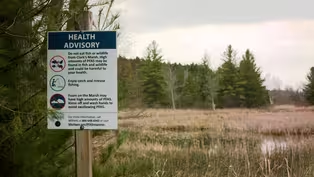
The Race to Replace Lead Water Pipes
Video has Closed Captions
Clip: S1 Ep25 | 9m 26s | Getting the lead out of tap water is costing Great Lakes cities millions of dollars. (9m 26s)

When the Road to Tokyo is on the Water
Video has Closed Captions
Clip: S1 Ep25 | 5m 42s | Great Lakes sailors will represent Canada and the U.S. at the Tokyo Olympics. (5m 42s)
Providing Support for PBS.org
Learn Moreabout PBS online sponsorship
- Science and Nature

Explore scientific discoveries on television's most acclaimed science documentary series.

- Science and Nature

Capturing the splendor of the natural world, from the African plains to the Antarctic ice.











Support for PBS provided by:
Great Lakes Now is a local public television program presented by Detroit PBS