Virginia Home Grown
Clippings: Big Old Trees
Clip: Season 25 Episode 1 | 26m 46sVideo has Closed Captions
Discover how large trees are cared for and protected!
View state and national champion trees and learn special care techniques at Maymont, Richmond’s historic park. Then tour the Dragon Run on the Middle Peninsula to discuss bald cypress trees and old growth forests. Engage with us or watch full episodes at Facebook.com/VirginiaHomeGrown and vpm.org/vhg. VHGC 505.
Problems playing video? | Closed Captioning Feedback
Problems playing video? | Closed Captioning Feedback
Virginia Home Grown is a local public television program presented by VPM
Virginia Home Grown
Clippings: Big Old Trees
Clip: Season 25 Episode 1 | 26m 46sVideo has Closed Captions
View state and national champion trees and learn special care techniques at Maymont, Richmond’s historic park. Then tour the Dragon Run on the Middle Peninsula to discuss bald cypress trees and old growth forests. Engage with us or watch full episodes at Facebook.com/VirginiaHomeGrown and vpm.org/vhg. VHGC 505.
Problems playing video? | Closed Captioning Feedback
How to Watch Virginia Home Grown
Virginia Home Grown is available to stream on pbs.org and the free PBS App, available on iPhone, Apple TV, Android TV, Android smartphones, Amazon Fire TV, Amazon Fire Tablet, Roku, Samsung Smart TV, and Vizio.
Providing Support for PBS.org
Learn Moreabout PBS online sponsorship(gentle upbeat music) >>We really try as much as possible to make sure that this landscape looks just like it did during the Dooleys' time.
And so if we lose a tree in this portion of the property, we replace it with something that was exactly the same, if we can trace back the fallen tree to the time of the Dooleys.
>>This is a place that is irreplaceable, in our history, it's part of our culture, it's part of our economy.
And it's really a special place, and getting people into it to see it, we can all be part of nature.
(birds chirping) >>Production funding for "Virginia Home Grown Clippings" is provided by viewers like you.
Thank you.
(gentle upbeat music) Welcome to Virginia Home Grown.
Today we're highlighting trees with a focus on large and old trees.
First up, we joined Shana Williams in Mascot to tour the Dragon Run.
The watershed has been designated by the Smithsonian Institution as the most pristine site in Virginia, and features an old growth forest with bald cypress trees over a thousand years old.
Let's take a look.
>>We have over a dozen species of trees here at Teta Kain Nature Preserve.
And of course, we have our beautiful bald cypress.
>>Wow, they're huge.
>>We have American beech trees, and we also have very large swamp chestnut oaks here, which have a invaluable food source for wildlife in the acorns that they provide.
>>They're absolutely beautiful.
And what do we have here?
I see some seed pods.
>>So this is the American hazelnut, and right now, the catkins are forming, it's releasing pollen, and several months from now, we'll start to see fruit form in the form of tasty little nuts that you can snack on as well.
They're the same nut that you see in the grocery store.
>>So, something to look forward to when I come back.
You were telling me earlier that you identified over 1,600 species of flora and wildlife?
>>Yeah, so our Citizen Science team has taken the time to identify all these wonderful species in the watershed, and have identified almost 100 different species of plants that previously weren't known to occur here in the watershed.
>>So, as we walk through here in different parts of the season, I should see various types of wildlife and different flora growing up.
>>Mm-hm.
>>I see some woodpecker damage here?
>>Yeah, so this tree, whether it's dead or in the process of dying, is hosting a larval species of insects that are boring in the tree, and that the woodpeckers are taking advantage of that available food resource by, you know, pecking, sloughing off the bark to get to those insects.
>>And it's interesting that we see so many things that look like damage, but it's actually the forest replenishing itself.
>>Yes.
>>And the wildlife.
In the distance all around us, I see pawpaw trees, a pawpaw grove.
>>Yeah, so this is the perfect environment for a grove of pawpaw, these really rich riparian soils.
And we have a really nice population of zebra swallowtail butterflies, because the caterpillars host on the leaves, but then there's also a lot of wildlife, like raccoons and deer, that will eat pawpaw as the fruit matures in the fall.
>>And over in the distance here, I see almost like a little valley and a body of still water.
>>Yeah, so what we have here is a vernal pool.
So these changing water levels are really beneficial to species like salamanders and frogs.
In the late winter and early spring, these pools fill up with water, and it provides habitat for these different species to breed.
But then also in periods of drought, these water levels recede, and it provides the opportunity for species like bald cypress to germinate, and you know, recruit into the next generation of trees to fulfill in the ecosystem.
>>What you guys are doing in here is amazing.
I would love to learn more about the Friends of Dragon Run.
>>Yeah, our president, Jeff Wright, will definitely be able to answer any more questions you have and tell you more about the organization.
>>All around us, I see these cypress knees.
Can you tell me what their purpose is?
>>Their purpose, they provide amazing support to these enormous trees that get over 100 feet tall, because the tree is set in water, and as the water's moving fast, these are the stability that keeps the trees in place, help prevent erosion, a lot of other things.
And you'll see the top of these here have been chewed on by beavers, and that's normal in the course of events in here.
>>Jeff, in the distance over there, I can see a huge bald cypress tree.
Now, what I wanna know is this looks like it's a couple hundred years old.
What are some of the ages of the trees in this forest?
>>It is.
We have trees of every age.
That's what's magnificent about old-growth forest.
But we have trees over 100 years old, hundreds and thousands of trees over that.
Some over 500.
But we have some select trees in here that are estimated to be over 1,000 years old.
So the bald cypresses really go on.
They've been hit by lightning.
You'll see some of the tops taken off 'em.
But that's a multi-century tree there.
And as you go up the Dragon, you're gonna see many, many more trees of 100, 200, 500 years old.
It's amazing to know how old these trees have been here and what they may have seen in Virginia's history.
>>Now, you are the president of the Friends of Dragon Run, as well as the president of the Old-Growth Forest Network.
What are you trying to accomplish?
>>Very similar missions, but a little bit different.
The Friends of Dragon Run, we're trying to protect this incredible swamp that is renowned, documented by the Smithsonian Institution as one of the key places in Virginia that needs to be protected.
This is our 40th anniversary, and this group started out in 1985 as a few people that wanted to protect that piece of land over there.
Now we're up to about 600 acres.
But we'd like to add more volunteers, more acreage, 'cause we're really focused on protecting lands along the edge of the Dragon for generations to come and generations forever.
>>So, the Dragon Run actually is bordered by four counties.
>>Correct.
>>And the stream is approximately 40 miles long?
>>It's about 40 miles long.
It twists and turns.
It starts out, really, on the border of Essex in King and Queen County, and then works its way down Middlesex, Gloucester, and then into the Piankatank.
So this is the headwaters of the Piankatank, which then flows into the Chesapeake Bay.
>>And you mentioned that you have two segments that are classified as the Old Forest.
>>The Old-Growth Forest Network is trying to protect a property in each county around the United States so people can have an accessible experience in old-growth.
And one of the properties that you're looking at over here is actually in the Old-Growth Forest Network.
So we are very proud of the Friends of Dragon Run that two of our properties are in the Old-Growth Forest Network.
The Old-Growth Network is looking at forests that have reached past the maturity level, are not of uniform age, single species, and have the wonderful complexities you see here.
You see hardwoods, you see softwoods, you see all kinds of understories.
So depending on what the species are in your area of the country, kind of defines old-growth.
But the big thing that defines old-growth today is mature trees and a commitment that you're not going to take those trees and harvest them.
So, to get into the Old-Growth Forest Network, it's that protection of a mature forest and making it accessible.
>>Jeff, why is it so vital that we conserve this beautiful natural resource?
>>The big thing is what you see here.
The big commodity that everybody needs is fresh water.
And it's a challenge because the aquifer is drying up in this section of Virginia.
This water is very important for irrigation for agriculture, very important to protect all these natural species and systems out here.
As we get more people living close to the water and everything, and we have industrial concerns that may want to use water, particularly data centers and everything, there's a challenge to try to make sure somebody's raising their hand and saying, "What about nature?
What about future generations?
>>And that's what you're doing.
>>And make sure we continue to do that.
We like to be a voice to speak for the forest and for the Dragon.
>>Jeff, in meeting you, what I've observed in this short period of time is that your love and your passion for this place.
>>It's fabulous.
>>And the one thing that I know is just a short period of time, I have a better appreciation for old forests and groves.
So I really appreciate everything that you've done and what you've shared with us.
>>We have a great team out here.
We do have a great team.
The natural wetland and the conservation efforts of various organizations have protected the trees in Dragon Run.
I applaud the Friends of Dragon Run for all the work they do to take the lead in managing and protecting this delicate ecosystem.
Next, Doctor Robyn Puffenbarger has a tip to share on how you can start growing your own big tree at home.
It all starts with the roots (upbeat music) >>So how do you get a big tree?
Well, you can start by collecting seeds and nuts.
So here are a couple that you might find around your yard.
And the acorn though, as you can see, has this tiny little hole.
A worm has already gotten in here and eaten the nut.
So this is not gonna sprout to give you an oak tree later.
So if you're not able in fall to collect nuts, what might you do to get your big tree?
Well, you might think about riding down the road to the local nursery and buying a tree.
And what you're going to find, beautiful trees, great looking trunks, awesome looking branches and leaves.
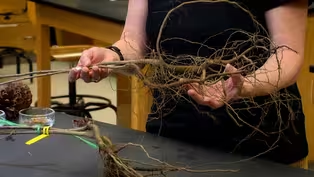
And what may be a little bit off in the nursery is this ratio of three part root to one part stem.
And if you go to the Virginia Department of Forestry, you can find lots of native trees, and they grow over 5 million trees in Augusta County at their Crimora site for Virginians.
And they have a host of native trees that you can find.
I have two species with me today.
I have the northern red oak, which is a tree of our forest all across the state of Virginia, and then I also have with me sycamores.
These might be trees that you have seen on your stream or creek or riverside that has the beautiful white bark.
Really beautiful tree that will tolerate having its feet wet, so it will grow in more marshy, wet spots.
And both of these are available through the Department of Forestry.
And what they are doing is they are gonna grow the tree, and when they're pulling them out for you, you're gonna get this really nice root mass and a much smaller trunk area.
That's so that the tree is going to establish, because it's this root system that's going to get the nutrients and the water out of the soil for this upper canopy.
So what you wanna do is if you are planting this in your yard, if you're putting it in a spot with turf grass, make sure you cut a very large circle, about three feet in diameter.
You're gonna want the tree right in the middle.
You're gonna wanna loosen the soil up and so that you can get these roots all spread out.
You're gonna wanna dig the hole a little bit deeper, several inches at least, deeper than the roots, and then of course, that nice three foot circle.
You're gonna put them into that hole up to this point where the stem meets the root.
And you don't have to amend the soil at all.
These are native trees to Virginia.
So whatever we've got, red clay, nice loamy soil, they'll take it, they're adapted, so don't try to amend your soil.
You just wanna keep the turf grass away, because turf grass, your lawn, and trees are competitors for all kinds of things, especially water.
Once you've got the tree in and up, you may wanna stake it just to kinda keep it straight, and then water it really thoroughly, mulch it, you could use wood chips or other mulch that you have on hand, and just keep the grass away as the tree gets established.
And over the years, you will see that you have a beautiful specimen coming up, and so you can enjoy your tree for years to come.
Happy gardening.
Big trees start with small seeds, water and sunshine.
During this show, we're learning other factors play a pivotal role in the process, too.
I visited Maymont in Richmond to talk with Sean Proietti about the many state and national champion trees growing in the historic park and the care they receive for future generations to enjoy.
Let's get going.
>>Maymont was originally the home of James and Sallie Dooley.
This was their home and estate from 1893 to 1925.
Then that's when they established this arboretum.
Sallie May Dooley was an avid horticulturalist and when they purchased the land, it was farmland, which they began cultivating into beautiful English-style park, and that parkland includes the arboretum.
We know they went to Europe many times, and we see that reflected in their Italian gardens, but they clearly had an interest in Asia as well, which we also see, in their trees as well as our famous Japanese garden.
>>Sean, I do love this tree.
It's so beautiful.
It's so big and majestic.
>>This is one of my favorites, too.
This is the Blue Atlas Cedar, and it's from the Atlas Mountains of Northern Africa and was therefore part of the Dooleys' program of bringing in trees from all over the world.
>>You know, they picked some amazing specimens.
They really did.
This tree is so big though.
>>They don't start that way.
Blue Atlas Cedars look a little scraggly, you know, for the first 30-35 years of their life.
And then they really come into their own much later.
But this is one of our champion trees here, meaning, of all the Blue Atlas Cedars in the entire state of Virginia, this one is the biggest of all.
>>That is so cool.
So what makes a tree a champion tree?
>>Pure size.
You have the diameter of the trunk of the tree.
You have the height.
And then you have the width of the crown.
And then each of those three categories is given a point number.
And then those points are added together, and that makes the overall score.
>>So the highest score wins.
>>That's right, the biggest tree.
>>Well, this certainly is deserving of that.
>>Yes, but you don't have to be a huge tree to be a champion.
You just have to be the biggest yourself that you can be, so you know, some of our champion trees, like the Tigertail Spruce by the fountain or the Japanese tree lilac, they're not necessarily impressive trees that anybody would come and notice that it could be a champion.
They're just really doing the best that they can to be themselves.
>>Yes (chuckles), the biggest of their kind.
>>That's right.
>>Within these beautiful 100 acres, how many champion trees are there at Maymont?
>>It changes all the time.
We have about 15 to 18 right now, and even I have to go on the Virginia Tech Big Tree Database website to find out exactly how many we have, because, sure, one of our trees could fall down and lose its champion status, but equally, somebody else could realize that they have a champion in their own yard.
And then ours gets bumped down the list, which has happened many times before.
>>Yes, and it's variable.
>>Yes, and it's fun because it makes it a competition, right?
I personally love the fact that, if somebody looks at our Deodars, and goes home and thinks, "You know, I think mine's probably bigger," and measures theirs... Let 'em have it.
>>Let 'em have it.
At least, they're becoming tree-aware.
>>Exactly.
>>So tell me, what is a Dooley tree?
>>A Dooley tree here at Maymont means a tree that goes back to the original estate, and we kinda go back and forth on the definition sometimes for purposes of data collection, like in the case of this Blue Atlas Cedar.
This tree was here when the Dooleys were here.
But behind you, the elms, those trees weren't there when the Dooleys were there, but the Dooleys did have elms there.
So depending on kind of what function we're trying to express, like, either of those may be considered Dooley trees.
>>These trees were planted on a private estate, but now they're growing in a public park.
So what are the challenges they face with that new... I'll say, "Use of the property."
>>Violent.
(Peggy and Sean laugh) You know, sometimes, it's, like, little boys hitting them with sticks.
They can't really do that much damage, but you know, we've also had people just rip branches off of them.
You know, I think people just are not as in touch with the natural world anymore and they don't really realize that these are fragile organisms.
>>And that they're living organisms.
>>Exactly, yes.
>>So how do you take care of these majestic trees?
>>There's all kinds of ways.
With old trees, the main thing is to not do anything that shocks them.
We often use compost as, like, a low-grade fertilizer.
We use wood chips to, basically, help the soil biome and keep all those microorganisms in there and keep the soil healthy, but you never wanna fertilize a tree and shock it by putting a lot of growth on it.
So we just, you know, kind of try and keep them happy.
The other thing that we do is trying to preserve the structure that's there, as opposed to doing, like, radical pruning, so we will use cabling, which allows the tree to move in tandem with wind shear, instead of having certain segments of the tree be exposed to wind shear individually.
Similarly, you can use brace rods, and that does the same effect, to not stress some of these limbs.
The larger trees may have overextended limbs that hold quite a lot of mass far away from the trunk, so we wanna try and keep all of that mass centered.
>>Well, speaking of mass, we all know that some big trees are actually like big sails.
What else can we do to help- >>That's right.
>>with that situation with these crazy storms that we're getting?
>>That is one example where pruning is kind of beneficial.
What you can do is do crown thinning to take out portions of the interior of the tree, and that allows the wind to pass through the crown of the tree without catching so much of that surface area of the leaf.
>>So you're not just scalping off the tree.
You're going in and making judgment calls as to what pieces to remove.
>>Yes, and it really... You never wanna remove 20-25% on, like, young trees, and on old trees, significantly less than that, so it really requires having an experienced arborist be a guide.
>>Yes, and I'm sure there's many arborists that help here at Maymont.
>>With the significance of these trees and the significance of the property, we try to never make decisions just one person making that decision.
We try and have it be a team of specialists.
>>Yes, so careful.
So important.
But when a tree does start to decline, are there any action steps that you go, "Oh my gosh, what can we do?"
>>There are.
So, we have a couple of trees that are suffering from bot canker, which is really, really common with cherries.
Many cherries will get it over the course of their lifetime.
But one thing that we've done recently is we AirSpaded the roots and reintroduced biochar into the soil, and that's something that we're starting here, and we would love to make it kinda more of our program, so we're trialing that a little bit right now.
The first year that, you know, you've disturbed that soil, you're gonna wanna make sure that that plant stays nice and watered, same as you would any new planting.
Basically, what we do is we take a 250-gallon tank and bring the tank there and just kinda run a hose to the base of the tree and let it soak that entire area.
You can use a sprinkler system as well.
>>Do you water any other big trees around here?
>>Rarely.
Usually, once a tree is past two years of its establishment, you don't normally need to water it, but during really prolonged periods of drought, we will water some of the more... Prized specimens let's say.
>>Well, Sean, I applaud you on everything you're doing here, taking care of all of these specimens and just keeping 'em alive and strong and healthy for people to come and enjoy now and in the future.
>>And thank you for all the work that you've done for the same program.
>>You're welcome.
We make a great team.
>>That's right.
>>Mrs.
Dooley was very interested in making sure that she bought the best, (laughs) so whenever she was seeking out new plantings for her estate, she was buying the best ones she could find from all over the East Coast.
Our current philosophy is that we do try to replace in kind whenever something is lost of the original collection.
You will continue to, hopefully, see Maymont just as they saw it 100 years ago 100 years from now.
(bird chirps) When caring for big trees, it's important to remember they don't respond quickly to changes.
When adding compost for the roots, managing pests or mulching under the drip line; please give the tree a year to respond.
And now Serome Hamlin has tips to share on understory plants that you can grow.
If you're lucky to already have a big tree in your garden.
(jaunty music) >>So I've heard the best time to have planted a tree was 20 years ago, and the next best time is today.
So today I'm here at Colesville Nursery to think about trees, but also thinking about the understory.
These plants really need to be able to take some shady and possibly some dry conditions.
I've got a variety of plants that I've found here, so we can start here with this beautiful Camellia japonica.
We've got this white one here blooming, and everybody loves Camellias, it's a very popular plant.
And one of my favorite plants though is our native hydrangea quercifolia.
This one is still holding onto its leaves from last season, but as you can see, during the fall season, you get this beautiful red-purple tinge to the leaves before they drop, and then in the spring you get a white cluster of blooms throughout the shrub.
Here we've got a nice evergreen shrub, this is our native Rhododendrons.
This one is Florence Park.
Boasts nice purple blooms for you in the season, and it is a evergreen, so you can have a four-season shrub.
Over here we have Leucothoe, again another native plant, but look at the different varieties.
So we have this one here that turns purple in the winter, but look at this foliage here.
Nice variegated foliage.
This one is called Leucothoe Rainbow, and it gives lots of interest for four seasons.
Moving along here, we have Illicium.
Another native.
Wow, it just seems like to be running a trend here.
But Illicium, common variety, you can see is green, but through breeding we have different cultivations where you could get a varied variety here or even a chartreuse or yellow foliage.
Now we've got the shrub layer done, let's move on to ground cover.
Now over here we've got an array of Hellebores.
Very easy plant to grow, so many different colors and varieties.
Cast-iron-plant.
This is a very tough, tough plant, evergreen.
It can take really dry, shady conditions, it can take really deep shade and still be happy.
Here we have a selection of Carex.
These two here are Asian varieties, but you could see that they're a nice chartreuse color, or a variegated form, and interesting blooms early in the season.
This here with this limey green is our native, and this Carex will start spreading and getting a nice mass, and you can actually even use this one for a lawn replacement.
So if you're planting big trees or you have established big trees, don't forget to think about the understory.
You can have an array of plants that provide nice shelter for wildlife and nice views for yourself.
So get out there, let's get our hands dirty, and plant the understory of our trees.
While every tree plays a role in the ecosystem, big majestic trees do the most to sequester carbon, produce oxygen, cool the air, reduce stormwater runoff, and absorb air pollution.
Plus, they are amazing to sit under and look up into.
I thank you for watching.
We hope we have inspired you to plant the champion tree of the future.
See you soon.
And until then, remember, gardening is for everyone and we are all growing and learning together.
(birds chirping) >>Production funding for "Virginia Home Grown Clippings" is provided by viewers like you.
Thank you.
(gentle upbeat music) (chime)
Video has Closed Captions
Clip: S25 Ep1 | 3m 17s | Learn the correct root to shoot ratio for planting new trees (3m 17s)
Video has Closed Captions
Clip: S25 Ep1 | 8m 11s | Learn how champion trees are measured and the special care they receive (8m 11s)
Video has Closed Captions
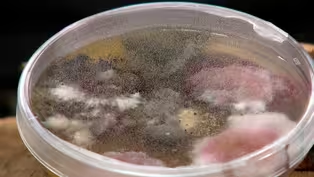
Clip: S25 Ep1 | 6m 42s | Learn about the many types of life recently discovered inside of trees (6m 42s)
Video has Closed Captions
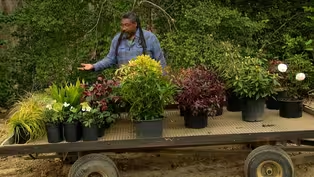
Clip: S25 Ep1 | 3m 11s | Explore shrubs and groundcovers that grow well under big trees (3m 11s)
Video has Closed Captions
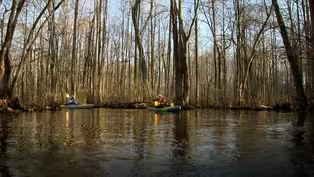
Clip: S25 Ep1 | 8m 4s | Explore the Dragon Run watershed, one of Virginia’s most pristine natural sites (8m 4s)
Video has Closed Captions
Clip: S25 Ep1 | 5m 20s | Learn the differences in native and invasive vines (5m 20s)
Providing Support for PBS.org
Learn Moreabout PBS online sponsorship

- Home and How To

Hit the road in a classic car for a tour through Great Britain with two antiques experts.












Support for PBS provided by:
Virginia Home Grown is a local public television program presented by VPM