Virginia Home Grown
Clippings: Deadly Plants
Clip: Season 25 Episode 8 | 26m 46sVideo has Closed Captions
Explore the world of deadly plants to discover their benefits!
Visit a globally rare ecosystem where Virginia’s native pitcher plants are being preserved. Then tour a private garden to learn about plants with properties that can be toxic to pets. Engage with us or watch full episodes at Facebook.com/VirginiaHomeGrown and vpm.org/vhg. VHGC 504.
Problems playing video? | Closed Captioning Feedback
Problems playing video? | Closed Captioning Feedback
Virginia Home Grown is a local public television program presented by VPM
Virginia Home Grown
Clippings: Deadly Plants
Clip: Season 25 Episode 8 | 26m 46sVideo has Closed Captions
Visit a globally rare ecosystem where Virginia’s native pitcher plants are being preserved. Then tour a private garden to learn about plants with properties that can be toxic to pets. Engage with us or watch full episodes at Facebook.com/VirginiaHomeGrown and vpm.org/vhg. VHGC 504.
Problems playing video? | Closed Captioning Feedback
How to Watch Virginia Home Grown
Virginia Home Grown is available to stream on pbs.org and the free PBS App, available on iPhone, Apple TV, Android TV, Android smartphones, Amazon Fire TV, Amazon Fire Tablet, Roku, Samsung Smart TV, and Vizio.
Providing Support for PBS.org
Learn Moreabout PBS online sponsorship(gentle upbeat music) >>Pitcher plants have photosynthesis but in the bogs that they're found in, they're acidic and they're low in nutrients and so these plants have evolved the ability to catch and digest insects and absorb nutrients for growth and reproduction.
>>You know, the Sago's leaves are a little bit on the prickly side and the interior where the seeds form has little thorns, so it is hard to get the seeds out.
>>Mm hmm.
>>So that's not really a problem, but they are known to be poison.
(birds chirping) >>Production funding for "Virginia Home Grown Clippings" is provided by viewers like you.
Thank you.
(gentle upbeat music) (upbeat guitar music) (upbeat guitar music continues) Welcome to Virginia Home Grown.
Today we're exploring plants that some may think of as mysterious.
Even a bit scary.
But by taking a deeper look, we can learn to appreciate these unique and misunderstood species.
First, Serome Hamlin visited a private garden in Richmond and discussed with Jeff Minnich many plants that can be toxic to our pets.
You may be surprised at how many common plants are highlighted.
So let's take a look >>I'm a landscape designer and horticulturist.
When it was time to retire... >>Did we ever retire?
>>Right, I still haven't completely retired, but when it was time to open the next chapter, I guess, we decided to move to Richmond and picked here in Forest Hill, and we absolutely love it.
But the wonderful thing is, aside from the great house, it's a flat, sunny garden.
I can have vegetables, I also have some wonderful trees, and I can have a wonderful shade garden.
And I'm a plant collector, and I'm also a zone pusher, which, of course, you know means that you try to grow things that aren't supposed to be hardy in this area.
And I've had a lot of surprises.
I think there are things here that I never would've dreamed would've thrived here, but they are thriving.
>>Yes, and then as I look around, we're gonna be talking about plants that could be poisonous or detrimental to our four-legged canine friends.
And most people think about tropical plants, but we don't really think about the common plants that we use in our everyday gardens that we love using and them being harmful.
>>Hostas, for instance, have some poisonous aspects to them, and arum lilies, which have a beautiful foliage in the winter, and then berries in the spring.
I would think that the fruit produced on plants would be probably the most interesting thing to animals to play with, maybe intriguing to them or-- >>It could look like a toy.
>>Yes.
But when we've had dogs here, it's mostly they just are wandering around, sniffing to get a feel for the place.
>>So you said you were a zone pusher, and with the climate change happening now, and that it's making it more and more easier to push the zones, you can say, for a lot of these plants that we couldn't grow years ago.
But just in our lifespan, we're noticing that they're becoming more and more hardy here.
For instance, the sago palm is starting to be able to survive some of our winters.
>>You know, the sago's leaves are a little bit on the prickly side, and the interior where the seeds form has little thorns.
So it is hard to get the seeds out.
Here we really don't have the problem with the seeds because we don't have a long enough season.
It's just not a long enough season to really get the seeds.
>>Yeah.
>>And so that's not really a problem, but they are known to be poison.
>>Yes, and you'll wonder why a dog will go after a particular plant or a berry, and it's no real reason I guess I should say.
They could think of it as a play toy or there's a certain scent that attracts them to 'em even though they're not supposed to eat it.
And it differs from dog to dog.
So you can't just say one species is going to do something over another or one dog over another.
But just like you, I personally don't garden thinking about what they may or may not go after.
>>Yes, and we do have a six and a half foot fence, solid fence around our backyard.
So that keeps most animals out.
I would say the raccoons and the squirrels and other wild animals do get in, but our domestic friends can't get in, unless they're invited in.
Now, the jade plant here, we do take in in the winter.
I will say that inside, particularly with cats, I would be more concerned about having some of these tropical things that come out for the summer.
>>For sure.
>>Yeah.
>>And I would definitely be a lot more aware of what I have inside the house for the winter.
>>Do you mind showing us around your garden, and we can see what else we can find that may be poisonous or detrimental to our four-legged friends?
>>Sure thing.
Let's go.
(water sploshing) >>Wow, what a nice combination you have here, Jeff, with the coleus and the Begonia.
>>Well, thank you, and this really was serendipitous because I had hoped that putting this color coleus against this wonderful old brick wall would look good.
But I wasn't sure it would get quite enough light to really bring the color out.
And it did.
It was one of those surprise-- >>Yes.
>>You know, combos.
And as you said earlier, the coleuses and begonias-- >>And begonias, both are poisonous.
>>Yes.
Around the corner here, we do have a lantana, a hardy lantana.
And what was the name of that again?
It was it... >>It was Miss Huff.
>>Miss Huff, right.
>>Miss Huff.
>>And it does come back every year.
>>And then the beautiful juniper.
>>Yes, and thank goodness we have this here.
It keeps the hot summer sun off.
>>Right, exactly.
I really love this variegated Kousa dogwood and the Spanish moss.
>>Oh yeah, yeah, the Spanish moss.
We get that when we're down south.
But, you know, even in Virginia Beach, in Seashore State Park, it grows.
>>It grows.
>>I think that might be the northern limit of it.
>>Oh, and I see we have a holly here, which is another plant that is commonly used in landscapes that could be detrimental to dogs.
>>Yes.
>>I love this wall of osmanthus bringing us into another room here.
>>Oh, I'm glad you said room.
That was the effect that I was hoping for.
>>I love your veggie beds, and I see you got a row of peonies here.
Peonies again is on our list.
And as far as veggies, we've gotta really watch out for certain things like tomatoes and onions for keeping our dogs from eating those.
And now look at this beautiful dahlia against this red wall.
>>Yes.
>>It's beautiful.
>>Full of pollinators, isn't it?
>>Yes.
I see it's really buzzing with life.
>>Yes, it is.
>>And again, it's on our list of poisonous plants.
>>I have one more area I wanna show you.
>>Oh, I'm excited to see.
>>Come on along.
>>Wow, what a tropical-looking area you got back here.
This is incredible.
>>It is really pretty and very dramatic.
And this is one of our favorite corners of the garden.
>>Castor beans, again, it is a poisonous plant, but what a dramatic effect it gives back here.
>>Yes.
And we do have it contained within our high fence.
We never plant it outside the fence where it could injure cats or dogs or other domestic animals.
The one positive thing besides its dramatic appearance is that the root system is quite extensive and it does really loosen up the soil.
>>Yeah.
So we've got compacted soils.
This is a good plant to break that soil up.
>>Yes, absolutely.
>>Jeff, I do thank you for having us here, walking around your garden, and exploring some poisonous plants.
You don't have to garden for your dogs, but keep those plants in mind just in case something goes wrong.
And then you can pinpoint that it could be one of the plants in your garden.
>>Well, thank you so much for coming and I hope that you'll come back often to visit.
>>I certainly will.
While avoiding these plants is an option.
So is awareness of what you are growing.
Keeping everyone comfortable when pets are outdoors is important.
If an issue arises, you can share with your vet a list of the plants you are growing.
Next Jen Naylor explains why tomatoes were thought to be toxic to us.
For one hundreds of years.
(gentle rhythmic music) >>It's the very end of my tomato growing season in my garden.
A long time ago, tomatoes were believed to be toxic, dangerous, and poisonous.
In Europe, the rich folks actually what they did is they ate tomatoes off of their pewter plates, and the pewter plates had a high content of lead.
So tomatoes being acidic, highly acidic, it leached the lead from the pewter plates.
And these folks who ate those tomatoes that are served on the pewter plates, they got really sick and died.
It went on for 200 years.
Can you believe that?
Oh my gosh, I can't live without tomatoes, especially fresh picked tomatoes, not for one day.
Now those folks who were poor, they ate their tomatoes out of their wooden plates or wooden bowls, and they didn't get sick.
How ironic, right?
Tomatoes are also part of the nightshade family.
Some of the plants in nightshade family are toxic.
Now, so people thought maybe the tomatoes are also toxic as well, so they're scared of eating the tomatoes.
It took a really long time for people to understand that only the leaves and the stems are harmful and not the fruit itself.
There's so much that you can do with the fruit of course.
There are so many different varieties or various ways of cooking tomatoes.
Now, in the beginning of tomato growing season, what I do is I take these metal stakes and I stake them into the ground.
And I go into the woods and I gather all these long, sturdy sticks.
And what I do is I zip tie them to the metal stake, and that gives a really good stability for tomatoes to hang onto.
Now, as the tomato plants grow, because they grow pretty fast during the growing season, I get the tomato string.
You can get it from any garden store or even online.
And what I do, I tie them from one end to the other side, and then tomatoes, as they grow, I support them.
So I tie them onto the string, and that way they can grow upright without just falling down.
It gives them a really good stability.
I'm gonna be harvesting some of these, my last of my tomatoes.
And of course my fall garden greens I just planted back in September, they're ready to be harvested.
And I'm going to be making kimchi pancake wrap.
Delicious.
I just hope that you love tomatoes as much as I do because it's safe to eat, it's not dangerous, and it's nutritious, and it's fantastic eats.
Tomatoes are an extreme example of a plant being misunderstood.
Imagine what our plates would be like today if we never learned how to use them.
Carnivorous plants also get lumped into the scary plant label.
But I met with Doctor Phil Sheridan at the Meadowview Biological Research Station in Woodford to learn more about Virginia's native pitcher plants and their unique adaptation to be able to grow in nutrient poor soils.
Let's get going.
>>Welcome to Meadowview Biological Research Station, home to the National Pitcher Plant Collection.
So we've got the largest collection of pitcher plants in the United States.
>>Interesting, are all of these native, or are some from other parts of the United States?
>>Well, two species are native to Virginia, the yellow pitcher plant, and the purple pitcher plant, and the rest are found in the southeastern United States.
>>So are we in the northern most part, or do they continue on up north?
>>We are at the northern limit for the yellow pitcher plant, which reaches its home in southern Virginia.
Purple pitcher plant goes on up into Canada.
>>Excellent, and I know these are very unique, in that they actually live in areas that are very starved of nutrients.
So how do they get their food and energy?
>>So they get their food through regular channels, like other plants.
So pitcher plants have photosynthesis, but in the bogs that they're found in, they're acidic and they're low in nutrients, and so these plants have evolved the ability to catch and digest insects and absorb nutrients for growth and reproduction.
>>So they've learned, they've adapted to kind of pull the additional nutrients they need from the insects.
>>That's right.
There's actually evolutionary pressure on the vegetable kingdom for plants to be carnivorous in certain conditions, basically where you have a sunny, wet, nutrient-poor habitat, if the other conditions are present in a plant family, then you might see the evolution of carnivory in that plant.
>>That's fascinating.
Well, how are those insects drawn in?
>>Insects are attracted by nectar and odor.
>>Fascinating.
>>And then they come to the pitcher, and some insects fall in, and then they get digested by both bacterial and enzymatic action from the plant.
>>That's fascinating.
I understand they take a special condition, a true bog, and that you've got one here.
>>Yeah, we have a bog right back in the woods with our native pitcher plants.
You wanna go see?
>>Oh, I'd love to see it, yes.
>>Let's go.
>>Okay.
Here we are walking through Eastern forests, but these plants are more moisture-loving than what I'm used to.
>>You're here on our Central Virginia Preserve, the northern most native pitcher plant bog in Virginia, on a globally-rare gravel bog.
This is a ocean strand from three to five million years ago.
And so on this portion of the preserve, we've got a a hillside seepage bog where water, moving down through the sand, hitting a clay layer, and percolating out on the side slopes here.
>>Oh!
>>What is this?
>>Yes, look.
>>What did you just find?
>>I just found a pitcher plant.
That's beautiful.
>>Imagine that.
>>Imagine that.
But you know, in my mind, I would've wanted it lower and into more, I'll say of a boggy situation that I'm thinking of in my head.
>>That's right, a lot of people, Peggy, when we talk about these plants, they think they're down in a swamp somewhere.
And they're really not in swamps.
Swamps are forested wetland.
They're actually, at least in Virginia, located on headwater spring systems.
And so here we have the springy ground, fresh, clean water coming through the sand, very low nutrient, with sphagnum moss.
You're not getting flood waters, which you'd get down in a swamp.
And all that together allows these plants, it's the conditions where these plants would occur.
>>Interesting, and it's right along the roadway that you created for access into this space.
>>That's right.
>>But yet the water is flowing underneath that sphagnum moss.
>>Yeah, flowing horizontally.
>>Yes.
>>Horizontally, in groundwater seepage, and then vertically of course, when it rains.
>>Right.
Because you had shared, these are basically thriving in nutrient-poor sites, and that that water is leaching the nitrogen away.
>>Nitrogen and potassium too, it's a number of nutrients that could be leached out.
And so part of that syndrome then, when you get that set up, and you have a sunny habitat as well, is you have the conditions for the evolution of carnivorous plants.
And this with it's one of the low-growing pitcher plant species, it holds water in the leaves, and largely through the action of insects in the pitchers, the insects are broken down, and nutrients made available to the plants.
It's a whole ecosystem that's being studied.
>>Yes, and each one of these is holding a little puddle of water.
And I can see there's insects, even mosquitoes in there.
So what type of mosquito is in there?
>>It's called Wyeomyia smithii.
It's an endemic mosquito of pitcher plants.
And those insects are really important.
Some of the studies that have been done, if you don't have the associate insect species, the water is loaded with algae.
>>Oh my.
>>And you can see the water here.
>>It's crystal clear, >>Clear, maybe cloudy, depending on how many insects are in a pitcher.
But that complex of insects is actually processing the captures so you don't get those algae blooms.
But if you miss components, you can, sound familiar, you get something polluted, you get an algal outbreak.
>>Yeah, but do all pitcher plants process their prey the same way?
>>Similarly, yeah, they have pitcher, a funnel, that captures and coalesces nutrients via insects.
This one has more water because it's open to the rain.
The trumpet species have caps on the pitcher that really prevent rainwater from getting in.
Those are more dry digestion versus a wet digestion here.
>>Interesting, but to get that rainwater, you need to have open air.
And I noticed that you've done a lot of work around here, Dr.
Phil.
>>That's right, this, when we first got this property, there were a lot of hardwoods, big hardwoods here, also sucking water outta the ground, so we had to remove those.
There were way too many pines, we cut those out.
The bog had very little sphagnum, there was only one small patch.
And we knew we had to open it up, get sunlight in here.
And once we did that, sphagnum covered the whole hillside here in bog.
>>Interesting.
>>Yeah.
>>But I also know you've got some more wetland species moving in.
You've got the Clethra moving in.
>>Well, you know, it's kind of one of the associates you do find on the edges of a bog, Clethra.
We've got alder coming in from the swamp.
But then we have more characteristic bog species like poison sumac that's only found in bogs.
And that's a really good indicator of the high quality here.
>>Yes, but also, you really don't want this alder here, do you?
>>It's part of the system.
I'll come out here with a tri-arc blade and cut it down at my leisure.
>>Right, because that's gonna be fixing nitrogen.
>>It's fixing nitrogen, and it's part of it, we just don't want it to be a dominant.
>>Right, right.
>>So we can correct it.
>>Right, 'cause we wanna preserve >>That's right.
>>Our serracenias here.
>>And that's what volunteers are for.
So Meadowview being a nonprofit, that's the kind of winter activity that volunteers can help with, clearing brush in the bog.
And we have those kind of options open if people want to help out.
>>Yeah, it's like anything else, trying to slow down nature.
You can't really halt it, but to slow it down in its succession toward woodlands, it takes time and effort.
>>And that's a very good point.
So some people would say, "Well, Phil, isn't that gardening?"
And I would say, "No, that's called managing a habitat."
Because many of the processes that were here prior to settlement aren't.
And so we're now responsible for the management of the bog since there's, so fire, even though we burn here, some of the browsers are missing.
So we are really required to come in and do our contribution to keep the habitat open for the rare plants.
And that's really state of the art in conservation biology today.
>>And that's really the purpose of Meadowview Biological.
>>That's right, that's right.
>>Yes, which is doing so much because you've got two locations.
>>That's right.
>>So do you have any plans for more?
>>The only limitation is money.
>>Oh, that's with everything.
(Phil and Peggy laugh) >>So here, our goal was, I think 156 acres, we're now at 85.
And if we meet them, there are more bogs to protect, and then we'd move on to that, if we get to that point.
>>It's so important, the work you're doing.
People just don't understand how we need to preserve areas, to protect all aspects of the ecosystem, even these cute little pitcher plants.
>>This is it, this is the end of the road for pitcher plants in Virginia.
The Meadowview Preserve System is it, I mean, we're the last best example of native pitcher plants in habitat in Virginia.
>>I know this has been a lifetime project for you, and I'm just so pleased with your successes, and I congratulate you.
>>Well, thank you, Peggy.
>>Yeah.
Well, I'll tell you what, let's go look for some more, okay?
>>Okay.
>>All righty.
The work of the station in protecting and restoring highly endangered habitats on the Atlantic coastal plain is key to safeguarding the diversity of that ecosystem.
Meadowviews efforts include preserving pitcher plants and other rare wetland species in Virginia and in Maryland.
I encourage you to take time to learn more.
Next, Serome Hamlin has tips to share for caring for another insect eating plant.
The Venus flytrap (lively music) >>There's a weird world of plants out there that may scare some people, but did you know that the United States, outside of our pitcher plants, the Venus flytrap is actually native to small pockets of North Carolina and South Carolina?
Venus flytrap is now on the endangered list because their ecosystems have been wiped out.
But you can find different cultivars in nurseries now, so it's worth taking a look.
Once you get one in, go ahead and repot it.
Here's a neat little trick.
This is the little tape that you use for drywall, and I use this to cover up the holes in the bottom of the pot so that the soil does not leak out the bottom.
The soil mix for this is one part to one part of peat and perlite.
They like a moist soil, but it still has to be free draining.
Now, I did have peat on hand, but coco coir could be used and it is a more sustainable resource.
So going to sift this perlite here, and I've already got the peat measured, so this is a half and half mix.
(perlite rattling) You can see, this is very dusty, but I will sift this behind me.
(perlite rattling) And if this bothers you, you can wear a mask.
Now, I've already got some that's already pre-mixed, so this is what you're looking for.
It's a nice fluffy mix that's going to hold a lot of water, but still it's free draining.
We'll add this to the pot here, and what I'm going to do is put it in, tamp it down a little.
I don't want the soil towards the top to be too tight.
And then I will continue filling this up.
Make the center hole here.
All right, let's get this guy out of the pot, and move this out of the way.
I'm trying not to trigger any of the traps, but as you can see, what they're normally packed in is just Sphagnum moss.
And as I'm doing this, I'm trying to be careful not to pull too many roots out.
And if you're into Bonsai, you will have different types of tweezers around.
I just want to clean up and remove some of the dead traps that's in here just to neaten the plant up.
So now we're starting to see where the roots are.
Their root system like to go straight down.
So as you're putting your plant into its new home, start off with a deeper hole just so you can get the roots down, and then we can tuck 'em in.
And it looks like I didn't trigger any of the open traps that was there, so that's good.
These plants actually are hardy to our zone.
Just because I just parted this up, I probably will let it over winter in the house under grow lights.
These plants do like to stay in water, so you can use a tray like I have here, and only use rainwater or distilled water.
So go ahead and try to grow the Venus flytrap.
It is a neat plant and you'll be helping to preserve a species.
Learning about these unique and misunderstood species removes the scary or unknown aspects surrounding them, and allows us to make informed decisions when making plant choices.
Thank you for watching.
We hope you will look at these plants differently and understand their ecological value.
As you thoughtfully consider incorporating them into your gardens.
See you soon!
And until then, remember, gardening is for everyone and we are all growing and learning together.
(lively music) Sweet potatoes are one of my favorite things to grow in my garden.
David wants to know, should I dig up my sweet potatoes before the first frost?
Absolutely, David.
They do not take well to the cold temperatures.
You want to let them grow out.
Let those leave, die off and pick them before the first frost.
Let them dry out a few days and you'll have some sweet, juicy, delicious, sweet potatoes.
You got this, David.
You can do it.
(birds chirping) >>Production funding for "Virginia Home Grown Clippings" is provided by viewers like you.
Thank you.
(gentle upbeat music) (chime)

Video has Closed Captions
Clip: S25 Ep8 | 8m 5s | Discover Virginia’s native carnivorous plant! (8m 5s)

Plants that can be Toxic to Pets
Video has Closed Captions
Clip: S25 Ep8 | 7m 36s | Learn about common and uncommon plants with toxic properties (7m 36s)
Video has Closed Captions
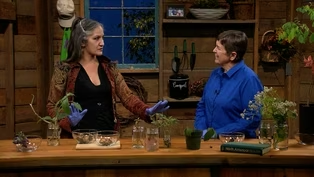
Clip: S25 Ep8 | 7m 30s | Learn how to identify poisonous plants (7m 30s)
Video has Closed Captions
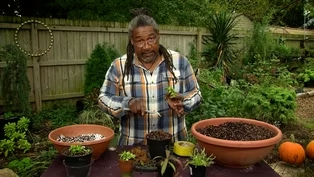
Clip: S25 Ep8 | 3m 31s | Learn how to grow Venus flytraps at home (3m 31s)
What is inside a pitcher plant?
Video has Closed Captions
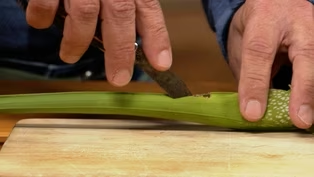
Clip: S25 Ep8 | 5m 56s | Discover how many insects pitcher plants catch. (5m 56s)

When Tomatoes were Considered Poisonous
Video has Closed Captions
Clip: S25 Ep8 | 2m 44s | Discover why tomatoes did not catch on in Europe for hundreds of years (2m 44s)
Providing Support for PBS.org
Learn Moreabout PBS online sponsorship

- Home and How To

Hit the road in a classic car for a tour through Great Britain with two antiques experts.












Support for PBS provided by:
Virginia Home Grown is a local public television program presented by VPM