Prairie Yard & Garden
Composting
Season 35 Episode 6 | 28m 45sVideo has Closed Captions
Steve Henry shares his methods for composting.
Many people are starting to compost leaves and other yard waste to mix along in to their gardens, flower beds, or pots. Steve Henry from Alexandria has been composting for years, and shares his methods and a secret ingredient.
Problems playing video? | Closed Captioning Feedback
Problems playing video? | Closed Captioning Feedback
Prairie Yard & Garden is a local public television program presented by Pioneer PBS
Production sponsorship is provided by Shalom Hill Farm, Heartland Motor Company, North Dakota State University, Friends of Prairie Yard & Garden, and viewers like you.
Support provided by:


Prairie Yard & Garden
Composting
Season 35 Episode 6 | 28m 45sVideo has Closed Captions
Many people are starting to compost leaves and other yard waste to mix along in to their gardens, flower beds, or pots. Steve Henry from Alexandria has been composting for years, and shares his methods and a secret ingredient.
Problems playing video? | Closed Captioning Feedback
How to Watch Prairie Yard & Garden
Prairie Yard & Garden is available to stream on pbs.org and the free PBS App, available on iPhone, Apple TV, Android TV, Android smartphones, Amazon Fire TV, Amazon Fire Tablet, Roku, Samsung Smart TV, and Vizio.
Buy Now
Visit the Prairie Yard & Garden Website
Do you love gardening? Consider becoming a friend of Prairie Yard & Garden to support this show and receive gifts with your contribution. Visit the link below to do so or visit pioneer.org/donate.Providing Support for PBS.org
Learn Moreabout PBS online sponsorship(gentle music) - Several years ago, Tom and I spoke at the South Dakota Master Gardener Conference.
Afterwards, I asked the attendees for show ideas that they would like to see.
Boy, did we get lots of good suggestions?
One of the more as popular was to have a show on composting.
I think four different people suggested that one.
So I've been on a mission to find someone that does lots of composting.
I'm host Mary Holm, and let's go meet and learn from someone who does composting using a special ingredient.
- [Announcer] Funding for Prairie Yard & Garden is provided by Heartland Motor Company, providing service to Minnesota and the Dakotas for over 30 years in the heart of Truck Country.
Heartland Motor Company, we have your best interest at heart.
Farmers Mutual Telephone Company and Federated Telephone Cooperative proud to be powering Acira pioneers in bringing state-of-the-art technology to our rural communities.
Mark and Margaret Yackel-Juleen in honor of Shalom Hill Farm, a nonprofit rural education retreat center, and a beautiful Prairie setting near Windom, Minnesota.
And by Friends of Prairie Yard & Garden, a community of supporters like you, who engage in the long term growth of the series.
To become a friend of Prairie Yard & Garden, visit pioneer.org/pyg.
(upbeat music) - One of the advantages of doing all the Zoom meetings during the pandemic was being able to visit with people I don't get to see very often.
One of those people was Diane Henry, a master gardener from Douglas County.
I asked her if she knew of anyone that does composting and she started to laugh.
She said, "There's someone sitting right here who does."
And she passed the phone to her husband, Steve, who said he would be glad to teach us all about composting.
Welcome Steve.
- Well, thank you, Mary.
And welcome to our garden.
And I'm looking forward to talking about one of my crazy hobbies.
- Tell us about your background and how did you get started composting?
- Well, I am a farm boy and went off to medical school and came back to Alexandria as a family physician, but I needed a place for a garden.
And so I found it and we have been gardening in this area for over 40 years now.
As you can tell, we live with a lot of trees and it just broke my heart to beg those leaves up and send them away.
There must be something better you could do.
So that's really how I got started composting.
- What does it mean to compost?
What does that term mean?
- Well, you're really breaking down organic matter.
Nature does it literally in the woods all the time.
All those leaves that fall, they rot if you will.
Composting is speeding up the process, controlling it a little better, and then being able to use the finished product.
- What are things that you have to think about when you are going to locate a compost bin or a compost pile?
- It needs to be relatively convenient.
Most of us want to compost the household waste, the potato skins, the orange peels and things like that.
If it's a long distance to the compost pile, it's probably not going to happen.
One of the little secrets we use is this compost pale, and it has a carbon filter on the top so that there's no odor, takes us during a normal week, about a week to 10 days before we need to take this out to the compost pile.
Again, if you're late season harvesting a lot of vegetables or, sweet corn, stuff like that.
No, no, this doesn't work.
But through most of the year, this is really a very convenient method.
- Do you have to worry about the smell of the compost pile outside?
- Not if you're doing it properly.
Again, the oxygen supply breaks, as things break down, there really is no odor.
If you pack it too tightly or put in too much rich material, there could be an odor.
- [Mary] Now, are there things that you should not put in the compost pile?
- Yes.
Food scraps that you really don't want in there are oil, fats, the bones from steaks say or something like that.
It just doesn't work very well.
I know commercially, they can use those things, but they have really big piles.
They're turning 'em frequently.
For a home compost, you really don't wanna do that.
A couple of other little secrets that aren't in most of the books is don't put ripe weeds.
Weeds that have gone to seed.
Compost piles warm up, but they don't get hot enough to kill weed seeds.
And so you really can bring a lot of weeds back into your garden.
And so that's not a good idea.
Corn stocks, especially dry corn stocks, don't break down very well and probably the toughest thing to compost and so I don't bother to put in there at all is sunflower stocks.
Three year later, there are still sunflower stocks.
They're just hard, and so those are a couple of other things that don't compost well.
- [Mary] Can you put tomatoes into the compost pile?
'Cause sometimes they'll get diseases.
- [Steve] Yes, we do not compost potatoes or tomatoes because no matter how careful you are, pretty much by the end of the season, there's going to be some blight and that could be spread.
It would not be breakdown in the compost.
And so we do not compost potatoes, vines and tomato vines.
- Why shouldn't you use fats and oils?
- They don't break down very fast and they're almost always odor with them and that will attract vermin.
- What else do you need?
- Water is hugely important.
You don't wanna drown things, but it should be like a moist sponge.
If you squeeze your compost, some water should form there.
If you don't get that water, it's too dry.
And again, bacteria, they need that moisture to survive.
They dry out really quickly.
- [Mary] Can we actually see how you compost?
- Yes, yes.
I think that's a good idea.
And the viewers can really appreciate exactly, and again, you don't have to do it exactly, but how I do it, at least.
(guitar music) - When we go to the supermarket, the cuts of beef we see in the display case can originate from up to a dozen locations in the US or Canada.
But did you know we produced some mighty tasty beef right here in Minnesota.
Today I'm at Prairie Horizons Farm near Benson to learn about the benefits of local organic and grass fed beef.
Just the kind they produce here.
This beautiful farm contains more than 480 acres of lush fields thick with native grasses along its rolling landscape.
Just look at the beautiful color.
Prairie Horizons is a certified organic farm, which means it's free from pesticides and follows natural biological cycles to replenish the nutrients in the soil.
For you and me, that can mean fewer chemicals in our beef.
Looking around this beautiful place, you'll see more than 150 cattle roaming freely in the pasture, eating as they go.
20 goats help maintain the new natural balance of the farm by eating the grass the cows don't want, and a feisty German shepherd keeps everyone in line.
Today, I am so pleased to be joined by Luverne and Mary Jo Forbord, the founders of Prairie Horizons.
- I think I enjoy it most because of what the Prairie has taught me.
I didn't know much about a Prairie growing up, but the diversity of the Prairie, I think the beauty first captivated me, but the learning came with how animals interact with all of the biodiversity that's here on Prairie Horizons Farm.
- I think it's a very sustainable way to farm and your farm is covered with the living cover crop all year long.
A very healthy product is raised.
It feels good to provide families with a good, healthy product.
- Healthy animals result in healthy food for us while keeping the water clear and clean for future generations.
- As always, when it comes to your food choices, it's better to check with your doctor or dietician to make the best decision for you.
Find a local need farmer or a certified organic farm near you.
Go to minnesotagrown.com for more information.
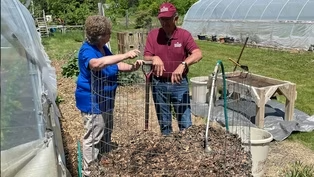
(cow mows) - This steel structure, simple wire structure is one that I found works well for a lot of people.
It should not be more than five feet across.
This is about four and a half.
So this is is close to as big as you want it.
Again, that oxygen has to penetrate to the middle.
Three feet is about the maximum.
So you add greens and then browns on top of that.
As you read the articles, a lot of times they'll say, well, 40% greens and 60% browns.
And greens are like green grass or the food scraps really are mostly greens out in the garden.
These are rhubarb leaves that you're seeing there.
A lot of this underneath here was weeds that we pulled in the last few days.
And again, they have not gone to seed early in the season.
They compost really well.
So you have this mixture and the browns is pretty much just the dried leaves.
Well, so I cover that up.
So now we have this and we'll scatter it out a little bit.
I probably had between two and three inches of the greens there.
So now I have somewhere in four to five range, four to six range of the browns on top.
You need to water.
This is just a very simple method.
Again, you want it moist to the point that you can squeeze it and get water that'll beat up, but not run out.
It is surprising how much water that takes and you'll find that you'll need to add water probably once a week in dry season.
Rain tends to shed.
So one of the important things with composting is to turn it and you need two of these structures because you're going to turn it from here into the other one.
And how often do you need to do that?
Oh, two to three times a summer at least.
Some people would say once a month.
There is a compost thermometer.
And as long as you're getting good heat, you know it's still working, it's still composting.
And so a good heat is somewhere in that 135, 140, 145 range, not over 160.
Again, if you put too much greens in there, you might get to that point but again, the bacteria don't like that.
But you need to turn out because the mixing will restart the compost procedure.
So that's a very important step.
- How do you measure the temperature of your pile?
- Very good question.
Unfortunately, there are thermometers available that you can put in the pile and there's different shades of green, the lightest green is not adequate.
The middle green is where you wanna be.
That 135, 140 range.
And then dark green is too high, up towards 160.
And so you just sink it down in the pile, give it several minutes to calibrate.
And then you know if your pile is working, if the compost is active, and ongoing, then it should be in that over 120, but ideal in the 130, 140 range.
- So where do you keep your thermometer?
- This is our toolbox and it's kind of maybe in the way and sometimes, but you don't have to go very far to grab a digger or a scissors or a pruner.
And so that's where the compost thermometer is.
- Do you have to add soil?
- I do.
And I think it, when you're just starting and in this, I've already added just a few scoops of soil twice, but that has the bacteria in it that helps get it started.
They talk about compost starter and some things like that.
- [Mary] Mhm.
- If you use some soil, you don't need to do that.
- Okay.
How about fertilizer?
You know, do you have to use that almost like a yeast to get things going, or is it the soil that gets in?
- The soil really does it on its own.
You can test your compost and I've done that a number of times.
And if you just use garden waste, household kitchen waste and leaves, it's not all that high in nitrogen.
And so at times I've added little fertilizer just to get the nitrogen content up.
But as we talk about my special ingredient, then we'll know where the nitrogen comes from.
- Okay, do you put your special ingredient in here?
- No.
No I don't.
And again, we'll get to the details of that.
- Do you ever have to worry about compost piles starting on fire?
- No, I have never heard of that.
Certainly they can get too warm as we talked about, but no.
With that amount of moisture, it's not gonna burn.
- Do you ever have to worry about critters getting into your bin?
- No, I really don't.
I say that a bit tongue and cheek, because as we get to my special ingredient, there are some tricks that you need to follow, or you will be attracting unwelcomed guests.
One of the other alternative methods of making a bin is to just use pallets, pallets, and some steaks, very simple, cheap.
Most times they're giving 'em away.
Again, he would have it so he could turn into the next bin there, but that's another method that is often used.
- Is it best to compost in the sun or in the shade?
- You need some sun.
It doesn't have to be absolutely total, but it works better in the sun that it does full shade for sure.
- How do you know when the compost is done?
- Well, you've turned it several times and it's no longer looking like leaves and things, it's brownish dark material, greeny and use the thermometer and you have turned it and it's moistened and it only heats up for a few days.
It's done, it's composted, it's complete.
So after it's done composting and I move it to a area where I can store it, lot of times, it's really not quite ready to be used yet, or it's not the time of year that I'm gonna use it yet.
And it's also where I add the special ingredient.
- Can we go see it?
- Yes.
(upbeat music) - I have a question.
Why would it be in important to grow native Prairie plants to attract pollinators?
- So native plants are unique in that they have evolved over thousands of years to grow well in our Minnesota landscapes.
We have some tough landscapes here.
We have drought, as we've all experienced recently.
We have flooding also experienced.
We have tough winters and we have lots of kinds of soil, and native plants are particularly resilient.
They have big root systems that reach deep down.
Plants are also very diverse.
Look at all the different forms and colors that we have.
And in this Prairie alone, we have grasses, we have flowering plants.
We also have a lot of foliage and there's a lot of rich nectar and pollen resources for pollinators.
So choosing a native plant for your garden, you can mix them in with non-natives as well, but they can really lend a lot to creating great habitat for pollinators, as well as great resources, such as pollen and nectar.
So sometimes a native plant form.
Isn't quite what we want for our managed landscapes.
A little blue stem, for example.
We have a lot of it here growing in the Prairie.
It's one of our native grasses, great plant, wonderful resources for some of our native insects like skippers.
But the form isn't always what we want in a landscape.
So we do have native cultivars.
So these are cultivars that have been developed from the native plant.
They carry lots of great characteristics but they might have a little bit more organized form.
In our case at the University of Minnesota, we have some terrific cultivars.
One in particular is called Blue Heaven, which was developed by Dr. Mary Meyer in the Horticultural Science Department.
And it is a cultivar of our native little bluestem.
Wonderful upright form.
Doesn't quite flop as much as the native plant do.
So it's okay to choose those non-native or those native cultivars as well.
- [Announcer] Ask the Arboretum Experts has been brought to you by the Minnesota Landscape Arboretum in Chaska, dedicated to enriching lives through the appreciation and knowledge of plants.
- This is my composting systems, and you'll see these windrows.
And this is the first of this year's compost and there's leaves.
And then I used some of last year's starter.
Later in the year, when I have a lot of garden waste and things, then that greens works really well.
Right now I do use this as a starter.
So that's, in this year's, there'll be another one on the far side of that.
This was last year's, and then that's two years ago and that's ready to use lose.
And I just turn these, like I said, about twice a year as they move this direction and it works well.
The secret is the Kubota tractor that you see in the background.
Obviously you would not do this by hand.
So why do you do this?
Well, we do have very large gardens.
Our son is a market gardener.
We have a lot of flower beds up at the house.
And so we use a lot of this compost bin, and so it never goes to waste.
- And what do you use for your secret ingredient?
You've had me curious.
- Okay.
Well I should give credit to Bruce Werner another master gardener who told me that he had a secret ingredient.
And so he introduced me to using (indistinct) Yes, now you'd say I thought we weren't going to compost things like that.
Well, the biggest secret is needs to be 15 to 18 inches down.
So you need a fairly big compost pile and it takes a few months for them to totally break down.
But at the end of about two months, you might have a gill scale left, but it is otherwise totally gone.
And that really improves the nitrogen content of your fertilizer for your compost, but I mean, it becomes almost like fertilizer then it, but very natural obviously.
So that's my secret ingredient.
- [Mary] Okay.
- [Steve] I didn't bury them quite deep enough the first two times.
And we did have a skunk come visit us.
And now we've been burying them deep enough.
No, no problems.
So that's the secret ingredient.
- So this pile will be moved over and this pile will be moved over, and that pile becomes that.
- Yeah.
- And then how do you know when that's ready to use?
- Well, again, it really is nice, soft, fluffy, brown material.
It's no longer heating up after it was turned.
And so it's ready to use, and I can just scoop that with my tractor, take it out and scatter it in the garden, and it works fine.
if I'm going to use it in a flower bed or in a flower pot or in those tank gardens that you saw up there, then I like to sift it.
And my sifting system is an old gravel sand, great of three quarter inch mesh.
It's four by eight, and I have it built up in the air so that I can dump a scoop out of my tractor on there, rake it off and all the fine stuff falls through, all the course stuff comes out the back and goes back into next year's pile.
And so that's how it gets you sifted.
- [Mary] The Leaves that you, in the grass clippings that you gather, do you have to worry about chemical being on some of that at all?
- [Steve] There's a lot of studies been done with that, and yes, there has been some carryover.
And so they're mostly broad leaf chemicals, broad leaf herbicides.
And so you need to be conscious of that.
And so I don't accept anything.
I have two lawn services that bring me grass and leaves in the fall, but not until after September 15th, when there's been no spraying for several weeks.
- Steve, if people want to start composting, what advice would you give to them?
- Start small, have it very convenient.
There's very few communities that don't allow composting, but do check to be sure.
And, you know, it doesn't have to be ugly, but it's not usually real pretty to the eye.
So if you can do it behind the garage or someplace again, you really like sunlight, wanna be close to water, so you can take care of that way.
But start small and boy, a couple years, you're gonna have some really useful stuff for your flower beds and gardens.
- [Mary] How much compost should you add to your flower gardens?
How much is enough or too much?
- [Steve] It's hard to say how much would be too much 'cause you can actually grow things well in 50% compost, 50% soil.
But what we frequently do in our flower beds is add about two inches, two and a half inches, somewhere like that.
In the spring, it really helps control the weeds, which is a nice benefit.
Then we kind of work that in, in the fall or in the following spring, put in a couple inches again.
And but in our flower pots, usually we're looking for about a 50/50 ratio.
- Well, this has been so interesting.
Thanks so much for sharing all of your knowledge about composting.
- Thanks, thanks for coming, I've enjoyed it.
(gentle music) - [Announcer] Funding for Prairie Yard & Garden is provided by Heartland Motor Company, providing service to Minnesota and the Dakotas for over 30 years in the heart of Truck Country.
Heartland Motor Company, we have your best interest at heart.
Farmers Mutual Telephone Company and Federated Telephone Cooperative, proud to be powering Acira, pioneers in bringing state-of-the-art technology to our rural communities.
Mark and Margaret Yackel-Juleen in honor of Shalom Hill Farm, a nonprofit rural education retreat center in a beautiful Prairie setting near Windom, Minnesota.
And by Friends of Prairie Yard and Garden, a community of supporters like you who engage in the long term growth of the series.
To become a friend of Prairie Yard & Garden, visit pioneer.org/pyg.
(upbeat music)
Providing Support for PBS.org
Learn Moreabout PBS online sponsorship

- Home and How To

Hit the road in a classic car for a tour through Great Britain with two antiques experts.












Support for PBS provided by:
Prairie Yard & Garden is a local public television program presented by Pioneer PBS
Production sponsorship is provided by Shalom Hill Farm, Heartland Motor Company, North Dakota State University, Friends of Prairie Yard & Garden, and viewers like you.