Oregon Art Beat
Craig Winslow
Clip: Season 25 Episode 5 | 8m 5sVideo has Closed Captions
Craig Winslow’s light projections celebrate an age-old craft.
Portland artist Craig Winslow uses projected light to temporarily resurrect dozens of “ghost signs,” the faded ads painted on the sides of historic buildings. With graphic skills and intricate projection mapping, Craig’s beautiful illuminations pay homage to a bygone craft. Now he’s working to restore a ghost sign with a permanent light installation, visible nightly in Astoria’s historic district.
Problems playing video? | Closed Captioning Feedback
Problems playing video? | Closed Captioning Feedback
Oregon Art Beat is a local public television program presented by OPB
Oregon Art Beat
Craig Winslow
Clip: Season 25 Episode 5 | 8m 5sVideo has Closed Captions
Portland artist Craig Winslow uses projected light to temporarily resurrect dozens of “ghost signs,” the faded ads painted on the sides of historic buildings. With graphic skills and intricate projection mapping, Craig’s beautiful illuminations pay homage to a bygone craft. Now he’s working to restore a ghost sign with a permanent light installation, visible nightly in Astoria’s historic district.
Problems playing video? | Closed Captioning Feedback
How to Watch Oregon Art Beat
Oregon Art Beat is available to stream on pbs.org and the free PBS App, available on iPhone, Apple TV, Android TV, Android smartphones, Amazon Fire TV, Amazon Fire Tablet, Roku, Samsung Smart TV, and Vizio.
Providing Support for PBS.org
Learn Moreabout PBS online sponsorship(casual uplifting music) - My name is Craig Winslow.
I'm a light artist and experiential director.
So I call this project "Light Capsules".
They are light installations that bring back to life these old ghost signs and faded ads.
What I love about light in general is that it is additive.
It has this like magic quality to it.
Being able to play with that and warp it to a wall that has never lit up before is what excites me to kind of give it a chance to really shine like I how I see these walls, you know?
To date, I've created 39 light capsule installations.
I did a series in London.
I've done Detroit and LA, Texas, Cincinnati, trying to put pins as far as I can.
I did a amazing series in Winnipeg.
One of my favorites is right downtown here in Portland, Roy Burnett Motors.
It's this giant wall.
It's got a couple layers to it.
What I love is there's obviously, there's a primary layer to it, but there's a hint of a layer underneath and you can actually see there's two sign companies' tags on here.
There's definitely a lot going on in this sign.
and finding new layers of the past and bringing them into the future is what is really inspiring to me.
You start to see this wall as no longer just like a moment in time, but like a spectrum of time.
So up until now all of these light capsules have been temporary where it's one night only, show up at a generator and a projector, map it really quickly, have this temporary installation.
So it's kind of this magic time portal that opens up and at the end of the night, it closes and it goes back to being what it is.
But some of them are just so beautiful.
I've been trying to make some sort of permanent installation of them.
(upbeat music) This ghost sign in particular, which is right over here, is the one that inspired the entire "Light Capsules" project and now it's becoming one of the first permanent installations of its kind.
(upbeat music) What I would hope to see is these ghost signs are acknowledged as historical artifacts that they get some protection, because if you're not aware of how significant and special these really are, a new building owner could come in and just be like, cool, we'll just whitewash the building, and it happens all the time.
If they're not historically protected, then they could be painted over and then just completely lost to time.
There's a lot of just logistics we have to deal with when you make something permanent that's not just a one night thing.
What I'm fortunate to find is these architectural gobo fixtures are built for 24/7 use.
They are weather-rated.
Square shields.
And to approve, like, yeah, we can mount this like giant light fixture on top of your roof and yes, we're gonna wire power separately.
So rather than a high tech video projection installation, we're actually going more analog.
So this is a custom gobo.
It is essentially a printed colored glass stencil that is placed between the light fixture and the wall, and it casts a very precise shadow that is our mapping.
Even the video mapping that I typically do has to be precise, but this is even more so 'cause it's like kind of an experiment at this point.
Nice, there we go.
But we won't know until we actually turn it on if this whole thing's gonna work or not.
It might be slightly off, but time will tell.
My first step when creating a light capsule is taking a lot of high resolution photos to analyze and see what layers I can see.
The most obvious layer on this wall is Astoria Sign Co., but there are multiple layers behind that.
And you start to see, you know, there's a C, and L, and O.
There's all these little details there, but I had to go to the Historical Society to really fill in the gaps.
Here's the wall right here.
So this is the 1931 Astoria City Directory.
Tailors, okay, so here we go.
I knew that the address was 404 Commercial Street, and searching under Tailors in the city directory, this name pops up and that tells me a pretty confident solve that Carl Lane was the one that was there.
The medallion is the trickiest part of this whole thing.
This is as far as I had figured out, which doesn't look that great, but this is all I really have to go with.
There's definitely some bits of a curve here, curve here.
What I was able to get finally was this historical photo.
This is the epiphany for not only what used to be here on this medallion, the Radio Service Co., but it confirmed everything else I had found.
(uplifting music) There's actually eight different businesses that are involved on the sign, and I'm able to bring them all back to life.
So tonight, we are going to have a public launch.
We have invited all of our friends and family and locals, and sign painters from Portland and everyone to come out and celebrate the lighting of this wall.
And I'm glad that we've essentially been able to give this gift to Astoria, and it'll be up sunset until 10, 11 at night every night.
So I'm very proud of this project, and just wanted to say thank you.
So yeah, that's it.
We will hang out in about 10 minutes, start to see, oh, we can start to see some stuff here, right, look at that.
It's coming through.
(casual uplifting music) - I think that the importance of this project is preserving the past and the history of this particular building, but also the businesses that used to be in Astoria, between tailors, and shoes and, you know, everything else.
These were businesses that operated in town at one point here.
- Allman Shoes, which I think is older.
There's been a lot of people that have stopped by tonight to thank me personally, to thank the building owner that we haven't destroyed the sign, we haven't painted over it.
They I think are just genuinely excited that this is now an added piece to a story that they can celebrate.
(upbeat music) There were sign painters that came out from Portland, historians that live here that love local history and to have conversations with all these different people that all contribute their own love for this wall in particular.
These personal connections, all of those make me really proud of the work that I've been able to make for this.
(uplifting music)
Video has Closed Captions
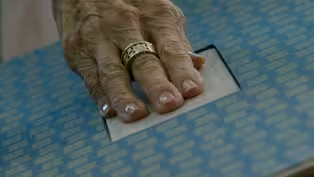
Clip: S25 Ep5 | 10m 23s | John Hasegawa uses pottery to explore Asian American identity. (10m 23s)
Providing Support for PBS.org
Learn Moreabout PBS online sponsorship












Support for PBS provided by:
Oregon Art Beat is a local public television program presented by OPB