Prairie Yard & Garden
Creating a Monarch Waystation
Season 37 Episode 1 | 28m 45sVideo has Closed Captions
Vicky Dosdall of rural Morris loves to garden and grow flowers.
Vicky Dosdall of rural Morris loves to garden and grow flowers. She also cares for nature and has established a Monarch Waystation to benefit the monarchs and other pollinators.
Problems playing video? | Closed Captioning Feedback
Problems playing video? | Closed Captioning Feedback
Prairie Yard & Garden is a local public television program presented by Pioneer PBS
Production sponsorship is provided by Shalom Hill Farm, Heartland Motor Company, North Dakota State University, Friends of Prairie Yard & Garden, and viewers like you.
Support provided by:


Prairie Yard & Garden
Creating a Monarch Waystation
Season 37 Episode 1 | 28m 45sVideo has Closed Captions
Vicky Dosdall of rural Morris loves to garden and grow flowers. She also cares for nature and has established a Monarch Waystation to benefit the monarchs and other pollinators.
Problems playing video? | Closed Captioning Feedback
How to Watch Prairie Yard & Garden
Prairie Yard & Garden is available to stream on pbs.org and the free PBS App, available on iPhone, Apple TV, Android TV, Android smartphones, Amazon Fire TV, Amazon Fire Tablet, Roku, Samsung Smart TV, and Vizio.
Buy Now
Visit the Prairie Yard & Garden Website
Do you love gardening? Consider becoming a friend of Prairie Yard & Garden to support this show and receive gifts with your contribution. Visit the link below to do so or visit pioneer.org/donate.Providing Support for PBS.org
Learn Moreabout PBS online sponsorship(gentle music) - My father-in-law died suddenly and very unexpectedly on the farm.
After the funeral, all of the children and grandchildren agreed to meet on Labor Day weekend to get ready for an auction.
We sorted, cleaned, and carried and then realized we were being watched.
Thousands of Monarch butterflies arrived and rested in the trees right next to the buildings where we were working in 2005.
Monarch numbers have since plummeted, but let's see what is being done to help their recovery.
- [Announcer] Funding for Prairie Yard and Garden is provided by Heartland Motor Company, providing service to Minnesota and the Dakotas for over 30 years, in the heart of Truck Country.
Heartland Motor Company, we have your best interest at heart.
Farmers Mutual Telephone Company and Federated Telephone Cooperative, proud to be powering Acira, pioneers in bringing state-of-the-art technology to our rural communities.
Mark and Margaret Yackel-Juleen in honor of Shalom Hill Farm, a non-profit rural education retreat center in a beautiful prairie setting near Windom, Minnesota.
And by friends of Prairie Yard and Garden, a community of supporters like you who engage in the long-term growth of the series.
To become a friend of Prairie Yard and Garden, visit pioneer.org/PYG.
(bright music) - Our regular viewers will see a very familiar face joining us this week.
Vicky Dosdall Gardens or has gardened in strawbales and pallets.
In addition, she has themed gardens all over her yard, which she uses to entertain over a hundred friends at her annual garden party.
Rumor has it that her newest adventure was creating a Monarch Waystation.
So, I called and asked if we could come to see what that was all about and she said, "Sure, come on over."
Welcome Vicky, and thanks for letting us come and check it out.
- It's great to have you back again, Mary, a new adventure here.
- Tell us about your gardening background.
- Well, I would say I got that from my mom.
My mom always loved flowers and was busy gardening and sharing plants with other people.
And then, I was in 4-H so I gardened and did a lot of different things.
And it just kind of evolves, kind of consumes a person at times, I guess.
- [Mary] Some people have said it's a sickness, but- - Well, yeah, it maybe is, and I don't think it's curable either.
(both chuckling) - Vicki, what is a Monarch Waystation?
- Monarch Waystation is just like you think of a waystation back in the early days for the horses, you know, the stage coaches, you know, they had a waystation to stop and rest at, well, this is a Monarch Waystation.
So the Monarchs need a place to stop and rest, refuel for their trip down to Mexico, because they're flying.
They may be flying all the way from Canada down to Mexico for the winter and then they fly back.
So on the way, they can stop at waystation, rest, and get some nectar and off they go.
- So, why is waystation so important?
- Well, we don't see as many Monarchs or butterflies as we used to and a lot of pesticides are being used out in the fields.
Chemicals, homeowners are using pesticides.
So, there's not the milkweeds, not the native plants like there used to be.
So anytime we can replenish that, that's the idea behind this.
- Why did you decide you wanted to do a waystation?
- Well, I'm not quite sure where I found out about them.
I'm thinking it was maybe from Morning Sky Greenery, but it could have been from, you know, at hort night, it could have been at the state fair, at magazine, but Morning Sky Greenery has been my go-to to get my plants.
And Sally's located just three, four miles from me, so it's been very, very convenient for that.
- [Mary] How did you get the idea of what you wanted to do?
- [Vicky] Well, there's a site, the Monarch Waystation site, and you go there and it tells you what things they're looking for.
One of them is the milkweed, that's the big thing.
And then the different types of plants that would have the nectar in it.
Sally had that list and I gave her the dimensions of my site, you know, how many feet by how many feet and I said, "I need plants to fit this."
Sally was instrumental in getting the right plants for me.
- [Mary] So what is all involved with creating a waystation?
- [Vicky] I'll tell you how I did this.
The area where I have 'em at, I used to do a lot of plant pumpkins and squash, so they weren't in my yard and I planted in strawbales and I even planted in the big round bales 'cause I could use those round bales for years 'cause it was just the medium.
Well, when I decided that I don't need all this work and the ground was black and everything, so we tilled it up and put the first waystation in.
And of course, I don't like weeds, so I laid a weed suppressant mat down first and then planted my plants.
- [Mary] Is there a size that the waystation should be or need to be?
- [Vicky] In my reading it said at least a hundred square feet.
You know, if you wanted to do a whole acre you could do it, you know, but that'd be a lot of native plants.
But you know, there's no limit as to how big, but they want it to be at least a hundred square feet.
- [Mary] Are there any other requirements for making a waystation?
- [Vicky] Just certain plants.
I decided to register my waystation and I believe it was $16 filing fee.
And I dunno, like another $30 that I bought the sign so that anybody that drives by and should happen to stop, they know what it is.
And I don't have any problems with people spraying, you know, farmers right close in this area.
But I just want people to know what it is because there might be people that just drive by and say, "Well, I wonder what she's doing now."
You know?
(both chuckling) - [Mary] Do you need to live out in the country in order to do a waystation or can there be some in town too?
- [Vicky] There can be some in town too.
Yep.
- [Mary] Who administers this program?
- [Vicky] It's called the Monarch Watch.
Well, you send in your paperwork, you tell them where you live, you give them the address.
I just had to send a filing fee in.
There's maps out there and then you can see where these Monarch Waystations are.
- Now are there other stations in Minnesota or are you familiar with other people that have stations?
- I don't know anyone locally.
I understand there's like, around a hundred of up in the Duluth area, but locally, I don't know if there's anyone else.
- [Mary] Where can people go to if they want to see where there are stations?
- [Vicky] I would just Google Monarch Watch.
- Vicky, I'd like to see how you actually did this.
- Well, let's go take a look, Mary.
(gentle music) - Flowers whisper beauty to the world in so many ways.
It's hard to think of a room, field or garden that doesn't look better with flowers.
And in Minnesota, we enjoy a virtual rainbow of flowers that bloom across our state.
We have marigolds, sunflowers, dahlias, cone flowers, gomphrena, zinnias, and verbena.
Really nothing brightens up your home more than a cleverly arranged bouquet of flowers.
And that's why today we're visiting Rustic Designs Flower Farm near Belgrade.
Started in 2011, Rustic Designs not only offers a lovely selection of flowers for your home and weddings, but they let you come out here, pick your own flowers and teach you how to place them together for a perfect arrangement.
Today I'm with Mary Solbrekken, who takes care of the many flowers here at the farm.
- My tips for designing a perfect bouquet, including cutting a very long stem length for your flowers, cutting linear flowers as well as focal flowers.
Make sure you don't forget about your greenery and your filler as well.
My favorite Minnesota-grown flowers are basically everything that I grow here.
That includes sunflowers, dahlias, snapdragons, lisianthus, the list just keeps going on and on.
If you're nervous about arranging your own flowers, I say don't worry, relax, have fun with it.
There's many rules for design out there, but with that I always say rules are meant to be broken.
Whatever's appealing to you doesn't have to be appealing to everyone else.
- While it's lovely here, you don't have to drive across the state to see these beautiful flowers.
Go to minnesotagrown.com to find a local cut flower grower near you.
- Mary, this is my first waystation that I did.
And this was planted in July of 2020 and it was probably the hottest day of the year.
Oh, I had some extra help down here and they were just like, "Yeah, she's lost her mind again."
- [Mary] But how did you pick this spot?
- This was where I had bales before and pumpkins and squash and as I got older, I didn't need all that work.
So we tilled this area up, got rid of the bales, worked it up real well, put some fertilizer in, and I used an organic fertilizer.
And then we laid the weed mat down, the weed suppressant mat and then we used a circle saw to cut the holes.
So all the holes were already cut and away we went with the planting.
- [Mary] How long did you wait from the time that it was tilled until you put the mat down and then started the planting project?
- [Vicky] I would say a relatively short amount of time.
We got it tilled, laid the blanket down and then got the plants.
The reason why is I didn't want any weeded growth, so that's why I put the blanket down right away.
I'm all about no weeds.
- [Mary] How did you know how close to space the plants?
- [Vicky] That was about a plant every square foot.
- [Mary] And the plants that you picked?
All flowers?
- [Vicky] No, a lot of grasses, milkweeds and flowers.
As you can see out here, there's quite a variety of plants out here.
- [Mary] How did you know what to plant where for heights and stuff like that?
- [Vicky] I didn't get nervous about that.
They just got planted.
You can see that there's some taller grasses towards the end and towards this end and it's just a variety.
Monarchs aren't fussy.
They land wherever they want.
- [Mary] How did you water?
- I use soaker hoses.
I call 'em a black oozy soaker hose.
And then I laid 'em out and I always staple the hose down with these wire staples that we use for other, laying the blanket down so that the hoses were in place, I didn't have to keep moving them.
- Well, then there's my next question.
What is this weed mat that you used?
- Okay, this is a weed mat that's made in Northern Minnesota.
So for me that's even a bigger plus that I'm using a product made in Minnesota and it's a 95% wood in this product.
And then there's some organic materials and some tackifier to hold this wood in place.
This weed mat is gonna be here forever.
I will never take it up.
So it's helping to keep the moisture in for these native plants for as long as the weed mats there.
And it's been here three years and you can see that it's doing really well, but there's no traffic on it.
This was out in a garden, which I use it for gardening.
You're walking on it and tending to have more wear and tear.
But here, it's there for the long haul.
The rolls are five feet by 50 feet and they're real easy to lay out.
And there again, I just use the staples to hold them down because you have to staple it down 'cause our wonderful wind would take it all over the place.
This is three years and I'm thinking this is probably gonna make another three, four years.
The native plants just keep getting bigger and bigger and so they don't have a lot of competition from the weeds and that's what I like.
- [Mary] How did you pick the plants for spring bloom and summer bloom and fall?
- [Vicky] There again, it was the plants that I got from Morning Sky Greenery and it seems like there's something blooming here all the time, so she did a good job.
- [Mary] So have you noticed more Monarchs around?
- Oh, yes.
And even my granddaughter, we'll drive down here and she'll see the butterflies and that's fun to have young people realize that they're important too.
And of course, you know, this is gonna benefit the bees also, you know, so it's really a dual purpose, but it's not called a Bees Waystation, it's Monarch Waystation.
But it's good for bees too, and we need that.
- [Mary] Vicky, this is kind of a fall time and you have so many beautiful plants that are blooming now, but I noticed that you have one of my favorites and this is anise hyssop and the smell on this, if I were a Monarch I'd be sitting on this one all the time.
(both laughing) It's so beautiful.
And then you've got the golden rods that are blooming now and some of the black-eyed Susans.
And then I see you actually even have cone flower here too.
- [Vicky] Yep.
It's just like a picture all the time.
The picture keeps changing, you know, when you come down here as to what's blooming.
And I think that's fun for me and fun for anybody that's driving by, you know, to see what's blooming.
- [Mary] I think that those are so nice left because the birds like the seeds out of those so much too.
- [Vicky] Everything gets left here for the winter and last winter I was really keeping an eye on this and there was this area here got so much snow, which was great because then when it melted it went right through the weed mat.
The nice thing about this weed mat is it's going to let the water soak right through it.
It's not like some people will use plastic in their gardens.
Well, the water doesn't get to penetrate through that.
So this is what another big feature along with stopping the weeds, it helps hold the moisture in.
- So then how much weeding do you do here in this patch?
- I do very little.
You know, if I were to see a thistle it would be gone, but I haven't had any thistles here but there's weeds out here and it's part of the prairie, you know, so.
And not all weeds are bad either.
You know, people consider milkweed a weed.
Well, I have them growing in my perennial gardens, which I'm sure my dad would say, "Really."
But I just feel it's important to have 'em around.
- [Mary] Do you ever have people question you as to why do you have that patch there that looks so wild?
- [Vicky] No, because they know I'm kind of different when it comes to gardening.
- [Mary] Using the natives is different from having your beautiful beds up by your house too.
- [Vicky] Yes, and this is probably the hard part for me because I don't like to see weeds and when I get down here and I see weeds, I just gotta let it go because this is native, this isn't a tended perennial bed.
So you know, if they got really invasive I would start pulling them.
But as of right now I just kinda let 'em go.
- [Mary] Do you have to worry about them moving to other locations sometimes?
- [Vicky] I think that the perennials will recede themselves in different places.
It's just like in your garden.
I've got a lily that's growing that I never planted, so who knows how it landed there.
I don't know, bird or whatever.
And I think that's the way with natives too.
- [Mary] Do you have to have kind of a different mindset?
- [Vicky] Yep, because when I plant this, it's pretty much on its own.
So that's the nice part for me that I don't have to weed it and I haven't watered this all year, this one, but it had all that snow and like I say, when we do get rain, it soaks it all up.
The thing is, when you plant something and that sun can beat down and get to the roots, well, because of the weed mat, the sun can't get to the roots.
That's protecting it too.
It's like shading it.
And here again everything is so tall that it shades, so it always dries out from the roots.
So if you, you know, leave everything tall it's shading it.
- [Mary] Well, now it looks to me like you've created a whole nother area too.
Tell me about that.
- That was the second area where I had the squash and the pumpkins and I decided I don't need that anymore.
It was just getting too much work and all the vines and I've thought, you know, I'm just waiting for a chance to trip and fall, you know, 'cause everything's slanted here, which is another good aspect for these native Monarch Waystations.
You want good drainage.
So we're sitting on a slope here.
So that's a good thing too.
So you don't want the natives standing in water.
You wouldn't wanna plant it in a low spot because if you and I stood in water all day, we wouldn't be happy either or our feet wouldn't be.
So when I took that, all those bales out, then we tilled that up and then laid the weed mat and started the process all over again.
- [Mary] Did you pick the same plants as you had the first time or did you pick some different?
- [Vicky] I think they're a little, maybe a few more grasses this time, but pretty much basic the same.
- [Mary] Is there a time that you recommend for planting?
- Well, July was hot that year.
That was kind of tough.
And then the second one I planted in October of last year and the plants were small and they didn't do so well.
So I ended up replanting this August.
So, but you know, the holes were there and everything so it was pretty simple to plant, you know, it just takes time.
- When you said that it was really hot so it was a little hard.
Was it hard on the plants or just you as a person having to plant in all that heat?
- I think it was hard on the people planting.
- Okay.
- But I got the water to 'em right away.
That's the key.
When it's hot you've gotta get water to 'em and you just gotta let it soak for a long time.
- Vicky, I'd like to find out more about the maintenance.
- Okay, let's go take a look.
(bright music) - I have a question.
I would like to plant something in my yard that's more pollinator-friendly.
Do you have some suggestions?
- So one thing that's become really popular for people who want to use their lawn for something other than just, you know, the aesthetics or maybe just the recreation is to also provide some suitable habitat for pollinators.
And one thing that we've been working on at the University of Minnesota is developing bee lawn mixes.
And these are plants of flowering species that can flower throughout the year that can tolerate mowing and still some light foot traffic, but by providing forage for pollinators like these.
Some of those mixtures that we found that work best are creeping thyme, self-heal and white clover as well as the fine fescues that we've really been advocating for, more low input turfgrass mixtures.
They all work well together as far as a bee lawn mix that folks can establish just like they would a normal lawn.
They could renovate their traditional lawn to this or fill in areas that have become thinned out because of drought or any other type of stress.
These bee lawns are really a great idea for having a multi-use space for their lawn.
- [Announcer] Ask the Arboretum Experts has been brought to you by the Minnesota Landscape Arboretum in Chaska, dedicated to to welcoming, informing and inspiring all through outstanding displays, protected natural areas, horticultural research and education.
- Okay, Mary, we're in my new Monarch Waystation that just got planted in the fall of 2022.
And then I replanted some plants in August of '23.
- So what do you have to do for these in order to over winter them?
- I'm not gonna do anything.
They're on their own.
- Is that the same with your first planting?
Did you do anything special with them, 'cause they're beautiful.
- Nothing, I don't do anything in the fall.
I will probably take some seed heads off and disperse out in my, where I've got some big bluestem, other native grasses growing and I started a be pollinator plot and so I'll broadcast some of those on and hope that I get some catches there, but in the fall it's pretty much on their own.
- [Mary] So then what about in the spring?
- [Vicky] Well, in the spring that's when I do my maintenance.
So my first one that we were at previously, I will just come in and and cut them all down.
I just take all the dead foliage and everything off.
I don't burn it or anything.
I usually throw it back out in some trees on some property that I have hoping that there's a few seeds there that'll catch and you know, just start growing and I cut 'em down and that's it.
At that same time, then I'll throw on some fertilizer in the spring.
- [Mary] Do you have to worry about critters at all with everything planted out here in the open and there's no fence around?
- [Vicky] Oh, yeah, this is kind of a deer station too, going back and forth.
So I have seen where the deer have stepped and made additional holes in the weed mat, but I can't do a thing about that.
I'm not gonna put a fence up or anything.
There's so many deer 'cause I'm close to the river.
- [Mary] How about rabbits?
- [Vicky] Well, I have a dog and I have some cats and I don't see many rabbits.
I don't think they stand a chance with my dog out and about.
So I haven't had any problem with that at all.
I don't in my other gardens either.
- What is this area next to this new planting?
- This is a bee pollinator area and I had bought, there's like, you can find anything, there's the seed for bee pollinators and this was planted about maybe three weeks ago.
So the seed is just starting to come up and that's got grasses and a few flowers and stuff in it also.
I'm hoping that from this area here, something will blow into there.
And then if I take seed heads off my original one and just scatter them about.
And the other thing I did is a lot of times you go to a hort show or state fair or a spring show and people are giving away little packets of native seed.
Well, you know, you pick 'em up and I kept those for years so I don't know how good the germination was, but then when this was planted we added that to that.
So I'm not sure what's gonna grow there.
I'm just hoping it turns green and there again, I hope it doesn't get too weedy.
- Yeah, 'cause you don't have a mulch on that one for now.
- No, no, that's, that's on its own.
But I've been watering this area and so this gets watered at the same time.
And now we're going in, hopefully the cooler part of the fall.
And anytime you seed any lawn or anything, you wanna get it seeded before the middle of September because you want to have as much growth as possible before it freezes up.
So a lot of people think they should wait till September, October and that's...
In my world, that's not the way you should do it.
Get it in so it gets good growth before it freeze up.
- So if other people are interested after seeing the show in doing a Monarch Waystation, what kind of advice would you have for them?
- Well, I would definitely use the weed mat because it's competition for the native plants.
I feel if you're gonna go through all the work and the money buying the plants, you wanna have good results.
And that weed mats gonna keep the weeds away so that it's less competition.
You know, I guess I never do anything in small proportions, so it's like making soup.
Why make a small pot when you can make a big pot?
But when I plant too, I didn't wanna start out small, I just didn't even think about that.
That was the size of my garden down there in the first one, and this one, I didn't do the whole thing 'cause this was really a big spot.
And I can always plant natives into that bee pollinator.
If I don't get a good catch, I can always add a few plants here and there.
- [Mary] What other things have you done to benefit the pollinators and the wildlife here in your place?
- [Vicky] Behind us Mary is, I think it's around seven, eight acres and that's all been planted into natives and we finally got it burned this spring.
I hired someone to do it because it's hard to coordinate.
You know, if you need enough help, you gotta have a water source.
You don't want it on a windy day and I had a lot of flowers out there and this spring I did see some flowers, but the big bluestem has just taken over.
It's a good stem, a big bluestem.
But I hope to see more flowers in the spring.
And I probably won't burn that again for another four or five years.
- [Mary] Well, and it looks to me like you have some trees planted out here too.
- [Vicky] Yeah, I've got some pear trees, three pear trees, and I've only got basically like one and a fourth apple tree.
The windstorm last spring was tough on my apple trees, but I'm hoping to get some planted again next spring.
So it's a nice area for wildlife and the birds.
And there's some trees that have berries on 'em, so it's kind of a little wildlife haven down here.
- [Mary] Well, thank you so much for letting us come and learn about the Monarch Waystations that you're making and just for all of the things that you have done to benefit the wildlife and the pollinators.
- Thank you, Mary.
It's always a pleasure to have you come visit.
- [Announcer] Funding for Prairie Yard and Garden is provided by Heartland Motor Company, providing service to Minnesota and the Dakotas for over 30 years, in the heart of Truck Country.
Heartland Motor Company, we have your best interest at heart.
Farmers Mutual Telephone Company and Federated Telephone Cooperative, proud to be powering Acira, pioneers in bringing state-of-the-art technology to our rural communities.
Mark and Margaret Yackel-Juleen in honor of Shalom Hill Farm, a non-profit rural education retreat center in a beautiful prairie setting near Windom, Minnesota.
And by friends of Prairie Yard and Garden, a community of supporters like you who engage in the long-term growth of the series.
To become a friend of Prairie Yard and Garden, visit pioneer.org/PYG.
(bright music)
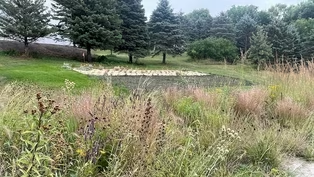
Preview: S37 Ep1 | 30s | Vicky Dosdall of rural Morris loves to garden and grow flowers. (30s)
Providing Support for PBS.org
Learn Moreabout PBS online sponsorship

- Home and How To

Hit the road in a classic car for a tour through Great Britain with two antiques experts.











Support for PBS provided by:
Prairie Yard & Garden is a local public television program presented by Pioneer PBS
Production sponsorship is provided by Shalom Hill Farm, Heartland Motor Company, North Dakota State University, Friends of Prairie Yard & Garden, and viewers like you.