Oregon Art Beat
Creative Rhythm
Season 25 Episode 7 | 25m 59sVideo has Closed Captions
Composer and percussionist Andy Akiho, contemporary dance company NW Dance Project
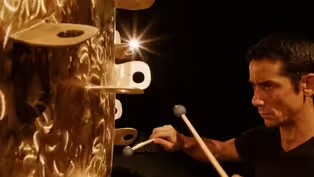
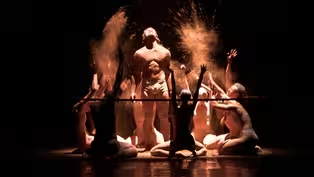
Andy Akiho’s compositions are not just musical performances; they’re immersive experiences that push the boundaries of classical music. The five-time Grammy nominee and Pulitzer Prize finalist is known for innovative symphonies. Northwest Dance Project is a contemporary dance company performing an all-original repertoire from a select roster of accomplished choreographers from around the world.
Problems playing video? | Closed Captioning Feedback
Problems playing video? | Closed Captioning Feedback
Oregon Art Beat is a local public television program presented by OPB
Oregon Art Beat
Creative Rhythm
Season 25 Episode 7 | 25m 59sVideo has Closed Captions
Andy Akiho’s compositions are not just musical performances; they’re immersive experiences that push the boundaries of classical music. The five-time Grammy nominee and Pulitzer Prize finalist is known for innovative symphonies. Northwest Dance Project is a contemporary dance company performing an all-original repertoire from a select roster of accomplished choreographers from around the world.
Problems playing video? | Closed Captioning Feedback
How to Watch Oregon Art Beat
Oregon Art Beat is available to stream on pbs.org and the free PBS App, available on iPhone, Apple TV, Android TV, Android smartphones, Amazon Fire TV, Amazon Fire Tablet, Roku, Samsung Smart TV, and Vizio.
Providing Support for PBS.org
Learn Moreabout PBS online sponsorshipSupport for Oregon Art Beat is provided by... and OPB members and viewers like you.
Funding for arts and culture coverage is provided by... [ ♪♪♪ ] [ low tone echoes ] [ playing sharp melody ] MAN: I just want it to be an experience.
Like, if I were in the audience, what I would love to hear and be a part of, musically and visually.
Hi, I'm Andy Akiho, and I'm a classical composer and steel pannist.
[ metallic melody plays ] It's got all these tabs sticking out, and the tabs made different pitches.
MAN: A lot of his music has a very visual aspect to it.
But not in a gimmicky way.
He brings fun to classical music.
He brings excitement.
He brings something new.
When you hear Andy's music, you're like, "Oh, my God, that was the spectacle of the show."
And people will talk about it, you know, after the show.
That is rare for modern composers.
[ rhythmic melody playing ] AKIHO: This project's been amazing.
I got to really work with the Omaha Symphony.
"Sculptures" is really like nine separate pieces in this suite that's honoring Jun Kaneko, the amazing visual artist.
Ree and Jun live in Omaha.
[ Jun speaking ] AKIHO: I started writing a symphony inspired by these sculptures.
[ notes echoing ] And then it developed... me starting to tap on them a little bit, and then it eventually became like me playing on these things and creating instruments.
And Jun Kaneko played on them, too.
Got him to hit a couple.
It's just been inspiring to make music out of these things.
It feels like they were made to sing.
It's like they want to speak.
And it was fun bringing that out.
[ playing gentle tune ] I kind of just like it without a chord, too.
We'll do both.
We'll record both.
When I'm improvising for ideas for a new piece, if it's inspiring enough for me to be excited about, then I'll really push that idea... Yeah, let's do one just the first score.
Yeah, let's do that.
...or rework that idea and change it up, dress it up.
That's just three, so four, the major seven, and then that crunch.
I've probably thrown away 99% of the things I experimented with.
I'm going to try one where I roll the last roll.
Just to have a different version.
Even if I'm just improvising with the sculptures, I can come up with something, but then to really sculpt it into a through-composed narrative, I did that over several months.
Emmy, is that cool?
All right.
[ rhythmic melody playing ] When I'm writing, I like to get to know the person so I feel the energy.
I can almost picture them performing it.
It's very intuitive.
I'm just trying to tell the story from the experience of working with them.
[ steel drum playing melody ] Some of my favorite places where my compositions have been performed is at the Kennedy Center and Carnegie Hall, Lincoln Center.
TV NARRATOR: Meet Andy Akiho, one of today's in-demand composers.
AKIHO: It was a cool experience to include the different steel bands I started out with who really inspired me to grow as a musician.
So that was my whole life in New York for several years.
A lot of it's a mystery to me.
I don't have a specific way I compose every time.
And that's good and bad.
I think it can be fun for innovation and creativity, but then it can be a challenge to make sure I'm efficient enough and getting the work done in time.
I'll work in bars and clubs and coffee shops.
I like the urban lifestyle more.
If I get stuck on something mentally, I like to be in another place where I'm hearing a lot of people.
There's some kind of energy in the room when there's more people around.
I want, like, cars driving by, I want the sound of the city.
It really helps me.
I'm always working up to the wire and the deadline.
It's painful sometimes.
I've seen Andy stay up three, four nights in a row.
If I'm working on the pan and the keyboard, I'll have a pillow there, and I'll just work until I can't move anymore, and then I might fall asleep for an hour or something.
[ steelpan drums playing ] But a lot of times, when I'm in the zone, there's no way I can fall asleep.
Sometimes he'll go a couple days without food.
I have to remind him to drink water and eat.
When he does eat, though, he can out-eat anyone, because he's burning so many calories in his brain when he's composing.
He doesn't compromise based on deadlines.
So sometimes he'll be working on something, and I'll just be like, "Man, that sounds pretty good.
Let's just go with that," or... And he'll be like, "No, it's not right.
It's not right."
And then he'll spend sometimes an entire night on one or two measures of music.
And then the next night, he'll write like ten pages.
That's me and my sister.
I got into music from my sister Kay, because she was a rock drummer in high school, and she got me into drums when I was about 8 or 9 years old.
This?
This is me, these three.
And then I got into drumline.
And then I got into steelpan in college.
I was very fortunate to go to Trinidad in 2002 and 2003.
See, this is how important steelpan is for the culture in Trinidad.
It's on the money.
I got to play with the steel orchestras down there.
Playing with a full steel orchestra, sometimes up to 160 members, it was just an inspiring experience, working with the big bands and having the energy, doing it all by rote.
There was no sheet music.
Everybody's there till the middle of the night, a lot of fun.
And that's definitely influenced a lot of my compositions throughout the years.
It's just been a journey.
I just like all kinds of music.
I love it all.
Classic rock and hip-hop and rap, jazz and fusion, Caribbean music.
Later in life, I got more into classical music and contemporary classical music.
[ playing melody ] So every time I rearrange them, it would come up with different material.
So I've got to be, like, decisive.
[ chuckles ] And figure out an arrangement.
[ laughs ] I don't know.
[ high tone plays ] These are very special chopsticks.
I find these a lot in Vietnamese restaurants, but I can't find them this heavy anymore.
The weight of these feel good.
They sound great on the pan... [ ringing notes playing ] It was my manager's idea to have a conversation with Olympic ping-pong players and orchestra.
[ playing classical music ] And I thought it was ludicrous at first.
And then I was excited about the challenge of it and trying to make a fun piece...
I wanted to make something that made sense musically and not just exploit the novelty of this idea.
I wanted to try to make something that was meaningful and that was fun for the audience and the musicians.
[ playing classical music ] [ clattering ] GREENEY: Everyone is just happy, from kids all the way up to grandparents.
His overall joy and love for what he's doing, that's the most important thing, and he just wants to share it with people.
I think people can really feel that.
AKIHO: I'm always grateful for when I can share a new experience with the collaborators and with the audience.
That's something I've always dreamed of, you know?
[ soft melodic music playing ] [ dramatic music playing ] We love dance.
We love dance, and this story is a story of tragedy, of despair, filled with pathos and love and death.
Do you know the original story?
[ piano playing melody ] WOMAN: I was freelancing as a choreographer.
Pre-2004, I was trying to find my own voice, and I'd worked with other choreographers, young, emerging voices.
We were all looking to express ourselves with very different styles.
There was so little opportunity for that in this country at that time.
And I thought, "What happens if you bring a group of directors together with an amazing group of choreographers, with a variety of young artists who had different backgrounds, and you put them in a room together and see what could be produced?"
And that was the beginning of NW Dance Project.
[ rhythmic music playing ] Good rhythms, good rhythms, and often, when you wanted to hold something, we were here.
SLIPPER: We've made a conscious effort to seek out and invite choreographers from all around the world to develop and create spectacular new work here.
[ dramatic music playing ] We titled the show "Stravinsky," and Ihsan Rustem has committed himself to doing "The Rite of Spring" and Joseph Hernandez is doing "Petrushka."
[ classical music playing ] RUSTEM: Doing "The Rite of Spring" here is a great challenge.
I mean, it's something that I did not want to touch for a long, long time.
It was first performed at the Théâtre des Champs-Élysées in Paris in 1912.
The costumes were pagan, ritualistic, and then the music was very challenging.
And I think people just weren't ready for it.
So the minute the curtain opened, people started booing, people started screaming.
They screamed, "Taboo!
Shut up!"
A riot erupted within the theater, and it carried on out into the streets after.
I think they call it the greatest scandal of the performing arts, which I kind of love.
I love a little bit of scandal.
I kind of want to feed in all of that, like, angst into the piece.
It's going to be very wild.
Going into "The Rite of Spring," he has a real description of each section of music.
--four, five six, seven, eight.
One, two, three, four, five, six, seven, eight.
At this point, I know every pling and plong of that Stravinsky music.
Every count, every... and I like that.
I find that really inspiring, and I'm trying to be as respectful to the music as possible and trying to let that undercurrent drive much of the creation.
[ music playing loudly ] [ counting rapidly ] Good!
I'm by nature a relatively organized person.
It sort of keeps me in check.
Have some masks coming along, and I kind of like this.
And I'm using the masks as a symbol of the chosen one, but also of removing identity.
I'll always create quite an extensive dossier, consisting of many images, consisting of a lot of ideas thrown in there, consisting of costume ideas, prop ideas, set ideas.
All right, why don't we swing a leg and just begin?
Yeah?
So just a full eight to come into the space.
One, two, three, four, five, six, seven, eight.
One, two!
Three, four!
That works.
Before I arrived, I pretty much have a clear overview of what I'm going to do, and I'll have a timeline and spreadsheets, and I have to get this done by this time and, like, I'm giving myself an ambitious task of, "I have to do 15 minutes in this first week."
I mean, that's... crazy, but I have to do it, because of the timeline we have.
Five, six, seven, eight!
One-- oh, one!
[ music playing over speakers ] Five, six, seven, eight!
Two, four!
The original "Rite of Spring" was based on a pagan ritual coming around in the spring.
It's very earthy and very grounded, super physical.
It's actually how my body moves.
You just...
I do a lot of floor work.
I'm quite grounded.
I almost never jump.
One, two, three, four, five, six, seven, eight.
In the company right now, there are a couple dancers that we're meeting today for the first time, so I really want to demonstrate and physically do myself so they also understand a little bit of my approach to movement.
We can help him up.
And then if you can be a little more tactile, like make her work for it.
That's great.
Can you go deep, also, into finding that... Like, that's your ritual.
Mm-hmm.
It's kind of a-- it's a super interesting space.
Each creation really is quite different, or I do my best to achieve that.
[ laughs ] At the heart of NW Dance Project, we love to let our choreographers come and try to instill that they can push boundaries and maybe turn the box over and see what we get, because I think that's the future.
We're going to do something we call folding.
So if you get to a point like this, you want to fold a joint in on itself... SLIPPER: Joseph will surprise me, and he is tackling some of the difficulties of the history of the work.
HERNANDEZ: I remember in a dance history class in school, I was shown a VHS of "Petrushka," and there's three characters, there's three kind of like puppet characters.
Petrushka, the sad clown, is in love with Ballerina, which is kind of archetypal woman figure, and then there's the Moor, who's this figure of the masculine.
He of course has this giant saber.
It's usually played by a man in blackface.
And I remember watching this and thinking, like, "Wow, this was not made with people like me watching this in mind at all."
I felt it was important to kind of take on pieces like this to kind of take a hold of that history myself and to use it in a way.
Like holding up sign, like putting a signpost, like, "I also exist here.
We also exist here."
What was the space between what you planned and what happened?
It's small space... SLIPPER: He's working very closely with the dancers.
It's almost like a free form.
WOMAN: He had us write little poems about things.
We're pulling from the old "Petrushka," but really kind of opposing it in a new way.
Kind of really leaning away from... what it was in the past.
Two things: there's like the piece as it exists in history and, like, the weight of that, and there's also, like, a bit of humanity that have, like, honesty... SLIPPER: He's interested in philosophy, and he lets the work kind of develop in front of you.
What did you think?
How was the thinking process there, and how did that manifest in your movement?
And what creates complexity is using that rhythm in strange... position ways, you know?
So a fold can go this way into that point, a fold can go down this way.
We could build something up this way to then fold back on it again.
Without forcing yourself to, like, think of them independently for a little bit.
I love working with Joseph and Ihsan, so I think they're going to be such contrasting works.
They are both very invested and physical in what they do, but the approaches are so completely different.
It'll be exciting to see how it all plays out.
[ music playing loudly ] [ inaudible conversation ] RUSTEM: It's a marathon for the dancers, I mean, an absolute marathon, but I like that.
I mean, it's exciting, and I hopefully want to take the audience on that journey.
[ music playing over speakers ] [ speaking indistinctly under music ] HERNANDEZ: What we're going to do is take an approach of sort of like talking about talking about the piece.
We know that the theater isn't perfect, but it should be a place to dream, to experience, to heal instead of constantly perpetuating more harm.
The piece is quite personal, it's very political, very specific, and it's very vocal about its positions.
I'm excited to share this with people, and I'm also a little bit terrified.
[ ♪♪♪ ] WOMAN [ over radio ]: Sound 12 and blue mike, go.
One, two.
One, two.
SLIPPER: We have an incredible lighting designer and team that go in, and they will be watching all the work.
Lights, sound, and rail go.
When you transfer a work from the rehearsal studio, there's some magic that starts to happen.
Just something very Vogue Italia.
It's like all the finishing touches that are put on.
More, like, physicality, because it's just going into that music.
I call the rehearsals, I call them the kitchen.
So everything is chop, chop, chop, chop, and you're making it, and then you have to put it all together, and the stage is like the dining-room table.
You present it, this brilliant meal that you've cooked.
[ Slipper laughs ] And all the pieces will be timed and put together at the right moment.
It's like making a big cake.
It's just fantastic.
[ laughing ] I just love it.
Lights 201, sound 41, go.
[ ♪♪♪ ] I get continually surprised and continually get excited.
[ audience cheering, applauding ] I think that is still a joy when you're excited about what you do.
I don't feel like it's a career anymore.
I kind of feel like it's my life.
Check, one, two!
Check!
Hey, check, one, two.
Hey, hey!
[ indistinct conversations ] AKIHO: I need those.
Grand casa.
Grand casa is su casa.
WOMAN: Perfecto!
But we're going to test these things back here first.
MAN: All good.
[ playing notes ] I don't mind if it sits there.
[ scatting ] All right, around 61.
[ playing rhythmic tune ] Yeah.
[ steelpan drum playing ] To see more stories about Oregon artists, visit our website... And for a look at the stories we're working on right now, follow us on Facebook and Instagram.
[ crowd cheering, applauding ] Thank you so much.
Thank you.
Support for Oregon Art Beat is provided by... and OPB members and viewers like you.
Funding for arts and culture coverage is provided by...
Video has Closed Captions
Clip: S25 Ep7 | 11m 19s | Composer Andy Akiho’s immersive symphonies push the boundaries of classical music. (11m 19s)
Video has Closed Captions
Clip: S25 Ep7 | 12m 6s | NW Dance Project performs original work by world renowned choreographers. (12m 6s)
Providing Support for PBS.org
Learn Moreabout PBS online sponsorship















Support for PBS provided by:
Oregon Art Beat is a local public television program presented by OPB