NHPBS Presents
Creative Spotlight | Hidden in Plain Sight
Clip: Special | 20m 30sVideo has Closed Captions
Performed at the NH Business Committee for the Arts awards ceremony.
An artistic statement on the invisible and yet powerful role that creative energy and artistic expression play in New Hampshire's economy. Performed at the NH Business Committee for the Arts awards ceremony.
Problems playing video? | Closed Captioning Feedback
Problems playing video? | Closed Captioning Feedback
NHPBS Presents is a local public television program presented by NHPBS
NHPBS Presents
Creative Spotlight | Hidden in Plain Sight
Clip: Special | 20m 30sVideo has Closed Captions
An artistic statement on the invisible and yet powerful role that creative energy and artistic expression play in New Hampshire's economy. Performed at the NH Business Committee for the Arts awards ceremony.
Problems playing video? | Closed Captioning Feedback
Where to Watch NHPBS Presents
NHPBS Presents is available to stream on pbs.org and the PBS app.
My mother played the piano.
My mother played the piano, not a lot at home.
My mother played the piano not a lot at home, but I know she could play the piano.
My mom cleaned people's houses in a very wealthy suburb, and she would punk me down in their beautiful libraries, and I could just pick books from the shelf and I'd spend.
I think of them as some of the most blissful hours of my life.
Sitting in a window seat, looking at the snow, falling outside, hearing my mother cleaning and vacuuming, but always singing to herself and just being there with books.
My father's an artist his entire life, he said it is easel.
And that's how he made his living.
More importantly, that's how he made his life.
I used to think my father and I were completely different.
He's an artist.
I can't draw a straight line with an inch.
I would say to him, I have absolutely no talent.
That's why I study math and physics.
You can learn that stuff, you can't learn talent.
I have absolutely no talent.
It's why I do physics and math, and my father jumped in, corrected that statement and said, I disagree.
My son has inherited something from me in the way of talent.
We just use different tools.
My sister said, you better go to college.
So I was going to go to a business school and my sister very wisely said, You do not go to a business school, go to a liberal arts school.
She said, You're in the business for the rest of your life.
You don't need business.
I ended up minoring in art and took sculpture and happened to love doing sculpture and architecture, and it was fascinating to me.
And I think what was the fascinating was actually the creative process.
It was something that was changing, creating and building.
I just wanted more from there on it.
It became very important part of my life because I started with the creative process.
I think my has become about a creative process.
My mother was an amazing quilter and every one of her grandchildren, great grandchildren, and we have one on our bed quilts that she made, and she made sure that she made one for everybody before she passed from this world.
And we have family members who are gifted carpenters and wood workers.
And I know these are sort of they're often relegated to somehow craft as a lesser.
And I think of craft actually as the art that was available to people where art had a real functional sense of use and day to day life.
And those things can go together in beautiful ways.
It's so interesting how context defines art for us, but taken in isolation.
I think one is as beautiful as the other.
Even though they were intended, one would be considered craft and one would be considered art.
I think one of my sort of favorite pieces of what I would call art, though others might call it craft are shaker boxes, which I have bought many, many, many from the store at Canterbury Shaker Village.
And I think there it is.
I think the workmanship is beautiful.
The utility is beautiful, but as an object, they're just beautiful.
And I think part of their beauty for me resonates in their functionality.
They're not beautiful despite their functionality, their enhanced beauty because of their functionality.
In the brains of great artists, there's a kind of they have more connections they see and they get creative.
How do you do that?
How do you take that notion and think about the brain of an organization?
How do you create those connections?
We look for people that say, what if?
I want people to think, what are the possibilities?
I think that's what an artist does.
Don't they?
An artist looks and says, What are the possibilities?
The artists I know are often saying what would happen if I did this?
Well, what would happen if I sort of used this paint, what would happen if I the creative mode is called for in contexts that are unclear, vague and open ended.
We're often asking what would happen if we rethought the way that we assess learning, what would happen if we moved the learning out of the classroom and how you end that sentence, what would happen if allows us to rethink and experiment and sometimes get it wrong?
But a lot of art making gets it wrong.
Ceramicist will tell you for every piece that they feel is perfect and beautiful.
They've sort of broken or dropped or cracked in the Killing X number of mothers.
Creativity involves several different processes that wind through each other.
The first is generating new ideas, imagining different possibilities and considering alternative options.
The second involves developing these ideas by judging which work best or feel right.
These processes don't come in a describable sequence.
Instead, they interact with each other.
What did you learn recently?
And with whom do you learn, how best do you learn?
Where are you learning now?
We've started to think about how do we bring our people together in different formats that encourages connections that would not otherwise happen with people who might not otherwise be in the same conference room?
How do the limits of what I know or how I think constrain my ability to recognize instances of creativity in others?
one of the things that I think happened so beautifully in the arts when it works well, is that you see unconventional connections sort of like the synapses are firing in new pathways.
We're trying to create organizationally a similar kind of dialog and pathways and rethink how we do our work with art in business.
You're stronger together.
I think innovation comes from just letting your mind wander.
And I think art does that because we don't manufacture anything.
We manufacture ideas, and I think art sparks creative impulses.
And I think that spark lends itself to ideas that I think I would never have thought about.
I get up every morning and try to create something that didn't exist before.
Get up every morning and try to create new products, new technologies, new solutions to problems.
That is an art.
That is his art.
That is his art.
That.
Isn't art?
Most experts agree that two elements are central to creativity.
first and foremost, it reflects our capacity to generate ideas that are original, unusual or novel in some way.
The second element is that these ideas also need to be satisfying, appropriate or suited to the context in question.
A creative effort might involve a great deal of idea generation while holding back on the evaluation at the start, but overall creative work is a delicate balance between generating ideas and sifting and refining them.
It's very hard to predict when somebody is going to be a creative person and even when a creative person will come up with something particularly creative.
It's not like you can schedule it budget and organize it.
Creativity is not very controllable.
Creative people are creative people.
You can be creative on stage, you can be creative in a laboratory.
You can be creative in a and a company making new products.
I think art sparks something in us that can shed light on a whole new element of things that we don't even think about.
I think in many ways we're artists of our own lives.
In our world, everything's not black and white.
It's where's the next idea going to come from?
How do we make that happen?
Where do the resources come from?
How do we find the people to make it happen?
Ideas can come from anybody.
Just like art, they can come from anybody, anywhere.
And I think the one thing you want to always be is open.
You want to plant the seeds so that they know it's OK to grow something.
I think artists constantly are planting seeds and all of us, and we don't know how they're going to grow or where they're going to grow.
I think the commitment that we all should have in our society is to encourage creativity of every kind and to use it to improve the quality of life.
Let's say with medical innovations or writing music or poetry or putting images on canvas, that's improving the quality of life because they help explain it.
Or make it more enjoyable and more comprehensible.
Communities with rich, our programs are healthy or more robust communities, they are more creative communities inherently, but they also attract more people like if we want to think about how does our city become a city that can attract the talent we want?
We have to feed imaginations and feed souls.
I think this is where the arts come in.
We can be better about supporting the arts.
If you look at any great community, it has great culture.
And understand, too, that in a difficult period like the one we find ourselves in the arts don't become less important.
They become more important.
If you think about people's struggle right now with all that is happening right now and there are enormous amounts of suffering, they're finding relief and expression in the arts.
I don't know if it's the next Shakespeare, but there's something being written right now by somebody who's been forced up against adversity and is having to write their way through it.
And that's just going to be beautiful, beautiful, beautiful, beautiful, beautiful, beautiful, beautiful.
Beautiful.
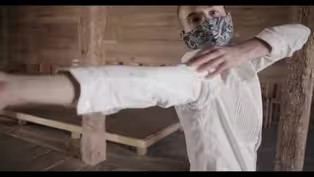
Creative Spotlight | Can't Quite Fathom
Video has Closed Captions
Clip: Special | 4m | Filmed in the historic North Shop at Canterbury Shaker Village. (4m)
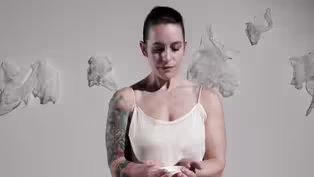
Creative Spotlight | It's All Gorgeous
Video has Closed Captions
Clip: Special | 3m 50s | A dance video based on the song Gorgeous. (3m 50s)
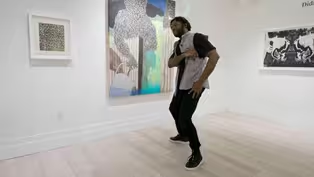
Creative Spotlight | Nefarious Gaze
Video has Closed Captions
Clip: Special | 15m 36s | Reaction to the news that George Zimmerman had been acquitted. (15m 36s)
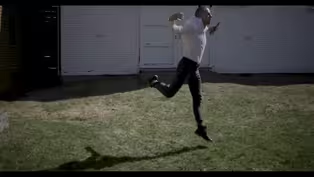
Creative Spotlight | That's How the Light Shines In
Video has Closed Captions
Clip: Special | 4m 33s | Twenty of New Hampshire's most diverse and skilled performing artists. (4m 33s)
Providing Support for PBS.org
Learn Moreabout PBS online sponsorship New Season
- Drama

Hugh Bonneville stars in a crime drama inspired by one of the largest robberies in British history.
 New Episode
- News and Public Affairs

Top journalists deliver compelling original analysis of the hour's headlines.

 New Season
 New Episode



 New Episode
Support for PBS provided by:
NHPBS Presents is a local public television program presented by NHPBS