
Culture
Season 2 Episode 5 | 54m 44sVideo has Closed Captions
Culture and modern energy go hand in hand.
Culture and modern energy go hand in hand. Our fashion, music and art all have been impacted by modern energy. Wealthy industrialists with fortunes made from energy funded much of modern culture, using energy systems to spread culture across the globe.
Problems playing video? | Closed Captioning Feedback
Problems playing video? | Closed Captioning Feedback
Culture
Season 2 Episode 5 | 54m 44sVideo has Closed Captions
Culture and modern energy go hand in hand. Our fashion, music and art all have been impacted by modern energy. Wealthy industrialists with fortunes made from energy funded much of modern culture, using energy systems to spread culture across the globe.
Problems playing video? | Closed Captioning Feedback
How to Watch Power Trip: The Story of Energy
Power Trip: The Story of Energy is available to stream on pbs.org and the free PBS App, available on iPhone, Apple TV, Android TV, Android smartphones, Amazon Fire TV, Amazon Fire Tablet, Roku, Samsung Smart TV, and Vizio.
Buy Now
Providing Support for PBS.org
Learn Moreabout PBS online sponsorship[dramatic music] - Coming to a working definition of culture is a very difficult thing.
Culture can be works of art, but it could also be the clothing you choose to wear.
It's works of literature, but I think even if we're talking about physical objects, whether it's a Renaissance painting or a Roman sculpture, it's always in the world of ideas.
They're representations of broader trends in a society.
- What energy has done to culture is transform the things that we include in our culture.
We have new devices and traditions today that we didn't have 200 years ago.
- Once people can start throwing energy at things, they find substitutes for everyday products.
The social transformation wrought by this new abundance of energy is massively influential on the everyday consumer.
- As soon as cars like the Ford Model T came out, this completely changed the dynamic of the American culture.
Now people have a chance to explore.
- Today, with modern energy, culture can move more quickly, because we have a means of disseminating that culture over television or radio and the internet.
These new tools have been instrumental to the rise and fall of different regimes.
So energy can lead to a massive change of culture as well.
[Narrator] Culture is all around us.
Culture reflects us, shapes us.
Energy has influenced our culture.
Movies, art, music, fashion, computing, and the internet are all powered by modern energy.
Human culture is a living thing, influencing, and influenced, by those who live within it.
Though for much of history, significant shifts in culture were measured over generations rather than lifetimes, modern energy has accelerated every facet of human life, including the way our cultures interact and evolve, as trends and fashions travel the globe.
Whether it is an age-old tr adition, or a fleeting trend, energy has always played a key role in the story of culture.
[upbeat theme music] [Narrator] To understand ourselves and each other, we must understand the force behind the global events that shaped the world.
[helicopter blades whirring] [ship horn blasts] [thunder rumbles] This is "Power Trip: The Story of Energy."
[crowd roaring] [soft piano music] - Before modern energy, culture was really a process of artisanship.
♪ ♪ People would make elements of our culture by hand, paintings, iron work, glasswork.
Architecture in these buildings were designed by hand and then built by hand.
And there's energy embedded in the artwork too.
We can look at a sculpture, and let's say it's out of bronze, a lot of things went into that.
The first is, there's some sculptor who is chiseling out the shape in granite or some mould, and then there's some energy used to extract the materials for the bronze in a mine, move it to location, melt it with heat, and then cast into the shape of the sculpture.
Or maybe the canvas that holds the paint, the oil paints, it's oil paints, they're made from oils, and then the wood frame, these are all forms of energy.
If you had new fashion, or new dress, maybe they'd be captured in a painting, and then eventually, the painting will be shown or reproduce, and over time, the culture would spread.
These exhibits, for some, is the only exposure people would have to different cultures or different traditions and histories, but people didn't get to travel very easily, so culture propagated more slowly before.
♪ ♪ Sometimes our cultural traditions emerge from our local conditions.
[geyser splashing] [Narrator] Before we had modern energy, it was common for aspects of culture to emerge from a people's surroundings.
Iceland is home to more than 200 volcanoes, and is teeming with geothermal energy.
Geothermal energy means the energy from within the earth, which is carried by hot water, or steam, onto the surface.
Some of Iceland's geothermal energy is released through geysers, steam vents, or boiling mud, but some is released in calm pools of water.
Geothermal pools are an example of cultural tradition that is rooted in Earth's naturally occurring energy.
- We think about the Icelander pool culture today as this modern thing, but we have had pool culture from the day the country was settled.
When people traveled on horses, when they didn't have a tent or sleeping bag, stop at the pool, maybe just rest with their feet down in the warm water and sleep on the ground, so the warm water would just kind of flow through the body.
[Narrator] Geothermally heated water sources contributed to the early settlers' survival in this harsh climate.
Modern energy may have reduced Icelanders reliance on the pools for survival, but the cultural significance of this tradition has only grown.
Today, nearly every city in Iceland has heated pools, and the significance of the pool culture goes beyond swimming.
Sitting around in heated pools having a conversation is a national pastime.
People take work meetings to discuss politics or the local community news, all while sitting in heated pools, a vital part of the local culture.
- In Texas, we would all go swimming to cool off from the heat of summer.
In Iceland, you would go swimming to warm up from the cold of winter.
Well, we think of it as purely social in the United States, but there's more to it in Iceland.
[Narrator] Natural energy from volcanoes may be responsible for Icelandic pool culture.
But it is humanity's adoption of modern forms of energy which lead to so many of the cultural traditions we know today.
Energy has been a catalyst for creating new culture, expanding who has influence over culture, and has changed the means and speed at which culture travels the globe.
This seismic shift in what constitutes culture began with the Industrial Revolution.
[Film Narrator] The Industrial Revolution was, in a word, productivity.
- The Industrial Revolution is really a story about the United Kingdom, and it transformed Great Britain from a rural, poor backwater to a cultural powerhouse around the world.
[majestic music] - What's important about Britain, pre the 18th century, is that there's no movement.
The people who have money held the wealth, and it was wealth in terms of court, court patronages, and huge amounts of land.
What we call the Industrial Revolution transformed British society, and suddenly, everything changed.
[dramatic music] - The form of energy in the Victorian Age that transformed the United Kingdom was coal.
Coal giving rise to steam power and steam machines.
[dramatic music] - Suddenly, we've got people saying, "Hey, we've got steam engines, we can make things in huge quantities and sell them."
All of this stuff is generating wealth.
So for the first time, you've gotta move away from the traditional landed gentry, and those sort of people, towards industrialists.
- These middle class, factory owning men, they become the rich ones.
This has a huge impact on social Britain.
These factory owners tend to be very strong philanthropists, this is partly due to their Protestant religion, the idea of giving back, and it's also a way to distinguish themselves from the debauched aristocracy.
Queens, like Victoria, are very conscious, the days in which the king would sit around and chat to his aristocratic chums, those are all gone.
They have to seem hardworking, humble, seem very concerned about the industrial nature of Britain, 'cause now, the middle classes have got power.
So the culture of Britain has changed, and what's really important is the parts of Britain that hadn't been so wealthy before.
The North, Manchester, Leeds, where you have the big factories, Birmingham, Nottingham, these cities really developed their own culture, their own theaters, so you see a lot of rise of painters and artists that the middle classes like.
Thanks to the Industrial Revolution, it's their cultural needs, it's their interest that's crafting Britain.
The fascinating question is, that the aristocracy of Britain, that had all the money, all the education, all the power, why didn't they come up with a spinning jenny?
Why didn't they develop the factories and consolidate their wealth?
And that is a really key question.
These middle class men had nothing, but they were wildly ambitious, they were desperate, they were determined.
So I think that's a lesson of the story, you never rest on your laurels.
[Narrator] Throughout history, human culture has taken different forms to differentiate one group from another.
If there has been one common thread among them all, it is that those who hold wealth hold influence.
The Industrial Revolution and the resulting massive shift in power, represent one of energy's key effects on culture, expanding wealth and expanding cultural influence to a new class of people.
[gentle music] - The social transformation wrought by this new abundance of energy is complicated.
Of course, one of the things that happens when you have all of these great big industries is the price of goods falls, which is great for your everyday consumer.
They can suddenly afford a few more luxuries, things that allow them to position themselves, status goods, if you like.
- People aren't actually in a subsistence position anymore, you are not just having to worry about the basics of life, there's more money, more disposable income which you can spend, and it's spent on things which I suppose previously might have been seen as luxuries.
[Kate] Britain transforms into what Napoleon calls as "a nation of shopkeepers."
So, what becomes the most popular leisure pursuit in Britain, which is shopping, that all starts in this period, the huge consumer culture.
[upbeat music] - Once you've got a good idea, and you can link that to a piece of machinery that's gonna be able to make that a mass production commodity, you've got a whole load of suddenly talented people jumping on that idea.
[upbeat music] - The range of goods which is available is amazing.
People come to London in the early 1800s, and they're amazed, there's shops everywhere.
- Factories creating stuff, and people all need to be encouraged to buy that, and so you have the idea of a fashion, that if you don't buy this season of dress, you're going to be out of fashion, and so women are encouraged to have more than one woolly dress, to have lots of dresses.
- Before access to high quality, cheap fabrics and fashions, the rich had much nicer clothes than the poor.
The dirty, low quality clothes were the differentiator between rich versus the commoners.
And then you see, as a result, the rise of uniforms for servants, where butlers started to wear tuxedos, and maids started to wear very particular clothes to differentiate them from the rich aristocrats.
- You've got shopping coats, you've got fashion, you've got celebrity culture.
For example, Lord Nelson.
[cannons roaring] Lord Nelson wins the "Battle of the Nile" against Napoleon and the French forces, finally, it looks like the war's going Britain's way.
Well, he's the great hero, and everyone has to have Nelson stuff.
There's huge factories generating Nelson stuff, it's Nelson necklaces, Nelson headbands, Nelson boxes, Nelson decorations for your walls, everything.
And also you have Nile sets, people want to decorate their houses with mummies, with sort of Cleopatra looks, with sphinxes.
So these celebrities have a huge amount of celebrity stuff.
[Narrator] Though this evolution of consumerism into a culture of its own was a result of a new energy-driven world, the intangible effects of energy were greater still.
One ingredient of culture is time, and energy had begun to show its remarkable ability to alter how people spent theirs.
- As well as the basic, you know, you're moving towards a new wealth based economy, it's just that actually you don't have to live in a tiny community in an agricultural area.
People are tending to move to cities and urban areas.
[upbeat music] [train whistle blowing] - Once upon a time, if you grew up in Somerset, and then you moved with your husband to London, you'd never see your family again, I mean, it's just too far.
Now, you can go on the train, the steam train.
Yes, it's transferring goods all around the country, but also people.
- There's a burgeoning nightlife causing a new kind of sociability.
People are interested in going out at night, going to the tavern, going to the coffee house, and these are places where people congregate around light.
[Kate] You see this transformation, cities everywhere start having lights.
We see the development of restaurants and big cafe culture.
Before, after dark, you really didn't have anything to do but go to bed.
You couldn't really work after about 6:00, cities were dark, there was crime.
Now you can have electric lights, and so leisure time can be extended.
There are more visits between each other, there are balls, there are celebrations.
And all of this is thanks to the Industrial Revolution.
[Narrator] British society was unrecognizable from the previous century, as energy transformed culture.
People could read after dark by electric light and expand their knowledge.
Women in particular had experienced a role change.
Energy aided in lessening many of the mundane chores women were expected to perform.
The new social order also helped spark the push for equality.
- Previous to that, the woman was helping, she was spinning, she was weaving if she lived with a weaver.
They were part of the whole community, the glove maker's wife was helping him in his operations, but now the woman has nothing to do with the factory, she's at home, and her job is to decorate, and her job is to be moral, and her job is to visit other factory owners' wives.
These wives of these industrial magnates, these daughters, well, they're the ones who have to conserve all the morality.
They must stay at home, decorate the house.
There were a lot of conduct books for the middle-class women in the 18th century, in which they're told not really to speak to men, to be silent, to be complacent, it's all about her saying nothing, her doing nothing, her being obedient, her smiling, her always obeying and helping her husband.
And increasingly, you start to see the women saying, "Is this all there is?"
And it's interesting that the more they produce these conduct books, the more you have women who are saying, "I want more."
"I want more than just popping along to the odd charity.
Shouldn't we have more?
Shouldn't we be allowed to be doctors?
And shouldn't we be allowed to be clerks and lawyers?
I think women should be able to be do more with their time.
I think women should have political power too.
I think we should get the vote."
[soft dramatic music] And of course, you see, the empire, the colonization, oftentimes rapacious colonization, of other countries, and these are the countries become the key export markets for Britain.
[Narrator] This rapid modernization could not be contained by the UK's borders.
Between 1720 and 1750, the imports of tea to Britain by the East India Company more than quadrupled.
Once this commodity afforded only to Britain's aristocracy went mainstream, the increased supply lowered prices dramatically.
Imports and exports increased around the world, and culture was also exported and imported.
Driven by wind, steam, and coal, the world was more connected than before.
- With the rise of modern resources, you also get the rise of colonialism and imperialism.
As countries would come into new areas, say the Middle East or Africa, to get access to the resources, and bringing their cultures with it.
Great Britain had an empire, it had land all over the world, but it's the cultural imperialism that I think is more interesting, the export of British culture.
Sometimes it doesn't go so smoothly, creating a clash of cultures.
[Film Narrator] India grew hundreds of tons of cotton annually, and yet Indians were unemployed half the year.
Instead of sending their raw cotton to English mills, why not make their own cloth?
Thus began the Caudi, or homespun, movement.
[Narrator] By the decline of British colonialism, culture was forever changed worldwide.
Wealth was easier to create, and more fortunes were made through energy.
In the United States, numerous families rose to the top through energy exploits, and their influence on culture grew alongside their wealth.
- One of the things that really happened in the 1900s United States was the rise of these oil fortunes.
Access to modern energy made certain people much richer, these oil tycoons.
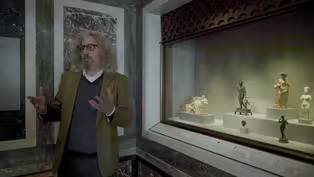
This incredible wealth that was accumulated by these energy fortunes often led to great art collections and investments in culture, like the Gettys of the world.
These museums are show pieces for the wealth of oil tycoons, but cultural expressions as well.
[dramatic music] - I think a lot of our culture in the United States can be traced back to personal fortunes that have grown out of industry and transportation, not just Getty and oil, but Carnegie and steel, and the railroads, Howard Hughes and aviation.
These things drove great fortunes.
♪ ♪ Jean Paul Getty was an American-born oil man who made a vast fortune at the beginning and throughout most of the 20th century.
As a young man, Getty loved to travel.
As an oil man, he worked in the oil fields as a boy, and then he would travel around Europe and into the Middle East to negotiate contracts.
And of course, as he traveled, he would visit museums.
Getty viewed himself as the David in the fight with Goliaths, he started as a small oil man, and he was up against the Rockefellers and Standard Oil, and they were kind of a model for him.
If you think about this site we're at, the recreation of a Roman villa turned into a museum, the Rockefellers built the cloisters in New York, a medieval abbey turned into museum.
The Rockefellers funded the Agora Museum in Athens, an ancient building.
You have the Carnegies, you have the Fricks, you have these great individual fortunes that get turned over into culture.
[Narrator] Oilman J. Paul Getty was a millionaire at age 23.
And by the late 1960s, he was called the richest man in the world.
Getty traveled the globe, collecting cultural objects and art.
[Kenneth] J. Paul Getty began the collection of antiquities in 1939, when he was resident in Rome, courting his fifth wife, Theodora Lynch, who became Teddy Getty.
And he traveled around museums and archeological sites and dealers.
There was a legal antiquities market in Italy at that time.
Their prices had dropped precipitously during the depression, and always, always wanting a good bargain, he recognized he could get these things at good prices, and the value would increase.
The first antiquity he bought is this piece here, this small terracotta group.
And it's a modern piece, it's an imitation or a forgery, and we long thought that Getty was duped.
The auction catalog had Getty's handwritten annotations.
He's thinking, how much is he gonna bid?
He writes 10 pounds, 20 pounds, 30 to 40, and then he writes "modern?"
We can see him thinking the same way he's buying oil leases, he's taking a calculated risk that he might get something really good for a low price.
It didn't work out in this case, but he wasn't duped, he was calculating.
Like many collectors, he was deeply invested in his objects.
He wrote whimsical fictions creating backstories, and he really was especially interested in the histories of his objects.
Although during his lifetime, he had a reputation not only for being very rich, but also being somewhat parsimonious, he now is, I think, known as an art collector and philanthropist.
[dramatic music] The Getty Villa is a one-to-one replica of most of an ancient Roman villa, a building we believe was built by the father-in-law of Julius Caesar on the Bay of Naples, that was buried but preserved by the eruption of Vesuvius in AD 79.
In 1750, workers were digging a well just outside the royal palace near Herculaneum, and they hit this beautiful marble floor, realized they had ancient remains there, and the king began the excavations, and then eventually drew up this plan, showing his tunnels, but also the finds.
[dramatic music] Paul Getty had in mind to have a replica of a Roman building to house, appropriately, his Greek and Roman antiquities.
It's one-to-one in scale, and it's better than virtual reality, it gives people the experience of walking through a Roman luxury villa.
[dramatic music] This is the Inner Peristyle Garden, peristyle just means having columns all around, like perimeter.
So we have a small, "small" peristyle that's square, and then the large peristyle out there.
This room was created for Mr. Getty's favorite statue.
On the floor, a replica of the floor first hit by those well diggers in 1750.
[dramatic music] ♪ ♪ We have 44,000 inventoried antiquities in the collection from the cultures of ancient Greece and Rome.
But those cultures didn't just live in those countries, they were all around the shores of the Mediterranean.
[dramatic music] So this is the larger Roman empire.
And we're talking about dates from the second millennium BC, in through the first millennium, so a great span of time.
[dramatic music] I think Getty's impact on culture continues to grow.
The museums receive, between the two sites, over 2 million visitors a year, but also the scholarly and conservation work that we do with partners around the world.
[dramatic music] [ship horn whistling] [Michael] The American dominance on new forms of energy innovation really transformed the United States into a cultural and technological leader.
[dramatic music] In the 1800s, the United States was poor and agrarian, in the 1900s, with the rise in oil and gas, the United States became the place to go for new fashions and new technology innovations.
[Narrator] What began earlier with the Industrial Revolution was now transforming societies around the globe at an even faster rate as people adopted oil and gas into their everyday lives.
- You have the tycoons that got really rich, but it's also the individual consumers got richer, from the jobs they had from these industries, either from oil and gasoline or from manufacturing the cars that used it.
And this made America much richer, and it created things like car culture.
- Set your lights!
[intense music] [engines roaring] [wheels squealing] - Modern energy was completely essential to the growth of American car culture, which has now just become a huge part of American identity.
And we have to remember that, before that, I mean, [chuckles] unless you had a horse, right?
You were walking.
[jazz music] [Michael] Horse culture was a big deal in the United States and Europe.
[Race Announcer] There they go!
[Michael] Horses were a source of entertainment.
[crowd cheering] - Oh, what a race that horse ran.
[Michael] They were used for transportation and mobility.
And they were used for work in the field.
So horses were critical to society.
[jazz music] - This reminds me of like, Chitty Chitty Bing Bang, except it's a two seater instead of the bigger one, and there's no wings, and it doesn't fly as far as I know.
You think about how this would've changed society, right?
You're walking everywhere or riding a horse, or doing horse and carriage, and then all of a sudden, at the turn of a crank or the press of a pedal, you can go long distances much faster, and without oats and food, maybe snacks for the passengers, and that kind of thing.
That's it.
[engine grinding] [horn honking] We're at the "Race of the Century" in Massachusetts, which is teaching and showing the evolution of the automobiles for the first few decades of the 1900s.
[Announcer] Audience, are you ready?
On your mark.
Get set.
Go!
And they're off.
[playful music] There it goes!
- "The Race of the Century" is a unique living history event based around transportation.
[Announcer] Neil takes the race by a hair!
- It highlights the chronological advancements of transportation technologies from the mid-1800s through the 1930s, and the narrative that comes along with the progression of these automobiles, their accessibility, cost, how they affect culture.
[dramatic music] The horse is a primary mode of transportation in the mid 1800s to late 1800s.
That's when we talk about, in the cultural wars, people pushing back against this new fandangled machine.
And they do that through a series of unusual laws, like the red flag law.
The red flag law stated that anyone driving a horseless carriage had to be proceeded by a pedestrian waving a flag or a lantern to alert any oncoming bystander or livestock of the machine approaching.
And it even got to the point that, in Pennsylvania, should you encounter any livestock, that you had to immediately stop, disassemble the vehicle, hide it in a nearby bush until the livestock was properly pacified.
[Announcer] Snowy is down there with the cart, and we're gonna do a straight line race to the finish line here.
- The horse versus the car race is the last ditch effort of the horseman to prove that no matter what happens, the horse will always be the fastest around.
[Narrator] Often the most impactful changes to a culture are initially met with resistance, from the Luddites of the Industrial Revolution, to those who clung onto the horse as a cultural necessity.
But there would be no stopping what had begun.
[dramatic music] ♪ ♪ [horns ooga] [Film Narrator] Look at that traffic on Fifth Avenue.
There's more hustle and bustle down at the market, and there's plenty of speed at an auto race once they get going.
[engines whirring] [engine sputtering to life] [jazzy music] - There was a definite class separation of those who had horses to those who had the horseless carriages.
And then, in the 1920s, you have cars like the Rolls Royce, the classic era of the automobile.
Which is kind of funny, because this is near the height of the Depression.
The car itself is very much a status symbol.
If you had a Stutz Bearcat, you were considered the Mac Daddy [laughs] of the time.
It was to the point of rolling around in a bright red Ferrari right now.
I mean, glaring.
It was a true statement that not only are you a man of means and adventure, but the-the car itself, it's a rolling piece of artwork.
Again, illustrating the class separation of those who have money, a lot of it, and those who don't.
That changed as soon as cars like the Ford Model T came out.
[Film Narrator] The idea is to find more efficient, less wasteful ways to use nature to make men more free.
So great is an idea, that within half a man's lifetime, a tiny workshop has grown into the world's largest industrial development.
[dramatic music] [Michael] Ford automated the process and really made cars much cheaper and accessible to more common people.
And it made them a middle class thing.
- The Ford Model T, one of the first mass produced cars, is probably the most influential car of the 20th century.
[dramatic music] - We had all this manufacturing capacity, the war had been won, the economy's growing, people had money, so car culture really takes off after World War II.
- And when virtually every American could afford at least a basic car, and the basic fuel, and find that fuel anywhere, and suddenly could travel hundreds of miles to any destination on a moment's notice.
I mean that almost reopens the sense of kind of frontier that was the foundation of America.
- Typically, people didn't travel more than 20 to 30 miles from their homes.
Making the automobile accessible to the common person completely changed the dynamic of transportation.
So all of the cultural idioms that come with people exploring, going out, sharing ideas, that completely changed the dynamic of the United States.
♪ What would you like me to buy you, honey ♪ And of culture.
- Dad, I have a date for the prom, I'd like to use the car.
[Michael] Everybody wanted a car.
They wanna go on vacations, they wanna move out of the city, they wanna move into suburbs, all these things happen around the same time in the '50s that transformed the American landscape.
What pops up are things like a road trip, and motels, the drive-in restaurant, and the drive-in movie theater.
[Announcer] All new hotshot electric in-car heaters have been installed for your comfort and convenience.
Warning, high voltage.
- In the '50s, we also start to see the rise of the teen consumer.
There's more money around, and teens always want their freedom.
- Where are you going?
- Out.
- In the 1800s, that was Tom Sawyer and Huckleberry Finn going down the river on a great adventure.
And in the 1950s, that would be teens driving cars, getting their driver's licenses.
So car culture and teen culture kind of merged, and teens were revealed to be a massive consumer force.
- Now, where'd you get that kind of bread?
[Michael] And so this gave rise to new types of music, and makeup, and magazines, and things targeted specifically at the teen consumer.
[Commercial VO] And you never know, the next boy you meet may be the one.
[Michael] The rise of petroleum-based products wasn't just gasoline and diesel for our cars, it was also showing up in our fashion, our makeups, and our hair products.
Oil to slick back your hair, or new types of ointments to make elaborate hairdos.
[Commercial VO] For the gal who loves her car, there's a swept-wing hairstyle, complete with rear lights, bumper, and exhaust pipes.
Plenty of mileage per gal.
- So oil changed the way we moved about, and what we could buy, but it also changed the goods we wanted.
[Narrator] The spread of consumer culture to the American teenager had a profound impact on American life.
Not only were products marketed specifically to teenagers, but now, teens had a massive influence on culture themselves.
It was their fashion, their interests, that drove production of new goods, and the goods themselves now contained byproducts of petroleum.
Movies and music were now aimed at and driven by this young generation.
- Hey, Johnny, what are you rebelling against?
- What do you got?
[Narrator] With energy embedded in virtually every step in the creative process.
- Entertainment is part of our culture, but sometimes entertainment becomes so widespread and so important, it shapes our culture.
Modern energy enabled this transformation in music and culture around the world.
And the Beatles are really emblematic of that.
When they rose to fame, they rose from a small live act in a pub, to becoming their own cultural force.
And modern energy made that all possible.
[rock music] ♪ It's been a hard day's night ♪ - The Beatles are part of an enormous cultural impact, but they're at the confluence of a variety of different strands right across history in many respects.
[jazzy music] ♪ Never thought that you would be ♪ ♪ Standing here so close to me ♪ ♪ There's so much I feel that I should say ♪ ♪ But words can wait ♪ ♪ Until some other day ♪ [Mike] You know, it's a very interesting period of time, 'cause that generation, they were only kids during the war, seemed to want to say something about themselves, they didn't wanna look back any longer.
American culture had always been popular in Liverpool anyway, so that allure of America, and its love affair with popular music, everything about it seemed to British youth to be very different from gray trouser legs, and yours shoes being soaking wet, you know, it all just seemed completely different.
And the cars looked so cool, and the electricity was sparkling.
[jazz music] It was incredibly alluring for that generation of young men and women.
And so, you know, it's inevitable, perhaps, that many, many Liverpool bands, and many Birmingham bands, and many London bands, you know, discovered the blues, and discovered country music, and just went down a pathway from which there's no return whatsoever, really.
But once rock and roll starts, it changes everything.
[record scratching gently] ♪ Well, I saw Uncle John with bald-head Sally ♪ ♪ He saw Aunt Mary comin' ♪ ♪ And he ducked back in the alley ♪ ♪ Oh baby ♪ ♪ Yeah baby ♪ ♪ Woo baby ♪ The last thing you'd wanna do when you've just heard a Little Richard record on Radio Luxembourg would be to go to work and pen-push for the next 10 hours.
[Film Narrator] It wasn't all easy, she made some mistakes of course.
[Mike] So, I think from a very early part of their teens, there was little else any of those lads wanted to do.
For popular music in the post-war era, really, they're the epitome of a band who have used technology, they've used the music industry very wisely.
And energy in particular, just energy.
Without energy, there would be no Beatles.
[rock music] During the Beatles early days, every time the Beatles were touring, and they were touring a lot by 1962, Brian Epstein would phone up the TV company, the independent TV company, said "The Beatles are in town."
And the news people might say, "Bring them in, we'll have a little talk with The Beatles."
"Well, they'll play for you as well, you know."
"Oh, well, they could play out the news program."
And of course, how do they get into everybody's homes in the United States?
Television.
[crowd cheering] - The Beatles were a remarkable confluence of great songwriters, but their timing was also spectacular.
The ability to be a cultural phenomenon globally was really not possible a few decades earlier.
The jet plane is also critical for The Beatles, because they could fly to the United States and perform on the "Ed Sullivan Show."
[Mike] If you go back even 10 years, most people, if they had a tour of America from the UK, they'd be sailing over there on an Atlantic liner, and it would take, you know, the best part of a week, maybe even over a week if the weather wasn't so good.
Just to play some clubs in New York, let's say.
The Beatles traveled completely on aircraft.
All of that diesel fuel, you know, aviation fuel as we call it now, very important.
And also if you think about their popularity in America, it's very interesting, technologically speaking, because they arrived in the aftermath of John Kennedy's assassination, which people would've seen on television.
So if you can imagine the power of television at that stage, the Christmas to come was basically canceled in the States.
And then, in the New Year, who turns up but The Beatles?
[News Announcer] There are rumors around that this is Britain's revenge for the Boston Tea Party.
Three thousand screaming teenagers are at New York's Kennedy Airport to greet... - It's not just young people watching it, because it's the "Ed Sullivan Show," which is a kind of institution by that stage, isn't it?
And so everybody's watching.
[Show Announcer] And now, here he is, Ed Sullivan.
[lively brass music] - Tonight, the whole country is waiting to hear England's Beatles.
[crowd cheering vigorously] [rock music] [Michael] Deeper in the '60s, their influence went far beyond just the songs and just the music.
♪ ♪ Traveling to India and talking about spiritual connection and meditation, a whole new approach to life.
They included their new look, they had longer hair all of a sudden.
- In the late '50s, guys' hair was just full of grease, literally, like Elvis' used to shine, you know?
The Beatles had abandoned that when they were in Germany, and their friend, Astrid Kirchherr, had redesigned their hair.
She was a member of this sort of beatnik outfit called "The Exes," all students from Hamburg.
So yeah, they were touched a little bit by the counterculture I think.
When Astrid introduced this idea of cutting their hair, they understood the reality, because it was regarded for a while as looking rather effeminate in those days.
And as Lenin continued to grow his hair, the hippie culture started to acknowledge that idea of hair as being a statement in its own right.
Technology, counter-cultural activity in popular music, that was all very much influenced in that era, and the Beatles were part of that.
[rock music] - So The Beatles Story is an immersive museum on the Albert Dock at Liverpool, it tells the story of The Beatles and their rise to fame.
- So we're an immersive museum which tells the story of four lads who were born in Liverpool, and how they became the world's greatest band, what is perceived by many, to say the world's greatest band.
♪ ♪ And we tell the story right from the beginning, from their birth here in Liverpool, through the formation of the band, through learning their craft, through their albums and tours, and then right on into their solo years.
♪ ♪ ♪ ♪ [Narrator] The Beatles' relationship with energy amplified their cultural influence in ways unseen before, and perhaps, since.
The fuel that powered their global travel, the plastic revolution that allowed the imprinting of their sound, the electricity within the music and radios, as well as the televisions that brought them into the homes of millions all aided four boys from industrial Liverpool in becoming cemented as one of the most important cultural icons of the modern era.
Energy continues to play an important role in modern entertainment, just as entertainment continues to be one of the most influential aspects of culture.
As Energy's relationship to music has changed, so too has the way people interact with music.
♪ ♪ - The development of multipurpose albums was a complete scene change in the use of vinyl.
That can be for, you know, artwork, and it can be for design purposes, it can be for pleasure.
It becomes a collecting item as well.
So it's a very, very good carrier of art, rather than ephemera.
[soft music] There's nothing better than owning an artifact which represents your investment in a piece of artwork.
I don't just mean financial, you are sharing the culture with the people that are making it, you are involved physically with that musical entity.
To have an artifact that then becomes part of your identity, without asking kind of ethereal nothing to play it for you, seems to have been lost on a lot of people.
The great downside to streaming is it's not right for the artists, it's just not right.
It strikes me as being, you know, completely unfair.
How do we expect young artists to feel inspired enough to write more stuff?
If The Beatles sold a million copies in an hour, they might get some money out of it, you need your royalties.
And I'm not saying it's all about money, but it's nice to think that you can pay for your hotel that night rather than drive through the night to your next gig.
It's like being a blues man in the 1920s, then.
And I think to turn it into an artifact that goes beyond it being simply a holder of music is common for most of us, you know?
And the fact that it was lost and is now being restored has got to be a good thing.
It's got to be.
[dramatic music] - Access to modern energy has transformed our culture in a variety of ways, such that, today, it's hard to imagine what culture is without energy.
The rise of oil and gasoline gave us car culture, which transformed American society.
Today, the driver of culture is all these electronic devices we have.
That's the way we consume, and move, and create information and entertainment now.
Before transistors, the way electrical components were operated were with vacuum tubes, which were quite large and fragile, they would burn out, you had to replace 'em quite often.
And you could replace a big vacuum tube with a tiny transistor, and eventually millions of transistors on a small chip.
And that transistor, this new invention from Bell Labs in the 1950s, created this world of microelectronics, and that changed the way we access culture and entertainment.
A part of our culture is also the rise of video games that replace board games or puzzles.
In the 1970s, I had one of the very first Pong games, which is like a tennis where you'd move a paddle up and down, and a ball would bounce back and forth.
And by today's standards, this would be the most lame video game ever.
But video games are now its own multi-billion dollar culture around the world, with hundreds of millions, or billions, of users.
[Narrator] In the late 1970s, leisure time for teenagers was at an all-time high in American culture, and electricity allowed the introduction of video arcades, with a whole arcade culture of its own.
By the 2020s, video gaming was more than entertainment, it was a cultural phenomenon.
Gaming is energy intensive.
Today, video games use about 75 billion kilowatt hours of electricity each year, or close to the output of 25 electric power plants.
In the United States, games require about $6 billion worth of electricity a year, more power than freezers, cooking appliances, and dishwashers.
- There's a lot of cultural positives from the way we consume entertainment today.
One is that it's easier for more people to be participants in the culture, to create their own content.
So you don't have to be a specialized movie maker the way it used to be, we now all have a phone in our pocket, access to a world of information at our fingertips.
And you also can have shared cultural consciousness around causes, things like protecting the environment.
So we see videos, especially from kids, around things like protecting water quality.
So these cultural forces can be used for good as well.
[Narrator] When you plug in a device like a Smart TV, you are plugging into water, natural gas, wind, coal, or nuclear power to provide that electricity.
Somewhere else, a power plant has to generate this electricity required for us to consume culture on screens at home.
The COVID-19 pandemic lockdowns sparked a massive increase in streaming services.
The energy efficiency of data centers has rapidly improved, so energy use and emissions from streaming today is lower than it was a few years ago.
- Our consumption of culture, electronically, while better than burning a bunch of coal in our home just for heat, still has energy impacts.
The fastest growing area of electricity consumption is for devices.
It's for the data centers that store the movies, and TikTok videos, and YouTube videos, and access to whatever movie or TV show we want anytime we want it.
These new cultural tools mean we can all be much more connected with other people around the world and know what's happening in a way we never would've known a hundred years ago.
My kids, they're in touch with their high school classmates wherever they may be, and this is a really exciting part of new energy culture.
But it also feels like the local town square is empty now.
We used to have a town square that was physical, that people would go to, The Boston Common, or these town squares in these small towns, and we've replaced that with these online platforms.
Instead of being in person at the same place at the same time to experience the same event, we can all virtually experience it wherever we are in the world.
We might be better connected to the person halfway around the world than our neighbor.
[gentle upbeat music] [Narrator] Energy is important to culture, but can we simply reduce all cultural trends to the availability of energy?
Before modern energy, culture existed.
Since humans mastered fire, humans have been expressing and creating, drawing, designing, and building objects for others to experience.
But culture's spread has been accelerated by new forms of energy.
Each major cultural shift can be tracked along with energy transitions.
Today, we consume more culture than at any point in history.
What is the future of human culture as we continue enabling more and more people to have a voice in influencing culture, and what effect will the next great leap in energy have on our culture?
[dramatic music] ♪ ♪ ♪ ♪ ♪ ♪ ♪ ♪
Video has Closed Captions
Clip: S2 Ep5 | 4m 10s | Do we owe our enjoyment of art and antiquities to oil fortunes? (4m 10s)
Video has Closed Captions
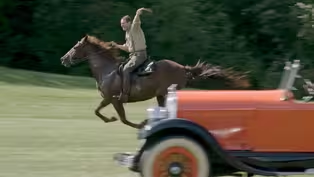
Preview: S2 Ep5 | 30s | Culture and modern energy go hand in hand. (30s)
Video has Closed Captions
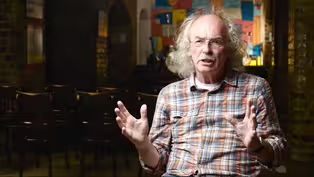
Clip: S2 Ep5 | 2m 2s | The energy implications of owning vinyl vs. streaming music. (2m 2s)

Teen Culture: Driven By Energy
Video has Closed Captions
Clip: S2 Ep5 | 1m 24s | Oil changed the way we moved about -- and the products teenagers wanted. (1m 24s)
Providing Support for PBS.org
Learn Moreabout PBS online sponsorship
- Science and Nature

Explore scientific discoveries on television's most acclaimed science documentary series.

- Science and Nature

Capturing the splendor of the natural world, from the African plains to the Antarctic ice.











Support for PBS provided by: