Virginia Home Grown
Cut Flower Production
Clip: Season 26 Episode 1 | 7m 59sVideo has Closed Captions
Learn how cut flowers are grown locally using sustainable methods
Serome Hamlin visits Wind Haven Farm in King William to learn about cut flower production with Jenny and Paul Maloney. Featured on VHG episode 2601, March 2026.
Problems playing video? | Closed Captioning Feedback
Problems playing video? | Closed Captioning Feedback
Virginia Home Grown is a local public television program presented by VPM
Virginia Home Grown
Cut Flower Production
Clip: Season 26 Episode 1 | 7m 59sVideo has Closed Captions
Serome Hamlin visits Wind Haven Farm in King William to learn about cut flower production with Jenny and Paul Maloney. Featured on VHG episode 2601, March 2026.
Problems playing video? | Closed Captioning Feedback
How to Watch Virginia Home Grown
Virginia Home Grown is available to stream on pbs.org and the free PBS App, available on iPhone, Apple TV, Android TV, Android smartphones, Amazon Fire TV, Amazon Fire Tablet, Roku, Samsung Smart TV, and Vizio.
Providing Support for PBS.org
Learn Moreabout PBS online sponsorship>>We are a sustainable cut flower farm, located in King William, Virginia, and we sell wholesale to florists and grocery stores and small boutiques and other businesses in Richmond, Virginia primarily, and a little bit in the Northern Neck.
The first flowers we're able to force into bloom are tulips in our heated greenhouses and crates, as well as our raised beds of tulips in our minimally heated tunnel.
We like to go for the ones that are not your average tulips, things that are unique, that are the right color palette that the florists are looking for.
All kinds of doubles and fringes and parrot tulips.
The same thing with Snapdragons.
We go for a lot of open face varieties or colors that are slightly unique.
And then we try to get them growing earlier than a lot of different places are able to.
Because it helps us create a year round position for our employees and income for the farm.
Every year we're like, let's dial it in a little further.
>>Yeah.
>>Let's have less waste.
>>Yeah.
>>What did we not need?
What did we enjoy?
What was easier?
What were our designers really wanting?
What's that color that they're really after?
Because wedding and event designers and florists are artists.
And they want very specific looks to their designs.
They're known for the look of what they do.
>>I think sustainability comes with a question mark always too, because you're always having to question exactly what is sustainable, and especially with everything that's changing so rapidly around us now.
Bonding the sustainability and efficiency, I feel like is really key.
At that moment, then you're gonna reach something that might work, you know, that can hold together and can sustain.
>>Sustainable growing practices as an organic measures, even though we're not a certified organic farm, we follow those planting practices.
>>Yeah.
>>Mm.
>>And sustainability for what it means for us and our team, and like being able to do what we're doing without burning out.
>>Yes.
>>Because farming is hard.
>>Farming is hard.
>>All right, it's hard, yeah.
>>Tell me, how did you get started with cut flowers as a farming method?
>>Well, Paul here grew up on a vegetable farm over in King and Queen County, and so I learned how to farm from his parents.
And then along the line, I kept pushing them.
I gravitated towards the flowers and I kept pushing and pushing for more flowers.
"Oh, let's go to farmer's markets.
We could do this, yeah."
And they were so kind and they indulged me.
(laughs) And they taught me so much and I'm just so grateful to them.
And then they needed to rearrange what they were doing and go back to doing more vegetables.
And I didn't just wanna do the vegetables.
So I was very upset and went home and cried and Paul was like, "We can till up the front yard tomorrow."
Because flowers are a wonderful thing, where you can grow a lot of flowers in a very small amount of space.
And that's why there's a huge resurgence of small cut flower farmers in the United States because you can be on a quarter acre lot.
You can be on an urban lot and have an urban flower farm that still produces many stems.
>>When we started, I don't know that we really knew what it was gonna turn out to be.
Definitely not quite this big.
>>No.
We didn't think we would have all this.
>>I'm glad it did.
I mean, we just kind of, it was something we could create together and I think that was part of has driven us and, you know, and gotten us to this point is doing it together, and with a team.
>>Yeah, that's awesome.
>>And with the team and then thinking about, you know, "Oh, wow, we really enjoy this.
Let's try to bring some more people on, you know?"
And then realizing that they enjoy it too, you know, it's not just work.
There's more to it than that.
>>Oh, yeah, most people enjoy cut flowers and they can be used for so many different events or occasions or anything like that.
>>That's true.
Think about all the moments in life where cut flowers are involved, like weddings and funerals.
>>Yes.
>>And like honoring someone after they passed.
>>So how do you choose what to grow?
I know you have your set client list, but how do you make those decisions on what can grow here to match what they would want?
>>You learn what works well.
I think we grow over 600 varieties of cut flowers, whether that be just a different color or a different variety or plant all unto itself.
But like, say this flower that's in front of us, Orlaya, we planted that in the fall, it likes to develop in the cool, and then will bloom super early for us now in these tunnels.
It's related to carrots.
It's in the carrot family.
But florists love it.
And it produces gobs of cut flowers, and it's one of the earliest ones we can get to grow in an unheated tunnel.
>>Then after your cold season crops, when do you normally start your warmer season crops?
>>So I looked at what we were seeding this week, and we're seeding, starting to get into seeding some of our warmer weather crops, like Gomphrena and Ageratum, and a few of the earlier ones that take a little longer in the greenhouse.
I'm not sure that this is the technical term, but we have a few that we call early annuals, where they will survive a frost but they don't particularly like it.
So some of those we're putting out in March, and then if we get a hard frost, we're gonna cover it with frost cloth.
Those are things like Strawflower, Statices, things like that.
They still wanna develop cold to be able to have nice, tall stems and be robust plants, but they can't take a hard freeze.
>>Yeah.
>>So we are in this high tunnel.
Do you think you could show us a little more of the farm?
>>Absolutely.
>>Yeah, definitely.
Let's go check it out.
>>Yeah, come on.
>>How did you choose this location for your high tunnels?
>>Partially out of necessity because a lot of our flat land past the barn I wanted to use for annual production.
And back here, it is all sloping, which if you think about that in some sense is not great, but a little bit of sloping is good, especially for high tunnel stretches because of the drainage.
Some of the challenges that we do have with these tunnels is that you're gonna end up building up, you can build up minerals.
You can build up salt.
Especially salt.
You can build up nitrogen.
You can build up pathogens, bugs, all that stuff.
So inside of these tunnels is like their own little ecosystem.
>>And each one is a little bit different from the other.
They're all kinda similar and they've gotten better, but they're all just a little bit different.
>>It is a difference between growing out in an open field and inside of the high tunnel, so how do you manage pest?
>>A lot of it's very much just walking through and having visual inspections.
Like I will inspect all the greenhouses at least once a week.
If I have a problem, then I'm in there more than that.
I take kind of a gradual approach.
I try not to over spray anything.
We use all OMRI approved.
Most of the time, I am using Neem Oil, and then the big guns is like the Pyganic.
That's what you graduate to.
Overall, our bug pressure is pretty good.
There's a lot to be said with having healthy plants.
Getting the soil health, the more optimal you can get it, then the better your plant's gonna be able to withstand anything.
>>Exactly.
Get a healthy plant, then it can, to a point, try to resist some of the bug pressures or diseases.
>>Yeah.
>>Well, awesome.
I'd like to thank you for walking me around and showing me the houses today and just chatting with us.
>>You're welcome, thank you.
 New
NewVideo has Closed Captions
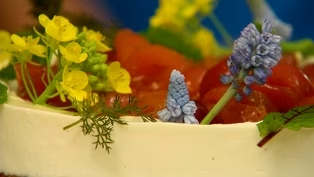
Clip: S26 Ep1 | 7m 57s | Learn about edible flowers and garnishes used to decorate cakes (7m 57s)
 New
NewVideo has Closed Captions
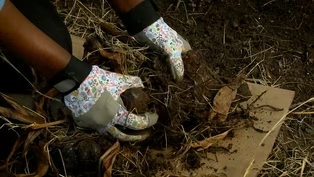
Clip: S26 Ep1 | 3m 1s | Divide and transplant perennial flowers to fill your garden with color (3m 1s)
 New
NewVideo has Closed Captions
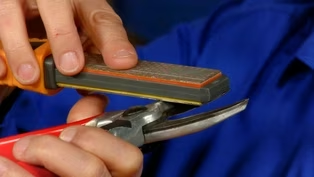
Clip: S26 Ep1 | 6m 4s | Learn tips to keep your garden tools sharp and clean (6m 4s)
 New
NewVideo has Closed Captions
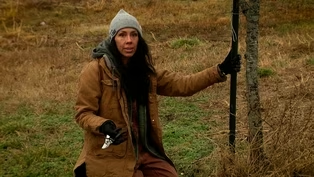
Clip: S26 Ep1 | 3m 33s | Increase blossoms and get a bigger harvest by properly pruning fruit trees (3m 33s)
 New
NewVideo has Closed Captions
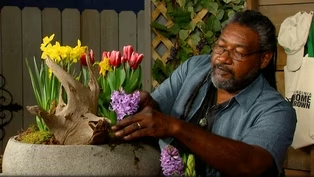
Clip: S26 Ep1 | 6m 54s | Learn how to make an easy spring planter using potted perennials (6m 54s)
Providing Support for PBS.org
Learn Moreabout PBS online sponsorship

- Home and How To

Hit the road in a classic car for a tour through Great Britain with two antiques experts.












Support for PBS provided by:
Virginia Home Grown is a local public television program presented by VPM