
Cutting-Edge Science
10/26/2023 | 26m 46sVideo has Closed Captions
A groundbreaking heart transplant, theater and tech, plus NC State’s nuclear reactor.
New medical technology makes a groundbreaking heart transplant possible and helps save lives. Learn why a nuclear reactor is in the middle of NC State’s campus and how technology is revolutionizing stage design in theater. Plus, high-tech cameras show the common housefly in a new light.
Problems playing video? | Closed Captioning Feedback
Problems playing video? | Closed Captioning Feedback
SCI NC is a local public television program presented by PBS NC
Sci NC is supported by a generous bequest gift from Dan Carrigan and the Gaia Earth-Balance Endowment through the Gaston Community Foundation.
Cutting-Edge Science
10/26/2023 | 26m 46sVideo has Closed Captions
New medical technology makes a groundbreaking heart transplant possible and helps save lives. Learn why a nuclear reactor is in the middle of NC State’s campus and how technology is revolutionizing stage design in theater. Plus, high-tech cameras show the common housefly in a new light.
Problems playing video? | Closed Captioning Feedback
How to Watch SCI NC
SCI NC is available to stream on pbs.org and the free PBS App, available on iPhone, Apple TV, Android TV, Android smartphones, Amazon Fire TV, Amazon Fire Tablet, Roku, Samsung Smart TV, and Vizio.
Providing Support for PBS.org
Learn Moreabout PBS online sponsorship- Hi there.
I'm Frank Graff.
How technology makes one's unthinkable heart transplants a reality.
Why there's a nuclear reactor in the middle of NC State's campus and raising the curtain on theater tech.
A look at cutting edge technology and science Next on Sci NC.
- [Narrator] Quality public television is made possible through the financial contributions of viewers like you who invite you to join them in supporting PBS NC.
- [Announcer] Funding for Sci NC is provided by the North Carolina Department of Natural and Cultural Resources.
[bright music] ♪ - Hi again and welcome to Sci NC.
The first heart transplant was performed in 1967 and technology has fueled countless medical breakthroughs since then, from medicines and medical devices to therapies and procedures.
It's almost routine, but producer David Hurst has a story that is anything but routine.
- Open heart surgery can be scary, especially when the heart is this small.
You see, this is the size of a newborn's heart.
For babies born with heart issues, sometimes their only option is a full heart transplant, which is risky.
But surgeons at Duke University Hospital have discovered an alternative.
It's called a partial heart transplant.
It's saving newborn lives and has the potential to revolutionize healthcare.
Lorna Duncan Soderblom wasn't sure what motherhood would bring, but raising her oldest son Waylon made having a second child an easy decision.
- So when I got pregnant with our second child, I was super excited 'cause I'm like, I know what I'm doing this time, like we're good to go.
- But at the 20 week anatomy scan, doctors discovered a heart problem.
They thought it was a heart defect called Tetrology of Fallot.
But when Kick Solderblom was born, doctors said it was actually an even less common heart defect called Truncus Arteriosis.
- At first it made me like really scared 'cause I had no idea what it was.
- [David] Infants born with this condition have only one blood vessel out of the heart instead of the usual two.
It's a life-threatening condition and there are only about 250 cases per year in the United States.
- Basically, instead of having an artery to the lungs and then an artery to the body, they're born with a single artery that then splits to the lungs and the body.
- Yeah.
- Kick's case was so severe doctors believed there was no time for more traditional surgery.
- Unfortunately, you know, the child was so sick that we knew we weren't gonna get a heart transplant.
A real heart transplant.
Those take about six months in this age group to get.
- [David] So doctors proposed a brand new treatment called a partial heart transplant.
With this procedure, doctors take the living tissue of an unused donor heart, put it in the newborn's heart and the tissue heals the heart and grows with the child.
Duke surgeons had only done this procedure once before and that was the first time it had ever been performed.
- They were basically like, we want to do the partial heart transplant.
And it was raining outside.
It felt like a movie and I was just like, is this my life?
I'm like looking around at all these people.
I'm like, this has been done one time and we're gonna be the second.
And it was just, it was the craziest experience I've ever experienced in my life.
- [Mother] Daddy.
- [David] This baby is Owen Monroe.
He received the world's first partial heart transplant at Duke University Hospital.
He also had a severe form of Truncus Arteriosis.
- And I just remember getting in the truck after that ultrasound and just, I think we just cried.
- We had the conversation of, I hope we don't have to plan a funeral in a few weeks.
- [David] Doctors at Duke told the Monroe family that the procedure had only been done on pigs, but they were confident it was the best option for Owen.
- I was at the point where I said, just do whatever you have to do to save him.
- [David] The procedure was a success and now Owen is doing remarkably well.
He's met all his developmental milestones since coming home from Duke.
- It's really, truly amazing just that we could be a small part of potentially changing history as it's not something that's easily comprehendible.
We're just a mom and dad who wanted to have a baby and here we are.
- [David] Seeing Owen's progress helped the Soderblom family with their decision to get the procedure for Kicks.
- I wish everyone could not experience the heartache and the pain that goes through it, but just experience like a glimpse of it so other people would know like how life is really such a gift.
Are you a happy boy?
- [David] And Kick's his partial heart transplant was also a success.
He's had to stay at the hospital a little longer due to other birth defects.
But this procedure is giving the Soderblom family a chance to soon take their newborn home.
- And heart surgery is not your everyday subject for a lot of people.
And if it can limit the amount of surgeries, that would be truly amazing.
And it's just awesome to be a part of it 'cause I never in my life thought I was gonna be a part of something like this.
- Every once in a while there's a new innovation that comes out and right now this I think is it, I'm getting emails constantly about people asking how we pulled this off.
- Now here's our result after the partial heart transplant.
- [David] Dr. Turek and Dr. Carboni say this procedure could be used for all sorts of heart conditions.
They say it could very well be a regular operation in the future.
- And introducing this into the field is a great feeling, but watching this scale and watching this multiply and watching more and more folks and other centers be able to do this work, you know, I think that's what what I'm really excited about.
I'm excited that we can bring this almost to the mainstream.
- Yeah, and then today.
- [David] Nothing could have prepared Soderblom for what she and her family have gone through, but she's excited to hopefully soon take her baby home and she's optimistic about the path her son has helped pave for other families in the future.
- It's just amazing just to see this like little child be able to like go through all of this and come out like on top.
I'm proud to be his mom for sure.
- [Announcer] Want more Sci NC?
You can find these stories and more on our YouTube channel like and subscribe.
Just a few years before that first heart transplant in 1967, NC State made history by opening the nation's first university-based nuclear reactor.
So come on inside the facility, it's part of our series celebrating the College of Engineering's 100th birthday.
- Hi, I'm Dr. Nehemiah Mabry, engineer, educator and entrepreneur.
Also a very proud graduate of North Carolina State University.
Right now I'm on campus right outside of Burlington Nuclear Laboratories, home of the nuclear engineering department.
Also home to the very first civilian nuclear reactor.
Now, before you start thinking about all the things that could go wrong with nuclear energy, I wanna tell you about some things that could go right, right through these doors.
Come on, let's take a look.
[bright music] - We are the first nuclear civilian reactor in the world.
In 1949, some of the visionaries of this campus decided that they wanna build a nuclear reactor.
And at that time, all the nuclear reactors in the world were behind secret fences.
- [Nehemiah] Clifford Beck, a native of Salisbury, North Carolina, was a renowned physicist who had worked on nuclear research during World War II.
Dr. Beck came from Oak Ridge National Laboratory in Tennessee to work on the first nuclear reactor at NC State.
There were no textbooks and the first students were Air force officers.
They associated themselves with a program launched by President Dwight Eisenhower called Atoms for Peace.
- And they wanted to show the world that nuclear is useful, nuclear is safe, and that we can actually take it to the level of serving the progress needs of society.
- [Nehemiah] There are currently 244 students that's undergraduate and graduate students, in the Department of Nuclear Engineering.
- This is the control room of the Polestar Reactor at NC State.
From this area, we can operate and control the reactor.
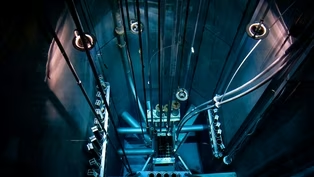
[panels beeping] And if you look down, this is the nuclear reactor itself.
This is an open pool of water and at the bottom of it there is a blue glow region.
That blue glow region is the core of the nuclear reactor, and that's where we have the nuclear fuel.
The nuclear fuel is basically uranium and it's a special form of uranium, it's uranium dioxide.
The blue glow itself is a product of the interaction of the radiation that is emitted in the core itself and actually moving through the water at very high speeds, approaching and exceeding the speed of light of some of these particles in water.
The nuclear reaction, when it takes place, it generates two products.
It generates energy and it generates radiation.
And we can use both of them.
We can also use the radiation that it generates for other purposes.
For example, medical purposes.
So every hospital you go into, there is a nuclear medicine department that helps with the diagnostics of patients.
And there is also radiation therapy departments that could be used for the treatment of cancers and other illnesses possibly.
- Unfortunately, the legacy of nuclear engineering and science is connected with the military applications, but this is because it's really tremendous power source.
It's much more powerful than the conventional sources.
But this can be used for good and currently most of the issues of nuclear power have been addressed like safety, like waste.
- The water itself is about 20 feet above the core of the reactor.
Water.
This is normal water, just like the water we drink.
But this water does three things.
It cools the reactor.
It also is a radiation shield.
It protects us while we are standing here.
So no radiation really hurts us.
And also it's the catalyst for the nuclear reaction that's taking place.
Without water, we would not have this nuclear reaction.
You know, we have special filtration that takes place and also we deionize it.
So this type of water is more clean than the water you actually drink at home.
But we don't drink it.
- We had the first reactor here at NC State at a university in this country in 1953.
We had the first PhD graduate in nuclear engineering in this country in 1955.
We had the first woman graduate in PhD in nuclear engineering in 1970, number of firsts, very well known.
- For 70 years, the operations of the nuclear facilities and the nuclear reactor in particular on this campus have been done with the utmost of safety.
We are a federally regulated facility.
- Our department, North Carolina State University is the only nuclear engineering department in the state and offers a lot of opportunity and combines advanced engineering with nuclear power.
This is the future.
And this is very attractive to young generation.
- Students in particular.
The new generation are very passionate about their work.
They want to save the world, right?
Want to leave it a bit better than how they found it.
So they're coming in understanding that we need to do things differently around climate and they've chosen nuclear to make that impact.
And then there's another set of students that are looking to work in the medical field.
And then there are other students that just come in.
They say this, this technology is cool, I wanna learn it.
And are trying to find their place.
- If you don't wake up most mornings wondering what am I doing here or am I in over my head, then you're probably not doing your job right.
- [Nehemiah] In addition to the nuclear reactor itself, a wide array of research is being conducted in Burlington Lab.
- Basically a diamond encrusted saw blade, and I'm able to make these little wafers.
So I cut the core into these tiny little discs.
It is smaller than a dime.
- [Nehemiah] Some of it relates to plasma systems for industrial applications.
Other research is dedicated to next generation plasma devices for new health applications.
- So in this lab, I'm doing multiple things.
I'm supporting our new graduate certificate in health physics and our undergraduate minor in health physics.
But it also helps support the research thrust in nuclear forensics and nuclear nonproliferation.
Yeah, it's really cool.
- [Announcer] Follow us on Instagram for beautiful images of North Carolina and cool science facts.
- You might not connect tech with theater, but you should.
While Shakespeare famously wrote in Hamlet, the play is the thing, producer Evan Howell shows us how the tech to create the play is the thing.
[bright music] ♪ You ain't know ♪ ♪ Texas women do it bigger ♪ ♪ Say it ain't so ♪ - [Evan] What does it take to turn a vision into a kind of magic?
- Take the vision and break it down into time, money, materials.
♪ And here the chauffer comes to life ♪ - [Evan] In the old days, many theater stage designers had to rely on drawing boards and even miniature replicas to give themselves an idea about what would work in real life.
But stage design today has become so complicated and with so many moving parts that doing it with pencil and paper doesn't work anymore.
So how do they do it?
They do it with a computer.
It's called Computer Aided Design or CAD It's technical drafting software used more and more in designing sets for theater productions, including this one, the Legend of George McBride done by Playmakers Repertory Company at the Paul Green Theater in Chapel Hill.
- Months ahead of time.
Directors, designers, choreographers, whoever are having meetings with each other about the concept, what they want it to look like, what they want the vibe to be.
- [Evan] So a vision wrapped up in a vibe, rolled into a plan.
- It takes a complicated thing and it gives you a toolbox to accomplish it more easily.
I can render an object in three dimensional space instead of having to carve a real model of it to figure out how it works.
I can move pieces against each other.
I can lay things out and make sure they fit instead of going.
I think that'll work.
We'll take some measurements and then build the thing and then cross our fingers and hope we don't have to cut it apart.
I have the that window seat.
- People want their stuff.
The want and desire for stuff to accompany stories goes all the way back, it goes to the coliseum, it goes to Epidaurus.
- Oh my God!
- [Evan] McKay Coble's career spans Broadway productions like Dream Girls to major motion pictures like Ghostbusters.
She says back then all they had to use was a pencil and a prayer to pull off complicated shows.
She says CAD turned that all around.
- Now if I wanna put 15 tons of water on stage, we can do the stress and structure, we can do the math, we can do the physics, we can do the chemistry.
My definition of theater magic is we're all sitting in this arena.
I see you, you're unwrapping a candy.
Someone over here is sneezing, whatever.
We are very aware we're in a human community, but what's happening on stage transforms as it takes us to a place.
- We need to move higher and about six inches off stage.
At different points in the process, we have different types of drawings.
Sometimes they're build drawings.
So I'm looking at a piece of paper saying you're gonna take this two by four and attach it to this piece of one by.
Sometimes we're in load-in where we're actually taking the scenery and putting it in and we have, you know, sort of maps of where things go.
Or I might have a printout of the grid and say, hey, according to this, you need to be over here.
And they go, oh, okay.
And then they take that information and they carry it on.
So instead of me or carpenters or welders remembering all the details, it's all drawn out.
It has typed notes, it has drawings, it has renderings.
- Now I can click with my computer, make extremely accurate drawings.
I can flip it around, which is enormous effort when you're doing orthographic projection or isometric drawings and you're just doing it with a pencil.
But AutoCAD allows us to really get into the the detail in a way we never could before.
- It is science, it is engineering, it is structural analysis.
It's art.
It's hands-on.
It's the place where you can get your hands on everything and you can kind of guide yourself through where you land in, what your real love is.
- [Announcer] Check out our weekly science blog to take a deeper dive on current science topics.
- From high tech to low tech.
The house fly, pretty common, pretty low tech insect and it's dealt with in a very low tech way.
Gotcha.
Ha.
However, Adrian Smith with the North Carolina Museum of Natural Sciences shows us why we should throw that away and just appreciate the simple fly.
- When I think of a fly, I picture this a common house fly, but flies are one of the most biodiverse groups of animals on earth.
One family, the Gall Midges which you'll see a bit later is thought to be home to a million undescribed species.
But even this common house fly when I see it flying at 8,000 frames per second is astonishing.
On the flip side of common, here's a fly I've only ever seen once in my life.
A cheese fly or a stink fly.
It's huge.
Here's one pictured on my friend Matt's finger for scale.
On this and every other fly species you'll see, you'll notice these.
The hull tears are hind wings that have evolved to be flapping gyroscopes.
Noticing them is one of the ways you can tell a fly apart from things like bees or wasps.
This stink fly though is unmistakable.
Nothing else looks like it.
And it's the only species in its group that occurs here in the US.
Getting flies to behave in front of the camera and fly in focus is a challenge.
But over the past few years, I captured enough sequences to put this together.
What you'll see here is just a tiny sliver of the diversity found within this order of insects.
Flies play a lot of different roles in their environments, but let's start with some meat eaters.
This is a blowfly.
It's a kerion feeder.
The iridescent adults deposit their eggs into dead animal tissue where the larvae will stay and feed until they pupate.
A different type of carnivorous fly is this a robber fly.
These flies are predators of other flying insects, catching and feeding off of things like beetles and wasps.
Some robber flies are big and fuzzy and look like bees, but this one's darkly colored and only about seven millimeters long.
This is a thick headed fly and you can find them hanging out on flowers, but they're not there just for the nectar and pollen.
They're parasitic, species in this group, catch live bee and wasp workers and then lay an egg directly into their abdomen.
These flies like the last couple, have to be agile flyers to catch other flying insects, but some other flies take to the air at a slightly slower pace.
This is a crane fly.
In flight, this one is doing about 42 wing beets per second and compare that to the thick headed fly right before this, which was flying at about 192 wing beats per second.
Here's another long legged fly, a non biting midge.
At rest, these flies hold their front legs up in the air and they seem to do the same in flight too.
They're occasionally called lake flies because they're larva aquatic and the adults can be found sometimes in massive numbers around the water's edge.
This little guy is a Gall Midge.
There are currently over 6,000 species described, but genetic studies predict over 1 million species in this insect family, making it the most diverse and understudied group of animals on earth.
But flying's not the only way gall midges get into the air.
This is a gall midge larvae and it has no wings or legs, but it can curl its body up into a loop and snap it open and jump across the distance of 13 body lengths.
This larval jumping behavior has only been filmed and studied in one other species of gall midge.
So there's likely tons more out there with similar ways of getting into the air.
Larvae of this fly hang out on plants and eat aphids.
It's a hover fly or a flower fly.
Like the name suggests, you can find the adults visiting flowers and feeding off the nectar and pollen.
They have a bee like appearance, but this one's short antenna, sleek abdomen and flapping hull tears give it away as a fly.
[dramatic music] These are yellow soldier flies or compost flies, the larvae live in and feed off of rot and vegetation.
And the adults with their iridescent eyes and yellow and green bodies are one of my favorite looking flies out of all the ones I've filmed.
This is a fungus gnat.
While some fungus gnat larvae are predaceous.
Most of them feed off of fungus and are what you'd see if you found a mushroom cap infested with worms.
Like the midges earlier, these seem to fly with their front legs up and leading the way.
Here's a different fly from a different gnat family.
The dark wing fungus gnats, the ones flying here are all females.
This picture shows the distinct orange abdomen of the female as it's mating with a uniformly dark colored male on the left.
This is another family of flies where we've only described less than 10% of the total species diversity.
Around my part of North Carolina, this is the most common fly you'll see resting on leaves if you go for a walk in the woods.
It's a Lauxaniid fly.
While they're common, they don't have a common name.
Instead, Lauxaniid is just short for the Latin name of the family Lauxaniidae.
And finally, some of the showiest flies we have, the picture wing flies.
This one I found on the trunk of a tree in my yard, scurrying around, flashing its pattern wings up and down from its body.
I like how when it takes off, it does a subtle head nod when it jumps into the air.
So that's just a small bit of the diversity of flies that live around this part of North Carolina where the lab is.
I hope next time you see a fly, this will have inspired you to take a closer look.
Thanks for watching.
- Flies are pretty amazing.
That's it for Sci NC for this week.
If you want more Sci NC, be sure to follow us online.
I'm Frank Graff.
Thanks for watching.
[dramatic music begins] ♪ [dramatic music ends] - [Announcer] Funding for Sci NC is provided by the North Carolina Department of Natural and Cultural Resources.
- [Narrator] Quality Public Television is made possible through the financial contributions of viewers like you who invite you to join them in supporting PBS NC.
Preview | Cutting-Edge Science
Video has Closed Captions
A groundbreaking heart transplant, theater and tech, plus NC State’s nuclear reactor. (20s)
Providing Support for PBS.org
Learn Moreabout PBS online sponsorship
- Science and Nature

Explore scientific discoveries on television's most acclaimed science documentary series.

- Science and Nature

Capturing the splendor of the natural world, from the African plains to the Antarctic ice.









Support for PBS provided by:
SCI NC is a local public television program presented by PBS NC
Sci NC is supported by a generous bequest gift from Dan Carrigan and the Gaia Earth-Balance Endowment through the Gaston Community Foundation.