
Darde Long
Season 17 Episode 6 | 26m 46sVideo has Closed Captions
Alison checks in with Zookeeper Darde, better known as Chattanooga Zoo's President & CEO Darde Long.
When Darde began her tenure at the Chattanooga Zoo, it occupied less than two acres, housed a handful of animals, and employed only two people. But under her leadership, the zoo has transformed into a world-class home for wildlife.
Problems playing video? | Closed Captioning Feedback
Problems playing video? | Closed Captioning Feedback
The A List With Alison Lebovitz is a local public television program presented by WTCI PBS
Darde Long
Season 17 Episode 6 | 26m 46sVideo has Closed Captions
When Darde began her tenure at the Chattanooga Zoo, it occupied less than two acres, housed a handful of animals, and employed only two people. But under her leadership, the zoo has transformed into a world-class home for wildlife.
Problems playing video? | Closed Captioning Feedback
Where to Watch The A List With Alison Lebovitz
The A List With Alison Lebovitz is available to stream on pbs.org and the PBS app.
Providing Support for PBS.org
Learn Moreabout PBS online sponsorshipThis week on the A-list, I sit down with a woman who has devoted her career to enriching the lives of animals and enhancing the greater Chattanooga community.
Somebody, a veterinarian that worked at the clinic Stopped by and said, Hey Darde, the zoo's hiring.
I was just like, the zoo.
I haven't been there in a million years, and I don't know anything about exotic animals.
And he said, trust me, you'll know you'll be as good as what they have there now.
And so I was intrigued, you know.
And there you are, city job, you know, single gal just to working it.
And I bet it I never thought that it would go this far.
But then, my goodness, you know, the community stepped up, and here we are.
Join me as I talk with presiden and CEO of the Chattanooga Zoo.
Darde Long coming up next on the A-list.
For more than 40 years, Darde Long has bee the face of the Chattanooga Zoo the driving force behind its remarkable growth.
If you've been in Chattanooga long enough, you might remember that in 1985, when Dougherty began her tenure, the zoo occupied less than two acres, housed a handful of animals, and employed only two people.
But under Darde's leadership, the zoo has transformed from its humble beginnings into a world class home for wildlife and a treasur for the Chattanooga community.
I had the chance to visit Darde in her natural habitat, where I learned all about her career as one of the first female leaders in the zoo industry, and met some new friends along the way.
think I'm gonna give this up to you in about two Oh yeah.
Bye Bye Well, Darde, welcome to the A-list.
Hi, there And I'm so excited to be here.
The zoo brings me so much joy.
Do you hear that all the time?
Yes, I do.
And you know it does.
Me too.
That's why I'm still around.
There's so much to be even, you know, listening outside of the children as they come in.
It's just, you know it's an amazing place to work.
I'm very blessed.
Well, you may be shocked to know that we have something in common about our professional aspirations.
When I was little, I too wanted to be a veterinarian.
Really?
Yeah, and look at me now.
I'm as far away as well.
You got the shirt on.
You know I'm on brand with a shirt, so.
And I am still in love and obsessed with animals.
But our paths took slightly different routes.
Tell me about yours.
You know, as I was nine years old when I decided I wanted to be a veterinarian, I had my first pony, and I was convinced that I needed to take care of animals.
We had a veterinarian that was so nice to me.
He would let me do things like give injections, you know, my own animals.
But I was definitely hooked.
But then I, you know, all I thought about in school was I had to get into Auburn because there was no Tennessee veterinary school.
So yes, I am indeed that old, but it was very competitive.
So I moved to Auburn, went to there.
You couldn't get in pre-vet if you were out of state, but there was just so much complication.
And then right in the middle of it all, my dad got sick.
He had his first heart attack, and then he had another one.
And I came home, spent a semester home, ended up going back and it just wasn't working.
It was I was too distressed.
My mom needed me and so I found myself attending UTC, taking, ironically, some accounting classes which have come in handy in my career.
But I just I knew I wanted to work with animals, and I got a job working at the animal clini on 23rd Street for Oogie Martin, who lots of our folks know, and it was amazing.
And I just fell in love with the practice.
But it was just an assistance job and not really a career.
So there you go.
Somebody, a veterinarian that worked at the clinic.
Stopped by and said, Hey Darde, the zoo's hiring.
I was just like, the zoo.
I haven't been there in a million years, and I don't know anything about exotic animals.
And he said, trust me, you'll know you'll be as good as what they have there now.
And so I was intrigued, you know.
And there you are, city job, you know, single gal just to working it.
And I bet it I never thought that it would go this far.
I kind of think I thought I'd b in that little acre and a half for the rest of my life, and it wasn't bad.
I mean, the zoo was horrible, but I loved the animals, you know?
But then, my goodness, you know, that the community stepped up, and here we are.
So it was 1985 when you started less than two acres and only two employees.
Yes, yes, dear Frank since passed away and myself.
And what was the mission back then?
Oh, goodness.
Provide animals for people to come in for free.
To see there was nothing beyond that.
Free.
Oh, yeah.
Not even admission.
No, there was a the gate was wide open and people could come in.
And finally we asked the city if we could put a donation box and people try to break into that.
So it was like a journey.
I mean, we finall I can't remember exactly that.
We started charging admission, but we convinced them that we would use that for capital improvements.
And, you know, that's how we would work.
But yeah, we were free for a while and you certainly weren't AZA certified.
Oh, no, I shortly after I came, though I contacted the Knoxville Zoo.
And that's one of the things that keeps you going in this profession.
Instead of being competitive.
We're all very open.
We share.
And I contacted the Knoxville Zoo and said, hey, I need to learn more than what I know clearly here.
And a really cool guy named Randy, who had been there for many years, told me about AZA.
And he said, you need to join as an individual and you need to think about attending classes and you need to do so.
I think 86, 87 and 88.
I went to school in Wheeling, West Virginia for one week to become an expert, and I took management classes and I took zoo biology because I'd never had that.
And I learned a lot.
But more importantly I met some really nice people.
And just a few minutes ago we were chatting about Jack Hanna and he invited me to sit down and have breakfast with him one morning And I was just wandering around.
Didn't know anybody.
Gracious guy.
So what was the turning point?
When did you see the zoo itself go from just sort of a free place where people could go to a place that was going to be really, to this day, a jewel of Chattanooga.
You're so kind.
You know, I think when we turned our sights to becoming accredited and we took a very long journey at that because we knew we weren't anywhere close.
And so we took the standards and we, you know looked at what we needed to do.
We started making some improvements.
So in 1992, we were able to get Hank the chimpanzee, who was notorious, I should say famous, infamous whatever you want to call Hank.
He was amazing.
But we got him some outdoor space that was much better.
And then we did something for our spider monkeys, and we starte just making little improvements.
By that time, I had captured another piece of land, the old playground that was just north of us.
I said, okay, we can have.
Can we have that?
Yeah, I guess.
The city didn't know what I was up to for sure, but along the way they were volunteers and I just ge a little what I think of them.
They came all the time to help.
They werent a large group, but they would clean cages.
They did things.
Now that we probably don't even let volunteers do, but they did it anyway.
And they helped fix diets and they did everything.
Then they started selling t shirts out on a table, and it was just this.
And suddenly, you know, we were we were getting some changes.
Gentleman from Knoxvill came down from the zoo and said, you could spruce this up a lot of landscaping, plant stuff, make it look more friendly, put some substrate in the stalls and the stuff for the animals because that concrete looks so bad and it'll give them some enrichment.
I didn't even know what enrichment for animals was when I came, so I know a lot about it now.
But it was we just, you know, we were going after accreditation.
So we applied in 1997 and were awarded accreditation in 98.
And I think that would be the biggest turning point of realizing once you've done that, you don't go backwards.
It's now even though we're small, we're still a part of a very elite organization.
And I think that' when it really changed for me.
And I realized that we indeed were going to make this zoo better.
And along that time some amazing people stepped up financially for the zoo.
And we just we did a new spide monkey was in it, and we built a new castle and got him some new chimpanzees to see, and it just took off.
The accreditation from the Association of Zoos and Aquariums certainly marked a major milestone, as the Chattanooga Zoo became one of only 250 organizations worldwide to achieve the recognition.
And while Darde's heartfelt efforts set a new standard for the future, it was the animals themselves that defined the spirit of the zoo for its growing number of visitors.
Okay, we have to talk about Hank.
You brought him up.
So, I mean, I, I, as you, I'm sure, get very emotional and nostalgi when I think about him because, I mean, my kids were here all the time, a lot of times with their grandmother of blessed memory who always swore she had special relationship with Hank.
And she may well have.
Yeah.
I mean, she would put her hand up on the glass every time she was with her grandkids, and Hank would come up and put his hand on hers.
And it was he knew he knew th regulars, and he loved people.
He did.
And, you know, people.
We got the other chimpanzees with the idea that we'd introduced him.
He could live in a troop.
He didn't want anything to do with them.
He had been perfect carnival act and traveled with a clown.
And he did.
He didn't know anything about chimpanzees.
And so we built a big window that you can see in the interpretive center.
So you could always look out and see them.
But he preferred sitting right there inside the interpretive center, right next to the glass and blowing kisses and just, you know, when he passed I got so many wonderful pictures and memories of him from folks who had, yeah, that shared all kinds of things, including the one park officer who told me that he used to throw him cigarettes back in the day, which I was not as thrilled about, but as a special bond.
Hank apparently knew that he was going.
Coca-Cola would get opened and thrown on top of his cage, because that's what it was.
Yeah, he was quite the character.
But I said, if Hank could have talked, I would have been out of a job because he was so charismatic and he was so wonderful.
And I, I this day miss him and miss day.
I have another special friend in this group, though, but it still isn't Hank.
It never be Hank, you know, and I, I feel like that he was also a part of getting him into his new exhibit, when we built Gombe Forest.
I think that was another.
Just look at what we can do, you know?
And so.
Yeah.
And here we go.
Did you teach him to prank you?
No, I did not.
He just did it.
Anyway, he was very good at he and he was not.
He would sometimes get a littl aggressive and try to bite you.
As he showed with a couple of board members, he thought it'd be fun to put their fingers inside the backup area, and he told them immediately that was not their space.
Fortunately, we didn't lose any fingers.
That's the thing about chimps.
They're not sweet.
Now.
Hank was different because he was raised with people, but they're not necessarily sweet, and they will bite you and they will bite each other's fingers off too.
So it's just like managing ia zoo here, you know?
That' got to be one of the challenges.
I mean, even I will admit I come here and the first thing I want to do, I want to I want to hug a giraffe and, and, you know, pet the chimp and do all the things you ar absolutely not supposed to do.
But that really is a credit to the environment that you hav built here, that it feels like it feels like a natural home for all of us.
Thank you so much.
That's very high praise for for an organization that started so poorly.
I mean, well, I don't know if you remember, but right when I got the job, there were starting to be letters to the edito saying we should close the zoo.
And I went, oh, wait, maybe that was a mistake.
But they Friends of the Zoo, who formed on their own.
They had a couple of really devout people who wanted to make a change, but they welcomed me.
In fact, they sat in on my interview with the city, and they welcomed me into what they were doing.
And then, like I said, without volunteers, we wouldn't have nearly what we do because they kept us going.
They kept us growing, they built things and, you know, fed animals.
You know, it was just it's crazy what they did so that we could do other things for them.
So I want to go back to Gambe Forest.
And also this idea that as the zoo transforms physically, you've seen the animals transform.
Yes.
You've often said it's like sending a kid off to college when you see them go from one habita to something much more dynamic and spectacular.
Oh, yeah, we put Hank in Gombe, It was crazy.
He was just.
He didn't know what to do, you know?
And being able to see him in that outdoor environment, he didnt like the outdoors so much, he liked the inside better.
But just seeing him in a big space where he could climb and you know, the things that chimpanzees do, it was so important for us.
And it's the same thing each time.
You, even the Jaguar who now we look at their exhibit and it's pretty old and showing its age a little bit.
They were in cages on concrete for a while because at the time we got them, we still didn't have the money to do that.
So it was always that thing.
But releasing them out on grass.
Best time ever.
So you celebrated your 40th anniversary here last year.
I don't see you retiring anytime soon.
You know, my board said do you have a succession plan?
I'm like, well, yeah, I do.
And I have an amazing team who do make my job, you know, so easy.
But I can't think of what I would do.
You know, I just I love coming here.
I don't even during Covid, I came every day just partially to support my team.
Partially because this is what I do.
Yeah.
I was like, I don't know what else I would do.
I could stay home.
I have I still have some rescue dogs I could probably spend more time with, but I love it here.
I have the most amazing tea that make my job so much easier.
It always has its challenges, you know?
And when you talk about sending animals off to college, you have to also realize that you you know, you're here for a lifespan with them.
And that's very difficult sometimes, and it's hard on the team.
But I mean, I thin when you know that you've done something nice for the and they've lived a good life, and I tell you if you want to retire somewhere, come here becaus we keep those geriatrics going.
We have a wonderful tea who can manage old the animals so well and just kind of keep them going alon until you know it is their time.
But that's the only downfall to it, is that except for the tortoises who will outlive me for sure.
So.
Well, it's easy to see the physical changes here and the evolution.
What has it been like for you with the emotional changes?
When did you decide this wasn't a job?
That really this was your life's work?
Gosh, you know, that's hard to pinpoint because there have been so many amazing things that have happened.
Accreditation.
Like I say, I always go back to that was a huge thing for me personally, because it really did identif the zoo like we wanted it to be.
We still had a long way to go, and even then I can't remembe how many acres we were exactly, but our bathrooms weren't quite finished.
We didn't have bathrooms on site.
I forgot to mention tha we were still installing those when accreditation inspection came, but they just asked for pictures.
And when it was time to go for the big commission meeting, we had our pictures of our finished bathrooms, two stalls, and I think in over the years we had 100,000 peopl go through here with two stalls.
Oh yeah.
So it just but the passion being able to start to think about conservation.
We were able to get some amazing animals to the Knoxville Zoo who's bee a partner with a lot of things.
We got our first red panda, Nagalia, and that was a big deal.
He was the first, probably most endangered species that we had exhibited.
And so that again, so you can start to turn that messaging toward this is, you know, an endangered species.
These animals are going extinct in the wild.
This is why we talk about them.
This is why they're ambassadors.
And you can get that messaging across.
And now that is jus just about pivoted completely.
So conservation is our focus.
Education.
We entertain naturally.
We're fun to come to.
So that is not a focus.
That's why we don't, you know, forc animals to be out all the time.
But we focus on conservation and we have tons of programs that we're working with, some even internationally and like Snow Leopard Trust where we.
The last thing I think we did was buy.
Oh, I don't know, maybe a satellite phone for one of the researchers that goes out into the wild like a by themselves.
And so we buy a satellite phone so he can.
Isn't that cool?
I mean, that's how we make a difference.
And then, of course, we've got the hellbender program, which we've gotten all involved with.
And that's local conservation.
So busy, so much to do.
Well, you've always said connection turns into conservation.
Absolutely.
So tell me more about some of the programs you're doing.
I mean, between PEDs and your internships and really getting people the the hands on approach to what zoo life is about, you know, our outreach programing and the things that we do like, that are very important to our mission.
It's a way that we can introduce people.
Yes, there are still things that you just like to have up close.
It can always be touchy, huggy, about being standing next to certain animals here, even the giraffes which have a fence, but being able to go bac behind the scenes and get close, that's an important mission for us, because then you connect.
You'll get those long eyelashes and those legs that are as tall as you are.
And, you know, they talk about what's happening to them in the wild.
And so yeah, that's easy to easy to sell.
Yeah.
From conservation efforts to educational initiatives, exhibit expansion and improvements to animal care.
Darde has led a remarkable transformation with compassion, dedication, and intentionality.
Stretching over 14 acres, the Chattanooga Zoo is now home to more than 1000 animals, and Darde's not stopping anytime soon.
when you look at the giraffes and use it as an analogy.
Right?
And the heights that they reach.
Does it inspire you to think about even greater heights?
Because I know you did a lot of research, but we're never on the master plan.
No, no, we I mean, we sort of started talking about that, I took a visit to the Knoxville zoo a few years ago, and I met t he giraffe, I had no idea.
And then we got a really good consultant and said, you should think about it.
They're not that hard.
You can make money off of them.
They help pay their way becaus they will do feedings and that.
He said just to think about it.
And so we did.
Now we have four.
We started with three.
We have four.
We have room for a couple more perhaps.
But right no I think this is a good number.
Yeah.
Yeah.
How much is that pushed you professionally to really I mean, talk about getting outside your comfort zone, starting as a zookeepe with two of you in the mission, and then every year literally upping your game and turning.
I know you love to say this is small but mighty, but you have become a mighty big force in the zoo world and in Chattanooga.
Do you feel that pressure of continuing to evolve professionally too?
I think so.
And I think I should always be challenge.
We just finished doing a brand new master plan.
I'm not going anywhere, you know?
So it's like it was really fun to go back and look at all the places we could improve and talk about that.
that we have the right resources for the zoo and managing it.
The thing is, is I think a lot of people to realize we manage a lot like the business here because we have admissions, we have salaries, we have contract to do food, we have all those things that help us be, you know, professional and help you succeed.
But you have to keep growing an you have to keep doing things.
Not necessarily always new animals, but you have to change things up, you know, talk about different things.
And then sometimes we get lucky and have a baby like our emperor tamarins, And so those are always fun.
Babies are definitely fun.
Babies are fun.
From fundraising to animal care.
Darde has devoted more than four decades to the evolution of the Chattanooga Zoo, and in the process, she has nurtured an environment where meaningful connection to the natural world can create lasting change.
What do you wish people knew about the zoo that they don't.
I just wish that they knew how special each individual animal is and how much their team cares for them, and how much these animals mean to people who will never travel the world, to see animals in different places.
And I see you buddy, And who don't have a appreciation for these animals, and you can never know how tall a giraffe is by looking at a picture of it, or by seeing a video of it, because it's a video.
But you come down here and stand face to face with one, you get it.
so I wish more peopl would realize you can do that, and you can do every day at the zoo.
So I think we can tell by their reactions today how much they love you.
But what do you hope they think?
What do you hope they feel to being here?
The children or the animals?
Oh, I hope they feel loved and protected.
And I know that our team spends a lot of time trying to make their habitats here, as much like their natural behavior would be, because even thoug they've never lived in Africa, they have the same kind of thing they would forage to want to find stuff on the ground, they want to pick.
And it's all about them.
Yeah, yeah.
And for people who think, oh it's so sad, theyre in a zoo.
You know, there are some people who will never come over, as I say, because I don't think they understand.
And it's hard to convince those people.
But I challenge people, come on down.
Look a tour book a behind the scenes tour with us.
Do something and let our team show you how much they care and let you learn.
Just how special these animals are which as they are everyone's special Shirley.
Special Scott special.
Dolly special Phil and Gene The Jaguars are special.
So I think it's just really important that people understan that you can make a much better connection, person to person, if you will.
And on a personal note, what do you wish more people know about you?
I know, I know, you don't like the spotlight.
I know, I know this.
The zoo is is your baby.
But you know, I really, I really mean this.
I wish they knew how truly grateful I am that I've had so many people in this community from school, kids raising money by selling, you know, your stuff, you know, a certain time of year to donors stepped up in a big way.
I've had people supporting me throughout the year.
I can tell you a story.
One time I was just finished chimp physicals.
Now, back in the day, I was very involved in the physical.
There was a lot of poop throwing because we were still using darts.
We didn't have these great trainers.
So we finally got finished and we had pizza set up in a room, and somebody brought me the mail, and Im flipping through it.
And there' an anonymous check for $50,000.
Now that I was speechless, I didn't know what to do and I was covered with the poop, My hands are probably still dirty and I was thinking, who did this?
And it happens a lot.
Things happen.
So those special gifts mean a lot, but I don't I don't think I would be anywhere without donors and my volunteers, my team.
Im just really a blessed young lady.
The support Darde has received over the years i a true testament to the impact she has made in Chattanooga and across the zoo industry.
From childhood aspirations to a legacy of growth and sustainability, it's clear that her work is fueled by a passion for the animals she cares for and a heart for the community she serves.
I kno you've had so many lofty goals and have so many lofty plans for this zoo.
What's your own personal mission?
What do you when you when you think back of that, that original seed right.
Of wanting to work with animals.
Right.
You know, I have to say, over the years it's evolved.
That's still my primary that's still that deep passion.
But realizing what we could d for this community and realizing what it meant to have a zoo and to have a really good zoo for all of the folks here that live here.
And we see tourists to.
And that's something that we've begun to develop a little bit more.
But for us, we're the community zoo.
And I think that knowing that we provide this wonderful resource for people to come to and enjoy and to learn about animals and all of the outreach programs that we take the zoo to you, you know, we we work so hard to make sure that we're accessible to everybody.
And I'm very, very proud of that.
We that's something I think, and I never thought of myself as being a part of something important to Chattanooga.
It was always very.
But I do feel that way now, and I feel like tha when we can step up to the table and bring something that helps people want to come and visit or drives our economic impact or brings in tourists, whatever it is.
I never thought I would enjo being a part of that, but I do.
Does it feel like work?
No, ma'am.
Just don't tell my board that it does not.
It is a joy.
Sometimes it does.
I don't know, it's most every day.
I mean, I really don't know what to do with myself when I don't come to the zoo, but I've learned to take days off and go watch a baseball game sometimes.
And for that young person who's watching, who thinks, I love animals, I want to work with animals one day, what advice would you give that person?
I would say to anyone who wants to do it, be sure you try it first.
It's hard wor and it's very passionate work, and it means that you hav to make a commitment to animals 365 days a year because when you know it's Christmas time, they still have to be fed.
So there are a lot of things to think about.
But I would also say if you're young enough to go to camp, go to camp, spend some time, you get to do some reall cool stuff, but then volunteer.
We have zoo teams and programs like that, but volunteer, really get into this and see if it's what you want to do, because it is hard work, and it's not always the fun stuff of just hanging out with animals and feeding them.
That's certainly a reward, but shoveling large, positive giraffe poop is also a part, as you have to be.
You have to make sure that that's really what you want to do with your life.
But the reward is great.
And if you're passionate about animals, it's definitely worth it.
I can't imagine yo anywhere else, I can't either.
Alison, I'm very happy and very blessed to be here.
Thank you.
Darde.
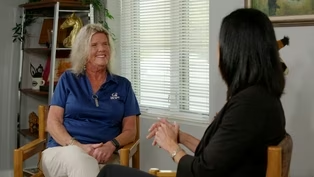
Darde Long on how the Chatt. Zoo has shifted focus to conservation
Clip: S17 Ep6 | 1m 59s | At the core of Chattanooga Zoo's mission is conservation of animals in the wild. (1m 59s)
Providing Support for PBS.org
Learn Moreabout PBS online sponsorship New Episode
 New Episode
- News and Public Affairs

Top journalists deliver compelling original analysis of the hour's headlines.

 New Episode
 New Episode
 New Episode


 New Episode
 New Episode

Support for PBS provided by:
The A List With Alison Lebovitz is a local public television program presented by WTCI PBS