WTVP EcoWatch
Power, Fire and the Choices Shaping a Greener Illinois
Season 3 Episode 2 | 27mVideo has Closed Captions
Data centers, electric homes and prescribed fire put Illinois sustainability to the test.
Mark Welp examines the growing data center fight and Illinois's proposed POWER Act, then visits a Macomb homeowner who eliminated fossil fuels with electric appliances, heat pumps and solar. The episode also explores prescribed burns and the Clean Water Celebration, where students learn conservation through seed libraries and hands-on activities.
Problems playing video? | Closed Captioning Feedback
Problems playing video? | Closed Captioning Feedback
WTVP EcoWatch is a local public television program presented by WTVP
Support for Ecowatch is provided by the Backlund Charitable Trust
WTVP EcoWatch
Power, Fire and the Choices Shaping a Greener Illinois
Season 3 Episode 2 | 27mVideo has Closed Captions
Mark Welp examines the growing data center fight and Illinois's proposed POWER Act, then visits a Macomb homeowner who eliminated fossil fuels with electric appliances, heat pumps and solar. The episode also explores prescribed burns and the Clean Water Celebration, where students learn conservation through seed libraries and hands-on activities.
Problems playing video? | Closed Captioning Feedback
Where to Watch WTVP EcoWatch
WTVP EcoWatch is available to stream on pbs.org and the PBS app.
Providing Support for PBS.org
Learn Moreabout PBS online sponsorship- [Narrator] This program is made possible in part by the Backlund Charitable Trust established to educate and create awareness of environmental issues.
(inspirational music) - [Mark] Welcome to our latest edition of "EcoWatch" on WTVP.
This program is dedicated to bringing you the latest environmental stories impacting our area and the state of Illinois.
We're going to introduce you to people finding unique ways to make the land of Lincoln a better place for mankind and animals by protecting plants, water, soil, and crops.
Let's get started.
- [Speaker] Do not engage in behavior that is disruptive, disrespectful, or distracting.
- [Mark] This episode, we look at the ongoing and growing fight against building data centers in Illinois.
We'll take you to an all electric home and show you how the owner is saving money while eliminating fossil fuels.
Plus, we take you to a unique event where kids are learning to protect the environment at a young age.
But first, it's a growing controversy that isn't dying down anytime soon.
Data centers.
We have updates on two major projects in central Illinois.
First in Pekin, where it appears a data center won't be built anytime soon.
Thousands of people joined Facebook pages and packed city council meetings to protest the development, which would've been between Sheridan Road and Route 98.
After hearing concerns about pollution, water, and energy consumption, and more, in March, mayor Mary Burress scraped the project.
- [Mary] After listening carefully to the concerns of our residents and the perspectives shared by members of the city council, as well as the due diligence from staff and my own personal conversations with the potential developers and my own due diligence, I have made the difficult decision that the city of Pekin will not move forward with this project at this time.
(people cheering) - But opponents of the data center shouldn't celebrate just yet.
There are legal proceedings that the city and developer need to address to void the contract.
- [Speaker] To say that we knew, whenever you're surmising, we knew we were coming is false.
(people clapping) - That will allow for less interruptions.
- We had 450 individuals here.
We could have done what some areas are doing.
They did a filibuster.
They signed up every single one of these men.
- [Mark] Fierce opposition in Sangamon County was not enough to convince the county board to vote against a $500 million data center project.
There were central Illinois building and trades council members at the meetings supporting the data center and potential job creation.
Developer CyrusOne has said the Sangamon County data center will employ 500 people during construction and create more than 100 permanent positions.
- [Speaker] Is this what you want to see at Sangamon County board meetings or do you wanna see the professionals.
- Go back for me, I'm pro life.
- [Speaker] Of people come here to talk about jobs?
- You suck.
(people clapping) - Everybody, I want everyone to know he told me to shut the (beep) up after he was done.
(people booing) - [Mark] The April meeting got very heated at times with sheriff's deputies having to escort data center opponents out of the room.
The 280 acre four building data center will be located in Waverley about 30 miles southwest of Springfield.
Because of the explosion of interest in data centers in Illinois, lawmakers have introduced a bill to regulate future projects.
The protecting Our Water, Energy and Ratepayers, or Power Act, has several provisions that would place strict regulations on new data centers in the state.
The provisions include mandatory plans to power the data centers with renewable energy and battery storage.
New rules will ensure that during peak electricity demand data centers can only use the amount of power proportional to the amount of new clean energy they bring to the grid.
The policy will also protect consumers from subsidizing the cost of upgrading data center distribution and transmission infrastructure.
Data centers will pay into a fund administered by the Department of Commerce and Economic Opportunity and the Illinois EPA to enhance energy affordability and environmental justice.
The bill would also require new data centers to pay for their own energy costs, including infrastructure.
The bill requires data centers to report their water usage, including how much they take in and discharge.
Sponsors of the bill say they aren't against data centers but want them held accountable.
- These protections are common sense, advancements in technology that contributes to the need for data centers could be good for climate progress and clean energy development.
And many of these facilities could bring with them important benefits to local economies.
With the Power Act, Illinois is showing the rest of the country that these advancements don't have to come at the expense of higher bills, dirtier air and polluted water.
- The Illinois Public Interest Research Group, or PERG, is a consumer advocacy group that works on solutions for issues impacting our health, wellbeing, and safety.
I recently spoke with Clean Energy Associate, Grace Kurtz, about PERG's efforts to get Illinois to transition from natural gas to electricity, and why she says the change has benefits, - The environmental benefits of an electric home is no fossil fuels in the home.
So our existing homes and buildings are a huge contributor to our CO2 emissions.
So by getting fossil fuels out of the home, we are taking a lot of our emissions just outta the equation.
Having fossil fuels in the home can contribute and exacerbate existing health conditions.
So there's been a lot of studies that have shown that having gas in the home can exacerbate things like asthma, which can be really bad for young children.
So putting all electric tech in the home and getting gas out of the home is great for air quality in the home and outside of the home.
And so is just overall better for our health.
- Let's talk about the economic impact of having an all electric home and maybe some money that people can save as homeowners.
- [Grace] So I will say for getting all electric technology or just any technology generally, there are gonna be higher upfront costs, but in the long run you are saving a lot of money.
So, as you probably know, and we all know, utility bills in the past couple years have been skyrocketing.
So by getting off that gas system, you're gonna be saving a lot of money month to month.
But if you're getting maybe a heat pump, that's a new thing and it's gonna cost some more money upfront.
So we don't recommend that people just buy new energy efficient technology.
But wait maybe until if your stove breaks down, then maybe consider an induction stove, stuff like that.
- What are some of the downsides, if any, to having an all electric home?
- I mean, I think they're pretty great, but we do hear a lot of people say, "Well, I mean I experience all four seasons.
Is this technology really gonna work when it's 20 degrees outside?"
And I think to that, I would say, it takes a lot of time, it takes a lot of research to really figure out what works best for your home.
But if you find qualified people that can like insulate your home, maybe fix your windows, figure out what exactly your home needs, then you can mitigate a lot of those, I guess, concerns.
And your home will be running pretty smoothly.
- And when people are making these transitions, especially if they do decide they wanna do it all upfront, they've got the money to afford it, what are some things they need to think about during this transition from maybe having gas in the home to not having gas?
- [Grace] I think the first step is getting a home assessment, figuring out what your home needs.
'Cause we all have homes from maybe a hundred years ago or 10 years ago.
You don't really know exactly what your home needs until you get that assessment.
'Cause some people, maybe you want solar, but it's too shady.
So getting that assessment, figuring out what your home needs kind of in the bones.
Do you need to be insulating, etcetera, stuff like that.
And just making sure that you are getting professionals that know your home, know what you need and can work together to make a plan so that the technology can work together to be most efficient and most financially feasible for you.
- You mentioned older homes.
You could live in a 100-year-old home and chances are that home may not be as insulated as a home that's only 10 years old.
So when people are thinking about maybe going solar or getting a heat pump, things like that, do they also have to look at their existing home and say the age of their windows or maybe how well insulated it is?
- Yeah, definitely.
I would say a lot of the homeowners I talk to, the first step is figuring out what the insulation situation is, what the window situation is.
'Cause for like an old home, the attic is not gonna really be insulated and you should be insulating it before you're putting in this expensive technology.
'Cause then it's not really gonna be efficient if you're heating up your home.
And then it's all kind of escaping out the attic.
So it's important to get your house checked, figure out what the needs are of your home before you're investing in technology, because a lot of times you gotta kind of insulate, fix the windows, et cetera, before you can fix the inside and the air quality and all of that.
- [Mark] We talked about the upfront costs and how they can be expensive.
Are there any like state incentives or grants or tax rebates that people can learn about?
- Yeah, definitely.
Both our utility companies and the state has programs for all different types of technology.
So I would recommend that if you're interested in starting the process is to look into what your local, or yeah, your utility offers and what the state offers and what you might be eligible for.
'Cause there definitely are programs that you can opt into.
- More than 80% of homes in Illinois rely on fossil fuels for home heating.
But Gary Freymiller home isn't one of them, not anymore.
The Macomb resident has converted his home to completely electric.
He gave us a tour that explained that he wants to help preserve the environment first and foremost.
At first glance, there isn't much unusual about this mid-century home in Macomb, but now the nearly 70-year-old house is free of fossil fuels thanks to an owner who was concerned about the environment.
- I can kind of go back to 2003 when I bought my first hybrid vehicle.
And so I've always wanted to do whatever I could to reduce my impact.
And I came across a book called "Electrify," by Saul Griffith, and he kind of mapped out a plan which is get rid of all of your combustion devices and electrify everything and then power your devices with renewable energy from like solar panels on the roof.
So that was kind of the idea.
And within the last five, six, seven years, the technology has advanced to the point where someone like me could even afford it.
- [Mark] The first steps to a cleaner way of living actually took place outside the home.
- We had one EV to begin with and we've later purchased a second.
So we're all electric in transportation.
To charge those EV's, we installed a level two charger in our garage and we can use the same charger to charge both vehicles.
- [Mark] Then purchasing all electric appliances and HVAC system.
- [Gary] The washing machine is normal washing machine.
The dryer here is a heat pump dryer, so that's different from most dryers.
You'll notice that it doesn't have a vent going outside.
That's because, unlike conventional dryers, it doesn't pull in the air and then exhaust it outside.
It just recirculates the air.
And so it uses half the energy of a conventional resistance based dryer and it takes a little longer to dry the clothes because it's not operating on such a high temperature.
So, you know, you are giving up a little bit of time, but we don't even notice that here.
- [Mark] Is there a big price difference between a dryer like this and a "normal" one?
- I don't think so.
We might've paid maybe 10% more than, you know, conventional type dryer.
And I'm sure there's all sorts of different levels of dryers.
So it's in the ballpark.
This is the heat pump water heater, and it looks like a pretty normal water heater.
The difference is it has this basically like an air conditioner sitting on top and instead of rejecting the heat to the atmosphere, it's rejecting the heat that it generates to the water in the tank.
And this is the air handling system for our heat pump, whole house heating.
It looks very similar to a gas furnace and it fits basically in the same space.
We were able to keep all of the same duct work.
All we had to do was replace this unit right here and you'll see up here, this is where the resistance heater is that we need when the temperatures go, you know, very cold and otherwise it's a pretty normal type heating system.
A typical furnace is based on combustion of a fuel.
Probably most homes have natural gas or methane as the fuel source.
So there will actually be a flame in the box and it's heating a heat exchanger and the air is being forced around the heat exchanger and the air is picking up the heat from the combustion.
So you end up, you know, I know that these things are supposedly 90 some percent efficient and we don't even notice it.
And it's, you know, maintaining the temperature that we have on our thermostat set point, just like an ordinary system, except it's not turning on and shutting off as frequently.
It, you know, keeps the temperature pretty constant.
- [Mark] And the final piece of the puzzle was installing solar panels to power the electrical components.
- We became all electric in like August or September of 2022.
So three and a half years basically.
And yeah, it was pretty exciting when we called Ameren and told them to remove the meter and they came and took it away, and you know, at that point we were like, we've done it.
Now there's no turning back.
Our energy bills are super low.
We pay the like monthly service charge for being connected to the grid.
We're still connected.
We don't have battery backup.
So, you know, when the sun isn't shining, kind of like today, we need the grid, but we also then feed back when the sun is shining.
So we have a couple of months a year where our electric bills are over $200 a month.
Otherwise they're, you know, right at the minimum under $20 for the rest of the year.
We don't have any natural gas bill.
We don't pay for any gasoline for our vehicles.
So from from that perspective, it's been great.
- [Mark] The conversion wasn't totally smooth sailing and isn't perfect.
- The first attempt was the heat pump water heater, but it actually turned out we had to upgrade our electric system to, from 100 amps service to 200 amps and then install a handful of 220 circuits.
We have an air source heat pump, so on on very cold days, I would say somewhere in the neighborhood below 20 degrees Fahrenheit, the heat pump loses its efficiency and then it has to revert, it has a built-in resistance heating element and that that can get kind of expensive.
- [Mark] If Gary had to do it all over again, he says he may have used different technology, but overall, he's happy with the results.
- I consider that we probably spent an extra maybe 10 to $12,000 that we wouldn't have spent otherwise to go electric.
And I figure we're saving somewhere in the neighborhood of four to 5,000 a yea in energy costs.
So the payback on that is, you know, somewhere between two and three years, which is quite good.
- There are at least two places in Illinois that have passed laws to help eliminate the use of fossil fuels.
In 2024, the village of Oak Park became the first local government in Illinois to require all electric systems for new buildings in order to meet state climate goals.
In 2025, the city of Evanston passed a law requiring the city's largest buildings to eliminate all fossil fuels and use 100% renewable electricity by 2050.
Evanston's Healthy buildings law is the second to be adopted in the Midwest after St.
Louis.
Every five years, beginning in 2030, there will be interim standards that buildings will need to meet until they fully comply in 2050.
Critics of the Evanston law are concerned about potential rent increases and declining property values.
When you think of fire, destruction maybe one of the things that comes to mind, but in nature, controlled fire can stimulate life.
More conservationists in Illinois might use this technique except for one big issue.
They can't get affordable insurance.
Well, now the Nature Conservancy in Illinois is asking state lawmakers to help.
All right, bill, tell us about the importance of prescribed burns and what you use them for.
- Yeah, prescribed fire is the most important tool we have in our toolbox.
It's helping us set back a lot of brush, it cycles nutrients, it brings health back to the land.
Fire brings sunshine, sunshine helps these systems thrive.
So we understand, I think most people get that prescript fire is a good thing and we wanna keep working to make fire safe and effective and build that community of fire practitioners.
- And what kind of things are you burning?
- [Bill] Prairies, woodlands, and wetlands and the woodlands that tend to be Oak-Hickory woodlands and the burning helps keep the oak and hickory propagating.
- [Mark] And if you didn't do these prescribed fires, how could you get the same result using another method?
Or could you?
- [Bill] You can't really mimic it.
On a very small scale, you might be able to work with mowers and hand tools, but as soon as you scale up beyond an acre, you start getting into a problem where fire is the only tool that's gonna be useful.
- And where around Illinois is the Nature Conservancy using prescribed burns?
- We're using them on the south side, south of Chicago and Markham.
We're down on the Illinois River at Emiquon and Spunky Bottoms.
We're working in Kankakee Sands area near Pembroke Township and we're down in southern Illinois partnering with DNR down there and the US Forest Service on the Shawnee National Forest.
- All right, let's talk a little bit about the prescribed Burn Liability claims pilot program.
And tell us how the Nature Conservancy and those proponents of using controlled burns are trying to get some work done in Springfield.
- [Gary] Yeah, this legislation is a win-win for us.
A claims fund would allow an insurance provider to realize that if there is an incident on a prescribed fire, the first money is gonna come from the claims fund.
And so the insurance provider says, I will give you a policy then and I will be the second money that that goes out if an incident were to occur.
So other states are adopting this and they're finding that it's a successful way to encourage insurers to keep giving insurance to landowners and non-profits that are trying to do prescribed fire.
- We've seen different municipalities around the state and including here in central Illinois, different cities and counties, use prescribed burns.
How difficult is it, do you think, for them to get that insurance done and know that while they're doing this thing that's good for the environment, they're covered also?
- Yeah, we've seen all the heartache in the west coast with California fires and so much property damage has occurred there for wildfires.
And so when you go to try and get insurance, if you say you wanna, can you cover fire, it scares the insurance providers.
And we're finding that getting insurance is more difficult.
Some people are losing their policies because we're being thrown into the same national concern about wildfires, whereas prescribed fires are generally low complexity, safe, and effective.
- And tell us now, as of today, as we're recording this, what kind of response that you've gotten from politicians in Springfield?
Is it mostly supportive?
Do they still have questions?
Where are we at right now?
- Well, we have a couple of sponsors.
We have, you know, the way legislation works, we are optimistic that we're gonna get a bill that will be voted on and we're working on that.
And I have not heard of concerns about the legislation because it doesn't change the liability standing of fire.
So I think that it's mostly a question of can we get the attention of the people we need to get?
Are they willing to make a vote on it?
And then, how do you fund such a claims fund?
- Yeah, I guess that is the other question about funding the fund.
- Yeah.
- What have you thought about that so far?
- Yeah, I've been saying that we're, the claims fund is kind of like a bucket of funds that can come from the public sector, it can come from the private sector, it can be nonprofits donating towards it.
Right now the legislation doesn't have money attached to it.
So we're like, we're funding this empty bucket that we hope to fill in the future to have this claims fund and we'll see how that goes.
If you do not put prescribed fire across your landscape, what you end up with is oak woods that are just choked with brush.
The oak stop regenerating the ground layer.
Plants are shaded out and the you end up with mud is your most common ground cover in your oak woods.
If you have prairies, they get full of brush.
You can't even walk through 'em.
Full of briers and multiple rows.
And again, you lose the whole prairie vegetation is just shaded out.
So fire is essential.
It's like sunlight, bringing sunlight to the landscape and without fire you end up with poor land health.
- Since 1994, central Illinois Sun Foundation has hosted the Clean Water Celebration.
Tens of thousands of students have learned how to make an environmental difference by protecting water.
We went to the Peoria Civic Center for the event this year and learned it's about much more than just H2O.
From learning how wind and water work together.
- Way to go girls.
- [Mark] to finding cool stuff using flotation archeology.
Water is the main attraction here, but there are plenty of other things to learn about, including spreading the environmental wealth.
Oak Grove eighth graders, Kenzi and Sam, are telling kids about the Bartonville School District Seed Library.
- I think the environment is really cool and things like this are really good for the environment.
- We are sharing our journey of having a community seed library.
It started when we harvested two bagfuls of Marigolds.
Knew that we couldn't use all those seeds and so we started looking at ways we could share it and it kind of went from there.
So now we have our seeds, so we're in the planning.
So it's like a journey that we have and we want to share that.
- [Mark] The seeds include all kinds of flowers and vegetables.
Science teacher Ranae Pincock says this type of sharing uses the three R's of gardening conservation, reduce, reuse, and recycle.
- We're reducing waste.
So if you have, you didn't use your whole packet of seeds, you can put 'em in the seed library.
We're reusing, we're harvesting our seeds, and we're repurposing.
So even our seed libraries, we had like a defibrillator box donated to us.
So we'll paint that up.
So it's about using what's in the community, donations, getting the community involved.
It's about creating stronger crops, plants, because then they'll be acclimated to this environment.
- [Mark] The Oak Grove Seed Library is still in the planting stages, but the students say anybody can take small steps to make the world a better place.
- I started my own garden at home and seed library just helps a lot of people.
- [Mark] What do you hope the kids get out of today, especially at your booth?
- Well, I hope they can start using the seeds, making their own garden, and maybe saving some money.
- I hope more of them learn how to be more connected to nature because so many people stay inside for so much longer and they're not as interested in plants and learning things like that.
- While Oak Grove gets its Seed Library up and running, you can check out other Seed Libraries around our area, including ones at the Bartonville Alpha Park Library, East Peoria Fondulac District Library, and the normal public library.
Thanks for joining us for "EcoWatch."
If you'd like to watch again, share with a friend; or watch past episodes, just look for us at wtvp.org.
I'm Mark Welp.
See you again soon.
(soft music) - [Narrator] This program is made possible in part by the Backlund Charitable Trust, established to educate and create awareness of environmental issues.
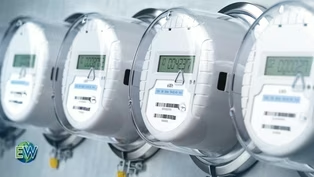
The Benefits of an All-Electric Home
Video has Closed Captions
Clip: S3 Ep2 | 4m 2s | Experts explain the health, environmental and financial benefits of all-electric homes. (4m 2s)
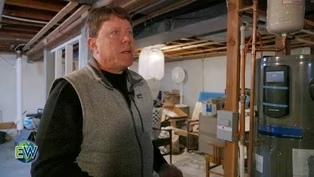
Inside a Fossil-Fuel-Free Macomb Home
Video has Closed Captions
Clip: S3 Ep2 | 6m 5s | Tour a Macomb home powered by efficient electric appliances, vehicles and rooftop solar. (6m 5s)
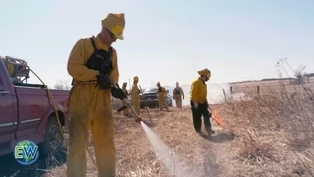
Why Prescribed Burns Need Better Insurance Access
Video has Closed Captions
Clip: S3 Ep2 | 5m 59s | Prescribed fire restores Illinois habitats, but limited insurance puts burns at risk. (5m 59s)
Providing Support for PBS.org
Learn Moreabout PBS online sponsorship New Episode
- Science and Nature

Explore scientific discoveries on television's most acclaimed science documentary series.






 New Season


 New Season

Support for PBS provided by:
WTVP EcoWatch is a local public television program presented by WTVP
Support for Ecowatch is provided by the Backlund Charitable Trust