WTVP EcoWatch
Data Centers Move Into Central Illinois
Clip: Season 3 Episode 1 | 3m 17sVideo has Closed Captions
Data center proposals promise jobs and tax revenue while raising environmental concerns.
EcoWatch examines proposed data centers across Central Illinois, including projects in Pekin, Fulton, Sangamon and Logan counties. Supporters point to jobs and new tax revenue, while residents raise concerns about water and energy use, noise and the loss of farmland. Developers explain how closed-loop cooling and infrastructure investments could reduce some impacts.
Problems playing video? | Closed Captioning Feedback
Problems playing video? | Closed Captioning Feedback
WTVP EcoWatch is a local public television program presented by WTVP
Support for Ecowatch is provided by the Backlund Charitable Trust
WTVP EcoWatch
Data Centers Move Into Central Illinois
Clip: Season 3 Episode 1 | 3m 17sVideo has Closed Captions
EcoWatch examines proposed data centers across Central Illinois, including projects in Pekin, Fulton, Sangamon and Logan counties. Supporters point to jobs and new tax revenue, while residents raise concerns about water and energy use, noise and the loss of farmland. Developers explain how closed-loop cooling and infrastructure investments could reduce some impacts.
Problems playing video? | Closed Captioning Feedback
Where to Watch WTVP EcoWatch
WTVP EcoWatch is available to stream on pbs.org and the PBS app.
Providing Support for PBS.org
Learn Moreabout PBS online sponsorshipData centers, house computer equipment needed for our increasing use of artificial intelligence, cloud computing, and streaming.
The centers can be as large as millions of square feet, and they are controversial because of concerns about environmental impact, high water and energy usage, noise pollution, loss of farmland, and more.
The Chicago area has the bulk of Illinois data centers, but developers are increasingly looking downstate where land is cheaper.
The city of Pekin sold 321 acres of land to a data center developer.
The site is between Sheridan Road and Route 98.
According to our partners at WCBU, Pekin officials say the center will employ 100 people and generate $20 million in property tax revenue annually.
The Fulton County Board has shot down a plan to build a data center and solar farm near Canton.
In January, the board voted unanimously not to rezone 32 acres of land from agricultural to industrial after a large community backlash.
14 miles southwest of Springfield, the Illinois Times reports the Sangamon County Board will consider rezoning 200-plus acres of land for a massive data center project.
The $500 million project would include six buildings covering 1.4 million square feet.
The center is estimated to generate $5 million a year in property taxes.
And in Logan County, the Illinois Times also reports the county board will vote on whether to rezone 250 acres of land near Latham for a $5 billion data center project.
The company Hut 8 says the 1 million square feet of space could generate more than $50 million a year in property tax revenue and bring in 200 permanent full-time jobs.
Last month, Hut 8 held a public forum in Lincoln where people ask questions and let their feelings be known.
One big concern is water consumption.
Some data centers use huge amounts of water to deal with the heat given off by the equipment.
But Hut 8 says, with their system, water will be delivered to the site and be recycled through the cooling system.
- According to the Environmental Energy Study Institute, large data centers can consume up to 5 million gallons of water a day, which, obviously, we are a big agricultural community.
I think that could really jeopardize our world as we know it.
I think there is a place for data, obviously, in our world, in our growing technology, but I don't think it belongs here.
- We are designing and been using this closed loop system because we think that water is also another critical asset, and more and more people are gonna be more and more sensitive.
So let's invest more money into the data center, and let's create this closed loop system where once you fill up the system with water on one go, then it works within its own ecosystem.
You're not adding water in a realtime basis, 'cause otherwise you're just constantly misting water on top of these things to cool them down.
- Opponents of data centers are also worried about their electricity bills rising, but developers say that data centers can stabilize or reduce rates because they pay for infrastructure upgrades.
Mining the Sun: Solar on Degraded Land
Video has Closed Captions
Clip: S3 Ep1 | 7m 13s | The Nature Conservancy explores turning degraded land into productive solar sites. (7m 13s)
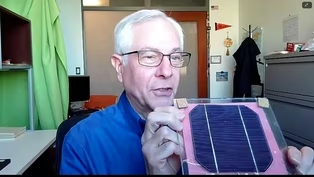
Video has Closed Captions
Clip: S3 Ep1 | 6m 16s | A solar expert explains what panels contain, how they endure weather and affect farmland. (6m 16s)
Providing Support for PBS.org
Learn Moreabout PBS online sponsorship New Episode
- Science and Nature

Explore scientific discoveries on television's most acclaimed science documentary series.



 New Episode









Support for PBS provided by:
WTVP EcoWatch is a local public television program presented by WTVP
Support for Ecowatch is provided by the Backlund Charitable Trust