
David Barby and David Harper, Day 1
Season 3 Episode 26 | 44m 23sVideo has Closed Captions
David Barby and David Harper travel all the way from Moy to Omagh in Northern Ireland.
It’s a brand-new week, hitting the road with David Barby and David Harper as they travel all the way from Moy to Omagh in Northern Ireland.
Problems playing video? | Closed Captioning Feedback
Problems playing video? | Closed Captioning Feedback
David Barby and David Harper, Day 1
Season 3 Episode 26 | 44m 23sVideo has Closed Captions
It’s a brand-new week, hitting the road with David Barby and David Harper as they travel all the way from Moy to Omagh in Northern Ireland.
Problems playing video? | Closed Captioning Feedback
Where to Watch Antiques Road Trip
Antiques Road Trip is available to stream on pbs.org and the PBS app.
Providing Support for PBS.org
Learn Moreabout PBS online sponsorshipVOICEOVER (VO): The nation's favorite antiques experts, £200 each and one big challenge.
Cuz I'm here to declare war.
Why?
VO: Who can make the most money, buying and selling antiques as they scour the UK?
He's very good!
VO: The aim is to trade up and hope that each antique turns a profit.
Oh!
VO: But it's not as easy as you might think, and things don't always go to plan.
CHARLIE: (SHOUTS) Push!
VO: So will they race off with a huge profit or come to a grinding halt?
Do you think I'd believe that?
VO: This is the Antiques Road Trip!
VO: In a week that promises slightly dubious weather, but wonderful scenery and fabulous people, the Antiques Road Trip is coming to you from Northern Ireland.
Lough Neagh.
DAVID HARPER (DH): The biggest freshwater lake in the British Isles.
Did you know that, David?
DAVID BARBY (DB): I did, actually.
DH: Oh, of course you did.
Sorry, I forgot you know everything.
VO: It's here our antique ambassadors David Barby and David Harper are about to charm a nation and hopefully make a profit.
DH: And look at this, David, it's one of the most romantic places in the British Isles, and here am I, with David Barby.
I mean, my life doesn't really get any better, does it?
I hope your inclinations are honorable.
Not at all.
VO: Freelance auctioneer and valuer David Barby is affectionately known as "Dolly" - not out of any close resemblance though to the toy.
DB: What for?
I don't know!
VO: He has a passion for antiques that began at the tender age of 12.
I've just asked what the bottom price is.
VO: Not to be outdone, David Harper started collecting when he was just five years old - or so he says.
I am a treasure hunter.
VO: Today, he's living the dream as an antiques dealer, writer, and thoroughly good egg.
DH: She's gorgeous, and I wouldn't mind taking her home.
VO: The two Davids are starting this contest with £200 each, and naturally, they're both hoping to have the luck of the Irish.
DH: Now, are you going to try and beat me on this, Mr Barby, or are you going to play the gentleman all the way through and just let me win?
I shall play the gentleman all the way through.
Do you think I'd believe that?
(MOUTHS) No.
VO: This week we're traveling from Northern Ireland, heading south towards the county of Meath, then across to the north coast of Wales, and once again heading south, ending our trip in Llanelli.
VO: Today we're en route to the village of Moy and our journey concludes with auction number one in Omagh.
VO: As for our experts' mode of transport, what could more glamorous than a Triumph TR3?
DH: If I was to close my eyes a little bit, I would think I was with some beautiful blonde.
DB: (LAUGHS) Too good to be true!
DH: Not for long!
DB: (LAUGHS) VO: Known to the locals as The Moy, back in the 1700s, this village was just a handful of cottages and a pub - most of which are still standing, and have been transformed into an antiques business that's been in the same family for three generations.
What's more, it has room after room of gorgeous collectibles, so what better place for our boys to make a start.
DB: Hey David... DH: Come on!
David!
Best of luck.
Oh, sorry.
Sorry, best of luck, of course!
Oh!
Oh sorry, Barby, do you want me to help you out?
Yes, thank you.
Anything to delay you!
BOTH: (LAUGH) VO: Now, while David Harper gets Dermot to give him the grand tour of what used to be entire village of Moy... DH: Look at this!
This is my idea of heaven.
VO: ..Lawrence - his father - is looking after our Mr Barby in the main shop.
DB: Can you tell me the prices of the Crown Devon?
£220.
Oh!
Sugars me!
That takes up almost all my money.
VO: In other words, time for a much cheaper plan B - this Georgian window panel.
Look, this is the one here.
LAWRENCE: It's an individual over-door, yes.
It's a genuine Georgian one, yes.
DB: So this would have been... Oops.
That would have been across the top?
LAWRENCE: Of course, yeah.
Yeah.
Yes.
DB: So we've got quite a lot of damage here.
LAWRENCE: Yes, it needs some of the wood replaced, yeah.
You've got layers of paint there.
DB: So this is probably, what, Regency?
George IV?
Yeah, around George IV, yeah.
So, what's your price on it?
LAWRENCE: £35.
DB: £35.
Is that your very, very best?
That's it, finito on that one, yes.
DB: I rather like that.
VO: For now, it's a strong maybe, because today David Barby is a man with a game plan.
DB: I'm looking for something that is unique, unusual, quirky.
You know, there's some decent stuff here.
Lovely, lovely, lovely.
I'm happy if I just sort of play in the middle ground.
I don't really mean that!
I'd love to win, but it depends how the day goes by.
VO: As for David H, his tactic is to spend lots.
DH: So is this an oil burner?
It's an oil burner, yeah.
DH: Yeah.
Oil burner.
A good thing.
In copper.
A bit of brass.
Nicely patinated.
Good, thick glass.
Imagine that illuminated.
DH: That, in a garden, would look the business.
Early 20th-century?
DERMOT: 1910, something like that.
DH: I would have thought it would be, wouldn't it?
Has to be, yeah.
What sort of money... DERMOT: The dealer trade price on that, say £35.
DH: Can it be £30?
£30, go on, good luck with it.
Good man, good man.
Nice to do a deal quickly.
DH: Man after my own heart.
Fantastic!
I love doing deals, Dermot!
Show me some more.
Leave that there.
Let's continue.
VO: Well, the boys are going great guns today and across the courtyard, David B has already found something else, though he has just one question.
DB: What are they?
LAWRENCE: They're Scottish, but not exactly sure what they were used for.
DB: They're both the same.
LAWRENCE: Mm-hm.
Yeah.
Two pieces.
DB: How much are they?
(LAUGHS) LAWRENCE: We'd do the two of them for £60.
They're quite unusual, yeah.
They are, but I don't know what they're for.
VO: And even more surprising, nor do I.
It's a chance that somebody else will know at the auction, but I think they're Churchill... VO: Rubbish.
DB: ..so probably dating from the earlier part of 20th century, so I think they're interesting enough.
DB: What's the best you can do on these ones, what's the price on them?
LAWRENCE: Oh, these are £60 for the two of them.
This one's got damage.
LAWRENCE: For the two, £50.
DB: I think you can afford to knock off some more actually, because you don't know what they are.
Maybe that's where the hidden value is!
Maybe these would make a lot more money.
DB: Would you do 40 for the two, please?
OK, 40 for the two, OK. Can I pay for those later?
There might be something else here, Lawrence, I'm getting rather excited now.
VO: Someone else who's excited is David Harper, who might just have found his next purchase.
DH: So, we have here a set of six, certainly 19th-century prints, but mounted in a really unusual way.
I love the shape of them, they're very different.
They could work - think about it, got to use a lot of imagination here - in a modern room, with a little bit of re-gilding on the frame, they would look really jazzy and really funky.
But proper things, 19th-century, probably 1860, 1880.
Potential, but they've got to be cheap.
Bearing in mind there's six of them.
DH: Oh no, this is a very bad start to this conversation, Dermot.
No it's a good start, what I'll do for you is £50.
DH: £50?
Dermot, give us it for 40.
45.
Good man.
Fantastic.
Love doing business with you.
I love it!
Right, OK. Another one in the bag.
Show me some more.
VO: My goodness, at this rate the boys will be done in time for elevenses.
Actually, I could murder a biccie.
Just spotted this, which I think is an interesting composition.
It's 19th-century.
What I like about it is the feature of the woman, and then this figure going at an angle across, which is unusual, as though somebody else is straining to look out from behind the curtain.
I rather like that.
Oh, and of course she has a naked breast, so it may well have been put in an attic rather than upset anybody's sensitive nerves because it has got an exposed breast.
Cleaned up, I doubt it'll be quite good, but there's damage across here.
I would hope it would be round about a sort of £50.
Lawrence, just spotted this as I came through the door.
I know it's got damage on it.
What's the best price you would do on it?
LAWRENCE: £40.
That's a law-enforced condition on whatever restoration has to be done to it.
DB: OK. Lawrence... Deal.
Thank you very much indeed.
OK.
Right.
Oh, I'm quite pleased!
VO: Perhaps there's something in the air...because at this very second, David H... ...is also now thinking... DH: She's a bit of alright, isn't she?
VO: ..about naked women.
DH: She's gorgeous.
I mean, not only is she lovely to look at cuz she's a lovely shape, but she's very contemporary, and you could put her, couldn't you, in a traditional house and jazz it up, couldn't you?
That's right.
Or a very modern place.
Very modern, yeah, very modern.
VO: This rather saucy painting that has David so excited is an amateur copy of Daniel O'Neil's work - an Irish artist now deceased.
Though, while the original did sell for ?50,000, I think this canvas is worth a bit less.
DH: What sort of money is she then?
I wouldn't mind taking her home.
Say something, I'll say... 30 quid?
20 quid?
I'd say 50 quid.
Really?
DERMOT: 45.
DH: You couldn't put it on my bill at 20 quid?
Say 30?
DH: 25 quid!
Let me take it home for 25 quid.
DERMOT: OK. DH: Good man, good man.
Gosh, we're never going to stop, we're never going to stop.
Come on, Dermot, let's go.
VO: As for David B, he's done and dusted, so that's one Georgian over-light, a pair of pottery figures, possibly Churchill, possibly not, and one very tasteful nude.
DB: So what's the total?
LAWRENCE: 115.
I'll give you 110.
Oh dear!
110.
OK, if you have 110... LAWRENCE: ...right.
OK, OK. DB: Yehoo!
DB: (LAUGHS) Thank you very much.
VO: Jammy old devil.
LAWRENCE: I hope you do well.
So do I, so do I!
Otherwise I'll be back!
VO: Though for now, David's headed south.
VO: His next stop is Milford, a small mill town that used to belong to the McCrum family, who famously produced some of world's best Irish linen.
Today, their family home - although protected - lies derelict, but their story is still being told thanks to the Milford House Museum, housed in what used to be one of the workers' cottages.
Welcome to Milford House Museum.
Thank you very much indeed.
VO: And it was founded by Stephen McManus, whose family - back in the 19th century - used to be weavers employed by the McCrums.
DB: Where is your interest in this?
Where did it all begin?
Well, it all began when I was 15.
I set up a charity called the Milford Buildings Preservation Trust to protect, promote and preserve Milford House for the benefit of the nation, and from that the collection developed.
STEPHEN: The family gave us back the remaining possessions that they had, and it was from then the collection started.
VO: The head of family was Robert McCrum, a man bordering on genius, who of course pioneered a new type of linen - double damask.
STEPHEN: When we say that Milford linen is superior to any other linen in Ireland, or indeed any other linen in the world, we're not joking.
Why do you say that?
If you look at this napkin here, you can see the design is printed on both sides of the fabric, so it looks exactly the same on each side, and because he invented and he patented it, he had the monopoly on the linen trade in Ireland until he died in 1915.
VO: Robert McCrum's design revolutionized the linen industry, and soon he had two factories and a thousand employees, who helped make him a very rich man, but he wasn't the only member of the family to change the world.
For a start, his daughter Harriet was a founding member of the Irish suffragette movement.
STEPHEN: This is a copy of the portrait of Harriet McCrum.
Now, there's no point in saying she was a great beauty - she wasn't, and she was close friends with Millicent Fawcett, who was the founding member of the suffragette movement in England.
Both ladies preferred to do the hard work and let someone else to take the credit, and this magnifying glass here was a wedding present from Millicent Fawcett to Harriet McCrum, and you can see it's inscribed "H. McCrum, with M.E.
Fawcett's loving care".
DB: That's a lovely little present.
VO: Meanwhile, Harriet's brother William was the black sheep of the family, preferring to gamble in Monte Carlo rather than run a linen factory, though he too has a claim to fame, for in 1890, in the park just outside this museum, he invented the penalty kick rule.
STEPHEN: In the 19th century, there were no rules in football.
Games could last an average four days at a time.
STEPHEN: An average seven men died playing football a year... DB: Really?!
STEPHEN: ..in England alone, but when he invented the penalty- kick rule, he was laughed at.
STEPHEN: But he was a goalkeeper, and my theory behind it is that he was very into acting and amateur dramatics; goalkeepers don't do much in the game, so for a split few seconds, he's the most important person in the game, and if he wins the game, he's even more important.
Oh, right.
STEPHEN: And today, he's more famous than his father was.
VO: And naturally, if one visits this world-famous site, how can you resist reliving a little piece of footballing history?
"Barby takes the run-up.
He kicks...
This is... (GLASS SMASHING) ...a criminal offense."
Time to go, I think.
VO: As for David Harper, he's gone well and truly off the beaten track to a place appropriately called Countryside Antiques.
DH: Well... Oh, I can't believe it!
Full of fantastic stuff.
VO: Absolutely.
And this unlikely shop is owned by Stanley, who used to be a farmer, but after a spot of heart trouble, decided to become an antiques dealer instead.
STANLEY: And it got bigger and bigger as it went on.
DH: This is what happens.
This is what happens!
It's a disease, it's a drug, Stanley.
It's worse than the heart disease!
It causes heart disease, this business!
Go on then, show me.
What have we got?
Let's have a look.
VO: Or more to the point, what hasn't Stanley got?
From Japanese Noritake to Mouseman furniture.
DH: That's not £100, is it?
STANLEY: Well that'd be the deposit!
BOTH: (LAUGH) VO: I'm afraid David Harper can't get any of it at the rock-bottom prices he's so fond of.
DH: They're quite interesting, aren't they?
STANLEY: I think they're Irish.
I'm not 100% sure.
DH: Let's see, you could be right.
Romany.
STANLEY: They could be Romany... DH: If you trace the Romanies far enough, you actually get to India.
You keep going east and east and east.
That's where they started.
So they've always got that Indian sort of influence.
So it could be Romany.
So you'd carry two of them.
What are you going to carry two of them for?
DH: Liquid?
Beer?
One of them each, I tell you what, you and I could have a great party, couldn't we?
DH: Fill 'em up.
STANLEY: Fill them up!
DH: I mean, there's a pair of them - what kind of... What sort of... STANLEY: A hundred.
DH: A hundred.
Take £50 and be done...
I can't, I have to get 60.
Getting no money out of them.
Stanley, I'm going to give you £60.
Thank you very much.
Thank you very much.
I think they're fantastically wacky, I love 'em.
Love 'em.
I've almost blown all my money.
VO: Well in that case, it's hats off to Stanley, and time for our esteemed experts to call it a day.
DB: Did you spend all your money?
You were going to do that, weren't you?
DH: You know that I want to spend all my money.
DB: The whole lot!
DH: I do, I wanna blow every single penny.
VO: As the sun hides behind several enormous gray clouds, the two Davids are nonetheless excited about the day ahead.
DB: All I can say is it's lovely countryside.
I think the only way to see Ireland is by open-top car.
DH: This is the way to do it.
DB: Yeah.
VO: So far, David Barby has spent £110 on three auction lots and still has £90 up his finely-tailored sleeve.
VO: David Harper, on the other hand, has gone a bit mad, parting with £160 for four auction lots.
Mind you, he says he's determined to spend every penny.
Cheeky!
DB: Is this your policy, you're going to blow it on each occasion?
DH: I might.
I'm going to try it this time, on our first leg out, and if it all goes disastrously wrong, I may change tact.
VO: The boys' first stop today is Armagh, known to many as the city of saints and scholars.
VO: And that's a story which begins in the mid-400s, when Christianity first spread to Ireland, and Saint Patrick established his principal church right here, thus making this the island's ecclesiastical capital.
Although it's since been destroyed and rebuilt 17 times.
VO: As for our story, that begins a few streets away, at the Shambles Market, where David Barby is about to have his world rocked.
DH: Hold on.
Now, this is the first time ever you've stepped onto the holy ground of a car boot - am I right?
DB: I've been to one of these country house car-boots.
So I would expect this to be something similar.
It's very similar.
You'll probably find some Rembrandts and some really good early George III furniture.
Oh, that's just what I want!
OK, well, good luck to you.
You go in that direction and I'll go in that direction.
VO: Whilst David's new to the cut and thrust of the car-boot sale, he's loving it, approaching every nuance as if he's narrating a nature documentary.
Well, this is the most extraordinary place I've been to.
It's all at a car-boot sale.
DB: It's amazing what's being sold.
And the people are so interesting as well.
They're all out there to get a bargain.
I hope I can find one!
VO: Even more surprising, this eclectic marketplace is also having a strange effect on David Harper.
Five pounds - it should be 25 quid, that.
It's madness.
That is so cheap it's probably illegal.
VO: What?!
Oh, right.
He almost had me there.
And true to form, he's now going on to squeeze the pocket money out of an 18-year-old stall holder.
DH: Two cracking bits of Murano.
Now, what would your price to me be for these?
20.
20 on that, and how much for that?
20.
DH: 20.
So here we are.
Here's a great example of Murano, made on the island of Murano just off the coast of Italy, but it's interesting because in Murano, they've been making glass for hundreds of years, maybe even a couple of thousand years, and many, many moons ago, to avoid any glass blowers, glass artisans, ever leaving the island, the threat was "we train you on this island; you become a master glass blower.
You leave this island and take those skills elsewhere - if we catch you, we'll kill you".
DH: It's a great story and they're still making there today.
What about a bit of a bulk- buy deal here?
I'd go for 35.
35?
25?
VO: Oh, he's shameless.
BOY: I'd go 32.
DH: Do 30 and we've done a deal.
Good man.
Good man.
OK.
Fantastic.
VO: David Barby, meanwhile, is going down the ceramic route.
After all, this slipper pan is the perfect opportunity for some lavatorial humor.
This piece here is a Grimswade.
A Grimswade piece.
I like Grimswade pottery, and I've just asked what the bottom price is.
VO: Oh, that's one.
It's 50p.
DB: 50p!
Pee being the operative word.
VO: That's two.
DB: It hasn't been used for ages.
VO: That's three.
And that's probably enough.
For 50 pence, I've got to buy it for 50 pence, haven't I?
WOMAN: Yes.
DB: I bought something!
Ah!
I bought something!
Thank you very much indeed.
WOMAN: You're very welcome.
Not at all.
I'll give you a pound.
WOMAN: Right and there's your change.
DB: Thank you very much.
And there's an Irish luck penny.
DB: An Irish luck penny?
WOMAN: Yes.
It's traditional when you buy something, you get a bargain, you get a luck penny back.
(WHISPERS) What have I done?
VO: With only £10 left in his pocket, David Harper is calling it a day, and is headed to the Armagh Public Library, founded in 1771 by the Archbishop Robinson, who thought of it as the "healing place of the soul", and filled its shelves with his collection of rare 17th and 18th-century books.
WOMAN: Welcome, it's a delight to have you here.
Thank you.
I'm David.
And I'm Carol.
Carol.
Thank you very much.
CAROL: You should feel very much at home here because Archbishop Richard Robinson, who had this lovely library built, was from Yorkshire.
DH: Ah, a fellow Yorkshireman!
CAROL: Yes.
A wonderful collector.
A wealthy man in his own right, and he set to and he bought and acquired books, manuscripts, prints, gems, coins; it was a very subtle way of saying "I have money and I want to show you that".
VO: Robinson's ultimate aim was to have a university in Armagh, so he started by building a library and each of the books he introduced was stamped with his own personal bookplate.
But whilst he died in 1794, his collection continues to grow, containing everything from theology to literary classics.
CAROL: This is a first edition of Jonathan Swift's "Gulliver's Travels" - known as "Gulliver's Travels"; obviously the title is "The Travels into Several Remote Nations of the World".
DH: Ah - that's the original title?
That's the original title.
Now I didn't know that.
And then it's by, you see, this surgeon Lemuel Gulliver, and of course we shorten it to "Gulliver's Travels".
Which is correct.
First edition, 1726, and this is the actual edition in which Swift chose to make changes in the margins, ready for a further print run.
This particular one?
Yes.
And that's what's so special for us.
There are areas here where we can actually show, in some cases, a little change.
In others... DH: Can I just see?
Does that mention Lilliput there?
CAROL: Yes.
DH: No!
And he's made a change?
The fact that Lilliput has been underlined I think is fascinating.
CAROL: If I may show you another one where he was just putting in... "Binding" is what's printed, and it should have been "bending".
So he was frustrated to find that there were several printing errors like that.
VO: Swift was so frustrated, in fact, he even fired the publisher.
Wow.
Carol, we're having a real feast here, aren't we?
I'm very glad you're saying that, that's great to hear.
We thought you might like to see this as well.
It's a 1614 copy of Sir Walter Raleigh's "The History of the World".
No!
CAROL: Raleigh wrote this while imprisoned in the Tower in London.
He had fallen out of favor with Queen Elizabeth.
CAROL: She was very angry to learn that he had married one of her ladies-in-waiting in secret.
Not the done thing.
No, indeed.
So he was imprisoned for quite a number of years and it was during that time that he wrote "The History of the World".
VO: Now, whilst David Harper's in no particular rush, David Barby still has more shopping to do.
VO: His next stop is Cookstown, which was founded around 1620, when ecclesiastical lawyer Dr Alan Cooke leased the land from the then- archbishop of Armagh.
It's also the location of the Saddle Room Antiques, and the man in that snazzy tie is Christopher.
My object is to buy some bargains, so I hope you've got some.
I hope so!
VO: Well, if anyone can sniff one out, it's Barby.
An old jelly mold.
DB: A late-Victorian, white-glazed jelly mold.
The ones that are collectable are the salt-glazed ones.
But what I like is this still can be used.
CHRISTOPHER: That's £18.
DB: What's the best on that one?
Eight.
DB: Can you do it for five?
CHRISTOPHER: OK. DB: I would like that for £5.
That will go nicely with another ceramic object I bought.
OK.
Yes.
VO: Hm.
Jelly and nobody's business.
What an intriguing combination.
Though he's not done yet.
His next acquisition might just be this stick stand, circa 1900.
DB: On the stick stand, I see you've got £78.
CHRISTOPHER: I would do that for ...35.
35...
Your very best at 35?
Um... Could you do it around about 20?
OK. VO: Twenty pounds?
That man could charm the skin off a snake.
DB: What I like about it is it's still got its original drip tray.
Maker's mark at the bottom.
It's a little interesting piece of social history.
DB: The sort of house this would come from would be a comfortable residence where there would have been servants, and this would have been in the hall, because only people of certain wealth could afford walking canes, umbrellas or parasols, and you'd date this probably round about the beginning of the 20th century.
VO: Which is David's way of saying he'll take it.
10 pounds is very good.
Thank you very much.
Yes!
(LAUGHS) What did we say it was?
CHRISTOPHER: 20!
20.
VO: Nice try... VO: With the shopping done, it's time for David and David to reveal to each other what they've bought.
Can I start first?
DB: Of course you can.
Would you mind?
Right.
DH: I think you're going to like this.
Clap your eyes on that.
DB: That is very good.
I think it's amazing that they can reproduce things like this so well.
Oh, stop it!
Stop it!
You know, 100%, that is not a reproduction.
DH: It's a trawler's lamp, for goodness sake!
DB: Um, I look inside, and I can't see any age to it.
It's this sort of thing here which is not particularly workmanship... Look, it comes out.
It's a pin, you've just pulled my blinking pin out.
VO: Final verdict?
DB: I think it's reproduction.
DB: Now, David, what do you think of these?
What do you think they're for?
DH: Do you know what they're for?
DB: No.
I was hoping you were gonna tell me!
But I'll tell you why I bought them - first of all, they're the Britannia Pottery Company, Scotland and Glasgow.
DH: Oh, that's good.
DB: These figures are caricatures of Churchill, and people do collect anything to do with Winston Churchill.
OK. Get rid of them, I don't like 'em.
VO: Hm.
Someone's a little jealous.
DH: Alright, David Barby.
We've got a set of six 19th-century prints, very, very dirty, obviously.
What are your thoughts on those?
DB: I think they're great social history.
I do like them.
I like anything to do with the countryside.
DH: Yes.
Good to have six.
DB: And hunting is very popular.
DH: Right.
Get your second item in.
What on earth have you been...
I don't actually think that I want to touch it.
Oh, it's perfectly clean.
It smells completely fresh.
Nice!
Just explain to me exactly what it is.
DB: This is a douche pan.
What does that mean?
DB: This means that either male or female would sit on it here, so that the hand could go in there to then wash... Look, I haven't tried it.
Thank the good lord!
It's a talking piece.
DB: Yes.
DH: It's good to have visitors to come along and them to ask you what it is and then for you so eloquently to explain... Or possibly demonstrate!
VO: And if you think that's odd, he's teaming it up with the jelly mold.
DB: The only reason I bought this is cuz it's white and it would go with this.
Alright, OK.
So what's that, a fiver's worth?
Yeah, yeah.
You hit the nail on the head.
Excellent.
OK. Get rid of them.
Let me get something else.
DH: What do you think about these?
One lot.
DB: Yes.
DH: Good shape.
Nice heart shape.
Czechoslovakian.
Um...
Probably made, oh, about five years ago.
DB: Based on, let's say, Murano glass.
DH: Well, that's how I described them, as Murano.
It's not Murano.
OK, that's not Murano.
Would you say that's Murano?
DB: I think it comes from the same source.
I'll tell you why I don't think it's Murano - because with this fleck, if it was Murano, you would have a gold element in it, and it has not got that, and that always distinguishes it, in my book, from, let's say, a host of other glass being produced.
OK. Well listen, let's just agree that they're Murano, Murano-esque, whatever.
VO: No.
They're either Murano or they're not, David, and I'm thinking the latter.
OK, don't say anything.
DB: You have to stand up.
DH: OK. Well, it's a stick stand.
Circa 1900.
Might be described as Victorian, but it's more 1900-1910.
DH: They used to sell well, nice drip pan.
That is worth £20.
That's how much I paid for it.
Well done.
That's not bad, is it?
I think these are probably Tibetan.
DB: They're possibly used for milk.
DH: Now, the lovely chap I bought them off was convinced that they're Irish and made for the traveling community.
DH: They're superb quality!
DB: They're very well-made.
They're flamboyant.
DB: Yes.
I rather like those.
DB: One overlight.
I think it's George III.
I was going to say, could be Georgian.
So this would have gone above a door of an important house.
Yeah.
Borrowed light.
To bring the light in.
Now, these things, architectural antiques, of course were very good news, weren't they, when there was a property boom.
DB: Yeah.
But people are still doing renovations.
DH: Yes, yes.
If there was a property boom, you'd get £200 for that.
It needs lots of work, but a good thing.
VO: And now for the adult portion of our antiques.
DH: OK Mr Barby, tell me what's going through your mind.
DH: David?
DB: Yes?
Get on with it!
(LAUGHS) Well, it is quite an extraordinary image.
Do you like it?
No.
No, I don't like it.
I can't believe it!
I find this leg awkward.
I find...
It's not a natural pose.
I think the breasts are OK... Oh yeah, they're OK, I've got to say.
They're alright.
But you know, it's modern art and I find it difficult to appreciate modern art.
DH: OK, alright.
OK. She's a beauty.
She's a beauty!
DH: Get some taste!
DB: (MOUTHS) I don't think so.
DB: Right, David.
What do you think of this?
Hmm.
I like her.
I do.
DB: I think it's after a Victorian artist called Alma-Tadema... DH: Yeah.
DB: ..who painted sort of Pompeian beauties.
DH: 1860, 1880, 1890.
But what I like about this is that the artist has put a Victorian face, and this little bit of eroticism which was allowed because it was a classical subject.
I think you'd could get away with it, absolutely.
I think that restored would be several hundreds.
I paid 40.
40 - it's for nothing.
It's absolutely for nothing.
That, I'm afraid, is the killer buy.
VO: Now, as if I can't guess, what do our experts really think?
Very surprised.
In fact horrified that Mr Barby didn't like my painting of a nude lady.
I mean, come on!
Who can say, hand on heart, they don't fancy her?
She's fantastic!
I think the worst object of all was the painting of the female nude after O'Neill.
I thought it was absolutely dreadful.
Dreadful!
After starting off in Moy, David Harper and David Barby end the first leg of their road trip in the county town of Omagh.
One of the oldest towns in Ireland, Omagh traces its origins back to the year 792, when all that existed was a single Abbey.
And since then, there's been rebellion, war and oh yes, it's also been burned to the ground in the name of William III.
Though right now, its biggest problem is traffic, courtesy of...guess who.
DH: Just look behind you.
Come on, we're going to really have to put our foot down - I'm sorry, I know you don't like it.
DB: Don't you put your foot down!
DH: Hold on to your horses, baby, let's go!
DB: That's fast enough.
Oh my God!
VO: Assuming Barby can cope with speeds in excess of 30mph, our next stop is Viewback auctions.
VO: Though before auctioneer Geoffrey Simpson gets things under way, how does he rate the chances of our two Davids?
GEOFFREY (GS): I wouldn't book any holidays to Bermuda on the strength of what they will be selling, but nonetheless, I think they'll possibly issue a little profit.
GS: The most interesting article perhaps for me is the architectural window, which is typically Irish Georgian.
GS: It's just a pity that there's only one.
It does show that the guys have at least an eye for something good.
GS: I'm not so happy with the fox-hunting prints there.
They seem to be a little bit too scruffy.
They have potential, perhaps, if they were cleaned up a little bit, maybe reframed.
GS: The most exciting lot for me are actually the pair of Churchillian Britannia pottery vases or jugs or whatever they are.
GS: I think they should do well.
They should make a good few pounds.
VO: Our experts began this journey with £200 each, and over the last two highly competitive days, David Harper has splashed out a total of £190 on five auction lots.
VO: As for David Barby, he's kept a little more in reserve - spending £135.50, also for five auction lots.
Mark you, he does have a secret weapon, thanks to his new-found love of car-boot sales.
DH: Can I hold the lucky penny?
DB: No.
Can I look at it?
No.
Not even look at it with my eyes?
No.
VO: Well, if you're quite ready, let the auction begin.
First up, it's David Harper's brass tankards, finely decorated with a touch of gypsy.
Go on, pump them up.
I hear 40, at 40, at £40 at the back.
At £40 here, 45 here at the front.
45.
50 at the back.
At 50, at 50, at 50.
Come on, push it.
At 50.
Any advance on 50?
VO: Oh dear, we stalled already.
DH: No, no, no, no, no.
GS: At £50, at £50, at £50 and it's once £50, and it's twice, all finished... Don't sell them.
GS: ...at £50, Mr X.
(GAVEL) DH: Mr X has just nicked them off me!
VO: Needless to say, Mr X has paid a lot less than our Mr Harper - that's a £10 loss before commission.
I can't believe it!
I think he knows what they are.
VO: Next it's the David Barby Ceramic Collection - not available in shops.
It's still a bizarre combination, if you ask me, a jelly mold and a douche pan.
Who's going to give me £50 on the slipper pan and jelly mold?
GS: 40?
30?
20?
Start me at 10.
DH: No, don't!
Yes!
Fiver.
Fiver bid over here.
At five.
Five?!
GS: At 10.
At 15, 15, 15.
20 down here.
At 20, at 20, at 20...
Someone's got taste.
Any advance on 20?
The lady's bid's at 20.
(MOUTHS) I can't believe it!
Give me that penny!
£20 and it's twice... DB: One more go.
(GAVEL) All finished and done at £20.
The lady's bid at 20.
VO: Well played Barby, well played.
Maybe there's something to that Irish luck penny after all.
Give me that penny.
Let me just hold it for a while.
VO: Actually, David, you may need it.
There's more than a few doubts over your so-called Murano.
We've got a heart-shaped Murano glass dish.
DH: He's mentioned Murano again.
That's strange, isn't it?
Yes, it is... ..Czechoslovakian.
At £30.
At 30, at 30, at 30, at 30.
At 35.
Yes!
At 40.
At £40.
At £40, any advance on 40?
Bigger profit, come on!
DH: David, give me the penny, give me the penny!
Give me the penny!
GS: Sir, you realize that these may be a little bit more modern than you think?
GS: At 40.
Are you happy enough?
At 40, at 40.
That's good.
It's good.
At £40, it is once... DH: Come on!
GS: £40 it is twice, GS: all finished and done at £40 with me... (GAVEL) VO: Not bad, considering there's no way on Earth they were Murano.
Will you not let me hold the penny on my next... No.
VO: That's right Barby, you hold on to it.
After all, your George III overlight is next.
GS: This piece of glass is unique to this part of the world.
That is true.
That's true.
Well, you never mentioned that.
Still true.
Starting me at £100.
Start me at 50.
40.
No.
One pound.
Ladies and gentlemen, 30.
20.
£20 bid.
GS: At 20, at 20, at 20, at 20, at 20.
At 30, at 30.
At 40.
GS: It's a pity there wasn't a pair of them - we'd be flying into £400-500.
DH: He's very good.
At £40 once.
Twice.
All finished at (GAVEL) £40 to the gentleman who knows.
You just can't stop making profit, can you?
VO: Yes, and that's another £10 in the kitty.
But now, perhaps, it's David Harper's turn to feel the love.
It's his thoroughly modern amateur copy of an Irish nude.
Oh!
She's stunning!
VO: Yeah, alright, calm down.
At £20, at 20, at 20, at 20, at 20, at 20.
At 30.
Yes!
Come on!
GS: At 40, at 40, at 40, at 40, at £40.
Any advance on 40?
Come on!
GS: At £40, it is once.
£40 twice.
All finished... (GAVEL) DH: (GROANS) Well, she made a bit of profit.
VO: Yes, indeed.
But perhaps the good people of Omagh like their nudes to be a little more subtle.
So let's see if Barby can tempt them with a cheeky flash of breast.
Start me at £100.
£100, anyone?
God, it's such a bargain.
GS: £50 then to start the bid.
60 bid.
At 60.
At 70, at 70 to the lady.
At 70, at 70 to a lady who knows.
Oh, come on.
GS: At 70, at 70, at 70, will I see 80?
£80.
90.
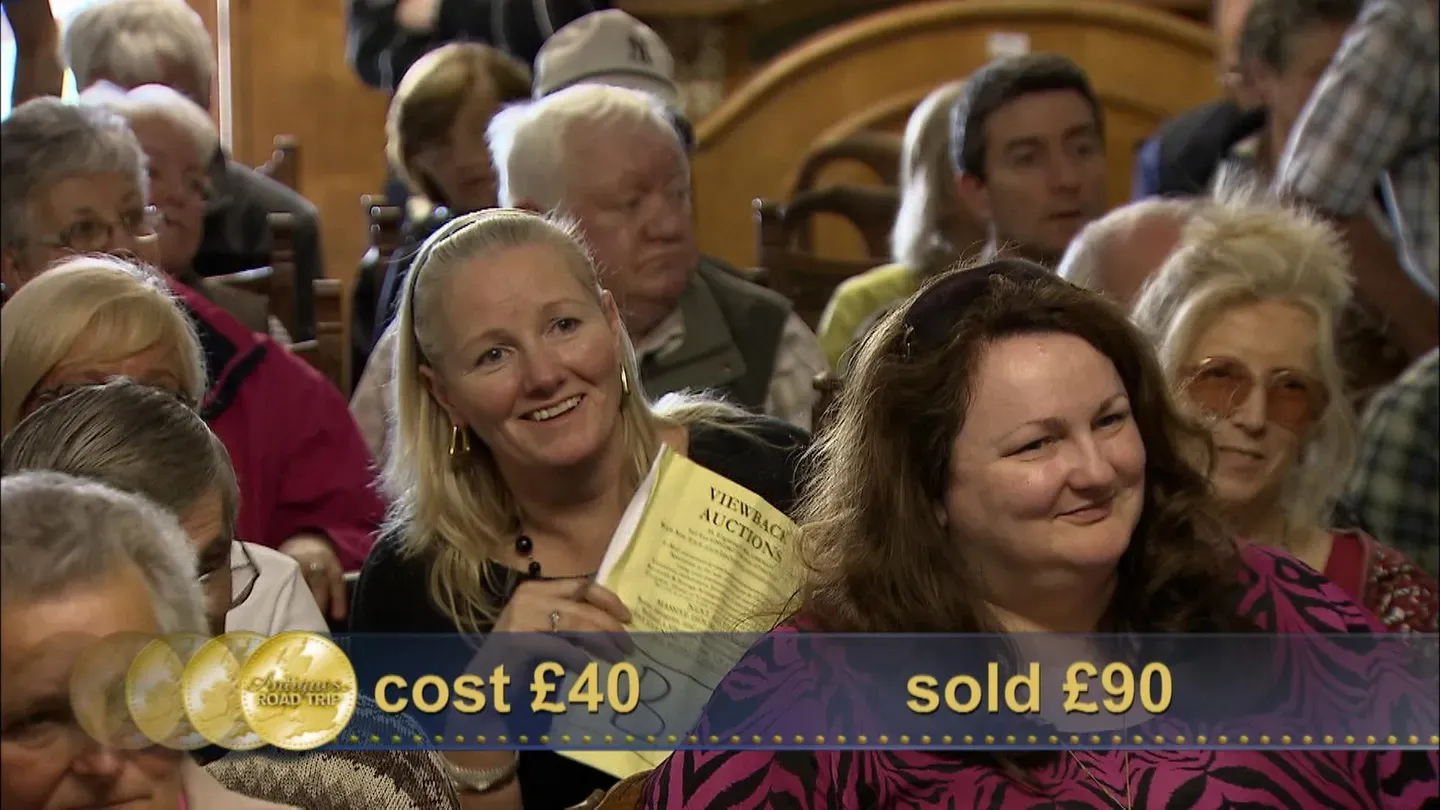
At 90.
Are you going to come again, sir?
GS: At 90, it's the lady's bid.
At £90, and I sell... Oh, Christopher Columbus!
At £90 once.
At £90 twice... Get it sold.
GS: (GAVEL) At £90, B.A.
DH: Get it done.
Well done.
Well done.
Well and truly thrashed.
Didn't have my penny in my hand.
Oh dear, I feel so awful for you!
VO: Yeah, poor old David.
That's only £50 before commission.
Staying in the art world for just a little longer, let's see if David Harper can lift his sagging profit margins with these hunting prints.
Come on now, babies.
Six of them.
At £20, at 20, at 20, at 20, at 20.
GS: At 30.
At £30.
Any advance on 30?
At £30, at £30, at £30, at 30, at 30, at 30, at 30, at £30.
And £30 it is.
VO: So, just to summarize: we're at 30.
GS: At 30, at 30, at £30, at 30.
At 40.
GS: At 40, at 40, at 40, at 40.
Come on!
GS: Once.
DH: Come on.
No!
And it's twice, all finished and going at 40... Mr E... (GAVEL) Oh.
£5 loss.
VO: And don't forget the commission.
David Barby's pottery figures now.
Which, I'm afraid, are still proving to be something of a mystery.
DB: I'm getting rather anxious about these.
I don't know what they're for, David, that's the problem.
I just bought them on a gut reaction cuz they were Churchill.
Now, we've had quite a lot of interest in these articles on the internet, so who's going to give me £200.
JON: What?!
GS: Start me at £100.
£100 bid.
At £100.
120.
140.
140.
160.
160.
180.
Come on, come on!
GS: At £200.
VO: Oh my!
Whatever they are, I love them!
We've got £220.
No!
At 240.
I see a smile!
Not from me!
At £240, at £240.
It is once... At £240, it is all finished and gone at £240... (GAVEL) VO: And that's why they call David Barby the master.
Bravo.
I'm sorry, but I'm going to have to applause there.
Well done, well done.
VO: Clearly, Barby's in the lead, but David Harper is hoping his ship's lantern will finally get the bidders excited.
Come on, boys.
GS: £30 bid.
At £30, at 30, at 30, at 30, at 40.
At £40.
DH: I need so much more... GS: It will be sold... ...if I can't get more bids.
Nobody into things nautical?
Go on!
He's trying hard.
He's very good.
GS: At 50.
At 60.
Aha!
New blood!
At 60, at 60, at 70.
At £70 behind you, sir.
At £70, at £70... You're doing well.
GS: At £70, it is once... DB: Your day is here.
GS: At £70 it is twice.
All finished, all done at £70, Mr E. (GAVEL) Delighted with that.
VO: And so you should be, old boy.
That's £40 profit before commission.
Mind you, it's a drop in the ocean compared to you-know-who, and it's time for his final lot - the 19th-century stick stand.
Take your penny out.
I have.
30.
£30 bid.
At 30, at 30, at 30, at 40.
At 40, at 40, at £40.
Who's going to give me 50?
At 40, at 40.
Nobody, nobody.
I'm going to sell it at £40.
I can't get more.
Sell it, sell it.
GS: It is once.
At £40 twice.
All finished, all done at £40 and the code is... GS: (GAVEL) ...Mr E. DH: Gone.
£40.
Well... VO: Well done Barby.
Drinks on you, I think.
Although for some reason, the man's frowning.
What are you moaning about?
I only made £20 on that.
DH: Thought you paid 40 for it?
DB: 20.
Just got you worked up!
VO: David Harper started this leg with £200, and after commission, made a rather modest profit of £6.80, which means he ends the first leg with £206.80.
VO: David Barby also started with £200, but after making an exceptional £217.10 at auction, he now has £417.10 in the coffers, and is very much in first place.
But hey, we've only just begun.
DH: Well and truly, utterly hammered, thrashed, killed, drowned - whatever you want to call it.
VO: Come on, Harper, pull yourself together.
There's still four days to go.
Right, hold on.
You are going for a spin.
DB: Do be careful!
DH: (LAUGHS) DB: (SCREAMS) VO: Join us tomorrow in the sunny republic of Ireland, where David Harper gets a grip of the currency.
DH: Bear in mind I've only got 200 and something euros.
OK...
Right... She's not very impressed with me now, is she?
VO: And David Barby gets a shock.
DB: Oh!
subtitling@stv.tv















Support for PBS provided by: