Living St. Louis
Debunking The "Arch Effect" with Steve Templeton
Clip: Season 2026 Episode 5 | 3m 17sVideo has Closed Captions
Some St. Louisans believe that The Gateway Arch can somehow divert storms and tornadoes.
Some St. Louisans believe that The Gateway Arch can somehow divert storms and tornadoes. The belief comes from the fact that many large storms seem to avoid the downtown area. KMOV Chief Meteorologist Steve Templeton explains why the myth is not true. Produced by Veronica Mohesky.
Problems playing video? | Closed Captioning Feedback
Problems playing video? | Closed Captioning Feedback
Living St. Louis is a local public television program presented by Nine PBS
Support for Living St. Louis is provided by the Betsy & Thomas Patterson Foundation.
Living St. Louis
Debunking The "Arch Effect" with Steve Templeton
Clip: Season 2026 Episode 5 | 3m 17sVideo has Closed Captions
Some St. Louisans believe that The Gateway Arch can somehow divert storms and tornadoes. The belief comes from the fact that many large storms seem to avoid the downtown area. KMOV Chief Meteorologist Steve Templeton explains why the myth is not true. Produced by Veronica Mohesky.
Problems playing video? | Closed Captioning Feedback
Where to Watch Living St. Louis
Living St. Louis is available to stream on pbs.org and the PBS app.
Providing Support for PBS.org
Learn Moreabout PBS online sponsorshipAs a St.
Louis area meteorologist, there's one myth Steve Templeton hears all the time.
I've been here two decades and I've heard it the whole time I've been here.
Sometimes I hear it from people who are serious and sometimes most of the time I hear it from people who are kind of joking about it.
Templeton is the chief meteorologist at KMOV.
He's talking about the so-called arch effect.
The thinking is people believe that some people believe that the arch can divert storms around the St.
Louis metro so they actually kind of split and then rejoin or that they weaken as they move into the St.
Louis metro but it's just not true.
The myth comes from the idea that many large storms and tornadoes seem to avoid the downtown area near the Gateway Arch.
If storms would weaken and or divert around St.
Louis, especially severe storms, well then we wouldn't have the unfortunate and tragic history we have with tornadoes.
You just look back at last year, we had May 16th but then also on March 14th, we had two on the ground at the same time in the St.
Louis metro, one in Maryland Heights and one in Arnold.
So, that was all just last spring by the way, not to mention Good Friday tornado among many, many others.
Templeton says the location of tornadoes is mostly up to chance.
Downtown's a relatively small area.
Um you know, we we average 17 tornadoes in our whole uh viewing area.
So, if I gave you 17 darts every year to throw at the St.
Louis region, would you hit a city or would you hit farmland?
You'd probably hit land.
To hit to hit a town or specifically downtown St.
Louis, the odds are stacked against you because the city is a relatively small parcel of land compared to where tornadoes are roaming across the Midwest.
And any difference between the weather downtown versus elsewhere has more to do with heat than the arch.
There could be an urban heat island effect, not an arch effect.
Uh but generally, the rivers are pretty small.
There's a localized effect.
If you're near the river, it's going to be more humid.
It can impact our temperatures too, but that's very localized to the rivers.
The big, big impact that impacts severe weather around here is the fact that we get our humidity from the Gulf of Mexico.
And when that humidity ramps up through the Mississippi Delta and up into our area, that sets up the storm fuel.
It's one of the ingredients, but it sets up the storm fuel for severe weather.
The other thing is the arch.
Its effect is kind of laughable on a 60,000-foot-tall severe thunderstorm.
Now, don't get me wrong.
The arch is tall, 630 feet, but you would have to stack 100 arches on top of each other to get to the top of a severe thunderstorm.
So the sheer scale of a severe thunderstorm is huge compared to the relative small scale of the arch.
But Templeton doesn't see any harm in the myth.
I think it's fun.
Whether it's something that brings us together, it's something we can all bond about and sometimes joking about it can just be kind of a good humored way to feel part of a community.

The 20th Anniversary of 314 Day
Video has Closed Captions
Clip: S2026 Ep5 | 2m 5s | Producer Brooke Butler spoke with #314Day founder Tatum Polk about the 20th anniversary. (2m 5s)
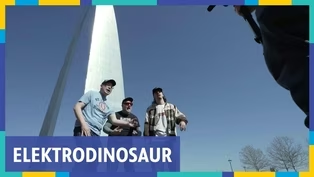
Behind-The-Scenes of Elektrodinosaur's "The Gateway Arch" Music Video
Video has Closed Captions
Clip: S2026 Ep5 | 3m 52s | Producer Mike Gualdoni goes behind the scenes of Elektrodinosaur's "The Gateway Arch" music video. (3m 52s)
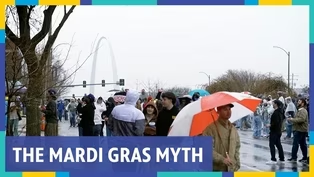
Does St. Louis Have The Second Biggest Mardi Gras in the US?
Video has Closed Captions
Clip: S2026 Ep5 | 6m 33s | Dive in to the myth, Soulard Mardi Gras history, and why the numbers don't really matter. (6m 33s)
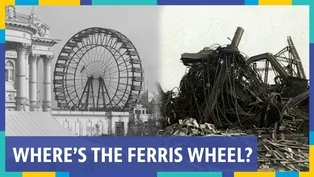
Is The 1904 World's Fair Ferris Wheel Buried in Forest Park?
Video has Closed Captions
Clip: S2026 Ep5 | 2m 55s | Producer Veronica Mohesky is debunking some famous St. Louis myths, including this one. (2m 55s)

Urban Buds Provides Locally Grown Flowers for St. Louis
Video has Closed Captions
Clip: S2026 Ep5 | 4m 58s | Producer Anne-Marie Berger spoke to Mimo Davis about how the business started. (4m 58s)
Providing Support for PBS.org
Learn Moreabout PBS online sponsorship













Support for PBS provided by:
Living St. Louis is a local public television program presented by Nine PBS
Support for Living St. Louis is provided by the Betsy & Thomas Patterson Foundation.