Living St. Louis
Does St. Louis Have The Second Biggest Mardi Gras in the US?
Clip: Season 2026 Episode 5 | 6m 33sVideo has Closed Captions
Dive in to the myth, Soulard Mardi Gras history, and why the numbers don't really matter.
If you've been to Soulard Mardi Gras in St. Louis, you've probably heard someone say that it is the second biggest celebration in the US. But it's much more likely that another US city claims that title. Veronica Mohesky dives in to the myth, Soulard Mardi Gras history, and why the numbers don't really matter.
Problems playing video? | Closed Captioning Feedback
Problems playing video? | Closed Captioning Feedback
Living St. Louis is a local public television program presented by Nine PBS
Support for Living St. Louis is provided by the Betsy & Thomas Patterson Foundation.
Living St. Louis
Does St. Louis Have The Second Biggest Mardi Gras in the US?
Clip: Season 2026 Episode 5 | 6m 33sVideo has Closed Captions
If you've been to Soulard Mardi Gras in St. Louis, you've probably heard someone say that it is the second biggest celebration in the US. But it's much more likely that another US city claims that title. Veronica Mohesky dives in to the myth, Soulard Mardi Gras history, and why the numbers don't really matter.
Problems playing video? | Closed Captioning Feedback
Where to Watch Living St. Louis
Living St. Louis is available to stream on pbs.org and the PBS app.
Providing Support for PBS.org
Learn Moreabout PBS online sponsorshipNot even cold rain will prevent St.
Louisans from celebrating Mardi Gras in Soulard.
So this is my 26th year being involved in this.
I can't ever remember rain on Grand Parade Day, but in terms of the crowd that actually came out for the parade, candidly, it was much larger than I expected, given the weather.
People in St.
Louis are like, "It's Mardi Gras and I'm going, and I'm not letting this rain get in my way."
Mack Bradley is the president of the Mardi Gras Foundation, and like most St.
Louisans, he takes pride in our excellent celebration.
It's become something that St.
Louis is known for around the country um and it brings people here for an outdoor festival in February to St.
Louis which is nuts.
And there's one thing St.
Louisans love to share about our festivities.
That St.
Louis is allegedly the second biggest Mardi Gras celebration in the U.S., the first being New Orleans.
I remember hearing it in the '90s.
I mean, before I ever got involved in this, people frequently said that.
And I hear it all the time.
No one is exactly sure where this claim comes from.
Bradley says it doesn't come from the Mardi Gras Foundation because they don't have exact numbers on how many people attend.
Like we don't have turnstiles.
Nobody walks through a turnstile.
We can measure the relative size of a crowd year over year based on trash tonnage.
- And while we don't have any confirmed numbers for St.
Louis, I was able to get some from a couple of other cities.
Outside of our region, Mobile, Alabama is generally regarded as the second biggest Mardi Gras celebration in the U.S., with over 1.3 million people attending the city's 39 parades over a three-week period.
Galveston, Texas, is also a Mardi Gras hotspot, drawing 400,000 people to the island for their festivities.
So it's safe to say that Soulard Mardi Gras is not the second biggest celebration in the U.S.
But hold on.
The real question is, does it even matter?
I don't think it matters whatsoever.
I think we can toss that aside.
That's Amanda Clark, a public historian at the Missouri Historical Society.
There's so many things that locals really want to be true, and the actual true story is way more interesting than the myth.
She says, forget the numbers.
St.
Louis has an awesome celebration, with unique events and an interesting backstory that has nothing to do with the French.
There is not a direct line between the French history of St.
Louis and us having this big Mardi Gras.
There's actually about a century in between, century, century and a half in between those two things.
So it really is just more connected to the Catholic history, which, you know, it definitely has some French roots, but much more influenced by Germans.
Soulard Mardi Gras actually began around 1980 with five guys playing poker.
It was a brutally cold winter.
They were bored and said, "Let's do a party because this winter is so terrible."
The men eventually threw what was basically a huge house party at a building in Soulard.
And the first parade was actually a march through the snow to the bar McGurk's.
So it grew organically into what I would describe as a large neighborhood festival to the mid-90s.
Then we had three consecutive years of 70 degree weather on Grand Parade Day.
And that changed everything.
I mean, the weather changed everything.
In 1999, Soulard Mardi Gras almost stopped for good.
Back then, there was a nighttime event in the neighborhood on Fat Tuesday itself.
There was some measure of disturbance at the Fat Tuesday that night.
Fights broke out between police and attendees, which devolved into a riot.
34 people were arrested.
This had been coming for some time.
The crowds got bigger every year.
This became more and more of a huge regional event.
So I think the pressures were already there.
But 1999 really sort of focused everybody's attention.
Mack Bradley helped lead the charge to make changes and keep the party going safely.
We spent most of the summer of 1999 creating the non-profits that run Mardi Gras now.
The two non-profits helped create the Soulard Mardi Gras celebrations that we know and love today.
Of course, there's the Grand Parade, but there's also the Mayor's Ball, the 5K, the Cajun Cook-Off, the Wiener Dog Derby, and more.
We have tried to do a schedule that allows you to sort of build your own Mardi Gras adventure.
And we have an event that qualifies as the largest in the world, the Purina Pet Parade.
That event today is our only Guinness Book of World Records holder is the world's largest costumed animal parade.
All the events are a boost to the local economy.
It fills up hotel rooms and bars and restaurants around the region and generates a little more than $23 million for the regional economy in February when there isn't a lot of other stuff going on.
On top of all that, St.
Louis still has one of the biggest celebrations in the country, even if we're not in second place.
That's really not important to us.
What is important to us is that we're one of the best.
You know, one of the most fun.
If you want to go someplace with your friends and have a great time, and do it safely, and get back home, and all of that stuff, this is the place to come.
That's really what we care about.
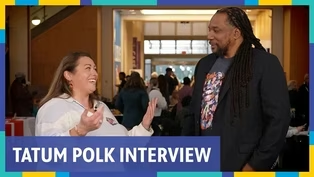
The 20th Anniversary of 314 Day
Video has Closed Captions
Clip: S2026 Ep5 | 2m 5s | Producer Brooke Butler spoke with #314Day founder Tatum Polk about the 20th anniversary. (2m 5s)
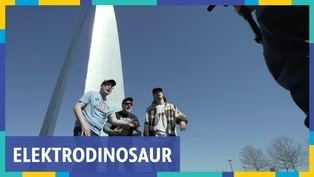
Behind-The-Scenes of Elektrodinosaur's "The Gateway Arch" Music Video
Video has Closed Captions
Clip: S2026 Ep5 | 3m 52s | Producer Mike Gualdoni goes behind the scenes of Elektrodinosaur's "The Gateway Arch" music video. (3m 52s)

Debunking The "Arch Effect" with Steve Templeton
Video has Closed Captions
Clip: S2026 Ep5 | 3m 17s | Some St. Louisans believe that The Gateway Arch can somehow divert storms and tornadoes. (3m 17s)
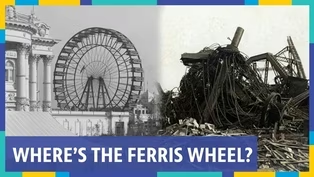
Is The 1904 World's Fair Ferris Wheel Buried in Forest Park?
Video has Closed Captions
Clip: S2026 Ep5 | 2m 55s | Producer Veronica Mohesky is debunking some famous St. Louis myths, including this one. (2m 55s)
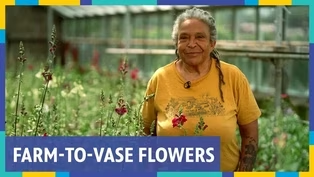
Urban Buds Provides Locally Grown Flowers for St. Louis
Video has Closed Captions
Clip: S2026 Ep5 | 4m 58s | Producer Anne-Marie Berger spoke to Mimo Davis about how the business started. (4m 58s)
Providing Support for PBS.org
Learn Moreabout PBS online sponsorship













Support for PBS provided by:
Living St. Louis is a local public television program presented by Nine PBS
Support for Living St. Louis is provided by the Betsy & Thomas Patterson Foundation.