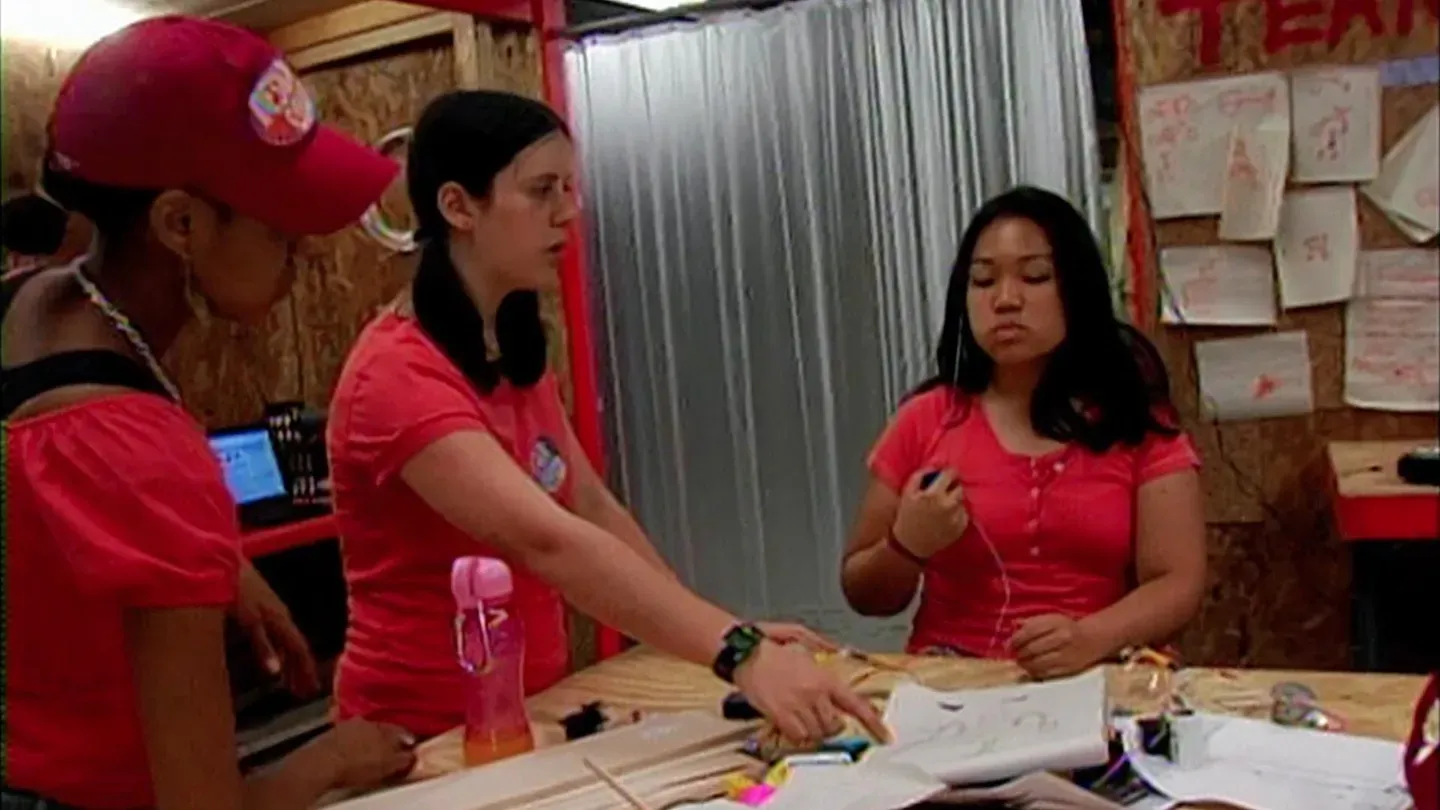
Design Squad
Got Game? (Ep. 105)
Season 1 Episode 5 | 25m 12sVideo has Closed Captions
The teams compete to prove who's got game!
The teams dive into action and compete to prove who's got game!
Problems playing video? | Closed Captioning Feedback
Problems playing video? | Closed Captioning Feedback
Design Squad
Got Game? (Ep. 105)
Season 1 Episode 5 | 25m 12sVideo has Closed Captions
The teams dive into action and compete to prove who's got game!
Problems playing video? | Closed Captioning Feedback
Where to Watch Design Squad
Design Squad is available to stream on pbs.org and the PBS app.
>> ♪ We've got two days to get this straight ♪ We got a challenge just won't wait our eyes are on the prize ♪ Two engineers just set the date ♪ We got this client can't be late oh, no, it's go time ♪ Build it, test, fix it debug now and kick it ♪ Got to get it off the ground yeah ♪ Stick around and you'll see what teamwork's supposed to mean ♪ It's so key Design Squad Design Squad!
♪ >> Bring it, Red Team.
>> All right, huddle up.
Huddle up.
Come on, guys, bring it in.
Bring it in.
>> All right, you guys ready for a little face time with our new client?
>> Yeah.
>> All right.
This week, it's Brendan Smith.
He's a basketball coach, and he doesn't want to miss any of the action on the court.
Check it out.
>> Hi, I'm Brendan Smith, head coach for A Step Ahead basketball.
Trap-- trap the ball!
Get up now!
Get up!
A Step Ahead basketball is a program that teaches the fundamentals of the game.
One of the best ways to teach is the videotape a game.
That allows us to analyze it, to break down a players strengths and weaknesses.
Go after the ball!
The hard part is to capture the action.
Design Squad, that is where you come in.
Now, your challenge is to come up with two different remote control camera systems that can tape the game.
Now, let's view the specs.
I want one camera system from the air, and the other along the sideline.
We will scrimmage from the small court to make life easier for you, but you may not attach anything to the walls or bleachers.
Trap him, trap him!
Don't let him out!
Let's get to work.
The camera system that best covers the action wins.
And the losers are running sprints.
>> What?
>> Looks like Brendan means business.
>> You guys are in for it.
So what we're going to do is we'll give you guys controllers and the camera systems.
>> And the systems are both going to be tested and judged at Brendan's basketball camp.
The winner will receive 100 points.
You guys have any questions?
>> How do we do this?
( laughter ) >> I have a question.
>> Yeah?
>> How do we decide which team builds which camera-ma-jig?
>> So glad you asked.
Free throw contest right now.
>> You guys are going to bring it.
>> So you see this line right here?
This is our foul line.
Each member on your team is going to get one shot and one shot only.
The team that has the most baskets gets to pick whether they want the aerial or the ground team.
>> Blue Team, you're going first.
Line it up.
One-zero.
Who's up next, Red Team?
>> You just made my day.
The pressure's on.
One-one, Joey.
>> Two-one.
One shot left.
Giselle, it's all on you.
>> Oh, yeah, no pressure.
>> It's all right, through, because I made the first basket, like, of my life.
>> I say we don't fight gravity and put it on the ground.
>> We could make a cool car.
>> Like a remote control.
>> Shh.
>> We could just put, like, a remote control car and go side to side, up and down the sidelines.
In the air, almost like a zip line type thing.
Like... >> Blue Team, did you decide?
>> Yeah.
>> We're going ground.
>> I have to say, I'm floored by your decision.
>> Listen up, Red Team, we have a final decision.
Blue Team's chosen ground, so Red, that means you get the aerial camera system.
>> Let's go brainstorm.
>> Game on.
>> Whoa, you found all the specs, huh?
>> I see you guys have already found your remote systems.
We gave you two full setups.
>> Here's detail about full dimensions of the court.
It's going to be a half-court basketball game.
We're going to be going down to a hobby shop.
It has all kinds of RC equipment, model-making equipment.
>> This is going to be fun.
>> All right, get to it.
I'm excited to see what you guys come up with.
>> Tom, activate.
>> The squads will use radio control, or RC, in their remote control systems.
And here's how it works.
A transmitter sends electromagnetic radiation, called radio waves, to a receiver.
The receiver decodes information in the radio waves to produce electrical signals.
And these signals power actuators that rotate their cameras and move their systems.
>> So we've got pretty much an open area.
We can't permanently attach anything, so if we were to attach something, it has to be semipermanent.
We have, what, 45 feet by 74?
That's a huge span to be crossing.
>> To the board.
>> Zip line.
>> Zip line.
>> I can't picture it.
>> This is our camera.
And the area of our basketball court is not going to be that huge.
Think about it.
Ready?
We have a spool down here.
The play's at Mike.
Mike pulls, and I'm just releasing.
>> The other thing that's seen in a lot of games is a helicopter.
Helicopters are really fast, but they can hover in one spot and then move to another location really quick.
That might be another alternative to try to do that.
>> I think it'd be really distracted if I was playing basketball and a little helicopter rode by and it was like... and I'd be like... >> I would love to be the camera.
>> All right, so here's what we're working with.
It's called an eye cam.
Basically one lens.
>> Wireless?
>> Yeah, it's wireless.
>> Wireless transmission is how the squads will get video images from their camera to the screen.
The camera captures an image and transmits radio signals through the air to a receiver.
The receiver converts the radio signals into digital information, so the image can then be sent to the computer and displayed on the screen.
>> We need to have two servoses... servi... servoe?
>> We can just have one.
>> Servi?
>> Servi.
>> We can have one servi there?
>> Servi?
>> Servo.
>> Servos, or servile mechanisms, are motorized devices that automatically control motion, and in this case, position.
Electrical signals from the receiver trigger the servo's arm to rotate so the camera can pan or tilt.
>> I think the nice neat way of doing this would be just to get an RC car and stick it on the RC car.
I really like the four-wheeled idea of having it be that you can pick it up and move it to wherever you want within, like, two seconds.
>> Can we check trains?
>> We can just buy a bunch of flatbed cars.
>> We can't buy a train set.
>> With the car you're moving left and right, you're constantly adjusting.
The cameraman is like, "Where are you going?"
"I don't know."
And then... >> Disaster.
>> I still like the idea of a free remote control car.
I like the freedom of being able to move wherever you want to find the shot, you know?
>> We're at a stalemate.
>> Yeah.
>> Are you, like, more in favor of, like, the helicopter idea as opposed to it being, like a zip line or whatever?
>> That's my first choice, is, like, the helicopter or, like, the blimp, something that's actually free and moving in the air.
>> I don't know.
I think I feel a lot more comfortable with something that's, like, planted, not really flying.
>> I think that if you don't take a risk, then we're going to be penalized for it.
We need to take the daring approach to win this challenge.
>> We just have to resolve how our car's going to be moving.
>> We could have, like, a monorail, and just have thing, like... just put a piece of wood here, underneath the car, and it can't move anywhere else but straight.
>> Then we would build our own car that would go on that track.
It's really not that difficult.
>> You guys, a car is just, like, a base with wheels.
This is our design for our car.
We're going to have... this is the cross section.
We're going to have the wheels.
There's the track, and the motor here, and it's going to have the camera mounted on top.
>> All right, now I want you to take this, and I want you to start spinning.
All right, I'm just sitting here.
>> Am I the motor?
>> You're the motor, you're the motor.
>> Well, I'm... >> Oh, that's really easy.
So we're going to do that.
>> So I've got our list.
>> We've got a $150 budget.
>> We're just going to get a couple of servo motors.
>> Write down some way to mount it.
>> Tires.
>> Pulleys.
>> It's shopping time.
We've got to go.
>> We'll be busy while you guys are shopping away.
>> Whoa, that's so cool.
>> Wait-- how much is that?
>> $189.
>> Man!
>> It works perfectly for, like, aerial shots.
>> Could you give us, like, a discount or something like that?
>> Let's take a bunch of these and bring them up to Alex.
>> Keep in mind we have a budget.
>> We're going to pick one.
We're trying to basically make a car that can have a camera mount on it.
Do you think we should go with the two motor or one?
>> How much do you think it's going to weigh, the whole vehicle?
>> The load's probably going to be, like, at least one or two pounds.
>> With that in mind, actually, the twin motor gearbox.
>> Here is what the car's going to look like.
This is the platform that the camera's going to by mounted on, and this is a two foot high foam base.
This is our track that we're going to be using.
>> Make it 74 feet.
>> I'll do 72 feet.
>> No, I want... just do 74!
>> But 72 is divisible by eight, and these are eight-foot boards.
That good?
>> 74 feet.
>> 72 it is!
>> We want our camera suspended from here somehow, or attached to the bottom line so that we can control it going back and forth.
>> Well, I have some motors that would be appropriate for that, but what I don't have for you is a good way to attach the motors to the pulleys.
>> Remote doesn't mean that we can't have any human intervention.
>> Right.
>> So what's stopping us from pulling this instead of using a motor?
We'll just have somebody on either side pulling it.
>> With the zip line.
>> Yeah.
>> Oh, I really like that, actually.
>> Yeah.
>> All right, so we're going with the person.
>> The whole thing needs to spin, and then this needs to be like a swingset, like swinging back and forth.
So somehow we need to mount it in something that allows it to swing back and forth, like, on an axle.
>> Let's wait for them to come back to just tell them what we're doing.
>> We're back.
>> Surprises, surprises, surprises!
>> Yeah, what did you guys get?
>> This!
We found it in the car.
>> Woo!
Good.
>> No, seriously, what did you guys get?
>> We didn't buy anything.
>> Why?
I thought I gave you guys the list.
Did you lose the list?
What's wrong with you?
>> No, I did not lose the list.
We just decided that we didn't need it.
>> Need what?
>> You know, we got there, and we had this epiphany.
We cleared our minds.
We defined remote.
Can you define remote for me?
>> It's something that controls something from further away.
Like, you don't have to touch it.
>> Right.
>> Brainstorm.
What else can we use to move something from far away?
>> Whoa, what that is, a fancy- looking puppet.
>> Human power.
>> So we can, like, pull on the ropes to make it go back and forth.
>> Yeah.
>> All right, so no motors?
>> No motors to pull it back and forth.
>> I like it.
>> You like it already?
>> Yeah, I like it.
>> I love being on your team.
>> All we need... here's, like, a side view of the gym.
That's the floor.
Here's the walls.
And here's the basket.
It's coming down.
We have a pulley up here and a pulley, like, up there-- or, like, even in the back, like, on the back.
The string goes across, comes down, comes down.
That's all we need.
>> So we got our motors, and we got our wheels and tires.
>> So this is our car.
This is two-foot-high foam, and this is the platform that we're going to be mounting the camera on.
>> Yeah, but can we cut it?
It's ugly.
>> I don't care.
>> I don't like this.
>> This is really light for a car.
>> You want to know something a little bit funny?
Red Team didn't really buy anything.
They didn't buy anything.
>> Did they buy any, like, ice cream or anything?
>> No.
>> Ha, ha, ha, ha, ha.
>> This thing's going to be sweet.
>> How awesome is that?
>> Get it all together.
>> When Nate and Deanne call time... we'll do that until Nate and Deanne call time.
>> Time's up.
Wrap it up, Design Squads.
>> All right, we've got to finish with our camera and mounting.
>> So do you want to build your own and you can build your own and then we can just, like, test and see what's best?
Because we want the best thing for our footage.
>> So we're building two and then we're only using one?
>> Just because we have so much time.
>> All right, we're going to have the camera, and it's going to be attached to an axle, which goes through two little pieces of wood.
And then we have the axle attached to the servo motor, and then the pieces of wood are going to be attached to a platform, which is going to spin from the motor.
So are you two going to build your own?
I think I should work on this because I was the one that designed it.
>> Yeah, work on that.
That's cool.
>> Here's how I think it would be best laid out.
I'm making kind of a prototype of the swivel head.
This is pretty much a swivel unit that will allow the camera to move on two axes of position.
The camera could actually be mounted either this way-- and she just came up with a great idea of mounting it right down here so the fallback position would be kind of right here.
From that position, it would be able to follow the ball up and down the court, 90 degrees, so it can go all the way like that.
But then this can also spin, and then it can follow the ball like that.
>> Oh.
>> So this... the line would be attached, like, out here.
>> Yeah.
>> You'd be like ( whirring ) and it'd be like ( screeching ).
Like, this thing would be able to spin.
>> How do you like that?
>> That's really simple.
That's more simpler than Kim's actually.
>> I'm glad Kim is diligently working and has a pretty good design that she's confident in.
I'd like to see the finished product.
I think that she should try to include the rest of us in her design.
>> This is actually good.
>> This little prototype didn't take three people to make, but we incorporated all of us.
>> Kim's not incorporating us.
>> It's all on one remote control.
This is the camera-- up, down, left, right.
Watch, watch.
Up, down, left, right.
And then this is the control for the car.
>> Just what, forward and backward?
>> You mean forward and backward?
>> Yeah.
>> Ah!
>> It works.
>> I'm going to drill a hole for a space where I can mount my motor.
All right.
Oh, that's incredible.
>> Oh, that's cool.
>> That's so sweet.
Dude, I love this thing.
It goes so fast too.
I love it.
Nice.
>> I like that idea.
>> Yes, you do, because I thought of that.
>> Mike, look.
>> I already saw it.
I'm just trying to catch up now.
>> Hi, Noah.
It's so cool.
I can see myself.
I'm on TV.
>> I love this.
>> Here we go.
Dude, check it out.
Remote control.
>> Very nice.
>> Yeah.
>> Kim, I want you to follow me.
Ready?
>> I had you pretty much in frame the entire time.
Oh, yeah, start rigging up the pulleys so we can get ready to test it.
All right, bring it towards you.
Ready?
Go.
>> It's kind of more difficult than I expected.
It bounces a ton.
>> The problem with Red Team's design is that the same rope controls both the camera's vertical and horizontal position.
So if one person feeds the ropes too fast, the line goes slack and the camera drops.
And if she pulls too fast, the line tightens and the camera bounces.
To fix their design flaw, Red Team needs a separate set of lines to hold the camera up and another to move the camera back and forth, or else... >> We have these inline skate wheels, and they're held at an angle to each other with this rubber band, and that keeps the car on the track.
>> Aren't you a sweet robot?
Yes, I am.
Yes, you are.
>> Hi.
Go that way.
Perfect.
>> That's the farthest, remember?
>> The farthest it'll go.
>> Unless you want me to do this.
>> All right.
So that's right side up.
The camera's set.
>> Want to test it?
>> Yeah, let's test this.
>> Yours is a little bit more balanced than Kim's is.
We want to minimize on the moving of the camera.
>> Red Team has a choice to make.
Both Mike and Kim's designs have a 360 degree pan and a 90 degree tilt.
So which is better?
Kim's unit is balanced.
The camera tilts evenly about its axis.
Mike's camera and battery are placed far from the pivot axis, so when the unit tilts, it swings wide, cantilevering its weight and increasing bounce.
So if Red Team wants a steadier shot, they should choose Kim's design.
But they don't.
>> That should be it.
I think all we need to do is fix the problem with this, see if we can make it smother, and it'll eliminate a lot of the bounce.
Got a little bit more practice in on trying to get it to move.
So let's see if we can play a lot more with camerawork and teamwork so that we can get the best, you know, video we can out of this.
>> All right, let's go.
>> You guys ready to test this?
>> Put it on the track.
>> And down.
>> Come on.
>> This is so much fun.
>> Everything here is just ready to go.
>> We're not saying we're going to win.
We're saying that we're confident in what we've done.
>> It's only bragging if you're not as good as you say we are.
But we are that good.
>> What did I tell you the other day about that?
( whistle blowing ) >> All right, Blue Team, let's start it up.
( whistle blowing ) >> Looks really good, you guys.
>> Whoa.
I thought he was going to crash right into the camera.
>> Blue Team, time's up.
>> Red Team, you guys ready to fly?
>> Turn the camera on.
Let's see the footage.
>> Well, I'm not ready.
No, wait, wait, wait.
We can get all the tangles out of the rope.
>> Yeah, it's working.
Why aren't they pulling or doing anything?
Maybe you got to yell at them to tell them where the action is.
>> Pull, pull, pull!
Kim!
Kim!
>> Go, that way!
>> Are they doing laundry, or are they filming?
Come on now.
>> It only takes one person to work our machine.
>> And, Red Team, your time is up.
>> Okay, Red and Blue Team, what do you guys have for me?
>> Blue Team ground cam.
>> Okay.
The kids would love to see this.
How about the Red Team?
>> Ours is hotter.
You'll like it.
>> Yeah?
>> The Red Team was the aerial cam.
>> With the pulley system.
>> Good view of the jump ball here.
That's a good way to see spacing on the court for players.
And all the footage pretty much looks the same from here to when you guys stopped?
That's the pulley?
The pulley was shaking, right, a little bit?
>> Yeah.
>> No, this looks good.
They put a lot of work.
Both teams put a lot of work into it, so... >> You ready to huddle up and make a decision?
>> I am.
>> All right.
>> Red Team, I... that was the aerial system?
>> Yeah.
>> It seemed a little shaky.
It was a little far from the court, the action, and it actually showed too much of the peripheral of the court.
When you're watching the game, you just want to see the action on the court.
The track was a better way to go, with the Blue Team.
>> All right, so you're going with the Blue Team.
>> Yes, I am.
>> Here they come.
Here they come.
>> The decision is, although both teams did a really good job, and I think the Red Team was a little bit more creative in terms of having something up top, sometimes you need to be a little bit more basic in what you're trying to do.
I think the Blue Team caught more of the action on the court.
The Red Team was a little shaky and too much of the peripheral action.
So the 100 points goes to the Blue Team.
>> Yeah!
>> Oh, yeah.
>> And the losers are running sprints.
On the line.
Captioned by Media Access Group at WGBH access.wgbh.org >> A win for the Blue Team puts Joey back on top with 430 points, but the lead is still up for grabs when the teams get reshuffled next time on Design Squad.
>> All right, Deanne, here's a new challenge: describe the Design Squad Web site in ten seconds-- go.
>> There are games, photos, new challenges, videos, quizzes, scoring updates.
>> Time's up.
>> Ugh!
Just go to pbskidsgo.org.
 New Season
- Drama

Hugh Bonneville stars in a crime drama inspired by one of the largest robberies in British history.
 New Episode
- News and Public Affairs

Top journalists deliver compelling original analysis of the hour's headlines.


 New Season
 New Episode




 New Episode
Support for PBS provided by: