Destination Michigan
Destination Michigan 1602
Season 16 Episode 2 | 23m 5sVideo has Closed Captions
Falmouth, Grand Rapids, Cedar Springs, and Alpena
We visit with baa-by goats in Falmouth. We break away to Second String Leather Company, they're taking your favorite retired hockey gear and scoring big by turning it into cool keepsakes. We stop at Cedar Springs Brewing Company where you'll feel like you're in a traditional Bavarian pub. In Alpena, we'll experience all things winter at an ice festival that celebrates its 1930's Winter Carnival.
Problems playing video? | Closed Captioning Feedback
Problems playing video? | Closed Captioning Feedback
Destination Michigan is a local public television program presented by WCMU
Destination Michigan
Destination Michigan 1602
Season 16 Episode 2 | 23m 5sVideo has Closed Captions
We visit with baa-by goats in Falmouth. We break away to Second String Leather Company, they're taking your favorite retired hockey gear and scoring big by turning it into cool keepsakes. We stop at Cedar Springs Brewing Company where you'll feel like you're in a traditional Bavarian pub. In Alpena, we'll experience all things winter at an ice festival that celebrates its 1930's Winter Carnival.
Problems playing video? | Closed Captioning Feedback
How to Watch Destination Michigan
Destination Michigan is available to stream on pbs.org and the free PBS App, available on iPhone, Apple TV, Android TV, Android smartphones, Amazon Fire TV, Amazon Fire Tablet, Roku, Samsung Smart TV, and Vizio.
Providing Support for PBS.org
Learn Moreabout PBS online sponsorship- Hi everyone, and welcome to Destination Michigan.
I'm Stefanie Mills coming to you from the campus of Central Michigan University on a beautiful spring day.
Here's a look at what's coming up.
Come for the baby goat cuddles, leave with cheese, soap, and a full heart.
Meet the woman who found her purpose in the most unexpected way through Nubian goats and community joy.
In Grand Rapids, Second String Leather Company is turning used hack equipment into personal keepsakes.
In West Michigan, we explore the area's German roots and uncover how they're uniting people from all walks of life.
Then winter may be on the way out, but the memories remain how Alpena celebrates the cold season with one frozen display after another.
Those stories next on Destination Michigan.
- [Announcer] Support for Destination Michigan is provided by the CMU Bookstore.
(lively music) T-shirts, sweatshirts, hats, maroon and gold memories, and an official outfitter of Adidas apparel at the Central Michigan University, owned and operated CMU Bookstore.
(lively music) Online shopping seven days a week@cmubookstore.com, On-campus, at the University Center, and game day locations at Kelly/Short Stadium and the John G Kulhavi Event Center.
(lively music) (upbeat music) - Hi, and welcome back.
Springtime in Michigan means new life.
And at Maple Leaf Farm & Creamery in Falmouth, that means plenty of brand new baby goats.
These playful kids are not only charming visitors, they also play a crucial role in the farm's cheese production.
As Jamie Mankiewicz shows us, it's about connection, local food and the joy of sharing farm life with others.
(goat kids bleating) (cool music) - [Jamie] Meet the newest additions to Maple Leaf Farm, Nubian baby goats, each one bringing joy to the world and just a little chaos.
They might be the cutest troublemakers you've ever seen.
But for Jeanne Suggate, the goats are more than just adorable.
They were the start of something unexpected and deeply meaningful.
- I grew up in Falmouth in the big city of Falmouth, and so I always considered myself a city girl.
We never had animals ever.
No cats, no dogs, nothing.
I married my husband and he had always done animals his whole life, so he talked me into raising some chickens for me.
So I did that and then he talked me into raising some pigs.
So I did that.
And each time I did it, I loved it because I love to learn.
- [Jamie] But the farm didn't truly begin until Jeanne got her goat, literally.
- So we bought our first goat and then we learned I'd never had an animal that had babies and I always told 'em I would never milk.
She sold me a pregnant goat and I had to learn to milk and then I had to learn to give a shot and it was just it.
It would just make cartoons, I'm telling you.
One thing just led to another in a way we want, here we are, a goat farmer.
- [Jamie] Today the farm is home to much more, chickens, mini horses, farm cats, and a fully licensed commercial kitchen.
At the heart of it all, cheese.
- This is our manmade cheese cave.
Everything is marked by what kind it is, when it was made, who made it, that kind of thing.
And then in the back we have some that we call our mystery cheese or the labels got lost or something.
So we sell it as a mystery cheese and people love it.
- [Jamie] From April through December, the farm becomes a destination.
There's soap making, cheese classes, goat school, water slide days, fall tastings, homemade soups, a storefront full of lotions, lip balms, bath soaks and more.
Plus a whole lot of farm fresh food.
- We run a CSA every year and a CSA stands for Community Supported Agriculture.
You pay ahead in the winter time and then we grow the veggies and then every week you get a bag of vegetables from us.
And then we also, you get a dozen eggs from us and then a loaf of artisan bread.
And you can do one bag or two bags and that.
And then do you have the option, you can either get fruit every week, you can get our homemade cookies every week.
- [Jamie] It's a small operation with a big impact, especially when it comes to joy, which is exactly why Jeanne created the Baby Goat Experience.
- What we found is that everybody that came, everybody wants to hold the babies and pep them.
So we developed the Baby Goat Experience so people can come and they can spend 25 minutes in there and pet goats and snuggle 'em and love on them, and that.
(lively music) - It's not just about the baby goats, it's about connection and community.
(chuckling) - The best part of the whole thing is the people that come.
That's the best thing for me.
The people I have met is absolutely incredible.
I have made such friends, I have loved on people, I have prayed for people, but the love I back is just absolutely, it's just incredible.
That's the part I love the very most about that.
- [Jamie] Purpose lives in every part of this farm.
Even in the shop where a mannequin wears Jeanne's mother's wedding dress.
- But my mom always told me all my life, you can do whatever you want.
At 62, I took on this big project and built a greenhouse, and built a shop, and a cheese cave, and I just said, I need a piece of my mama with me, and so I brought her dress out and I put it on a mannequin and sits in there.
So I have my mama with me every day.
- [Jamie] And if you ask Jeanne what she hopes people take home.
- Joy.
I hope when they leave here, they've had, they come and they just had so much fun and they just leave here with so much joy in their heart, either by shopping in the store or playing with the kittens, zing around the goats, or just to be a part of the farm and the fresh air and the homesteading and to see the greenhouse and all that, joy is what I hope they leave with.
(lively music) - Thanks Jamie.
For the people at Second String Leather Company, every scuffed hockey pad, glove and puck tells a story, and they're preserving those stories by turning old hockey gear into handcrafted treasures.
Chris Ogozaly takes us to Grand Rapids.
(ice scraping) - It literally started with, you know, Zach and I being just friends in general, just always throwing around the idea of like starting a business, and just throwing some crazy ideas around of like, what can we do to start a unique business in hockey.
It was like a two o'clock in the morning phone call from Zach and he is like, I got this idea.
We're gonna take hockey equipment and we're gonna repurpose it into leather (indistinct).
And I was like, wow.
I was sort of speechless.
And that's sort of how the whole concept and idea started back in 2017, actually.
- Born and raised in Grand Rapids, pretty much played hockey all my life.
I think my parents put the skates on me at three and I've never taken 'em off.
So wasn't sure what I wanted to do in life.
You know, hockey's been a huge part of my life.
Basically my whole life.
I wanna do something with hockey for the rest of my life, just 'cause I love the sport and want to continue with that.
We came up with the idea to do leather goods, you know.
So, and we ran with that and it's been amazing.
- [Chris] Well, some say that nothing good happens after 2:00 AM.
Joe and Zach are putting that idea on ice while creating memorabilia that can be used every day.
- Key chains, bathroom bags, coasters, we do some like tote bags as well.
But the wallets are the biggest thing, 'cause it just has, you know, the meanings of like, you know, being able to carry, you know, your wallets and your id, but it's something that you pull out every day or you sort of have your hands on every day, whether it's, you know, you grab it from your counter and put it in your back pocket or put it in your backpack or put it in your messenger bag.
It's something special that you always have with you.
So I think something that you can actually physically hold onto and have those meanings behind it.
With what we make and what we share to the world of athletics, it's pretty cool to see how these people can actually now have a piece of their own memorabilia, but in their back pocket.
So if they go out with their friends or they're at the ice rink or now as we venture into these other sports fields, you know, they can pull out this wallet and has a story behind it.
I think that is just so valuable.
- [Chris] So some of their creations come from NHL materials while others from gear that highlights popular hockey equipment manufacturers.
Or you can collaborate with Joe and Zach and their team of leather workers who will turn your old gear into something brand new.
- Once we finalize through the emails of, hey, this is what I wanna make, this is the thread color that I want, this is the leather color that I want, they ship the gear to us and then we take that, we sanitize it, clean that, we don't clean the puck marks off because those are the character, right?
So we take those, clean 'em, and then we break 'em down and then we start laying out the pieces with our dyes and trying to figure out what way fits the best and what looks the best for the customer.
Our leather team, great team, we have a group of three that does that for us.
And they rock it out.
(sewing machine whirring) They tear that thing down and they, again, they lay everything out flat, iron it out if needed, you know, those rolls on the pads.
So they kind of need to be flat, somewhat to work with it.
They're the masters, honestly, of like piecing things together, having a mirror image on both sides.
It's amazing, it's truly amazing what they can do.
- [Chris] Second String Leather Company found their groove, stitching together used hockey gear with vivid and unforgettable memories, but they're still working on that next 2:00 AM idea.
- All right?
(drilling machine buzzing) - We're also gonna be using not just the equipment, whether it's, you know, goalie pads or glove and block or player gloves, we're actually gonna start getting into more of the memorabilia side of what with the jerseys, 'cause jerseys are another important part of the game and there's some meaning behind that, there's special patches on there, maybe some rips, or some bloodstains from a fight or whatever it may be, but there's a special story with those jerseys as well.
The cool sort of process to see how we've taken hockey.
We've transcended into being much bigger than we ever anticipated over the course of five years.
Football's gonna be the next field that we're gonna get into, like to make the leather goods.
- [Chris] So when it comes time to take off the gear and hang up the hockey sweater for the last time, maybe that's not the last you'll see of it.
- Second String Leather Companies having a second life at the product.
We use the goalie pads and you love 'em, you cherish 'em.
They go from rink to rink with you, locker room to locker room, and you know, hey, we're done playing with 'em.
Like, all right, well what do we do with 'em now?
You know, do you sell 'em, do you keep 'em on the shelf and let 'em rot away or you know, give them a second life.
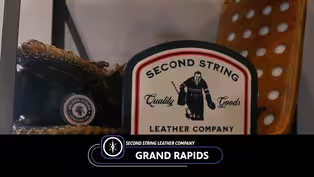
And that's where we come in and we can give them a second life, which is why we called it Second String Leather Company.
- Now, Zach, who you just met also coaches hockey at Hope College and the Dutchman won the 2025 ACHA Division 3 National Championships this year.
Congratulations.
Well, as we've learned over the years, there is no shortage of unique people and places throughout our great state.
In fact, Michigan is such a beautiful blended mix of different cultures and heritages.
On the west side of the state, German pride runs deep and its uniting people from all walks of life through food, community and of course beer.
- These establishments were the social media of the day, back before people were attached at the hip to their phones.
- [Stefanie] The times before cell phones were just different times.
David Ringler, a West Michigan native continues the legacy of those days of gathering without modern day distractions.
He tries to anyway.
- And now suddenly they get to talking and they create conversation and a connection.
And now they're meeting here every once in a while, you know, and they recognize each other and say, hey, you know, good to see you again.
It's those types of connections with these large gathering places, large tables that build community.
- [Stefanie] David is the owner, well actually, Director of Happiness at both Cedar Springs Brewing Company and Kusterer Brauhaus near downtown Grand Rapids.
Each one is modeled after those iconic beer halls in Bavaria, Germany, complete with authentic menu items from the old country in addition to their American style foods, - Brussels sprouts are to die for.
(David chuckling) But we also feature a kitchen that's directly from Oberbayern, upper Bavaria.
And we all stick our kitchen staff over.
We've taken them over three times, so they've spent a week working in Munich Kitchens.
But we have a very nice Bavarian menu, a Munich menu with schnitzels and bratwurst and (indistinct) and some of these typical dishes that you might find in a beer hall in Munich, - [Stefanie] Whether it's at the Cedar Springs or GR location, it really feels like you just stepped into a different time and space.
Colorful flags from various sports clubs and German states adorn the walls and ceilings.
Authentic beer mugs, line the shelves.
David credits Christophe Kusterer, a mid 1800 German brewer whose legacy in the West Michigan area lasted nearly a century as the inspiration for their style of beers that followed those strict German beer purity laws.
- Christophe Kusterer was kinda lost to history a little bit.
So we adopted this name as for our German lineup of beers, and we dedicated this to the Reinheitsgebot, which is the German beer purity law.
We have taken our brewing team over to trains three times, and our beers have won, especially this original vice beer, which is a Bavarian style wheat beer that dates back centuries.
But we've won 40 international awards, including the Great American Beer Festival a couple of times, World Beer Awards in London, the Australian International Beer Awards, the World Beer Cup in Japan.
Tons of them around here.
- [Stefanie] There's no doubt so much to celebrate here from the dishes to the drinks.
What matters most isn't actually what you see, it's what you feel.
- And one of the things we found cool, we have a Stammtisch and in that tradition that's usually reserved for the regulars.
So our mug club have reserved seating, and we found that there's people who have lived in this community their whole lives, and they show up here on a Tuesday and they meet somebody across the table who also has lived here and they never met.
The whole key really is this German idea of gemutlichkeit which doesn't have a true translation, but it's kind of just that warm, fuzzy, comfortable feeling of relaxation that you're trying to foster when you're sitting around on the friends, and maybe in Michigan, you're out in the beach with your feet in the sand and you're like, isn't this great?
That's that feeling of gemutlichkeit.
In some cases, lubricating the conversation can help.
But breaking bread with friends, old and new fosters and that's where we get that sense of community where, you know, maybe we're not just being mad at somebody 'cause they disagree with us politically, but yet we can know that person and they're a good person regardless.
And we can still be friends.
And I think that hopefully helps keep us close going forward.
Now, between the two different locations theres always something different going on.
there are nights dedictated to books, sporting events and even travel groups to Germany.
look them up online and see what happening when and where.
- Well, the Covid Pandemic was an unprecedented time, as we all know, but towns across the state found creative ways to bring their communities together.
In Alpena, the Thunder Bay Arts Council revived a beloved tradition to help people reconnect and enjoy the outdoors.
Adam takes us outside in the heart of winter to the Alpena Ice Festival.
(driller buzzing) - It was our way of dealing with Covid actually, most of our events were in local auditoriums, all indoor events for the most part.
And we had to really get creative during Covid in order to stay relevant, to stay alive.
So we thought moving outside was our way of engaging people.
- [Adam] In February, 2022, a winter festival returned to Alpena.
- So the Ice Fest is our biggest winter event.
There's over 50 ice sculptures that are on display both downtown and over at Mich-e-ke-wis Park.
It's just like a great opportunity to get out and enjoy the community.
- You know, there's a lot of pride in history, what this community has done historically, and to keep those traditions alive.
This is different, it's not the same thing as Winter Carnival, but it has its own character, and I think people are building a greater and greater appreciation for what it brings to the community.
- [Adam] Now it's turn back time to understand what the Alpena Winter Carnival was.
Winter festivals became popular in the 1930s.
Several Northern Michigan communities held these events.
Alpena Carnival was a celebration of all things winter.
An outdoor ice rink was the hub of excitement where National Speed Skating (indistinct) were held.
And the best figure skaters from the region demonstrated their skills.
The town turned out to cheer on these performers and waited in anticipation to see who was going to be crowned queen of the year's carnival.
The event drew in hundreds of spectators.
Community members still talk about waiting for the snow train to pull into town, a train full of passengers coming to experience winter up north.
- My great grandparents used to live in Detroit and they remember taking the train up here because there wasn't a lot of snow down there at that time, like Alpena was just a winter wonderland.
You could do all these winter activities.
Thunder Bay Arts wanted to start a new winter activity inspired by that carnival, but maybe a little bit different flare, and that's how they came up with the Ice Festival.
- [Adam] Art is at the center of everything the council does, and the ice festival highlights art in nature that includes a healthy dose of family fun.
- To get out in the dead of winter, breathe in the fresh air.
We're really trying to get younger generations to engage with art, it's a creative way of getting people out, engaging in recreation, but at the center of that recreation is art.
In this case it's ice sculptures.
Ice like marble could easily crack, and if you're not careful how you actually engage the process of carving, you could run into lots of trouble.
You gotta have vision and kind of allow the image that you have in mind to reveal itself from this block.
- [Adam] The frozen sculptures started going out Friday night.
Ice Creations from Napoleon, Ohio brought in a truckload of sculptures and carved others right on site.
The sidewalks and street corners of downtown soon became home to impressive ice creations.
- Winter is a really slow time for the community, especially downtown.
You know, it's cold out, gets dark early, people don't always wanna leave their houses this time of year.
And so it's really a big boost for the businesses and also for the community to have something fun to do this time of year get out, you know, you see people that, you know, you meet new people.
It's just a great community event as well as a large economic impact too.
- It's that time of the year when people are yearning for something to do.
We're far enough away from the holidays and we're looking towards spring, but it's still a stretch.
And so I think even if we get slammed tomorrow, people will still come out.
- [Adam] Tim was right, winter was in full effect for the festival, but that didn't stop to community from coming out, just as he had hoped.
- Just to watch these young kids out there playing and I'm sliding down the hill and then we're playing a game and then they come over and admire somebody sculpting on ice and they'll just stare there, just stand there and stare on kind of an amazement.
And if that's the key is that, you know, if you ask them to come to an exhibit, they might not even come.
But if you integrate these things, it can really lead to an appreciation by a younger generation of people.
Where else would they have that opportunity?
And here we are out in the middle of the field in the dead of winter, and they're having fun, they're playing, but they pause for a moment to appreciate art and yet it's frozen water, and it'll disappear.
But it's a moment in time that they'll probably never forget.
- [Adam] The snow and frigid wind help create those lasting memories, especially for those who stuck around for the grand finale.
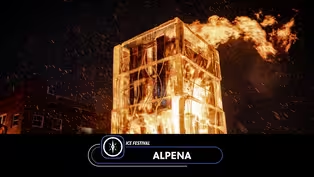
- This year we are doing something new, a literal fire in ice, and they'll build almost like a chimney out of ice block and then create a fire in the middle of it.
And it goes on for a while and you see this, you know, really strong vortex of fire up through the center of the ice.
And eventually it starts to melt and it implodes and it's apparently quite a little show.
- The festival has seen all kinds of weather from over the years, from bitter cold to bare ground, and this year's sideways snow, pure Michigan, right?
It just goes to show that Northern Michiganders won't let a little weather stand in the way of a good time because we're tough like that here in Michigan, right.
Well that wraps up this edition of Destination Michigan.
We'll see you again soon, goodbye.
(upbeat music)

Video has Closed Captions
Clip: S16 Ep2 | 3m 55s | Cedar Springs Brewing Company, Grand Rapids & Cedar Springs (3m 55s)

Video has Closed Captions
Clip: S16 Ep2 | 4m 32s | Maple Leaf Farm and Creamery, Falmouth (4m 32s)
Video has Closed Captions
Clip: S16 Ep2 | 5m 4s | Second String Leather Company, Grand Rapids (5m 4s)
Providing Support for PBS.org
Learn Moreabout PBS online sponsorship















Support for PBS provided by:
Destination Michigan is a local public television program presented by WCMU