Destination Michigan
Destination Michigan 1606
Season 16 Episode 6 | 26m 40sVideo has Closed Captions
Honor, Alanson, Interlochen, and Hancock
We’re off to Honor to park beneath the Northern Michigan stars and watch the silver screen with wonder at the Cherry Bowl Drive-In. we’ll grab the tackle box for a visit to the Oden Fish Hatchery in Alanson. It’s a story that’s good for your “sole” as we stop in Interlochen to try on classic shoes at Vintage Sole. We heat things up, in Hancock when we visit Takka Saunas.
Problems playing video? | Closed Captioning Feedback
Problems playing video? | Closed Captioning Feedback
Destination Michigan is a local public television program presented by WCMU
Destination Michigan
Destination Michigan 1606
Season 16 Episode 6 | 26m 40sVideo has Closed Captions
We’re off to Honor to park beneath the Northern Michigan stars and watch the silver screen with wonder at the Cherry Bowl Drive-In. we’ll grab the tackle box for a visit to the Oden Fish Hatchery in Alanson. It’s a story that’s good for your “sole” as we stop in Interlochen to try on classic shoes at Vintage Sole. We heat things up, in Hancock when we visit Takka Saunas.
Problems playing video? | Closed Captioning Feedback
How to Watch Destination Michigan
Destination Michigan is available to stream on pbs.org and the free PBS App, available on iPhone, Apple TV, Android TV, Android smartphones, Amazon Fire TV, Amazon Fire Tablet, Roku, Samsung Smart TV, and Vizio.
Providing Support for PBS.org
Learn Moreabout PBS online sponsorship- Hi, and welcome to "Destination Michigan."
We have a great show ahead for you, so let's take a look at what's coming up.
(dramatic whooshing) This Northern Michigan summer classic gets a second act.
How new owners are keeping the Cherry Bowl Drive-In's movie magic alive under the stars.
(dramatic whooshing) Next, we go underwater at the Oden Fish Hatchery.
Why the fish and facility are just a couple reasons of what makes this place so special.
(dramatic whooshing) Then, we venture deep into the woods to uncover shoes from another time that are sure to leave a mark on your soul.
(dramatic whooshing) Finally, we detox our bodies and delight our eyes at Takka saunas up in the upper peninsula.
(dramatic whooshing) Those stories next right here on "Destination Michigan."
(dramatic whooshing) - [Narrator] Support for "Destination Michigan" is provided by the CMU Bookstore... (upbeat rock music) T-shirts, sweatshirts, hats, maroon and gold memories, and an official outfitter of Adidas apparel at the Central Michigan University owned and operated CMU Bookstore.
(upbeat rock music) Online shopping seven days a week at cmubookstore.com, on campus at the University Center, and game day locations at Kelly/Shorts Stadium and the John G. Kulhavi Event Center.
(upbeat rock music) (upbeat electronic music) (upbeat electronic music continues) (upbeat electronic music continues) (dramatic whooshing) - Hi, and welcome back.
I'm Stefanie Mills, your host for this trip around our Great Lakes State.
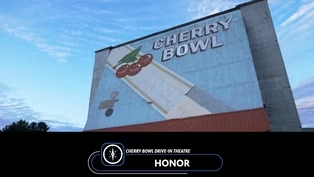
Well, we start off this show with the silver screen under the sky Northern Michigan-style, for more than seven decades, the Cherry Bowl Drive-In in Honor has been the place where families watch movies under the stars, and as one of only eight drive-ins left in the state, its new owners are working hard to keep the tradition alive.
Cue the lights, roll the film, Jamie... (indistinct) Takes us behind the scenes.
(dramatic whooshing) (gentle guitar music) - [Jamie] As the sun sets, the Cherry Bowl Drive-In flickers to life.
Families roll in, radio's hum as the previews queue up, and a Michigan summer tradition begins.
For Mindi Jarmin, that tradition became a second act, and a chance to change her life.
- So I've been a preschool teacher for the past 15 years, we lived in the Lansing area, I've taught in Ann Arbor, Detroit, Lansing, and I loved it, and after COVID, my husband was like, "You're not happy," and I was like, "You're right, I'm not," and he was like, "Let's find something that makes you happy."
Our boat has been in Frankfort for many, many years, which is just around the corner, and so, we spent all summer up here, and last year we drove by the drive-in and it was for sale, and I looked at my husband and I said, "John-John, we're gonna buy the drive-in," and he said, "Will that make you happy?"
And I said, "Yep, I think so," and so, that's what we did.
- [Jamie] What started as a chance drive-by became a mission, to keep a Michigan summer tradition alive.
- So there was a theater in Beulah that was owned by... I don't remember their names, but it was owned by a couple, and they decided to open the charitable with another couple, and shortly thereafter, they separated ways and it was run by a woman until 1997 when Laura and Harry Clark took it over, and then, they ran the theater until last year in September when my husband John and I bought it.
- [Jamie] Stepping back into the fabulous '50s is part of the feature here.
The grand opening was Saturday, July 4th, 1953.
On the big screen, the mightiest of motion pictures, Cecil B. DeMille's "The Greatest Show on Earth" in Technicolor, followed by the campy thriller "Bride of the Gorilla."
Admission was just 60 cents for adults and kids were free.
The screen tower was later widened to accept the new CinemaScope phenomenon, the widescreen revolution of its day, and you can still spot the smaller frames on vintage cartoons during the pre-show reels.
- I also really love that we get to play the nostalgic cartoons, we have the dancing hot dogs and we have my favorite... ♪ Let's all go to the lobby ♪ ♪ Let's all go to the lobby ♪ So that's been fun to, like, research those, and we have them on 35-millimeter, but we also have them in our digital system, so that's been super fun.
- [Jamie] It was the kind of small town Americana that helped define an era, and it's still alive here today.
- We have a line you drive in, you pay for your tickets, and then, you park your car, and that is your movie seat, so you can bring blankets, you can bring chairs, you can bring couches, you can bring your hammock, you can bring whatever you want, set it up outside of your car and you have your whole car to enjoy the movie.
You can run around at our playground, you can play putt-putt, you can be outside the whole time, you can sit with your best friend, and then, you come in and have delicious snacks and take 'em right back out to your car.
- [Jamie] It's a rare pause in a busy world, a chance to put down the glowing screens in your hands and just soak up the moment and the memories together.
- And I think one of my favorite things about the theater is that it is a place where you are in real life, you are not on your phones, you walk around the lot at night and people have card games set up, they have Scrabble, they are sitting down talking to and laughing with their families, and, you know, there are very few people who are just sitting there scrolling on their phones.
- [Jamie] Many of the faces behind the snack stand and the screen grew up coming here themselves, like Thomas, who now helps create the same family atmosphere for a new generation of drive-in fans.
- So I've been coming to the drive-in for as long as I can remember, it was a big part of my family, we always fight brother and sister for who gets the best seat in the car and everything like that, and it's kind of just, like, hanging out with your family, you just make sure everybody's being safe and having a good time, just no shortage of a smile, I don't know it, it doesn't feel like work most of the time.
- For more than 70 years families have pulled in their cars, tuned on their radios, and watched movies the old-fashioned way, and there is no shortage of snacks.
Behind the scenes, even the equipment has its own starring rolls.
The Cherry Bowl's popcorn machine has been cranking out kernels for more than 72 years.
A true veteran of the concession stand.
- His name is Harold, he's a delight, so sometimes he screams at us and he... You might hear him start up and he goes... (Mindi mimicking Harold whistling) So we had to name him like an old man, and he is from 1953, we actually have two others in the garage just in case Harold breaks or we need parts for him, but he has been popping popcorn for us for 72 years.
- [Jamie] Being a kid here is half the fun, especially when you're a big fan of the owner herself.
It's the perfect place for a busy four-year-old to enjoy the fun with mom and dad.
What are you most excited about when your mommy tells you you get to come here?
- Movie Mindy.
(gentle guitar music) - We've been coming here since the old owners, and my husband and I started coming when we first started dating, so we've been coming for over 10 years, so it was... It's like a new family tradition that we come as many times as we can.
- [Jamie] Even the outtakes are part of the experience.
Families adding another story to tell.
And for first timers, that fun is even marked with a milestone.
- Certificates for people who are at the drive-in for the first time, because it is a monumentous occasion.
- [Jamie] Whether it's your first visit or your 50th, the feeling is the same, a touch of summertime cinema charm.
As the audience settles in and the lot quiets, like a theater dimming its lights, the opening credits roll, not on the screen, but behind the scenes in the projection booth, where Movie Mindy steps up to the microphone, delivers the night's announcements, and presses "Play" on another show.
- Every single night our manager Eric and I go into the projection booth and we turn on the microphone and we do the announcements, and then, we look at each other and he pushes "Play," and then, we wait and we look through the window to see if the movie's actually on screen, and when it is, we do a little dance and we do a little "Yay," and we say, "We did it again!"
(laughs) - [Jamie] And for the Cherry Bowl crew, it's not just about events and entertainment, it's a mission to preserve something bigger.
- It truly is a way of life and I feel a huge responsibility to maintain it and continue to restore it for many generations to come.
- [Jamie] That commitment gives way to quieter scenes at the end of the night, when gratitude takes center stage, each night on the lot offering a reminder of why this work matters.
- So every night we live on the property, and I walk away from the concession stand, and I walk away and I look up at the stars and I think to myself, "How could I be so lucky to be the one who gets to be the custodian of this place?"
- [Jamie] At the Cherry Bowl Drive-In it's about connecting generations.
A place where movie-goers become part of a story bigger than themselves.
- It is not only spectacularly beautiful, but the relationships that we've made in such a short period of time have been incredible, and I think that that is the true nature of Northern Michigan is that it is a community-based place and we're thrilled to be a part of it.
(dramatic whooshing) - The Cherry Bowl Drive-In runs rain or shine, with its first movie beginning at dusk, visitors are encouraged to arrive around eight o'clock for the best spots.
They usually close for the season late summer and re-open in spring, and now, you can learn more about showtimes and theme nights at cherrybowldrivein.com.
Thanks so much, Jamie.
Well, our next stop takes us to the Oden Fish Hatchery, a state-of-the-art facility that's been raising and releasing brown and rainbow trout in Michigan's Great Lakes and inland waterways since the 1920s.
The hatchery holds more than 2 million of them on-site, so get ready to see a lot of fish.
(dramatic whooshing) (relaxed country music) - Oden State Fish Hatchery is one of six fish hatcheries in the state of Michigan, that's run by the state of Michigan, we are a broodstock facility and a production facility, whereas we raise production fish to plant in the state of Michigan, but we also have the rainbow trout and the brown trout broodstock.
Now, broodstock are the adult fish, we spawn them, take the eggs out of the females and the milk out of the males, cross them and make fish.
- Production hatcheries help to supplement and restore fish populations throughout the state.
There is a lot of natural reproduction that is occurring, and we're happy for that, but sometimes we need to add fish.
If there's pressure from anglers, that means people are fishing in an area, there's habitat loss, and a big one is invasive species, we might add fish in those areas in order to create world-class fishing and keep that.
The fishing industry brings about I would say $4 billion to the Michigan economy, so it's a win-win, we have this really great place, healthy resource, and people are coming from all over the state and in-state to enjoy what they... We have in Michigan and offer.
- [Person] Michigan's fish stocking story began more than 150 years ago in the mid-1800s.
Invasive species and widespread logging took a toll on rivers and the spawning grounds.
By 1870, the state realized the fish population was in trouble, so it formed the Michigan Fish Commission and built the first hatchery in Cass County to help restore balance to the waters.
(relaxed country music) - So the hatchery's been here originally since 1920, so the original hatchery is now the visitor center, but 2002 is when we built the new facility that's standing, and so, it's relatively new compared to hatcheries, and we have six hatcheries throughout the state.
At the visitor center we have a rail car, so when hatcheries were first produced and started producing fish, the easiest way for us to transport those fish was through railway, so all of our hatcheries had to be located by a good water source and the rail system, and so, we have a replica of the last fish car, the Wolverine, that has some interpretive history in there and how we used to transport the fish, so if visitors come and they go into... They'll see milk cans, and that's where the fish were actually housed when they're about finger-length size, and they were released following up throughout the state.
- [Person] Today, technology has vastly improved the way fish are raised and delivered across Michigan.
It's a multi-year process that begins with tiny eggs and ends up with healthy, mature fish ready to be released into the wild, helping to keep Michigan's waters thriving.
- We're right in the middle of our fish stocking season, we generally stock 700,000 or 800,000 production fish per year.
What we did today is we had three, four compartment trucks that we loaded to go to different lakes around the state, so the technicians were in the raceways of fish, they just walk around with the fish, we have to take a sample to see how big the fish are, we weigh a sample, we count how many fish are in that sample, and then, that can tell us how many fish per kilogram that we use at the hatchery, and once we've figured that out, then we just weigh the fish onto the truck based on how many the... How many fish the local biologist wants in a particular lake or stream.
- People need to know that hatcheries are raising fish and releasing 'em in lakes, rivers, and streams throughout Michigan, and most people don't realize that our funding comes from the sale of hunting and fishing licenses.
That's what funds production hatcheries and all the work that we do in the field.
- [Person] The fisheries department closely tracks each delivery, ensuring the right number of fish are stocked to support healthy populations.
After an order form is submitted, staff load specialized transport trucks and send the fish across the state, yet not every fish leaves, some remain at the hatchery.
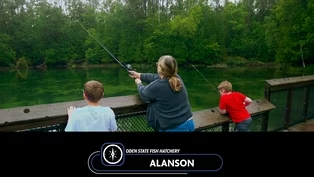
- So behind me we have our youth fishing program, where we have some youth ages eight to 14, but we kind of accept all ages, and they're learning how to fish, these ponds hold rainbow trout and brown trout that we put in here for the visitors to enjoy, they're actually hopefully trying their hand at catching some fish, and we've had a few successes this morning, but it's not easy to catch rainbow trout and brown trout, and the kids are learning that, but they also learn skills on how to cast, how to bait their hook, how to release their fish safely, so it's a really good program for incorporating and hopefully working at more people fishing in the future.
My favorite part of the job is connecting kids to nature, like, a lot of times they're always on their phones and things like that, and we can stop them and slow them down and realize that there's so much of the world around them, that's what I really, really enjoy, you know, whether it could be a flower, whether it could just be sitting quietly and writing in a journal and realizing that this is something that they can do on... At home, a lot of kids don't get experienced to being outside, and sometimes they're a little bit scared at being outside, but then they realize what a wonderful place it is.
- [Person] My son Maximus came along for this shoot and spent the morning casting a line.
I think he might've had the catch of the day, but it's that smile that really tells the story.
- I think that the... That this visitor center and the Oden State Fish Hatchery is this hidden gem that we have in Northern Michigan, and a lot of people will always say, "I've gone by and I've never stopped," well, we encourage you to stop here, and they find out it's lovely and they return year after year with their families, so this is a great place that you're gonna find something for everyone.
(gentle guitar music) (dramatic whooshing) - The Oden Fish Hatchery covers 125 beautiful acres with walking trails open in every season, be sure to check their website for visitor center hours and guided tour times, it's a great place to learn, explore, and take in a bit of Michigan history.
Our next story is sure to touch your sole, the sole of your feet, that is, in Interlochen, there's a vintage shoe store... Well, it's more of a barn, you have to see it to believe it, Chris Ogozaly takes us shoe-shopping at A Vintage Sole.
(dramatic whooshing) (relaxed piano music) - I guess the real beginning in how we wound up here is my wife's family has been going to Crystal Lake since 1905, and I married into it and about 20 years ago, we decided to move up here full-time.
Because we knew the Frankfort area very well, ran into one of the shopkeepers, she was the daughter of the guy that had actually opened the original shoe store in the 1930s and she said, "Eh, I'm interested in selling my shoe store," well, I'm fourth-generation shoe business, grew up in it.
- [Chris] Jim sure did grow up in it.
His grandfather Steven had multiple shoe stores in Wisconsin, and his great-grandfather... (indistinct) Had a store in Grand Haven.
With a family tree that has more than a few pairs of shoes hanging from it, Jim's curiosity was piqued.
- The rafters were just above your head, and in the basement of the shoe store, shoes were piled up almost to the rafters, and not just on the wooden shells, in the aisles in-between, and when you turn the lights on, nothing really happened 'cause they were all buried in these mountains of shoes.
- [Chris] Now, Jim's daughter also plays an important role in this process.
Away at school in LA, she decided to give the vintage shoes a test drive or walk.
- After a month or so, we're on the phone with her and said, "You know, how are those shoes working out?"
She said, "These are the most comfortable dress shoes I've ever owned," considering she grew up in a shoe family, you know, it was like, "Wow, really?"
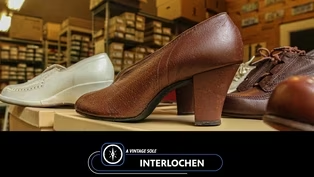
And she came back and made an arrangement with the owner to buy 6,000 pair, which is how this all kind of started and people started showing up here wanting to actually try things on, which is... To be honest, is my favorite way of doing things 'cause you need to feel 'em, you need to see 'em, and geez, it looks great but it hurts or it feels wonderful, you know, you really need to try 'em on, so we're... We invested in our fancy rug and chairs, and this became a showroom of sorts, and the thing that's unique about this inventory is not only, you know, started out with 6,000 pair, but they're all unworn in their original boxes, so from a vintage standpoint, you know, the shoes going back to the '30s, they're considered mint.
- [Chris] History and traditional shopping habits play a role in the available shoe inventory.
- We still have a couple thousand women's shoes, a typical family shoe store from that era, you know, 70%, 75% of the shoes would be women's, 20% kids, and then, you know, the rest men's.
Most family shoe stores, you know, women did the shopping, they shopped for the kids and men bought shoes mostly 'cause they had to, now, we do have, you know, some men's dress shoes, but mostly, what they carried in Frankfort were work shoes and boots, which was typical for this area and that era.
- [Chris] Jim has seen a lot of shoes in his time and knows his store is packed with an interesting inventory that showcases quality construction and materials.
- You hear the phrase frequently, "They don't make 'em like they used to," for this era of shoes, it's really true, it's not just the construction techniques that are different, but also the quality of materials.
The minute stitching in the older shoes, little teeny-tiny... Well, you know, they could still do that, but they don't do that because it's faster to use a bigger stitch, they figured out a bigger stitch still holds, one can argue it doesn't look as good, but it takes a third of the time, and time is money.
- [Chris] Arriving at A Vintage Sole is all part of the experience and the adventure.
Think, "Over the river and through the woods to A Vintage Sole, we go."
- The last shot here is a gravel road up a long quarter-mile hill down a long driveway, and can't find us, you can't come.
One of the things that that puts a smile on my face more than anything else is when a car pulls up driven by a boyfriend or, you know, husband or dad, in summer, the windows are down, it's like, "Why would you put a store here?"
This certainly is a destination shoe store and I don't really think of it as a shoe store per se, it's my barn, so it definitely is a destination.
- [Chris] What's the future for the soul of this vintage shoe store?
- Once they're gone, they're gone, we looked in other places to try to find inventory like this and it just doesn't exist, this is a once-in-a-lifetime fluke, if you would, and we'd be happy if they were all gone at a reasonable price and people use 'em, you know, the shoes were meant to be enjoyed, these shoes are too good to be kept in a box, and I joke with a lot of customers that these shoes have been waiting decades to meet you, and they're... They want you to adopt them, and take them home and use them, that's the whole point of why they were made in the first place.
(dramatic whooshing) - And Jim wasn't kidding, getting there is part of the adventure.
Now, A Vintage Sole is happy to put you in a classic pair of shoes, but you'll need to give 'em a call and make an appointment before you go.
That's so cool, okay, now, it's time to get hot in the UP of all places.
Adam enjoys a one-of-a-kind sauna experience that includes stunning views of the Portage Lake Lift Bridge.
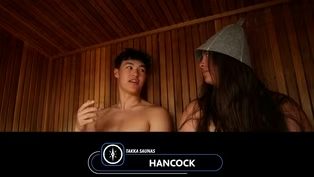
(dramatic whooshing) (gentle guitar music) - We are sitting right now at Takka Portage, which is located in Hancock, Michigan.
Sauna-ing is just part of the Finnish heritage in this area, and like many Nordic areas where it is a harsh winter and a way to warm up.
Jason, one of the owners, his family is Finnish and he grew up taking sauna baths at camp like many locals did around here.
- It's just part of, like, growing up around here, I mean, we love to be in the lake and we love to do things around the lake, but it's not always warm here, so it's nice to just be able to, like, hang out in the sauna, get a sweat on, and obviously, like, we reap the benefits of all the health benefits of sauna-ing when we do it, so it just feels good.
- [Jamie] The benefits of a sauna are numerous, from stress relief and detoxification to improved sleep and circulation, but at Takka, there's another benefit, the social connection that comes from sharing the experience.
- At Takka Portage, we have both a social and a private sauna sessions, so a social is you would be sauna-ing with other like-minded people, you might know them, but it's just bringing people together in the sauna.
- The culture of sauna in Finland is always been centric around the community sauna.
In Finland, they have just, like, locations like this where everybody will come and gather, and it's a really normal thing for them to do, so the fact that we do social saunas here is just a little bit more of an authentic taste of what sauna-ing in the place where it originated is really like, and it kind of just introduces, like, a way to connect with people without alcohol involved, which is really fun.
(water splashing) - It's just a way to connect, so a part of being in a sauna is to disconnect, and then, you also get to reconnect, it's just a way to connect with others.
There's not a lot of opportunities that we have that aren't alcohol-based that you get to connect with people, and with the sauna, everything just happens, so whether you want to sit in peace, you get to do that, or if you want to talk to the person next to you, you might get the opportunity to do that as well.
- [Jamie] Megan described it as a curated experience.
From the moment that you arrive, the goal is to provide something truly one-of-a-kind, an authentic sauna journey that she and the staff thoughtfully guide each visitor through.
- I think that the view is definitely a benefit, a lot of times... Some of our first guests are a little apprehensive because when you think of a sauna, you're thinking of the gym sauna or a hotel one where it is closed in and you get a little claustrophobic, and with the big glass windows and the view, you just don't have that here, but definitely, a part of the attraction is definitely the view.
Most people like to do about four-to-five cycles of hot to cold, so you like to sit in the sauna for 10 to 15 minutes for... Is what most people want to enjoy or to get some health benefits out of it, then to do a cool feature, so whether that cool feature be just sit outside and lower your body temperature, or if it is getting the cold plunge and really reduce it quicker or use a shower just to reduce your body temperature, and then, you can get back in the sauna.
At the end of the day, we like to tell people, "Do what feels comfortable to you, maybe push yourself a little bit, but we're here to relax and not necessarily get the max benefits from it, but to get some benefits."
- [Jamie] And if it ends up being just a memorable stop during your visit to the Keweenaw Peninsula, that's perfectly fine too.
- The view of the bridge is so gorgeous and this has been an area that's been underutilized for how beautiful and, like, perfect it is for these types of things, so I think the location is perfect and just, like, what it's all about is so, so awesome.
(relaxed guitar music) (dramatic whooshing) - Oh, my goodness, watching that feels like instant relaxation.
Well, Adam says if saunas with a view are your thing, Takka Superior is their flagship location, it's nestled on the shores of Lake Superior at the northernmost edge of the Keweenaw Peninsula.
Well, that wraps up this edition of "Destination Michigan," we hope you learned something new and added some new spots to visit on your next trip around the Great Lakes State, thanks so much for watching.
(dramatic whooshing) (upbeat electronic music) (upbeat electronic music continues) (upbeat electronic music continues)
Video has Closed Captions
Clip: S16 Ep6 | 5m 44s | Oden State Fish Hatchery (5m 44s)
Providing Support for PBS.org
Learn Moreabout PBS online sponsorship















Support for PBS provided by:
Destination Michigan is a local public television program presented by WCMU