
Destination Michigan
Destination Michigan 1703
Season 17 Episode 1703 | 28m 30sVideo has Audio Description
Mt. Pleasant, Sanford, Sault Ste. Marie, Portage, and East Lansing
This time on Destination Michigan, we'll take you to Creatively! Glass & More in Mt. Pleasant. We'll check out handcrafted games at LL Wooden Creations in Sanford and step inside The Yooper Pasty Company in Sault Ste. Marie. Plus, we'll introduce you to the Army veteran led Zero Day BBQ and we'll find how, "Go Green" takes on a new meaning at the W.J. Beal Botanical Garden.
See all videos with Audio DescriptionADProblems playing video? | Closed Captioning Feedback
Problems playing video? | Closed Captioning Feedback
Destination Michigan is a local public television program presented by WCMU
Destination Michigan
Destination Michigan 1703
Season 17 Episode 1703 | 28m 30sVideo has Audio Description
This time on Destination Michigan, we'll take you to Creatively! Glass & More in Mt. Pleasant. We'll check out handcrafted games at LL Wooden Creations in Sanford and step inside The Yooper Pasty Company in Sault Ste. Marie. Plus, we'll introduce you to the Army veteran led Zero Day BBQ and we'll find how, "Go Green" takes on a new meaning at the W.J. Beal Botanical Garden.
See all videos with Audio DescriptionADProblems playing video? | Closed Captioning Feedback
Where to Watch Destination Michigan
Destination Michigan is available to stream on pbs.org and the PBS app.
Providing Support for PBS.org
Learn Moreabout PBS online sponsorship- Hi and welcome to "Destination Michigan."
Creativity abounds in this episode.
Take a look at what's coming up.
Timeless beauty made in this century just like it was centuries ago.
We visit a shop in Mount Pleasant where art comes with a side of history.
Then we swap glass creations with wooden ones, meet the couple creating wooden tabletop games through their shared passions.
It's the oldest city in Michigan, but until recently you couldn't find a dedicated spot for the UP's most iconic meal.
We're heading inside the Yooper Pasty Shop for food, fun and history.
In Portage, it's all about barbecue, beer and boot camps.
Learn how Zero Day is helping support our veterans.
And we'll stop in East Lansing where Go Green takes on a whole new meaning at the W.J.
Beale Botanical Garden.
(upbeat music) Hi and welcome back.
Well, it's really hard not to be in awe of the entrepreneurial spirit that exists here in Michigan.
Over the years on "Destination Michigan," we have introduced you to makers large and small.
Who can forget Stormy Cromer, whose iconic Michigan made hats have come to symbolize the grit of the Midwest.
What began as a small family business now pops up on heads across the globe.
In communities across our Great Lakes state, that creative energy can be found in places like storefronts and local farmers markets with unique and one of a kind products often inspired by the scenery all around us.
Small businesses make up the heart of our state.
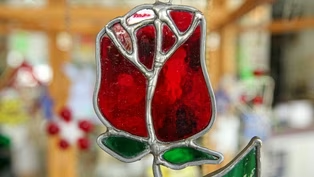
And that's what led us to our next story in Mount Pleasant, where one woman is keeping an ancient type of glassmaking alive and sharing it with the next generation.
- I love what I do.
I love interacting with the customers and sharing my art.
Stained glass is an expensive hobby.
So anybody who's interested in it and takes classes, I look at it as preserving an art form.
And there's a rich history of glass art, too.
- [Stefanie] Stained glassmaking hasn't changed much, if at all, over the centuries.
- You need a glass cutter.
There's a couple different pliers that you can use that are very helpful.
A glass grinder, cutting, grinding, foiling.
You use copper foil and then soldering.
So you need a solder iron.
My beginner classes are about six hours to make a project that has eight to ten pieces of glass in it.
Give it a little tug and keep doing that until it comes apart.
I include a lot of history and a little bit of chemistry and physics of glass in those classes because those are things that are interesting to me.
So I like to share them with students.
- [Stefanie] Jean Holland owns Creatively Glass, a small shop that has a lot going on.
For Jean, envisioning herself in this line of work seemed like a natural fit and a bit out of the blue.
- I have always been a crafter.
I started crocheting when I was five.
My parents were farmers.
My mom was a nurse.
So we did a lot of homemaking type of crafts, crocheting, and I made a lot of my own clothes.
Recycled a lot of my clothes into kids' clothes when I had little kids.
The kids had done stained glass in 4-H, and I thought, well, that would be fun.
Maybe I will take a class and do some stained glass.
And in looking at classes, found out that the business was for sale.
And so with no experience in stained glass, no experience in business ownership, I asked my husband, who's the saver in the family, if I could buy a business.
And he said, yeah, sure.
No hesitation whatsoever.
- [Stefanie] Well, that was 10 years ago, and it seems like it's all worked out pretty well.
Stained glass art adorns the windows, hangs from the walls and on shelves.
Tucked into corners are all the supplies you need to do projects at home.
There are weekly classes for people that focus on technique, safety and fun.
- So if it breaks, you work around the break.
- Okay.
- You need to be careful when you're using the grinder about inhaling powdered glass because that's just like asbestos in your lungs.
And then the solder that we work with contains lead, so you have to be careful about that.
Fortunately, we're working at temperatures where lead doesn't vaporize.
So working below that temperature, I usually tell my students the most important thing when we're soldering is don't put your hands in your mouth.
I enjoy talking to customers one on one and helping them with their projects.
When somebody comes in with a pattern and says, can you help me pick out glass?
That's fun.
But I also enjoy the making process and I love the teaching process too.
The most common reaction is wow, I didn't realize there was so much involved in stained glass.
Now I understand why it's so expensive.
- [Stefanie] No previous knowledge is necessary to take part in a class.
They're open to anyone from anywhere.
- You could make these smaller leaves darker or smaller petals darker.
See, when they give it depth.
I'd say the most common is that they just take it home and say that was a nice experience.
I frequently, especially the last couple years, have had couples taking the class together.
So it's just a date night experience for them, something to do.
Once in a while, they'll take the class again and do a little bit bigger project.
Everything is made in Michigan, made here.
To my knowledge, there's not a shop this size north of here.
So I do get customers from the U.P.
and northern Michigan.
I get customers from Cadillac, Big Rapids.
I do have competition in Lansing.
But yeah, there's not another store like this.
- Jean, thank you so much for sharing your story with us.
Well, inspiration comes in different times and in different ways for makers, right?
In Sanford, a couple turned a shared hobby into a second act.
Adam spent time in a wood shop getting to know Larry and Dawn of LL Wooden Creations to learn what goes into making their handmade tabletop games.
(machine whirring) - LL Wooden Creations is a company that creates wooden artifacts.
We focus mostly on games and we sell at craft shows and art shows around Michigan.
- [Narrator] Larry has always had a passion for woodworking.
After spending a career teaching fifth grade, he and his wife were ready for a simpler life.
- I can enjoy my retirement and I have a full-time job.
When I get up in the morning, I walk 30 feet from my back door to the wood shop here.
And we are able to work all day and do something we like.
I tell my wife all the time, one of the benefits of what we've chosen to do is, if for some reason I want to eat lunch at 9:30, I can eat lunch at 9:30.
There's no reason to tell me no, lunch isn't until 12 o'clock.
So I have the freedom to live my life in a more casual way and we're doing something that we really like doing.
- [Narrator] These days, they've become a familiar sight at art and craft shows across the state, but they didn't always specialize in handmade wooden games.
- When we first started, I made mostly cutting board, charcuterie boards, which honestly is where most woodworkers start.
I like the process, but if you're making a quality cutting board or a quality charcuterie board, assuming the customer takes care of it, it's not really a lot of repeat customers because they last forever.
One day, I said to my wife, I was like, you know what, I think we just make games now.
And it's grown from there.
We have currently 26 different games in our inventory.
So I take existing games, classic games mostly, or I like to try to find games that are from around the world.
We have a Viking game, we have a game from Africa.
So I like trying to add a little more unusual games as well.
But mainly we'll take existing classic games and give them a little design twist, a little tweak so it looks a little different, so it looks unique for us.
- [Narrator] From cribbage to Chinese checkers, the games Larry creates practically invite you to sit down and play.
And one board in particular looked very familiar.
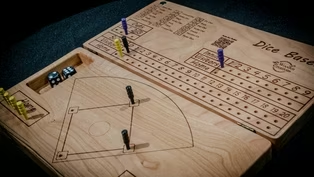
- There's a game called Dice Baseball.
Now again, I didn't invent the game, but I did come up with my own kind of design for it.
The gist of the game is you roll the dice and the combination of two dice tell you what your at bat has been, maybe an out or a hit or a walk or whatever it might be.
So you're going to keep track of runs, you're going to keep track of outs, you're going to keep track of the score.
You've got little cribbage pegs for game pieces.
They run around bases and all the fun of baseball with none of the sweating.
You know, a lot of people spend a lot of time playing games on their phones nowadays, but I found that people wanted to have a little more connection with the humans around them.
And there started to be a lot of game night revivals among friends and families.
These are they're nice, quality, solid games.
They give you a way to spend time with people around you at the table.
A lot of times, as a matter of fact, people will come up to the booth and maybe they have a young kid.
Kid's grabbing the dice, grabbing the marbles and the adults like, "Oh, no, don't touch that."
That's absolutely the opposite of what we want you to do.
When you see us at a show, we want you to come up.
We want you to play with the game.
We want you to touch the pieces.
Marbles are meant to be touched.
A lot of the games people will tell us, you know, we bought this, we keep it on the coffee table.
It never gets put up.
It's always laying there.
It is a display piece, but they do play it as well.
- [Narrator] For Larry and his wife, the work doesn't stop when they leave the wood shop.
They're constantly refining their designs, finding new ways to make their games even more user friendly.
They've added QR codes to each board, making it easy to pull up the rules without needing paper instructions.
And recently, they've even rethought how the boards are stored, completely redesigning them with convenience in mind.
- The big development this past year has been we are making the games all self-containing.
In the past, we had a flat game board.
We'd have the pieces.
We'd put it all in a little box and present it that way.
Well, now we've got the game itself that will fold up in half with cutouts.
So the pieces store inside, a little magnetic clasp to keep it together.
And that's been the big upgrade this last year, which has gone over really well.
- Now, if you've been following Larry and Dawn's journey, you might be aware that a devastating fire destroyed their shop in April of 2026.
But the couple tells us they are committed to their craft.
They're planning to rebuild and a temporary woodshop is already in place.
Good luck to you both.
Now, in Michigan's oldest city, the winters are long, the snowfall is legendary, and the lifestyle is one of a kind.
As Jamie Mankiewicz shows us, until recently, Sault Ste.
Marie was missing one essential comfort, a dedicated shop for the UP's most famous meal.
From the outside, Yooper Pasty Company looks like a simple gray building, weathered by years of Upper Peninsula snowfall.
But when you walk inside, it's a whole different story.
- If you're lucky enough to still have a deer camp, God bless you.
And if you're lucky enough to have a camp or a cottage, if you're a troll, God bless you.
Are you lucky?
- [Stefanie] The moment you open the door, you're transported directly into the heart of an Upper Peninsula tradition.
- I wanted to have my own deer camp.
I wanted to have a place to hang out.
I wanted people to come in here and get the full experience of being a Yooper.
Everybody's got their awful afghan from grandma out at deer camp, you know, when your toes poke through the holes in the middle of the night.
We all remember what that feels like.
I was told once the best gift you can ever give to anybody is happiness.
And that's free.
Evoking sweet memories in nostalgia in people, I think brings happiness to a lot of people, young and old.
- [Stefanie] Heidi Ritter was born and raised in Ishpeming, a proud Hematite with deep Finnish roots.
After high school, she served in the Army National Guard and then went on to college.
- And I went to Northern Michigan University where I got my bachelor's degree in elementary education.
- [Stefanie] That's where she met her husband, Jeff.
They traveled the country as a Coast Guard family and then finally put down roots in the Soo when her husband retired.
(person shouting in background) My husband's here now.
He's a lot.
He's Southern.
Also very excitable down there.
Gotta love him, met him in Marquette.
Can you imagine?
He was the captain of the Buckthorn.
We had such a blast while he was doing that.
We fell in love with the community.
- Heidi quickly noticed the Soo was missing something very important.
- When I got here, there were no hot pasty shops.
As far as anybody knew, there were no dedicated pasty shops that ever existed here, which is insane being that once you cross the bridge, people are looking for pasties.
It kind of fired me up as a Yooper, I guess.
Just really got my gears going where I thought, maybe I could do it.
Maybe I could be the pasty person here because I've been making them my whole life.
- [Stefanie] So Heidi and Jeff bought this trailer and they got to work.
Baking in Barbeau in the middle of the night, three o'clock in the morning, walking across my dirt road with sacks full of pasties.
It just became a kind of phenomenon when we were parked in town here at the Valley Camp.
There were people waiting in line already before we even set up the generator.
- [Stefanie] As fast as she could make them, they were selling out.
- We started making bigger batches and then we decided right after we got the trailer that we needed to do something that had a kitchen, call our home base and be able to bake pasties.
And this opportunity was just blessed and given before us.
It was amazing and serendipitous.
- [Stefanie] Like many places in the Upper Peninsula, this building has a history.
On the first day that they started to set up shop, they discovered an unexpected surprise from the past.
- And in the bottom of the bin, there was a neon sign that says pasties.
And at that moment, I knew I was going to be all right.
And I plugged it in and I'll be darned if it lit up and I bawled.
- [Stefanie] The transition was far from easy.
Just two days before opening the doors, she received a devastating diagnosis, breast cancer.
- Facing cancer my entire first year and a half, I was here working, doing pasties.
Pasties and hockey saved my life.
- [Stefanie] Today, Heidi is healthy, sharing her passion for life with the next generation.
- We were able to partner with the Soo Eagles hockey team.
They come in after practice and they dial in here.
There's Meat Man.
There's Dough Boy.
You pick your position.
Dishwashing is always the last to be picked.
Imagine that.
When we really are grinding, we can absolutely turn out at least 200 pasties in one day.
When I was in the army, I had to shovel my own foxhole once.
That was the most difficult thing I've ever had to do in my entire life.
Chopping rutabagas is also really it's up there because you're having to cut a boulder in half.
- [Stefanie] Luckily, we didn't have to cut any root vegetables.
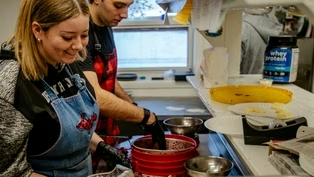
Instead, we helped put together some of her famous sweet pasties filled with fruit.
- It is such an art.
It's like sculpting.
It's really either you can do it or you can't.
And that's okay if you can't.
- [Stefanie] These are skills Heidi learned watching the generations of women work before her.
- As you know, it takes an entire assembly line to make it work.
Grandmas, nobody gives them enough credit for what they did for us.
I awoke this this inner Finnish grandma on me that's got to get the job done.
- [Stefanie] While the rest of the world debates whether ketchup or gravy belongs on top, Heidi has her own perspective.
- I say I don't care what you put on your pasty.
Just keep eating them.
And here's a little Yooper folklore for you.
Miners would often toss the handle of the pasty, the thick crust, leaving them behind for a friendly, mythical spirits to keep them safe while underground.
It served a practical purpose, too, so they wouldn't accidentally eat the poisonous arsenic dust on their hands.
Well, beer, barbecue and 12 foot tables, they're all helping to bring people together in Portage.
Adam takes us to Presidential Brewing Company to see how the community is rallying together to support veterans with a zero day barbecue boot camp.
- We are here to build community.
Food is a great way to bring people together.
Good food, man.
You could sit around the table for hours and just enjoy each other's company.
And one intentional choice that we made in here is to not have TVs on the wall showing sports because I want people talking to each other.
Another thing that you'll see when you look around the taproom, we have 12 foot long picnic tables.
The idea behind that is to force people to sit next to people they might not know.
And by chance, you might overhear a conversation that's relevant and all of a sudden you start to see friends forming at these tables.
That is what I'm excited about.
- [Narrator] Jake founded the brewery out of a passion for bringing people together over great beer.
What started as a home brewed oatmeal stout aptly named Obama quickly became a hit, sparking the creation of the Presidential Brewing Company.
- Serving as a restaurant in this community, we have a leadership position in our community and we wanted to represent that well.
So we thought, how can we support our local community the best that we can?
And we found that being spread out across everything is not always the best answer, but trying to dial in and focus on a specific part of the community seems to fit really well.
I have a lot of friends that I've served and I talked to them about this idea that I had.
I want to do a buy a veteran a beer program.
The idea would be that the customer could come in and add an extra beer to their tab.
We could hang it on the wall and it would go to a veteran when they come in and they could just grab a beer that somebody in the community bought for him.
And all of them were super giggly about it.
They thought that was such a cool idea.
We also were friends with James Dentler through Zero Day and they came over and talked to us before we opened and told us a little bit about what they did.
And we just thought, man, this is such a cool partnership opportunity.
Whatever we can do to support this organization and focus our efforts towards them.
It's in alignment with what our brand is.
And I'm really excited about trying it out.
So we did.
And it's been great since then.
- [Narrator] Zero Day, a nonprofit organization based in Battle Creek, has a clear mission: to empower veterans through intentional employment, purposeful training, housing and deliberate application of discipline and core values inherent to military veterans.
Army veteran and pitmaster Steve Seige has been involved with the organization since 2022.
- We do mostly vocational training.
We try to do that transition period from veterans getting out of the service.
When you get out, you have to find something else.
We do wood shops.
We have a greenhouse.
We do the culinary program.
We also pair up with Pro Start, which is troubled teens.
We run those through the culinary program also.
We have a couple of trailers.
And what we do with the trailers is everybody wants to run a barbecue trailer or a food trailer, but they have no idea what's involved.
We get their feet wet, see if they have an amplitude for it, and if they want to take it to the next level, we help sponsor with their own trailer if they move down the path.
- [Narrator] Steve operates the Battle Bites food trailer, working side by side with veterans and their families, serving up mouthwatering dishes while turning service into success.
Beyond the trailer, Steve also hosts Zero Day Barbecue Bootcamp events, hands on experiences where he shares his extensive barbecue knowledge while raising awareness about the many ways Zero Day supports and empowers veterans.
- Today we've got a ribs and rubs class, and I'm super excited about it.
How to put the best rub mixes together, how to make your own barbecue sauce from scratch and techniques from somebody that's a pitmaster that's been doing this for years.
It's kind of funny.
You see people that go from craft beer and then they almost always end up with a smoker at their house.
And so there's kind of a natural synergy between our community and theirs.
And that's going to be part of what goes through today.
- 20 years ago, nobody was doing barbecue, you know, hardcore hobbyists now, almost everybody has a pellet grill.
And that's where it's kind of gone.
I love to teach and to hand down the techniques and the knowledge that I have to keep it going and to grow it.
When you see people talking and sharing food and sharing beer together, it's such a great experience.
I don't think we have enough of that community experience.
You'll see that at the class today.
They'll start talking across table and talk about their smokers and where, you know, it's pretty cool.
- To learn more about Zero Day, check them out online or follow along on social media to find out where and when you can find Steve hosting a barbecue food camp or serving up meals from the Battle Bites food trailer.
Thanks, Adam.
Well, now on the banks of the Red Cedar, there's a botanical garden that may not be known to all.
Their specialty is nature.
And this garden welcomes all.
Chris Ogozaly takes us to East Lansing.
(bells ringing) - We are right across the beautiful Red Cedar River from the football stadium, so it's a great place to come before a game and relax.
It's a garden right in the heart of campus, which is really, really unusual for botanical gardens.
And it's been here 154 years, right?
We haven't moved in all that time, so it's pretty spectacular that way.
The garden was established in 1873 by W.J.
Beale.
He was a professor at MSU and he started the garden as an education garden.
Since we started in 1873, that makes us the oldest university botanical garden in the country.
So we've been educating students longer than any other garden in the country.
That's something we really love, right?
Two years later, he started a different garden just adjacent to that garden.
He called that one the botanical garden and that he started as a conservation garden.
So from our very roots, we've been a conservation and education garden, something we still do today.
Over time, the garden has changed a lot.
It was originally a little valley with a creek running through it.
It's been filled, you can see.
- [Narrator] Well, sure, the garden has changed over 150 years, but the reasons folks visit are consistent.
- Typically, visitors come to the garden to learn, but also to connect with nature.
And when they do, there's a lot of interpretation for them to see if they want to learn about plants.
But there's also a lot of well-being stations where people can actually focus on connecting nature and their physical and mental health.
Lots of little things to try.
So you don't have to just, you know, do a meditation.
You could also, for instance, do a stretching exercise or read poetry all centered around nature and well-being.
I am really happy to say that that's one of the top two things people come to the garden program.
So to connect with nature, that well-being aspect, and to learn.
- [Narrator] And there is a lot to connect with and enjoy.
- We have a huge collection of plants, right?
We have over 2,000 species of plants that are documented, that are labeled, that people can learn from.
On almost all of them, there's a little label that says something about the plants, usually related to the purpose of the collection they're in.
We're embarking on a program we call Rewilding the Garden.
So we are turning gardens back to more nature, even though it was before, we're increasing our proportion of native plants.
We are providing ways for people to connect with nature.
We're softening the landscape a little bit to make it a little more natural.
So you'll see all of those things.
But of course, any time of year, there's going to be lots of plants blooming, lots of interesting things to learn about.
Sometimes you can just sit and watch people in the garden.
It's a lovely place just to relax and get away.
In the spring in particular, of course, a lot of our trees are blooming.
I think you can see a dogwood right behind me, for instance, or red buds in the garden.
We have trilliums blooming all over the garden right now.
There's always seasonal color.
Later in the summer, our pollinator garden is always a big hit because it's a riot of color and tons of bees and butterflies floating around pollinating plants.
So that's a real eye-catcher later in the summer.
- [Narrator] You might even find a creative spark for your home garden.
- We do try to inspire people to both plant native plants in their own yards, bring a little nature into their own yards.
Part of what we like to do is explain what you can do for the environment when you're here.
We also, for instance, in our pollinator garden, it's not just a pretty garden.
We actually study it.
We bring in plants that not everybody would grow in the pollinator garden, but that are commercially available.
So if you wanted to, you can find them at like a local native plant nursery.
- [Narrator] For Alan, there's no such thing as an all-time favorite garden spot.
However, my favorite today is actually Sleepy Hollow.
So Sleepy Hollow is part of the garden that is just across the road from the rest of the garden.
It's adjacent to Beaumont Tower, that iconic place on MSU's campus.
And it's probably the most natural place in our garden.
There are not very many labels there.
It's a place where we're constantly putting new native plants there.
It's almost entirely native plants.
It has some of the biggest trees in the garden.
And it's just adjacent to West Circle Drive.
So people who've been to campus know that place on campus.
It's just like a park full of 400-year-old trees.
So Sleepy Hollow is part of that.
So it's really a special place.
It really is one of my favorite places in the garden.
We do remind people of the importance of nature.
We do show people that you can change the world a little bit by maybe making your yard a little more natural.
You know, volunteering in a nature area around you.
I think that that's really important.
Also, our garden is a place of history.
154 years old now, touching that legacy on this campus that is so old.
You know, being connected with those roots of the University of Michigan, I think is really important.
And then I would also say that you can really connect with natural heritage of Michigan here, right?
You can do that in a forest anywhere probably.
But you're not going to have the opportunity to learn about it like you can learn about it here when you visit the garden.
- Thank you so much, Chris.
Well, at the Beale Botanical Garden, you can find the Michigan monkey flower in their collection.
It's a federally protected flower that only grows wildly in our state.
Pretty amazing, right?
Well, that wraps up this edition of "Destination Michigan."
We are so glad you could join us for this trip around the state.
We'll be back soon with more episodes.
Thank you for watching and for your continued support for public television.
(upbeat music)
Video has Audio Description
Clip: S17 Ep1703 | 4m 22s | Creatively! Glass & More (4m 22s)
Destination Michigan 1703 Preview
Preview: S17 Ep1703 | 30s | Destination Michigan 1703 Preview (30s)
Video has Audio Description
Clip: S17 Ep1703 | 4m 38s | LL Wooden Creations in Sanford (4m 38s)

Video has Audio Description
Clip: S17 Ep1703 | 4m 57s | W.J. Beal Botanical Garden, East Lansing (4m 57s)
Video has Audio Description
Clip: S17 Ep1703 | 5m 9s | The Yooper Pasty Company, Sault Ste. Marie (5m 9s)

Providing Support for PBS.org
Learn Moreabout PBS online sponsorship New Episode
 New Episode
- News and Public Affairs

Top journalists deliver compelling original analysis of the hour's headlines.

 New Episode
 New Episode
 New Episode



 New Episode
 New Episode

Support for PBS provided by:
Destination Michigan is a local public television program presented by WCMU